

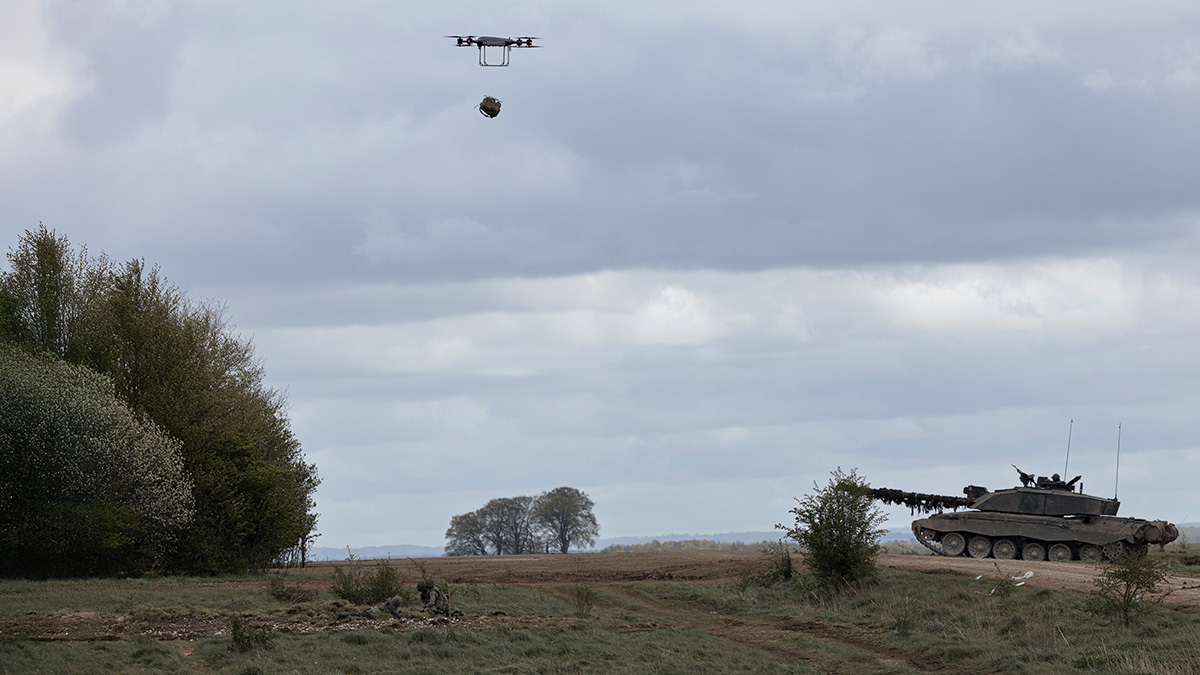
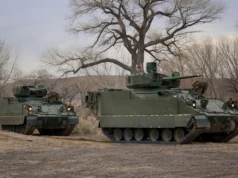
The British Army’s 3rd Division has demonstrated how it intends to fight in the near future at an Armoured Expo event on Salisbury Plain, showing how autonomous ground vehicles, drones and soldiers will operate together as an integrated force across land, air, sea, space and cyberspace, according to the Army.
The event brought to life the vision set out by Chief of the General Staff General Sir Roly Walker for an Army that will be more lethal and harder to defeat by changing the way it uses weapons and vehicles. Under that vision, 20 per cent of the Army’s fighting power will come from tough armoured vehicles designed to carry soldiers and survive on the battlefield, 40 per cent from uncrewed robots and drones that are cheaper to produce and replaceable if destroyed, and 40 per cent from simple, low-cost drones and missiles designed to be used once and discarded, produced in large numbers to generate mass on the battlefield.
Major General Olly Brown, General Officer Commanding 3rd Division, told industry partners the Army faced “a demanding challenge to be ready to fight, pick apart, and destroy a Russian warfighting enterprise” and was clear that it could not do so alone, saying “we cannot do that alone; we must do it with our mission partners” and adding that the Army would not generate the capability needed to thrive on the battlefield “without you.”
The event included immersive experiences designed to put guests directly into a simulated fight with the enemy, making clear the progress made by the Iron Division and its industry partners, alongside a live demonstration of how autonomous armoured ground vehicles, drones and soldiers will work together. Industry partners also ran workshops giving a preview of innovative equipment in development, with soldiers testing kit and providing feedback to help refine capabilities in the months ahead.
Closing the event, Brown said he was “immensely grateful for our mission partners’ openness, challenge, and creativity” and that when joined with the imagination, professional skill and discipline of soldiers, it generated “an unbeatable battle-winning team.”







This has been repeated for years.
When is the order for tens of thousands of assorted UGV taking place?
The Mission Master has been trialled for years, then seemingly discarded?
Vital as Drones now are, I worry this 20% lark is a ready made excuse to not buy artillery, armoured vehicles, and other standard kit.
Yep it’s all very well saying 20 40 40 but they need to actually practice and develop their doctrine..
That means buying and using a huge number of drone for each battalion battle group.
The 20% is the hard bit to produce and with how things are today is a decade plus to deliver, especially when the manufacturing base is gone, same with ammunition stockpiles.
The drone aspect is higher risk with how fast the technology is moving and deep stockpiles of those make less sense as production is much more low tech and scalable, although the army needs something to Atleast get used to and develop doctrine around, with the expectation that very quickly something new could come along.
Is this 20% actually 100% of what is now with the teo 40% added on or ideally still an uptake plus the two 40%s to give a genuine uptake in lethality? Still and I’m a complete outsider 20% just sounds and looks wrong. Maybe 25-30-33.3-40% would be safer bets?
And in advertising all of this our potential adversaries can of course do the same and in even bigger numbers so who wins in the end? The West could potentially be out-gunned, out-shipped and out-droned! The West might have any tech edge further dented if Taiwan and its microchip industry falls into China’s hands.
The order will be placed after the meeting that decides that discussions are taking place to inform the interested parties so that they can decide whether their section needs to be involved in this uncalled for liason to expidite a meeting.. Sorry, what was I saying? 🤔
You do have to wonder if this 20 40 40 approach needs a complete redesign of the brigade battle groups and battalion battle groups..
If 20% of the power of a battle group is traditional combined arms formations then it’s an utter rethink..
will a heavy brigade be deployed as a whole ( 1 MBT regiment 2 heavy Mec battalions) ?s
Or will a formation in a drone saturated battlefield be squadron sized MBT formation backing up by Mec infantry companies and cavalry as the 20%…
Infact is the light cavalry and light Mec now the formations you need in that 20,40,40 mix and MBTs and armoured infantry because very niche capabilities.. to big, to obvious and to expensive in a world full of drones.
It’s all bollocks, the blokes just hoping that when the shit hits the fan he will be elsewhere… The only truth is we can’t do it alone… For me that is sick…
20,40,40 seems to be more about delivering 20% of what the Army actually needs, talking about the next 40% and then not ordering it, then ignoring the final 40% of equipment and stockpile needs altogether and hoping no one notices. That 20,40,40 seems far easier target for them to meet.
You could almost call it a 10 10 10 plan… with 70 being room for theoretical growth and improvement… or “opportunity “ as my old boss would say.
Hopefully no one in the MOD/Treasury reads your 10,10,10 idea as they would be all for it, the kind of proposal that would push someone to the top of the MOD, the new slogan would become ‘opportunity’.
The DIP will be released with a plan to fully equip one brigade then outline future opportunities to scale it up to the remaining brigades at a later date if war breaks out, provided their is 10 years notice to reinstate industry.
The Army hasn’t doctrinally fought as 1 MBT Regiment with Mech Battalions for ages (IIRC as early as the pursuit of Rommel across north Africa post El Alamein Regimental Commanders had little to do). Instead it’s typical for a Armoured Regiment to distribute it’s squadrons to the Mechanised Infantry in almost exactly the way you describe; a Battalion of Infantry with a Tank Troop attached to each of it’s Companies.
Is that the typical construct of a Battlegroup?
With a RA Battery, RE Sqn, and so on, but the BG being based around the Infantry Battalion.
It’s inherently flexible and ad hoc, but yes, the default is Battalion HQ with 2-3 Coys of Infantry, an armoured Squadron, a Battery or Troop of Artillery, and an Egineer Sqn. There are a lot of varitons depending on what the Brigade and Division have available. Eg during Telic 7th Armoured Brigade had 4 Battlegroups by essentially drawing Challengers from Tank Regiments that stayed in Europe to deploy with the Infantry Battalions, and Infantry Companies from Infantry Battalions staying in Europe to assign to the Armoured Regiments.
Thanks, I’d always thought along those lines.
So taking Js original point further, will the BG itself be split into smaller groupings with the current dominance of Drones.
Also, regards your exchanges with Luke further down, maybe the Infantry very lightly Mechanized isn’t so bad now for the same reasons with the Drone threat.
Speed, mobility, concealment rather than a big armoured target like a Tank, IFV, or Ajax, very expensive and harder to hide.
I appreciate though that they’re needed for firepower and that the Drones dominance will be countered sooner or later.
Concealment is a real concern but the big issue is we haven’t really emphasised it much in the last 40 years, so big gains can be made relatively painlessly relearning those lessons at the tactical doctrine level (The joys of total air dominance). Tanks and IFV’s tend to be as fast and mobile as IMV’s (like Humvees) over terrain that isn’t roads. The bigger point is availability, Ukraine uses a lot of IMV’s because it’s what they can get their hands on easily, they also use MRAP’s a lot (same point but more survivable).
Im thinking the move to drones will actually save our bacon now. Our light role infantry would really struggle on the battlefield, lets be honest. However, if they are absolutely stacked with drones and one way effectors they could be very relevant. Ukraines drone wall is doing a great job and their infantry is very thin on a 1000km front.
What Light Infantry?
We’ve got 32 battalions and next to no mechanized units. 14 reserve units to i beleive.
Our Regular Infantry Battalions:
4 are Heavy Mechanised Infantry (1 R Welsh, 1 Mercian, 1 Fusiliers, 5 Rifles)
3 are Light Mechanised Infantry (1 Yorks, 2 Anglians, 4 Scots)
4 are Specialist Recce Strike Battalions, which have their own organic vehicles (IG, 1 Anglians, 3 Rifles, 3 Scots)
5 are SOF or SF, which don’t operate as traditional infantry and are motorised on CAV, WIMIK and Jackal (1 Ranger, 2 Ranger, 3 Ranger, 4 Ranger, 1 Para)
1 is a Recce Regiment on WIMIK and Jackal (1 R Irish)
17 out of 32 are Mechanised, hardly “next to no mechanisied units.”
Of the remaining 15:
2 are Ceremonial (Welsh Guards, PDT+5 Scots)
4 are static garrisons (1 PWRR, 1 Rifles, 2 RGR, R. Gib. Reg)
3 are Airborne/Air Assault Battalions that can operate either of Aircraft or Light Mechanised vehicles like Pinzgauer (2 Para, 3 Para, 1 RGR)
1 is an experimentation Battalion with no deployable role (2 Yorks)
That only leaves:
5 Battalions in 4 Light Brigade that are not deployable under any reasonable condition but are due to be mechanised under the LM Program.
Of our Reserve Battalions:
5 are aligned to the two mechanised Brigades (3 Welsh, 3 PWRR, 4 Mercian 5 Fusiliers, 7 Rifles)
1 is Recce Strike (4 PWRR)
1 is Airborne (4 Para)
1 is Ceremonial (London Guards)
8 are non deployable pools of IBCR’s for the combat brigades.
We don’t have Light Infantry in the fighting Orbat anymore.
The heavy mech and light mech are just light going around in armoured boxes. Boxer and foxhound aren’t fighting vehicles and never will be (unless we purchase a boxer module with autocannon). Nor will the Patria when we order that too.
They are very lightly armed. We need to go all in on drones and OWEs to give them abit of punch.
Oh so now that you’ve been caught out and proven wrong you are shifting the goalposts?
Have a day off from being a tit Dern, just once, it’ll do you good.
And now shifting to insults because you know your wrong.
Are you capable of being honest?
Light Role specifically refers to Infantry that has no organic lift, being primarily foot mobile and generally (in the British Army) using TCV’s supplied from other units or sub units for mobility.
You claimed our Light Role Infantry would struggle, I pointed out that we don’t have operational Light Role Infantry, you claimed that the majority of our infantry was light role. I then listed our infantry out.
AFTER that you changed your claim to be talking about what weaponry our vehicles have, when you specifically where talking about mechanisation in your OP. I pointed out that that was a goal post shift, and not what you brought up, so you resort to throwing an insult.
If anyone is being a tit it’s you.
The terminology of what is and isn’t debate makes me think back to the early 2000s 1 and 3 Divisions.
The Warrior Bns were classed as Armoured Infantry. 6 in 1 Division, 2 each for 4,12,20 Armoured Bdes, and 3 in 3 Division 1 Bn each in 1,12,19 Mechanized Brigades.
The FV432 Bulldog Bns were called Mechanized Infantry, 6 in 3 Division, 2 per Brigade supplementing the Warrior Bn.
Before them, I’ve forgotten whether the Saxon Battalions were termed Mechanized, as Foxhound and Saxon seem similar in operation, an Armoured box designed to get troops from the UK to Germany and now wherever, not an IFV.
Even further back, I remember our FV432 Battalions in 80s Cold War BAOR vintage were Mechanized.
Interesting how the terminology changes.
Do you know 11 LRSBs vehicle types? I noted ASOB, I’d known of CAV for them.
Re Saxon (and Saracen) I don’t really remember either, but gut feeling I think they just where called Infantry with no modifier, as opposed to Light Role Infantry.
11LRSB I think is mostly Land Rover and Greyfleet (LMV stand ins) vehicle types.
Daniele, SAXON were definitely operated by Mechanised Infantry, as they were APCs (wheeled). FV432s were operated by Mechanised Infantry too, as they were APCs (tracked), succeeding SARACENs. Mech Inf rode/ride in APCs; Armd Inf ride in IFVs.
Haha! Well said!
Great summery there. I always think there are more Light Mech than the 3, I had 5 Bnd down for 7 LMB. I assume those are the Battalions that rotate into the Cyprus/Middle East Theatre Reserve role so leave their Foxhounds.
Though even that I’d read will change with one of the 3 Div Battalions doing one of the Cyprus rotations, which was I read caused 5 Boxer Bns to then became 4.
Your thinking that in part because 1 Rifles (Cyprus) and 2 RGR (Brunei) are officially subordinated to 7LM, and yes 1 PWRR is subordinated to 3 UK div, and rotates with the Boxer Battalions.
But also I *knew* I was missing one Battalion: Scots Guards resubordinated to 3 UK Division to make up the 1 Battalion on Cyprus Rotation (but for now I think is staying Light Mech? Maybe it’ll gain Boxer later on)
Thanks, so I was sort of correct.
On 1 SG, I didn’t have that info.
I’ve gained $17,240 only within four weeks by comfortably working part-time from home. Immediately when I had lost my last business, I was very troubled and thankfully I’ve located this project now in this way I’m in a position to receive thousand USD directly from home. Each individual certainly can do this easy work & make more greenbacks online by visiting
following website—.,.,.,.,.—>>> JobatHome1.Com
SDR 2025 set the scene.
‘Autonomous and uncrewed (land and aerial) systems are now an essential component of land warfare, integrated with core armoured platforms in a dynamic ‘high-low’ mix of capability. A ‘20-40-40’ mix is likely to be necessary: 20% crewed platforms to control 40% ‘reusable’ platforms (such as drones that survive repeated missions), and 40% ‘consumables’ such as rockets, shells, missiles, and ‘one-way effector’ drones.’
This is the 20%:
‘The UK-led, multinational NATO Allied Rapid Reaction Corps (ARRC) Headquarters already provides the Corps Headquarters and two divisions for one of two new Strategic Reserve Corps…’
This is a large part of the 40% and 40%:
‘Project ASGARD will enhance the Army’s ability to find (‘recce’) and destroy (‘strike’) enemy targets. It brings together digital networks and data, Artificial Intelligence (AI), and intelligence capabilities with firepower to find and strike enemy forces at greater distances than ever before across the battlespace. It will fully integrate surveillance capabilities (including cyber and space) with firepower (such as artillery, long-range missiles, aircraft, and single-use uncrewed aerial systems) via the digital targeting web. This will provide machine-speed decision support through AI.’
This is how the two division model works:
Fighting the First Battle / Deep Battle involves pre-emptive deployment to establish a fixed defensive line and a separate mobile forward screen. The latter allows deep fires assets such as rocket artillery and longe-range precision guided weapons to be directed at an attacking force at stand-off distances, engaging enemy units at ranges beyond their ability to return fire. The forward screen will shield artillery assets and canalise the enemy into kill zones while allowing friendly forces to withdraw and regroup as often as possible rather than fighting from fixed positions where they will be subjected to the full weight of enemy artillery.
The experience of Ukrainian forces has built confidence in the British Army’s light mechanised infantry brigade construct. Currently, these brigades are equipped with Foxhound and Jackal vehicles. Wheeled vehicles provide good operational mobility, but tend to have less than ideal tactical mobility.
In any future conflict scenario, friendly forces will be surprised or outnumbered. It is very likely that we will lose ground that needs to be re-taken. Therefore, we must retain a capacity to fight the Second Battle / Close Battle…Supported by tube and rocket artillery, strike aircraft, attack helicopters, and UAVs, combined arms units will plough their way through an enemy position…Russian forces, which did not begin to make significant territorial gains in 2022 until they resorted to proper combined arms manoeuvre tactics…the destructive effect of massed artillery fire was pivotal in allowing tanks and infantry fighting vehicles to seize and hold ground. Conversely, in 2023, it was Ukraine’s lack of heavy armour and air power that turned the much anticipated counter-offensive into a damp squib.
This experience demonstrates that the British Army is right to retain a manoeuvre element with its 3rd (UK) Division constructed along the lines of a traditional heavy armour force. Tracked vehicles provide good tactical mobility, but lack operational mobility.’
WHY THE BRITISH ARMY NEEDS TO ADOPT A TWO DIVISION MODEL, February 16, 2024, UK Land Power, Nicholas Drummond
But:
‘…this Review instead advocates a model of constant innovation of the Integrated Force at wartime pace, delivered through a new partnership with industry. This ensures that commercial innovation and the ability to scale and sustain supply is built into how the Armed Forces are conceived and operate. Under this model, there is no end state for the Integrated Force: its design and capabilities—and the way that wider Defence supports it—must continue to evolve as threats and technology do.’ (SDR 2025)
The key is to spot the decisive step change in technology and catch that bus.
‘Sky Map links acoustic sensors, radar and AI systems to detect threats and guide air defence systems. Each interceptor is operated by a trained pilot, tracking the drone’s camera feed in real time on a monitor or via first-person-view (FPV) goggles close to the area of engagement. The technology is becoming increasingly autonomous, with onboard sensors and AI-assisted inertial navigation systems which allow the drones to perform rapid, midair alterations, track moving targets and maintain accurate flight paths even if GPS signals are jammed.’
But this is not a one time big contract procurement decision:
‘…decisive advantage in modern war is not any single platform, drone airframe, software package, or even battlefield data. It is speed. The speed at which one develops the ability to test, fail, adapt, manufacture and redeploy technology within weeks, sometimes days.’
Industry must now deal direct with frontline formations…that means delegation of the drafting of operational requirement salient points to Regiment/Battalion level. The British Army must mandate that and rehearse it. Industry must team/delegate operational requirement response to SME level innovators…
That is today’s ‘Revolution in Military Affairs’…and Whitehall/Westminster doesn’t like, really doesn’t like, that kind of stuff…
Thanks Pete..😊
“20 per cent of the Army’s fighting power will come from tough armoured vehicles designed to carry soldiers and survive on the battlefield, 40 per cent from uncrewed robots and drones that are cheaper to produce and replaceable if destroyed, and 40 per cent from simple, low-cost drones and missiles designed to be used once and discarded, produced in large numbers to generate mass on the battlefield.”
Well, I don’t think this percentage of 20 40 40 % of this, and that will even stick, because the battlefield dictates what can be used
And just like I see on the Ukraine stats, the attrition rates will be a lot higher.
It would soon be down to what each company or battalion has left to fight with
FPV and UGVs will saturate the Battleground on both sides, at serious depth, and until you get the upper hand over the enemy, in 1 – 10km, then having 20 tanks, 50 IFVs, etc., will not mean anything until being able to move freely and hope to penetrate the line if enough survive moving forward
Logistics will have to be bloody good to keep a frontline supplied
It’s going to be very complicated
Throwing numbers about means nothing
Very true. Drone/drone C2 development somewhat resembles aircraft/RFC/RAF development 1914-18.
And, as you comment, the growth in numbers, now as then, are remarkable. Ukraine produced 4 million drones in 2025. Ukraine has also set up a separate drone force and command.
Concepts of operation are developing rapidly with 15-30km drone dominated kill zones between opposing forces, assaults utilising armed ground autonomous vehicles in conjunction with infantry.
Coordination between front line drone operators and drone producers drone R&D, swift development, upgrades, is vital to adapt to a fast moving technical contest for low level air superiority.
The key for Britain must be to train up significant numbers of drone operators. Ukraine has just outlined a recruitment of a further 15,000 drone unit soldiers.
That makes the present size of the British Army look, at best, a bit out of whack with tactical developments in the land domain.
I think all these demonstrations and demonstrators are a means to hide the fact we don’t have enough kit to fight a conventional war, and we don’t have the kit ordered for the future war. So we play pretty games to pretend we are innovating whereas what we are really doing is generating a smoke screen. A good example is the Atlantic Bastion. We have maybe 1 or 2 prototypes so we can pretend the concept is moving forward but the reality is we have very few real hulls and no orders for the unmanned replacements.
How many of these new wunderwaffe have HMG ordered?
The dates for the meetings to discuss future requirements are yet to be decided.
Sorry but I have to say there are just TOO MANY ADS on this site – it’s crazy and so annoying!!!
Get yourself an sdblocking browser and most/sll sds gone. Simples.
Thank you for the tip – much appreciated!
Any thing if looks good on paper, is cheaper and no rush to get it, normal pres release a lot about not a lot. Makes look like the MOD are doing loads and ordering kit , spending money etc when really its likely to happen a snail pace but be talked up.
More importantly I think we may have discovered the answer to the numerous reports of orb ufos.
Oh?
The drone seems to be dropping one
Ahhh, sorry, I’m with you now.
Was going to say, orb sightings have been around for many decades, so unlikely to be Drones.
Where has this 20-40-40 mix come from? Some solid Operational Analysis?
Maybe ROM for planning purposes, grounded in recent operational experience?
‘According to internal Ukrainian estimates and government data published by Reuters, drones accounted for 69% of strikes on Russian troops and 75% on vehicles and equipment in 2024.
By the end of 2025, drones were responsible for more than 80% of all enemy targets destroyed, with 819,737 video-confirmed hits logged that year.’
Caution in leaping to bulk buying seems wise:
‘The vast majority of first-person view drone missions can be completed more cheaply, effectively, or reliably by other assets. Furthermore, other authors have noted that drones still do not come close to matching the effects that can be achieved by massed artillery fires. Additionally, experts on artillery systems consistently note the greater reliability and range of artillery.
Scaling up drone use would also involve scaling up the drones’ logistical tail. This means more complicated and expensive logistics for drones that would compete for resources with other types of weapons. For the time being, first-person view drones are unlikely to fully replace other weapons systems. No military leader is yet seriously advocating doing away with artillery completely in favor of first-person view drones. This means that the military will have two competing logistical tails: one for first-person view drones and one for artillery.
For sophisticated NATO militaries, instead of investing heavily in the development of first-person view drone capabilities, I would, first of all, recommend ensuring that troops in the field have well-trained organic mortar support with an ample supply of ammunition. Mortars, like artillery, can’t be stopped by bad weather, jamming, or crowded frequencies. Nor can they be impeded by the dark. A well-trained mortar crew can reliably put rounds on a target in less than five minutes. Our first-person view sorties took about 15 minutes from the initial request to the moment the drone struck the target, and that was only when conditions were optimal. A mortar’s price per shot is lower than a first-person view drone. Drones can nominally have an advantage over mortars in range, but this is variable and depends on the terrain, the specific location of the mortars relative to the drone launch site, and the deployment of intelligence, surveillance, and reconnaissance assets that find the targets for drones or mortars. In practice, I don’t remember a single case when we struck a target that was beyond the range of mortars, and we certainly never struck a target that was beyond the range of artillery.
Secondly, for the rare cases when troops actually need tactical-level, organic precision-strike capability, and when actually carrying out such a strike is feasible, I would recommend something a little bit more high-end than a first-person view drone. NATO countries and their allies already produce high-quality loitering munitions, like the Switchblade. Such loitering munitions provide greater precision in day and night, more ease of use, and higher resistance to electronic interference than first-person view drones. They are also more expensive, but their cost is, like first-person view drones, coming down. The investment in quality seems to justify the greater expense, especially since, at most, one in ten first-person view sorties is a precision strike.’
Jakub Jajcay, June 26, 2025, (2024 and 2025, served for six months as an international volunteer on a first-person view attack drone team in the Armed Forces of Ukraine)’
The key, at least until reliable AI direction.is commonplace, perhaps may be, short term, to have a significant reservoir of trained operators. I have no doubt that the British Army is moving in that direction. I simply wonder if it is receiving sufficient support, given current ‘events’?