

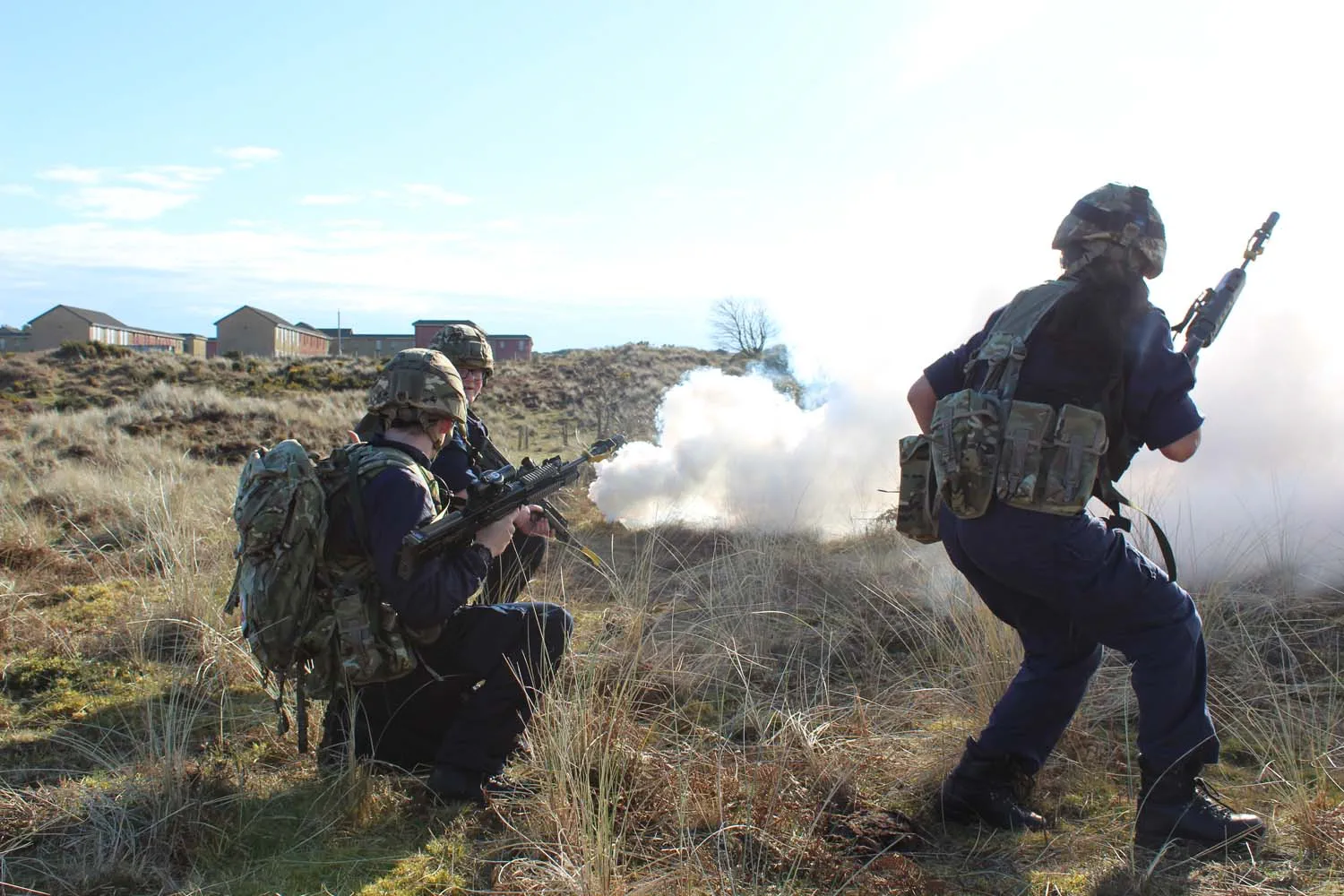
The Ministry of Defence has confirmed that only four to seven per cent of people who apply to join the UK’s Armed Forces Reserves successfully become untrained entrants, with the Army recording the lowest conversion rate of just four per cent in financial year 2024-25.
Conservative MP Steve Barclay asked what proportion of applicants to the Active Reserve forces successfully joined in the last available year. Parliamentary Under-Secretary Louise Sandher-Jones confirmed that in 2024-25 the Royal Navy converted seven per cent of applicants, the British Army four per cent and the Royal Air Force five per cent, describing this as “in line with a long-standing trend.”
The minister said a variety of checks and tests were conducted between application and becoming an untrained entrant “to ensure that any applicant entering training is suitable for military service and that it is credible that the applicant will complete training”, adding that this ensured “that the standards of the Armed Forces are maintained and that public funds and resources are not wasted.” Reserve applications also reflected “an older profile of applicants together with a need to balance service with civilian work and family life” and historically the process had involved “multiple stages and appointments, which can lengthen timelines and increase drop-out before entry.”
Earlier this year, we reported that almost 60,000 applications to join the British armed forces have been rejected on medical grounds since July 2024, according to new figures released by the Ministry of Defence. In a written parliamentary answer to Conservative MP James Cartlidge, Defence Minister Louise Sandher-Jones said a total of 59,010 applications across the Army, Royal Air Force and Royal Navy were rejected for medical reasons between 5 July 2024 and 31 January 2026, you can read more on that here.
Turning to the recent statement, Sandher-Jones said the department had taken “urgent and targeted action since November 2024 to improve throughput which has been low historically”, including streamlining recruiting processes by reducing the number of appointments, increasing automation and using digital tools to speed up decision-making, which had “improved conversion in some areas.” Reserves-specific national and local marketing campaigns were also being used to “better target likely candidates and set clearer expectations from the outset.”
From next year, Reserve recruiting will transition to the new Armed Forces Recruiting System, which the minister said would use modern technology and industry expertise to deliver “a faster, more effective and more consistent recruiting experience across Defence.”







good means standards are high, lets not water them down to keep the bean counters happy.
Yes we only need one really good soldier and we will be the best army in the world… Not the biggest but the very best.
We were never the biggest, standards matter though i am sure many will disagree with me on that.
It’s not necessarily that. I applied to the reserves after full time service, ended up reminding my application due to time taken and constantly being asked for the same information over and over, information that was originally generated by the army and held on army computer systems.
they do not take ex Army with PTSD and injuries other wise I would be a reserve. Any way i hace done my time , that good enough?
Yes it’s all the politicians fault we can’t have a bigger army.
We should reestablish the TA and do as the US does with the national guard, make it a separate operation under the same unified command.
I am sick of listening to British Generals on TV telling me how we are near a state of war then the same asshole bounces 19 out of every 20 people volunteering to join the reserve.
The British army is and always will be a small colonial police force. It’s always treated reservist with distain which is the reason it’s lost every initial war it’s ever fought on the continent and has to be rescued by the navy then bailed out by a massive increase in civilian volunteers and conscripts.
Fact is that reservists cost 20% of regular forces.
Fact is the US Army the world most capable operates a 1.1 ratio of full time vs reserve force but the British army that claims to be close to a state of war operates a 3 to 1 reserve ratio and now we find out that they are refusing 19 out of 20 applications.
The Royal marines don’t refuse 19 out of 20.
Jim, increasingly I feel like you don’t like the Army.
I don’t like the people running the army. Four years in the TA gave me a unique perspective.
4 years in the TA gave you not very much, I’d argue – what did you do?
I done 3 years TA before a 10 year regular spell and now, 8 years after leaving regulars, just attested for reserves.
I think it laughable that you feel to know everything after 4 years in the TA, and that it gives you some kind of special knowledge. You say they should bring back the TA? The TA was rebranded as the Army Reserves; but you should know that!
Everyone has the right to an opinion, but Jim, your 4 years TA service in what cannot be any less than 16 years ago (TA was rebranded in 2014) doesn’t really give you as much of a “unique perspective” as you think; and you’re just making yourself sound like your greatest achievement was your veterans badge. Wind your neck in fella!
I left the TA after university and went on to found a multi national company so I know a thing or two about organisations.
The British army leadership tends to be very myopic, the issue primarily being that the skills who make some a good soldier tend to not be the skills that make someone good at running a large organisation.
So you did ten years in the regular army? What happened? Sounds like half a career.
At least I managed to stick out 10 years pal and never saw HM Forces as a hobby or something to pass time whilst at uni!
You wouldn’t know what makes a good soldier, you were a hobbyist; probably ran crying when you got your first set of call up papers.
Founding a company is nothing like running a defence force. And I don’t think I’m the only one who has noticed how your answer to my Army specific question has been answered primarily with how great you’ve been at building your company… that would be your niche, so stick to that lane.
Dude you couldn’t even hack it as a part timer once you had any sort of demand on your time, and your having a go at someone for doing a decade of regular service on top of 3 years in the reserves? Just stop.
4 years in the TA and that made you an expert? You sound very bitter.
Ohhh the popcorn 🍿 is out for these two have a crow fight
Can’t argue with that, the army needs major restructuring to stay relevant. It does need a massive increase in reserves and equally investment in unmanned capabilities.
On a roll today Jim !
The TA was never gotten rid off, it was just renamed the Army Reserve.
“The British army is and always will be a small colonial police force. It’s always treated reservist with distain which is the reason it’s lost every initial war it’s ever fought on the continent and has to be rescued by the navy then bailed out by a massive increase in civilian volunteers and conscripts. ”
This is counterfactual. In 1940 the British Army had on the order of 30 Infantry Divisions, the vast majority of which where TA divisions that had been called up. Of the 15 Divisions Britain actually deployed to the Continent 9 where Territorial Army divisions that had been called up, not Regular Formations. Iinto the cold War the British Army maintained 13 Brigades of Reserves, which was roughly eaqual to the Regular Army’s fighting strength. (I’ll also point out that while the National Guard is about the size of the US Army, the US Marine Reserves are about 30,000 compared to the Regular US Marine strength of 160,000.)
The bottom line however is that reservists aren’t as good as regulars. I know they like to think they are, but they both in terms of their usefulness to an expeditionary force and their skills and drills they just don’t provide the same value. Their main benefit is to do what they did in WWII, which is provide bulk when it’s needed, but even that bulk has to be enabled with the capability to maneuver (This is why despite having 30 divisions, 15 stayed in the UK in 1940, and why the BEF could claim to be fully mechanised, everything that wasn’t was left behind). Once you need to get your reservists to be able to manuever alongside the Regulars the “A reservist costs so much less than a regular” argument starts to loose water.
FYI the Royal Marines Reserve is only 600 people, have one intake per year, and from what I can find, their rejection rate is much higher than 1 in 20 making it in.
As someone who was a reservist off and for over 40 years here’s in both the army, ( green jackets, para reg, and airborne medics) and a flight nurse in the RAF here’s my tuppence worth, firstly over that time the length of time it takes to be “on boarded” has gone from weeks to over a year, the attrition rate greatly increased once crapitia became involved, in some areas for example surgeons, paramedics, nurses etc… can have skills and experience in excess of regulars particularly in the absence of enduring ops like Afghan, there are probably other areas such as cyber and drone operators where reservists could have similar capabilities as regulars, even in the combat arms there are probably reservists (particular ex regulars) whose skills and drills are up to snuff, at the time of leaving the concept wasn’t for reserve units to be mobilised as formed units but as individual augmentation to regular units either to deploy or backfill. I think my aeromedical squadron is the only reserve unit deployed as a formed unit sine WW2 when we mobilised for op Granby
I’m going to push back slightly. Drs, especially surgeons, Paramedics and Nurses in regular service are required to practice either through DPHC or by working in the NHS outside of times of war in order to maintain their competence. Where there is a delta is when you have non vocational healthcare providers who don’t have civilian pins like Class 1 Combat Medics, who then get compared to individuals, like Paramedics slumming it in a CMT-1 role (when they should be CMT-P’s). But you then also have CMT-3’s in Reserve units who don’t have a medical day job, and they bring the average down (at least CMT-1’s get patient facing placements, and provide support on exercise and deployments).
Similar deal with Combat Arms, yes you get some reservists who are incredibly keen or ex regulars (ignoring that skill fade is 100% a thing) who are “up to snuff,” and those personnel are the ones most likely to put their hand up to be an individual augmentee or join a reserve company group on an OTX or OP. And on the one hand you want those motivated people who keep on top of things, but it hides that nearly half the Army Reserve does not meet it’s minimum 28 day training requirement.
Yes Drs are given a lot of time to keep up their skills I worked in a major trauma centre and we had a senior navy anaesthetist effectively on staff most of the time she wasn’t on ops or similar, although they still get dragged off to do green jobs. For other trades it’s not quite the same, particularly for military paramedics who don’t really get long placements in the NHS and I stand to be corrected but I don’t think they get advanced paramedic roles and placements, In my aeromed squadron we had several advanced critical care paramedics, HEMs paramedics and HART paramedics, (some of which spent a long time in Salisbury), I’m sceptical that any are dealing with critically ill and injured patients day in day out. Also people in medical reserve units bring in other skills and experience Ive served with medics including advanced medics who have been serving or previously serving firearms police officers, ex parachute regiment, light infantry and special forces soldiers. I totally agree that many combat, particularly infantry reservists are unlikely to be of the standard of even an average full timer, and obviously some far below that, but that’s not such a problem when reservists get deployed as individuals into regular formations assuming that is done well.
Military Paramedics are registered with the same governing body as civilian Paramedics and have the same requirements for minimum patient facing time as their civilian counterparts, if they are not operational they have to maintain contracts with civilian ambulance services and trusts in order to meet those requirements, rather than placements within the NHS. As I stated the only who don’t have mandated regular patient facing times in order to retain their qualifications are the Class 1, 2 and 3 Combat Medics [And non-RAMS personnel such as ATM’s, RTM’s and TM’s but those are a different kettle of fish], as they do not hold a PIN and practice under delegation from their Nurse, Paramedic, or Doctor.
Re other skills; I can say the same about Regulars. I’ve worked with Regular Medics who where ex-NHS, ex-Infantry etc etc etc, so that’s a wash. And I disagree about it not being a problem. As I said above, the current systems hides the fact that half the Army reserve does not meet it’s annual training commitment, and while the top 10% might be eager and volunteer to backfill operations, that doesn’t over ride the issues with the majority of the reserve. The Reserve existing only as a pool of individual replacements is a really bad situation frankly.
Doesn’t seem to be going that well in the reserve below is from forces news and House of Commons library
The British Army Reserve is experiencing sustained under-strength, with total trained strength declining to 23,740 as of January 2026, a 0.6% drop from 2025. Despite being the largest reserve force, it faces significant recruitment hurdles, with a 2024 review describing the health of the reserve as “poor” and in decline.
GOV.UK
+1
Key findings regarding the Army Reserve’s under-strength status include:
Declining Numbers: The Army Reserve has continued to decline from a peak in 2020, with 5,000 fewer personnel by late 2024 compared to 2021.
Recruitment Failures: A damning 2024 review found the recruitment system, run by Capita, “unfit for purpose”. Reports suggest only 4 in 100 applicants were successfully joining at one point, creating a gap between trained strength and necessary targets.
Hollowed Force: The Army Reserve faces a “hollowed out” state similar to the regular component, failing to meet its intended establishment size.
Wait Times & Retention: Recruitment processes can take months, with training modules requiring significant, though flexible, commitments of 19-27 days per year.
Total Strength (as opposed to trained strength) is 25,770. Given that nearly 3,000 troops are listed as part of the untrained strength, maybe that sheds some light on the rejection rate?
The piss poor state of the TA divisions sent to France in 1940 kind of sums up the UK treatment of reserves in peace time. The Germans were calling up reservist divisions and sending them off almost immediately on complex operation’s like Norway, we sent three TA divisions to France that were barely armed.
If the British army had out more effort into equipping and training TA divisions in the interwar period it would have faired significantly better in the battle of France.
“Piss poor state of the TA divisions sent to France” You mean the only fully mechanised force in Europe that is always vaunted?
The three divisions that you refer too where sent for rear echelon security duties and engineering support not a combat role, so I’d disagree with that. The remaininder operated alongside the Regular Army with much the same equipment.
If the British Army had put more effort into training and equipping the TA divisions then the 7th and 1st Armoured Divisions wouldn’t have existed. Would it have been nice to have all 30 divisions fully equipped and deployed to the continent? Yes (though I’d argue it would have just meant more people to evacuate in Dynamo had we charged into Belgium with 30 divisions instead of 15, as the size of the British and French Armies in 1940 wasn’t the issue). But let’s not pretend the army had unlimited funding in the interwar years.
I really don’t think the TAs performance in WW2 has any relevance today, as far as combat arms and probably most other trades the idea of mobilising reserves in formed reserve units is not on the cards, we would have to go down the IDF or American national guard road when reservists spend a hell of a lot time in uniform. I can’t see that happening
Reserves would flow in and flow out. What was missing was the integration with the Regular forces and joint respect, ARABS always had an issue with STABS.
The training was pretty hopeless in the late 80s and 90s with exercises taking place in the TAC with tents set up to role play because there was no fuel allowance for movement to the training sites; when we did have the fuel, then there was no ammunition, so hauling around a CharlieG or a GMPG was such a delight.
Brecon, Cambrian and Nijmegen Marches were something that was never raised and no one really cared about whether infantry or MilPol, no competition within the Dets and the Regular DS coming to the end of their time and taking it easy – some days could be piss poor.
And family life did interfere and yet, people were in fast, out fast, numbers kept up, some stayed the distance – I went overseas and taught English missing out on the Balkans and the Sandbox wars which would have been huge magnets for recruitment; today, I can’t comment but 4%? That is appalling and truly unacceptable and yet terms and conditions have not really improved other than the Reserves do now receive pensionable service… little acorns.
Part of the problem is the AR has generally been really well staffed in the last decade from what I can tell, typically sitting at between 26 and 30,000 trained strength, with it’s maximum liability being 30k. I was talking to a fellow NCO who is leaving the Regular Army and was looking at joining a local reserve unit, and they where commenting on how hard it was to try and find a vacant PID with their SQEP.
Thanks Dern, it does take a serving AR to talk about any issues there may be. I understand that 77Bde is staffed by AR specialists and does it’s own thing, but, I wonder how the Inf are doing.
Another thing to ask is could AR get to circa 70 trained bods in X number of years – could they all be equipped? Many TACs have gone to become housing or clubs and yet when you look at the North there is probably a ready pool of infantry – with those brought up on Cumbrian values (the Coast towns are a tad… remote) making great Infantry just as their forefathers did in long forgotten wars whereas I will be happily be put back in my box by learning that PARA have a TAC in Croydon and ‘them’ occupy a TAC next to a former ammo depot between Reading and Basingstoke… so, I’ll happily be corrected.
77 is, last I checked, Hybrid. So part AR and part Regulars. But it’s a very small unit (People complain about calling ASOB a Brigade but ASOB is well north of 2x the size of 77 Brigade).
From what I’ve seen, perspective being from a regular, No they couldn’t, or at least not usefully. You’ve got the 6 Battalions that are aligned too the Infantry Battalions in 3 UK Div and 11 Brigade, which, as far as I’m aware are not going to recieve their own Boxers since their entire purpose is to replace casualties in their respective Regular Battalions. 19 Light Brigade? Not sure if they have the TCV’s and Jackals to lift their entire Battalions if they needed to move, but given that 19L has absolutely nothing in it to support Brigade or Battlegroup manuever, I’d be surprised if any of their Battalions could support more than a Company group with their organic assets.
Other units, I’d maybe be a bit more optimistic? I’d hope that at least 103 RA has it’s own Guns, but I don’t have a source that says for sure either way.
Ironically given the structure of 19L, I think more reserve Infantry is not what we need, we need more reserve Artillery, Engineers, Logisticians, so that we can split 19L in two and maybe look at a reserve Division.
Thanks Dern.
I guess when you spaff £5Bn on Ajax, funds could get tight, but could we still recruit, equip and arm an extra 30 – 40K AR? You’ve high-lighted the lack of organic transport and the fact that the units are seen as BRCs which I would find de-motivating as a unit but volunteered for in the 91 Gulf War where of 600 applicants, 60 were chosen.
PS you missed Milpol off your list of specialists needed and there was a convo with Airborne where sometimes a Carabinieri type formation might be more useful than a truly full-on kinetic unit… You’ll have your informed opinions on that one 😉
Tbf it wasn’t supposed to be a exaustive list, but yes.
I also think that 600 applicant vs 60 chosen is indicative of why a lot of reservists come up with the “we are as good as the regulars” attitude. Because only the top 10% that are really eager volunteer for stuff and are selected down from there, and then that top 10% of the top 10% get compared to the entire unit.
I believe the Reserve RA Regiments have their allocation of LG, and 101 MLRS.
The 3 Yeomanry Light Cav Regs have I think their Jackal complements.
Everything else, I’m dubious.
Same.
I can now say I was part of the top 4%. Feels good to be special. Certainly didn’t feel like it when I joined. You’d go one week and sign up and the next week they would be booking your trip to Gibraltar barracks.
Crazy that only 4% getting through the recruitment process. This is not about watering down the standards of recruit. The recruitment process unlikely fit for purpose.
This was my experience years after I left the services. Long time ago, but shambolic. Hours filling in endless forms to no end.
Complete waste of time. Ex NCO with 9 years service. Pointless exercise.
Bring back national service, end of
A couple of things here that are really important to note some learning from history.
The UK has always had a population health issue that causes the army issues.
Most people forget that essentially almost all of our public health and healthcare infrastructure and systems were set up with the purpose to ensure the army had fit is people. Even in a state of total war during ww1 the army rejected 40% of applicants on medical grounds.. and they were not being picky and need to recruit in the millions.
Health visitors, school health checks,school meals, national insurance act, the NHS are all essentially designed for war and came from war.. not socialism not nanny state.. but an understanding that the fundamental requirement for a nation to win wars is a healthy resilient population.
If your population is an unhealthy bunch riddled with metabolic diseases and mental health issues… your not winning..
Why do you think the very first thing Hitler did was focus on health and wellness.. the third Reich put in the most extreme public health laws that would have everyone going what a socialist if we tried it in the UK, the irony that the most right wingers in history believed in big government intervention in aggressive public health campaigns, including pioneering anti-smoking and anti-alcohol campaigns, restrictions on asbestos, and promoting healthy diets (wholemeal bread, vegetables). As well as mass almost mandatory and free physical fitness.. They believed this would increase the “fighting power” of the nation ( as they were evil fascists we all know the dark side of killing off the weak and mentally ill).
But instead of slagging off the armies process for saying people are not mentally or physically able.. maybe we should accept they know what makes a soldier and instead do what we did in the past and figure out why we have a population full of metabolic diseases and mental health issues and actually create a match fit population ready for a war… creating a fighting fit resilient population is not socialism left wing interventionism it’s national survival.
Second point, Because everyone knows I like to complicate things..
The preset TA etc are set up to recruit and train part time members of the armed forces who are fit for overseas deployment.. but we very well know that the modern war of necessity is going to be fought not as an expeditionary event only but also will involve the enemy trying to smash our national resilience..
This means we will need very large numbers of none deployable forces..
1) our military infrastructure will need staffing by people who don’t need to be deployable just turn up to an air base or port and fix stuff.. same with logistics hubs.
2) we will need an international security force.. this sounds a bit Orwellian, but part of the play book from China and Russia is grey warfare and that is sabotage and terror attacks on a large scale. Also as a peer war goes on some of your population will buckle and may try to overthrow the government.
3) home air defence.. in the drone age we are going to have to defend every bit of civilian and military infrastructure we want to keep..the RAF as is cannot stop 5000 drones a month aimed at any and all targets.
4) role 4 of the operational care pathway.. this will need a massive expansion in capability.
5) UK based logistics.. it will be a vast effort to feed the war machine, drivers drivers drivers.
6) offensive and defensive military cyber
Civil defence
1) vast numbers of fire, rescue and ambulance volunteers.
2) health systems, large numbers of volunteers to support mass casualty events and run the
3) infrastructure resilience.. people trained in the post rescue clear up and recovery of infrastructure..
4) civilian logistics.. making sure people have food and water in a full peer war is going to need a whole group of people.
5) defensive civilian cyber.
So if someone wants to volunteer to serve we need a whole host of options.. because in a true peer war the forces are going to need a huge tail if people who will never need to leave the UK and don’t need to be fit! but need to know how to work within their systems…and we are going to need a vast civil defence force. so why not recruit the 50 year old nurse, yes they will never deploy but you will be begging for any nurse to do your role 4 when the shit hits the fan.. and if that nurse has retired, handed in their pin and let their skills go you have lost a hard to replace resource.
Generally I think that if there is a Homeland Defence/Civil Defence formation it shouldn’t be part of the army, which should be maximally expeditionary.
I do think what the AR needs is a much clearer red line for when it can compell mobilisation, and a clearer idea of what Mobilisation plans are. In 1940 we knew what we wanted the TA to acomplish, in 1980 we knew which TA brigades where being rushed to Germany, which where providing security to the lines of communication, and which where remaining as Strategic Reserves in the UK. Today the AR has no such clarity beyond “Hey if we give you some notice can you muster up your best and most motivated blokes from across 19 Brigade and form a company group or fill some vacancies in a Regular Battalion that’s deploying.”
Yes indeed, this country badly needs a volunteer civil defence force, it’s one of it big open weaknesses and shows a lack of resilience and resolve.
Campaign poster: the British Army doesn’t want you
A 96% failure rate suggests to me that there’s a mismatch between the Army’s expectation of their Reservists and the abilities of the people willing to be one. If the army need more Reservists then they have to reduce their expectations.
Other 96 were turned down for being white or male.
Oops. You said it… I was waiting… You didn’t say strait.
I joined the TA back in 1991 at the age of 17. I left due to life commitments and always regretted it. At the age of 52 I’m too old but I would rejoin tomorrow if I could.
Could always try MPGS.
A reservist force will, far more than a regular force, reflect the population from which it is raised
It is all very well railing against the poor health of the population etc, but you will always struggle to obtain large numbers of recruits who maintain standards of fitness far beyond those they require for their regular lives.
If we want the reserve force to be larger, then the Armed Forces will have to work out how to generate combat power from people who can’t meet the fitness standards expected today. Just as they would inevitably have to do if a war broke out.
I think you could make an argument that reservist infantry is a terrible idea on that basis. Especially given the probable need for vast numbers of additional air defence weapons given the threat of missile and drone spam against the home islands.
But in any case, it’s all very well demanding that fitness standards should not be diluted, but that is difficult to square with demands for force expansion given the reality of our position.
We must adapt our way of war to our circumstances, and to the personnel who will ultimately be called upon to fight.
Army-centric comment here….I thought that the Establishment (liability) was increased for AR from 30k to 35k quite a few years ago?
Much comment about medical rejections in the article, no doubt relating to both Regular and AR rejection rate, but there must be other reasons that applicants were rejected to come up with such an astonishingly high rejection rate of 96%? So what are they?