

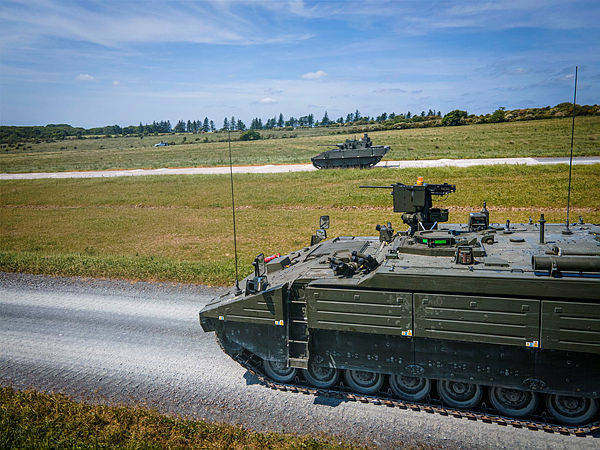
The British Army is examining potential weapon options for the Ares armoured vehicle as part of a wider programme assessing how elements of its armoured fleet could be equipped with enhanced lethality.
In a written parliamentary answer, Defence Minister Luke Pollard confirmed that the Army and the Defence Science and Technology Laboratory have established an enduring research programme to assess possible capability upgrades, including the consideration of medium-calibre cannon options, the UK Defence Journal understands.
Responding to a question from Conservative MP Ben Obese-Jecty on whether the Northrop Grumman M230LF dual-feed Bushmaster chain gun was being assessed for Ares, Pollard said the weapon was one of several systems under consideration.
“The Army and the Defence Science and Technology Laboratory have established an enduring research programme to assess the benefits of equipping elements of the armoured vehicle fleet with a range of capabilities, including enhanced lethality,” he said, adding that “the M230LF is being considered alongside other medium-calibre cannon options available from industry.”
The minister’s response follows earlier parliamentary answers setting out the intended role of Ares within the Ajax family of vehicles. Pollard has previously stated that “the ARES variant of Ajax is designed for mounted close combat and is being delivered to the Field Army.”
He confirmed that the decision to field Ares with infantry battalions was taken “after a considerable assessment programme,” with the vehicle intended to provide protected mobility for infantry rather than to operate as a traditional infantry fighting vehicle.
In the same response, Pollard made clear that there is “currently no Ajax Infantry Fighting Vehicle (IFV) variant,” and that while a concept demonstrator exists, “this is not a prototype IFV.” He added that the Army continues to review its requirements “to deliver the Armoured Infantry Capability.”
However, these capability assessments are taking place against the backdrop of a wider review of the Ajax programme itself. Ministers have confirmed that the programme is now under formal reassessment following long-running technical and safety issues, including problems related to noise and vibration.
Speaking to the Defence Committee, the Secretary of State for Defence said that the programme must now be “backed or scrapped,” with work underway to determine whether Ajax can be made safe, effective and viable for long-term service.
Initial Operating Capability for Ajax has been withdrawn, programme governance has been reset, and responsibility has been removed from the Army, with a new Senior Responsible Owner appointed to oversee the review..









Ok, this will confuse, as ARES is a part of the Ajax family.
Why have this study to decide on its gun if the Ajax is canned? Or do the problems ONLY effect the Ajax Scout variant? It has been asked before here and not fully resolved AFAIK?
No I checked up on this to see if it was just the excess weight of the Ajax turret causing the problems and apparently the reported issue is from both ARES and Ajax.. it’s a apparently a whole host of issues coming together from poor alignment of the original hulls from Spain, leading to poor fitting of the equipment and electronics and finally drive train issues due to weight..
Thanks.
So, hope for the hulls made here then after the first batches, hopefully.
Hi Daniele, no hulls are manufactured in UK.
Although during bid Sandy Wilson promised Ajax would be British from its bootstraps ie from the ground up. The truth is we cant believe a word GD say! In a recent statement they mentioned soldiers safety was their key priority. Clearly a lie . No Hulls or meaningful investment in UK facilities at all. GD never intended to do anything here.
Give it a rest.
Are there really no hulls being produced in the UK? It was previously reported that GD had agreed to move production of the last 489 Ajax.to the UK. And that 80% of vehicle manufacture would be in the UK.
If the hulls are all being made in Spain, these.previous announcements are misleading hogwash.
Why would we want more hulls from GD Spain anyway, when their first 100+ delivered have varying panel sizes, misaligned hull structures, wrongly drilled holes and sub-standard welding? Which clowns in D&ES signed that lot off and paid GDUK for this rubbish?
Surely we could build hulls in the UK at Telford or wherever, getting better results and rebuilding armoured vehicle manufacturing capability. Or have our bunglers got us locked into some hopeless contract with GD that we can’t vary or dictate?
Hi Ian.
Ohh! I had that all wrong, then. What are they doing in Wales, then, just assembling kits from Spain?
Yes
No
Not “kits from Spain”. The hulls arrive and the vehicles are built up using components from a huge number of suppliers, a very good number of which are British. The program supports a large UK supply chain.
Thanks Ian.
Interesting “very good number” are British.
So not 80% then!
Daniele, to add to Ian’s point, AFAIK the hulls for the Ajax family will continue to come from GD in Madrid (was Santa Bárbara Sistemas) as GDUK does not have (and have never had) a proper ‘tank factory’ to make such hulls, given that their specialism is avionics and military radios, not vehicles.
They have turned an abandoned fork lift truck manufacturing facility into a mere Assembly Hall, which is rather a different facility.
Hi Graham.
Yes, the much vaunted “jobs in South Wales” that Cameron was grandstanding about in 2015!
Always got their priorities.
So current production Ares models are problem free?
No! the ARES’s vehicles involved in training op Titan Storm on SPTA were Drop 3 – The latest and supposedly best & problem free hulls. ie allegedly not subject to non parallel hull sides, Hull sides different lengths, Mounting hole border not square, Mounting holes on wrong centres / off centre. Poor quality welding & assembly, no repeatability between hulls etc.
This speaks of even more deep seated design faults
The hull problems must have been spotted during assembly, it would have caused misalignment of running gear and other components
Sounds like GD bodged together the first batch, and hoped nobody would notice.
Exactly what happened- BUT what happened to First article inspection. Serialisation QA, QC, inspection criteria and reporting? Smacks of serious collusion
Having worked on both sides of the divide, DE&S have very, very limited understanding of Quality. Choosing desktop audits rather than actually looking at what theyve bought.
Warrior Major servicing introduced a huge number if non compliant items, from nuts and bolts to specialised gears and fake shafts in suspensions., not just on Warrior, But Bulldog and CVRT and Challenger, Titan and Trojan.
Fake and false items galore
How many hulls came from Spain! Was it just the 50 batch 1 or any more/any less!
There are 24 vehicles that were going testing for noise and vibration.
Hopefully the current batch 3 are all fine and worse comes to worse we just scrap the 24 for spares and do a follow order which can use the parts that are still good
Who would pay for the follow on order? LM have delivered the initial batch as ordered working or not.
It has already been stated that there is no consistent build standard or effective configuration management/ Quality control on the first 150 hulls. They all need scraping.
All hulls are made in Spain! in spite of Sandy Wilsons promise that Ajax would British ‘from its boot straps’ ie from the ground up.
Quality and manufacturing skills like welding in SBS (GD Spain) have been so appallingly bad that outside contractors have had to be employed to teach GD how to Weld!! Jigs, Fixtures and laser alignment and inspection were non existent.
If that is true then that is shocking.
Apart from anything else jig built would be cheaper….never mind better…..
Yes it seems that the problems will not be fixable because it’s not just a design issue the very bones of each vehicle are broken and a lot of the noise and vibration stems from these broken bones…
Reading this do you think that there may be scope down the line for a criminal prosecution ?
It doesn’t sound from this that Ajax will ever be fit for purpose or safe for our troops.
Probably not.
It is one of those contracts where the gvmt/mod accepted risk for specifying equipment weight beyond the scope of the vehicles projected parameters….
As a reminder of such parameters: aus boxer has had troubles with cannon control and rheimetal etc al made a public announcement stating that the issue was due to over specification by army/gvmt that exceeded known parameters.
The contracts for these vehicles allow exploration of vehicle limitations. That exploration is partnered by the facilitating manufacturer/engineer but is contractually the responsibility of the purchasing party.
Ajax appears to have been a folly and a mistake but there were very good reasons not to contract for Bae cv90 at the time of contract award.
I think people forget that bae were taking the piss in other ways at the time and that there was heavy suspicion of corruption and non competed awards for bae products
The army didn’t really have a choice. They had to choose ascod. …. They didn’t ,though, have to push the engineering parameters to the point of being inoperable by onboard humans….
Maybe bae shareholders controlled the specification…..who knows???….no one can deny that it’s really weird (in it’s currently press released format):-
It’s like some sick little, profiteering, small minded, puppet master is attempting to prove some knowledge nd of childish I told you so without releasing the full facts or any real semblance of truth:-
Obfuscation is the English way and it sucks
Aaaah. That explains things
Thanks Dan 👍. Very helpful
‘It is one of those contracts where the gov t/mod accepted risk for specifying equipment weight beyond the scope of the vehicles projected parameters.’
Yes, it does seem that way; that there is some law of physics and engineering which relates and limits weight and dimensions (in tracked vehicles ) to vibrations. In the latest trials vibration issues are apparent even in vehicles which have ‘true’ hulls. For all the doubts and criticism of BAE they were far sighted to use F1 derived active suspension technology to support weight increases in later CV90.
If the government consciously knew they were taking a risk, then GD’s liability would be limited and we need to take it on the chin.
So if it’s only the Spanish built hulls why is the gvmt being so dramatic with it’s press releases????
I have heavy hatred for profiteering but there is no place for precious dramatics in these contracts.
If it is only some hulls that attenuate the vibrations to sickness levels that should be specified and already in the public domain.
Bla bla bla NADA NADA NADA……
It was previously published that the early hulls from Spain were the problem ones so I must simply be stupid (because I am not naive) for not understanding why gvmt oversight has previously failed and now fails to commit.
One of the very worst traits of Englanders is that we have been programmed and socialised to defer to and accept obfuscation commited by higher powers.
It’s a sickly weakness and ridiculous illogicality that even victims of it will defend for no reason!
They’re studying the gun so that they have an answer IF Ajax isn’t scrapped and they stick with it. It’s something they can do in parallel with deciding whether to ‘back or scrap’.
Yes, I guess so.
Thanks.
Probably not.
It is one of those contracts where the gvmt/mod accepted risk for specifying equipment weight beyond the scope of the vehicles projected parameters….
As a reminder of such parameters: aus boxer has had troubles with cannon control and rheimetal etc al made a public announcement stating that the issue was due to over specification by army/gvmt that exceeded known parameters.
The contracts for these vehicles allow exploration of vehicle limitations. That exploration is partnered by the facilitating manufacturer/engineer but is contractually the responsibility of the purchasing party.
Ajax appears to have been a folly and a mistake but there were very good reasons not to contract for Bae cv90 at the time of contract award.
I think people forget that bae were taking the piss in other ways at the time and that there was heavy suspicion of corruption and non competed awards for bae products
The army didn’t really have a choice. They had to choose ascod. …. They didn’t ,though, have to push the engineering parameters to the point of being inoperable by onboard humans….
Maybe bae shareholders controlled the specification…..who knows???….no one can deny that it’s really weird (in it’s currently press released format):-
It’s like some sick little, profiteering, small minded, puppet master is attempting to prove some knowledge nd of childish I told you so without releasing the full facts or any real semblance of truth:-
Obfuscation is the English way and it sucks
Thanks.
Well posters here know my views on the MIC, out to milk the taxpayer dry.
And what you describe back in the day is jist another example.
I note that the Boxer problem was eventually solved (else why did the German government order a whole heap of Australian Boxer in the same configuration itself?). With Ajax, everything was ignored in the hope the next person would end up wearing it.
Dan, the British Army did not choose a derivation of ASCOD2 over CV90 recce or GDUK over BAE. I would have thought that army staff would have preferred the BAE bid for a whole host of reasons including BAE’s proven and long-term ability to build acceptable families of AFVs for the British Army and the fact that CV90 is something of a favourite and well-used vehicle in Europe. They would have looked closely at the CV90 mocked up to be a recce variant that was also exhibited at a major arms exhibition c.2010.
In contrast GDUK had never before made an AFV, or in fact any sort of vehicle, not even a pedal car, as their speciality was avionics and military radios such as Bowman. Of course they didn’t even have suitable premises initially to design, develop, test and manufacture 589 AFVs of a new design; they did secure an abandoned buildng that had once been used to make forklift trucks and kitted it out as an Assemby Hall, not a proper ‘tank workshop’ which forced the import of finished hulls from GD Spain.
It is politicians (the relevant MoD Minister) who select the winning bid based on advice from a variety of sources, including HMT, and their own political judgement. Their scrutiny of a given company’s ability to do the job technically seems not to rank very high with them but perceived VfM and the number and location of British jobs occurring is seemingly very important to them.
The Minister for Defence Procurement was no doubt heavily influenced by the fact that GDUKs bid would create 250 jobs in a deprived part of Wales. It is said that BAE’s bid had the vehicles being made in Sweden and they only offered to build in Britain after the Bid had been awarded to GDUK – astonishingly naive of BAE if this story is true.
Possible upgrade path for the RN 30mm guns?
“Possible upgrade path for the RN 30mm guns?”
I think it would be a downgrade. The M230 is the Apache attack helicopter’s lightweight 30X113mm gun, while the DS30M naval mount uses the more powerful 30X173mm MK44 Bushmaster 2 gun.
Nope, it’s a low velocity 30mm cannon and the RN is moving to the 40mm Bofors
The RN is using both types, you can fit 30mm guns in places that you can’t fit a 40mm. For what it’s worth, I do still believe that the RN should look at replacing its current 30mm guns with something with a higher rate of fire, like the MLG-27 (basically the 27mm cannon from a Typhoon in a naval mount).
Yes, fair enough. I got tempted by the dual feed feature. But the 40mm is a real step up.
Warrior is being retired soon and there’s no replacement IFV in the plan! Does anyone think that’s a little odd?
No, the Army has been full of gaps for years what’s another between friends.
For better or worse, probably worse, the army decided it no longer needed a IFV and instead doubling down on the boxer. Clearly that was a cost driven decision but time will tell if it was a compromise too far or not.
Every Army decision taken over the last fifteen years seems to be coming back to bite them in the bum!!
So far they have got lucky because they haven’t been to war where capability gaps have caused issues, well putting aside the decision not to replace the unarmoured vehicles, but not sure if that was a money decision or a lack of understanding that conflicts had changed since ww2.
Boxer is designed to be a multi mission vehicle. Plus Germany appears to have given tracked Boxer a tick. It is not by the way – particularly cheap (unless you are referring explicitly to Ajax). The whole thing can of course be bought undone by a sub-par mission module. That’s not Boxers fault.
Just cheaper than the warrior life extension /upgrade program.
Very unlikely to be more than Ajax, since at least it was predominantly British, and thus would havebrought work to the right country. And the same turret was proposed for both
Steve, I’m amazed that you think the army believes it no longer needs an IFV. Why would they think that you no longer need IFVs to work with tanks in an armoured brigade? Way back the army stated a Requirement for WCSP, an upgraded Warrior, called by some Warrior Mk2 and that was well on its way to the close of development albeit with delays and cost overruns, but it was cancelled by the Minister, not the army. The reason was to make a monetary saving when the army (CGS personally by all accounts) advanced the date of Boxer fielding. This caused a collision of army projects requiring funding at the same time – CR3, WCSP, Boxer, AS-90 replacement. The Minister, doubtless goaded by HMT, decided to cancel one of those programmes to find monetary headroom over crucial years and chose WCSP….with no idea as to how to equip the armoured infantry….but some idiot clearly suggested that the vehicle for the Mechanised Infantry (Boxer) could be fielded in the armoured brigades. Made no sense as Boxer cannot do that job. They hadn’t even ordered enough Boxers for the Mech Inf (and others)..only 623 instead of about 1200, let alone now supply Boxers as well to the armoured brigades. Total disaster.
I am puzzled about your claim that something (tracked Boxer with a big cannon?) is cheaper than Warrior Mk2 would have been – no way. Upgraded Warriors (WCSP) were highly affordable, in fact the programme was cheap. Boxer (in any version) is about the most expensive medium weight AFV in the world, and tracked Boxer with a beefy cannon specifically would have an eye-watering price tag.
I think the issue was more to do with finding sufficient hulls to upgrade. There was an issue with delamination od some parts of the hull, IIRC
They’re replacing it with Boxer.
Paul, sadly I do not find savage defence cuts which create huge capability gaps odd.There have been too many examples.
Ermm, yeah errr well that’s all pretty messed up then.
Does anyone actually have a clue where we are with all these Tanky things ???
Obviously, the army must have reviewed and successfully concluded the fixing options for Ares and decided to move on to the gun options. All sounds very positive.
There are 245 CTAS 40 weapon systems sitting somewhere, that were original bought for the Warrior capability sustainment program, or have they been sold on? Nexter manufacture the T40 unmanned turret specifically for the CTAS40, which is used by the VBCI-2 and Jaguar EBRC. Could the T40 turret combination be fitted ARES? Thereby giving the vehicle the same punch as Ajax, significantly more lethality than using the much smaller Bushmaster M230. But also not significantly increasing the logistical and maintenance burden of having to service and maintain yet another weapon system.
My thoughts entirely! Maybe MOD is hanging on to them as a possible option for an IFV version of Boxer? I think I recall seeing a Boxer/CTA40 prototype/mockup before so someone has considered it. Opens the wheels vs tracks debate!
I guess if an IFV is officially not wanted it might get called “infantry fire support vehicle” or something…
Alex, a replacement IFV for Warrior, is not just wanted, it is needed. Warrior upgrade cancelled in March 2021 to make a saving. MoD at the tome said that Boxers would be issued to the Armoured Bdes, which of course was not the original plan, or even a sane plan. Boxers are for Mech Inf and have no place trying to fill a role done by the AI in IFVs, which is all about keeping up with tanks across very difficult terrain and having a cannon for fire support whilst moving, whilst the infantry section debusses and thereafter.
Not enough Boxers have been ordered and there is probably no money to but more Boxers. I am sure Dern said that the existing WCSP turrets could not fit on a Boxer to turn it into an IFV.
Understood. An army without an IFV seems crazy. However, as far as defence priorities go, I’d put integrated air defence of UK against massed cruise missile and drone attacks first, followed by more hulls for RN. IMHO follow on batch of T31s is obvious choice (with Mk41 VLS from start) plus maybe some new OPVs/corvettes (with some proper offensive/defensive weapons) built by smaller yards with spare capacity.
British Army just isn’t big enough to make a difference, leave that to the Poles etc who are building a decent land army.
Alex, the whole ethos of NATO is that 32 countries combine to produce military resources to deter, and if necessary defend, the entire Euro-Atlantic region. It really doesn’t work if countries, especially significant countries with a large-ish defence budget like ours, choose to reduce what they send. The entire European continent cannot be defended by just the Polish army.
On the army side we are under remit to deliver two divisions (an armoured and a mech/light div), a Corps HQ and Corps support units to form the framework of the ARRC, one of SACEUR’s two strategic reserve Corps sized formations. This is a crucial and very important role. Some commentators are critical that one of our declared divisions is only mech/light and not fully armoured- we cannot dilute our contribution any further.
Starmer wants to increase the size of the regular army when funding permits from 73,000 to 76,000 established posts. We have an army reserve established at 30,000 posts although some documentation says 35,000. If push came to shove then the British Army’s strategic reserve of ex-regulars still with a reserve liability would be called up – estimate is that this is 50,000 to 60,000. Of course WW3 would have to be declared for all this guys to be stood up, not all would be in the deployable field force and there are doubts as to whether the two reserve arms (army reserve and strategic reserve) could be properly equipped with everything required including weapons, vehicles and radios,
Sorry, Healey, not Starmer!!
Given Bradley’s are tearing up T72s, would love to see what a Boxer with a 40CTAS could do. The T40 turret would seem a no-brainer for this.
Bradley has been brilliant…
What Ukraine has shown is that ammunition is paramount. 40mm CTA is dead in the water. There are ammo producers around the world that can manufacture from 20mm to 155mm that can’t manufacture 40mm CTA. Ukraine could exhaust the worlds supply of 40mm CTA in a week.
So you’re justifying using inferior ammunition because it’s not as widely produced?… I imagine the same would have been said about cartridges when everyone was firing musket balls.
There’s factories in France and the U.K. producing 40mm CTA, ensuring we have sovereign capability.
Ukraine could exhaust the world’s supply of just about any munition in a week, they have such a target rich environment.
Barrel life is 750-800 rounds due to blow by before cased rounds seal in the barrel, round complexity makes them very expensive and high recoil through short springs is an issue. Can they afford to use ones in storage.
‘An enduring research programme’. That’s a new one on me. =no idea what to do and not really planning to find out.
Used like this, ‘enduring’ means going on for, if not ever, pretty much so.
One of the advantages in canning Ajax and going for CV90 is that it comes with an IFV variant.
Even if AJAX is saved ARES is a poor choice for an IFV. I don’t think anyone would want to wait for another decade well General Dynamics gets around to building an IFV.
One wonders if we could get the 40mm CTA onto CV90. The Swedish use a 40mm Bofors on their CV90 however I doubt the British army has enough time to mess around with a bespoke design.
The treasury are not going to buy another IFV
Army promotional material suggests that they have been given scope to contract an unknown number of ascod 42 as a section level APC……and these days a remote turret would make it an ifv
A modification of a vehicle we are/were planning to get a large number of, not a whole new platform
Why would you replace the totally proven 40mm Bofors with the crappy 40mm CTA gun?
Ascod 42 ( or whatever the British variant is called) has been shown at trade fairs in apc/ ifv format with enoughing seating for a platoon section.
Once the vehicles are rengineered to use continuous composite rubber tracks (if that solves the sickness level vibration) then we will have proven how expensive and labour intensive and logistically impossible modern tracked heavy defence vehicles are and can stop obsessing about vehicles that cannot realistically be deployed in any recce or remote 2nd battle scenario.
It’s undeployable… And always was…..it is though a realistic home defence insurance policy
The problem is billions have been spent (or should I say wasted) on something that various allies have surpassed some time ago while Ajax still are not even safe to drive. Time is killing everyone here.
Jim, ‘I don’t think anyone would want to wait for another decade while General Dynamics gets around to building an IFV.’
Don’t have to wait at all. GD make an IFV, and they have made iFVs for donkey’s years. Their ASCOD2 is marketed in Spain as Pizarro and in Austria as Ulan. You might now have heard of it – used as a starting point by GDUK for their own recce vehicle for the British Army….Ajax!
I agree that ARES as it stands is a poor choice as an IFV…because with seating for only 4 dismounts and no cannon, it is not an IFV, it is a ‘small capacity’ APC.. It could perhaps be turned into an IFV with time and cost to fit more seats and a cannon. A bizarre way to get an IFV for the BA. Take an ASCOD2 – modify it into an ARES that may still have noise and vibration issues across all or most of its hulls and cost a lot of time and money…and then modify it further to get it back to an IFV. A labrynthine approach that takes time, costs huge money and may still have hull faults.
It looks like a fleet of Warriors is being converted into manned/unmanned vehicles for mine clearance..
6 of them I think!
I think rhey are doing a few but looking expand. Actually, I this was meant to be for someone but I refreshed the page and it moved to the bottom .lol
Ajax has got to go. Even worse than Haddon Cave. Each vehicle sounds like its hand built so no consistent specs and the basic incredibky overweight design is awful. At least Nimrod was a great aircraft. Ajax is just an omnishambles from start to finish. And the fact that UK can’t or eon’t sue GD is just obscene.
If Spanish manufacturing and weld quality on military vehicles is so poor, have there been any known issues in their build control for naval vessels? Seeing as big chunks of the RFA fleet will be made there with a ” new” workforce in Belfast doing the assembly. Hopefully there is no repeat.
Is it really that difficult to dust off a Warrior or Stormer design and invest in some hull manufacture for IFV and Recce? OTS turret, gun and sensor packages are available.
Similar with new Challenger hulls, they say it’s possible.
We’re. It making new challenger hulls were making new turrets. And I wouldn’t be surprised if the turrets even reuse parts
We’re not
Isn’t warrior one of those vehicles where the myth is bigger than the balls.
I doubt warrior has protection levels that match those of boxer…..and whilst you could argue otherwise….you won’t find printed words that prove otherwise.
I think Brit forces got away with promoting a narrative of being mysteriously effective beyond their material means for quite some time but I really don’t think that adversaries are sucked in by that mythology any longer…..
…..I further think that the army planning for a heavily armoured 42ton recce vehicle means that they don’t believe the mythology either.
Warrior does not have capacity to have the hp to carry contemporary levels of armour.
Cta40 was a great idea in the making but once rejected by wider NATO it becomes a failure that should be replaced by 35mm 50mm where possible….
It’s sucky that cta40 didn’t attract a greater following but it’s done.:
Other NATO nations have selected 35 or 50 standard where better blast effects where deemed necessary.
-Warrior is dead.
-CT40 is going to remain extremely expensive.
-Ajax/Ares was never deployable in number but might be rescued for home defence ( with a huge logistical requirement)
– UK funds an expensive nuclear deterrent which should excuse it from deploying heavy tracked vehicles on behalf of NATO.
Prior to 2022 the Army and MOD believed the Warrior chassis was perfectly good until 2040 hence the upgrade plan. Was it problems with turret and CT40 rather than the hull that got it canned? A simple OTS turret wood at least give something rather than binning it off with no replacement.
The problem is anything CTA 40 can do, you can do with alternatives that cost less & can be made by most manufacturers. It doesn’t matter how effective your gun is, if you can’t supply the ammo when it’s needed, it is a waste of time.
🤣
Dan, not sure there are any myths saying that Warrior has phenomenal levels of protection these days. The vehicle was designed 1972-1980 in the Cold War era and fielded from 1987. At 25.4 tonnnes it was significantly heavier and better armoured than its predecessor, FV432, of 15.3 tonnes. Warrior deployed way back on GW1 in 1990/91 with good quality applique armour to boost its already good organic armour, and therafter on other operations.
I am sure its protection was very good, especially with applique, in its first 20 or so years of service but substantial upgrades to protection, electronics and firepower were detailed in Requirements documents in 2010. WCSP should have been fielded about 2017/2018 and would give a lease of life out to 2040. Thus it was recognised that its armour needed to be improved mid-life and the upgrade programme would have achieved that. So without WCSP, no-one is thinking Warrior armour is good enough.
‘Ajax/Ares was never deployable in number but might be rescued for home defence ( with a huge logistical requirement)’.
‘Once the vehicles are rengineered to use continuous composite rubber tracks (if that solves the sickness level vibration) then we will have proven how expensive and labour intensive and logistically impossible modern tracked heavy defence vehicles are and can stop obsessing about vehicles that cannot realistically be deployed in any recce or remote 2nd battle scenario. It’s undeployable… And always was…..it is though a realistic home defence insurance policy
What do you mean by this? The Ajax family is being procured to kit out 3 Div which is one of our two deployable divisions. It is essentially an armoured division for expeditionary operations. How are medium and heavy tracked vehicles suddently not deployable (we first deployed tanks overseas 110 years ago and have deployed armour overseas ever since, most recently to Estonia, and we have always deployed the armour in time to meet timelines.). We have never, except perhaps in 1940, deployed armour for Military Home Defence when invasion by Panzer armies was expected. What has changed in very recent times to prove your claim that we can no longer deploy heavy and medium armour overseas? I am baffled. If it was true, then you may as well decommission 3 (UK) Div, and we declare to NATO that we can no longer fulfil our land forces commitments.
First time I have seen in print that ARES is officially going to Infantry battalions, which might mean they’re going to augment the Boxer battalions in the armourd brigades? Or does it mean that the Infantry in the armoured brigades will be transported by ARES now, although they can only take 4 or 5 dismounts and not a full rifle section. Are they somehow going to fit more seats or supply twice as many ARES to a battalion? Can a 2-man crew (driver + commander) also operate a Northrop Grumman M230LF dual-feed Bushmaster chain gun or similar weapon?
Pollard has previously stated that “the ARES variant of Ajax is designed for mounted close combat”. That is a considerable change of wording as ARES was procured as a ‘battle taxi’ for small specialist teams who would dismount to do their job and then be moved on elsewhere. Is that really mounted close combat?
Why do the boffins at DSTL have to get involved? – doesn’t need a scientist to work out what gun to fit.
I don’t think this is any change to existing plans, just confusing wording IMO.
Good point Graham, I too have been puzzling over what is meant by ‘mounted close combat’. Does it mean a low-level air defence/counter-UAV version to replace Stormer and maybe an anti-tank version to.fill the gap left by Striker? Or perhaps a mortar carrier version?
That would be fair enough in a tracked AI formation, but a bit odd in operational terms in a wheeled APC Boxer unit.
Cripes, ‘Mounted’ means that participants are in a land vehicle or helicopter. Close combat refers to combat in the Direct Fire zone ie within the range at which direct fire (using sights and with flat trajectory) weapons are used. It used to be considered that it was out to about 2km (arguably still OK as a yardstick), notwithstanding that some weapon systems can fire longer than this (tanks out to 5km in extremis and helicopters can fire anti-tank weapons put to 10-11km in extremis, but with effective ranges of 2-3.5km and 8km respectively).
The Combat Arms that conduct Mounted Close Combat are – Infantry, Royal Armoured Corps, Army Air Corps – so the weapons used are Small Arms including MGs, cannons, tank main armament, ATGM and air-to-ground missiles.