

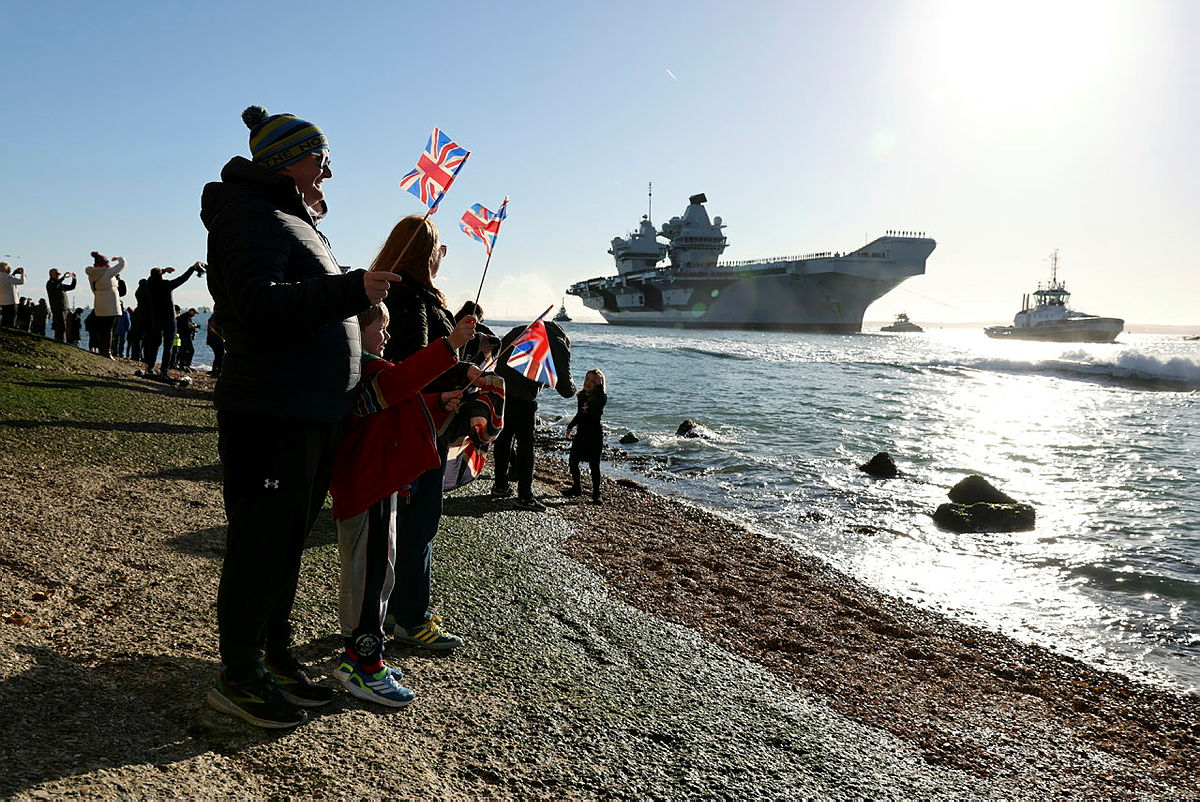
Midday on a late autumn Sunday, the nation’s flagship HMS Prince of Wales finally appears on the horizon off Portsmouth.
On deck, sailors in immaculate rows catch sight of the familiar English shoreline as tugboats shoot celebratory plumes of water. Families cheer and wave banners from Old Portsmouth’s walls, bracing against the sea breeze and holding back tears of joy.
It is the Royal Navy’s largest homecoming in a generation, with more than 2,000 sailors, aviators, Marines and soldiers returning from the deployment known as Operation Highmast. Commodore James Blackmore summarised the deployment shortly before arrival. “It has been a privilege to lead the nearly 4,000 soldiers, sailors, aviators, and marines who have sailed over 40,000 nautical miles as part of the Strike Group, working with over 30 nations en route,” he said.
He pointed to the Defence Secretary’s confirmation that the Carrier Strike Group had reached full operating capability and said the achievement reflected the work of many crews over several years. “The Strike Group has come home stronger for NATO than it departed and I am incredibly proud of all those who have taken part in Operation Highmast.”
Operation Highmast began in April and took the strike group from the Mediterranean through the Red Sea and Indian Ocean and on to the Indo-Pacific. The task group structure remained constant throughout. HMS Prince of Wales served as the command ship. HMS Dauntless provided air defence. HMS Richmond and Roald Amundsen handled anti-submarine and surface protection. Aircraft from 814, 815, 820 and 845 Naval Air Squadrons flew regular patrols, while 700X Naval Air Squadron operated small uncrewed systems that transferred stores between ships in controlled trials.
The group covered more than 40,000 nautical miles, spending around half the deployment east of Suez. Aircraft from the task group flew more than 2,500 sorties. The deployments covered a wide range of activity, including participation in major multinational exercises, maritime security patrols and coordinated operations with allied navies.
Lieutenant Commander James Callender, Executive Officer of HMS Richmond, said the crew had maintained a high tempo throughout the mission. He described his pride in their work and said they were now focused on reuniting with family members. “We are now looking forward to the joy of homecoming and being reunited with the family and friends whose support has helped make this deployment possible,” he said.
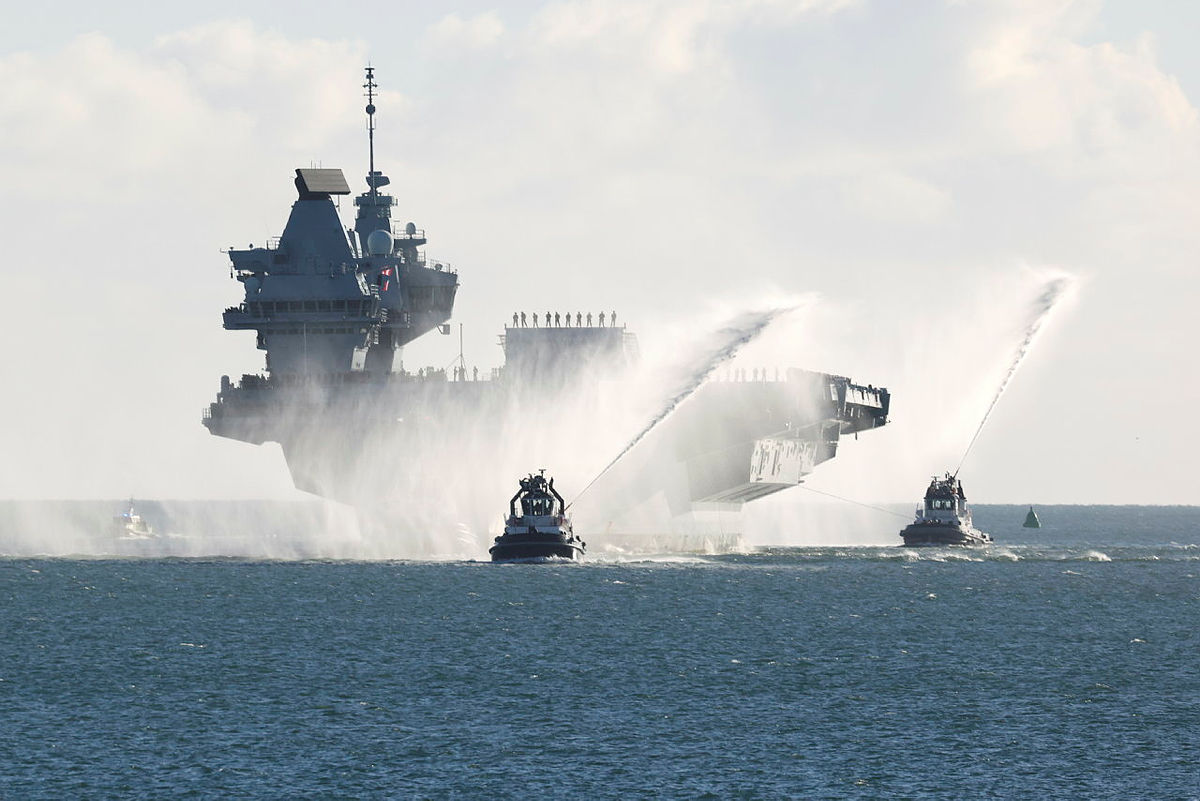
The Indo-Pacific phase of Highmast involved extensive cooperation with regional forces. Exercise Talisman Sabre in northern Australia formed the centrepiece. It was followed by a joint activity with the United States and Japanese maritime forces. Across the deployment, the strike group exercised with nine different carrier groups.
809 Naval Air Squadron, known as The Immortals, deployed for the first time aboard HMS Prince of Wales. Commander Nick Smith said the squadron’s workload reflected the scale of the deployment. “The range and breadth of the activity the squadron have been part of is truly amazing,” he said. He noted his team supported the full operating capability announcement and maintained performance levels across a variety of conditions. The squadron operated in daylight and at night and launched from both British and allied carriers.
Cooperation extended beyond aviation. Ships from Australia, Canada, France, Italy, Japan, New Zealand, Norway, Portugal, Spain and the United States joined the task group at various points. Some contributed directly to escort duties. Others participated in exercises or replenishment operations. These links formed a consistent rhythm of interoperability throughout the deployment.
Life at sea offered occasional breaks from routine. Some sailors climbed Mount Fuji during shore leave. Others visited ports in Singapore and South Korea. The strike group also held a memorial service above the wreck of the Second World War battleship HMS Prince of Wales in the South China Sea, linking the modern deployment with its historical namesake.
A jet recovery in India required a carefully coordinated engineering effort. The passage through the Bab el Mandeb took place under increased alert due to regional missile activity. The task group maintained routine watchkeeping and flight operations despite these pressures.
As the ships entered Portsmouth, the atmosphere shifted from operational focus to the practicalities of docking and disembarkation. Families waited along the harbour walls. Children held signs and flags. Sailors lined the deck rails, scanning for familiar faces. Once the first lines were secured and the gangways lowered, the crews stepped ashore to cheers that carried across the port.
Operation Highmast delivered a long and varied deployment for the Royal Navy and its partners. It strengthened UK cooperation with Indo Pacific and European allies. It provided the practical proof behind the full operating capability announcement for carrier strike. It also gave the crews experience in real conditions and at significant distance from home.
The ships now return to routine maintenance and post deployment assessments. For the people who served on them, the homecoming offers a break after long separation. For the Royal Navy, the completion of Highmast marks a step in the continued development of its carrier strike capability.




Well done your country is proud of you all.
welcome home boys and girls. enjoy your homecoming and a well deserved rest thank you.
Very proud of all our brave lads and lasses in uniform.. Keep the course raised good people and have a great Christmas. God bless you all🇬🇧🇬🇧🇬🇧🇬🇧
Quality
there’s nothing to beat a Pompey return from a long time away from home
Its a fantastic feeling when you return from a long deployment. Channel night the night before is also always fun 🍻 Years down the line you look back on these trips and remember all the good times. And quickly forget the low points.
A very successful cruise, showing why the RN is so impossible for the UK.
One bit of good news worth mentioning is that it’s seems shipborne vertical rolling landing has not been cancelled.. it has instead been realigned with other complex weapons programmes..
I meant to say important.. blasted autocorrect on phone.
The point has finally been made, despite the detractors and the shortcomings. The UK can do this, an option for HMG if the need arises.
Assume the QEC will rightly remain in the Euro area for the n3xt 3 years or so before the next sortie?
Great summary Daniele!
Hi mate. Cheers.
Yep if we can put 24-36 F35s in the high north..that is a huge problem for Russia.. what most people also forget is that those enablers for everything else also massively enabler a carrier battle group.. for the UK especially in the high north.. a UK carrier in the high North could be permanently supported by strategic air to air tankers, strategic AEW aircraft ( wedgetail) and P8s..that would essentially make it an impossible nut to crack.
I think it’s one of the reasons the UK needs to invest in strategic air capabilities such as more wedgetails, P8s and tankers.. because of our sovereign basing essentially a UK carrier battle group could be followed around most of the globe by strategic air AEW,ASW, ISTAR and tanker support which is far beyond anything you could organically put on a carrier.. a wedgetail is profoundly better than any Tactical based AEW.. most of these platforms could manage 24 hour sorties and cruise at 600mph.. but you need the carrier as the linchpin as its tactical air allows air dominance.
Presumably POW will have a lengthy lay off now. When will QE be operational after her current refit?
And what now for Dauntless and Richmond?
No idea.
There is an article on Navy Lookout suggesting that the QE will in in the dry dock in Rosyth for 7 months. I gather she sailed from Portsmouth to Rosyth in the middle of July, but not sure when she actually went into dry dock as she was doing some sea trials and FOST work on her way up to Rosyth. Assuming early August she should be coming out of the dock March April time…
Cheers CR
Congrats to the crews of both Dauntless and Richmond, but their ships are likely to have very different futures.
We know that at some point in the first quarter of next year, Richmond is scheduled to undergo a hull inspection, which will dictate if it will be able to undertake its next full refit or if that will be too expensive. Either way Richmond will be removed from active duty, either for some years or permanently. We don’t know if Richmond will undertake any short deployments before that, but given the long deployment she’s just come off, I’d doubt it.
Richmond was commissioned over 30 years ago. Since the last refit Richmond and her crew have worked exceptionally hard, giving great service against the Houthis in the Red Sea, conducting FNOPS in the Taiwan Straits, testing NSM, and Richmond was the only ship to undertake both major carrier deployments to the Far East.
Dauntless, OTOH, is less than 20 years old and isn’t due for a major refit, although I expect she’s due for a wash and brush up. There were rumours she’d be given NSM during a service period in 2023, which didn’t happen. So I wouldn’t be surprised to see Dauntless getting NSM next year. I’d expect Dauntless to serve for many years to come.
Ok. Thanks Jon and ChariotRider for you helpful replies.
POW will undertake post deployment maintenance in Portsmouth. But she could still deploy at 48hrs notice.
Good to know.
The article states that this homecoming is ‘is the Royal Navy’s largest homecoming in a generation’…
That’s rather inaccurate because in 2021, that Carrier Strike Group comprised HM Ships Queen Elizabeth, Defender, Diamond, Kent, Richmond, an Astute Class SSN, RFA Tidespring and RFA Fort Victoria.
2021 was COVID era so the docks were rather sparse…
Disagree, hundreds at HMS Kent’s homecoming and no restrictions.
Wonderful day !
Pleased to hear it!
Great work, and I’m looking forward to the next one. Four years is a while though, so I’ll summarise what we can expect over the next four years in the run up to the presumably Indo-Pacific CSG29 deployment.
Looking at the elephant in the room – the availability of a submarine to accompany the CSG should have increased significantly by this time, and hopefully with Agamemnon joining the fleet, at least one boat will be able to join the QE in her journey eastwards. I’d be very interested to learn how measures were taken to combat the trailing by PLAN submarines that undoubtedly occurred during this most recent deployment – presumably a combination of the British and Norwegian ASW frigates, and perhaps also an allied submarine (an American Virginia or LA).
Integrating unmanned systems seems to be a goal universal across the British military – by 2026-7, the QE-class will test a jet-powered, unassisted takeoff UCAV as part of Project Vanquish. Saab and GA are also pushing their MQ-9B AEW system quite fiercely (though I expect to see Crowsnest be extended in service), and by all accounts, drones will form a significant part of the air wing of CSG29.
The escorts will also have seen major changes. The first Type 31 and Type 26 frigates will have entered service at this point, and I assume at least one those will accompany the group. The destroyers will have received their PIP, their CIP, their SVE and their DragonFire in varying stages as well, all boosting CSG capability.
The major issues that will of course remain are the lack of an anti-ship missile on the F-35B, which won’t arrive until CSG33, and the FSS ships that are similarly delayed. By all accounts, the CSG that enters the Pacific in 2029 will be Britain’s most capable expeditionary force is quite some time, yet it’ll be at least eight years before the UK can deploy a fully-rounded CSG to the Chinese sphere.
I thought an Astute was part of this group, that was always the plan
Didnt get past Gibraltar, we only have 1 at sea thanks to issues.
Exciting times ahead then. Just hope I will still be here to see it happen!
So whats going to happen to get both carriers up to fighting status?
Since only one carrier has enough jets and helicopters to go into combat, is the other one essentially going to become a drone carrier?
Not a bad thing, you could fit quite a few drones on one of these things
No, they were never intended to operate at the same time, two were built to maintain availability of one at all times.
That said of course if both were available and able to operate and were needed then 12 to 16 F35B on each rather than 24 to 32 on one would be a good thing.
The only thing I would like to see is more training with in barked apache helicopters, just to give more options if the situation arose for the need of an LPH. With RFA Argus’s future more in the melting pot and no MRSS for some time, it might be a good valuable training exercise?
That’s OK in peace time but when you go to war…. Well you need everything now and maybe in two different seas.
Alway I thought the long term plan was to only have one carrier generally available? Plus we don’t have enough escorts to defend two carriers…. We could only manage two for the POW deployment, and the numbers are still declining…
It has been said time and time again that the RN and Mod have stated that only one carrier will operate at a time, rotating from operational or in maintenance so. I’m not sure why this question keeps coming up? Unless we are at war then probable never as this has never been the intention unless to can provide evidence this status has changed.
Just curious, since I find it pretty sad that a nation that has two carriers can only operate one at a time.
Doesn’t exactly give off an image of strength to our enemies now does it?
I’m starting to think you might be a troll … If both are operated together there will be a day when 0 are available due to maintenance .
So no it’s not sad it’s is extremely sensible. how many carriers does Russia have? 1 this when it is in for repairs they have 0 available, France is in the same position.
With 2 ONE is always available that is the whole point of having 2 and not 1.
If the royal navy had proper funding, it would be able to run multiple carriers, like it did back in the cold war and the 90s.
Oh and I’m a troll because I have a different opinion? Not how the way the world works. Grow up snowflake 😊
Different opinion? Lol
In the cold war we ended up with one broken catobar carrier for about a decade so were actually doing better in that regard.
Reply was to redshift. Sorry. How many di we have in Ww2 mate, if not being repaired all at sea with escorts and squadrons on deck… So you say Russia but that’s not the whole story is it?.