

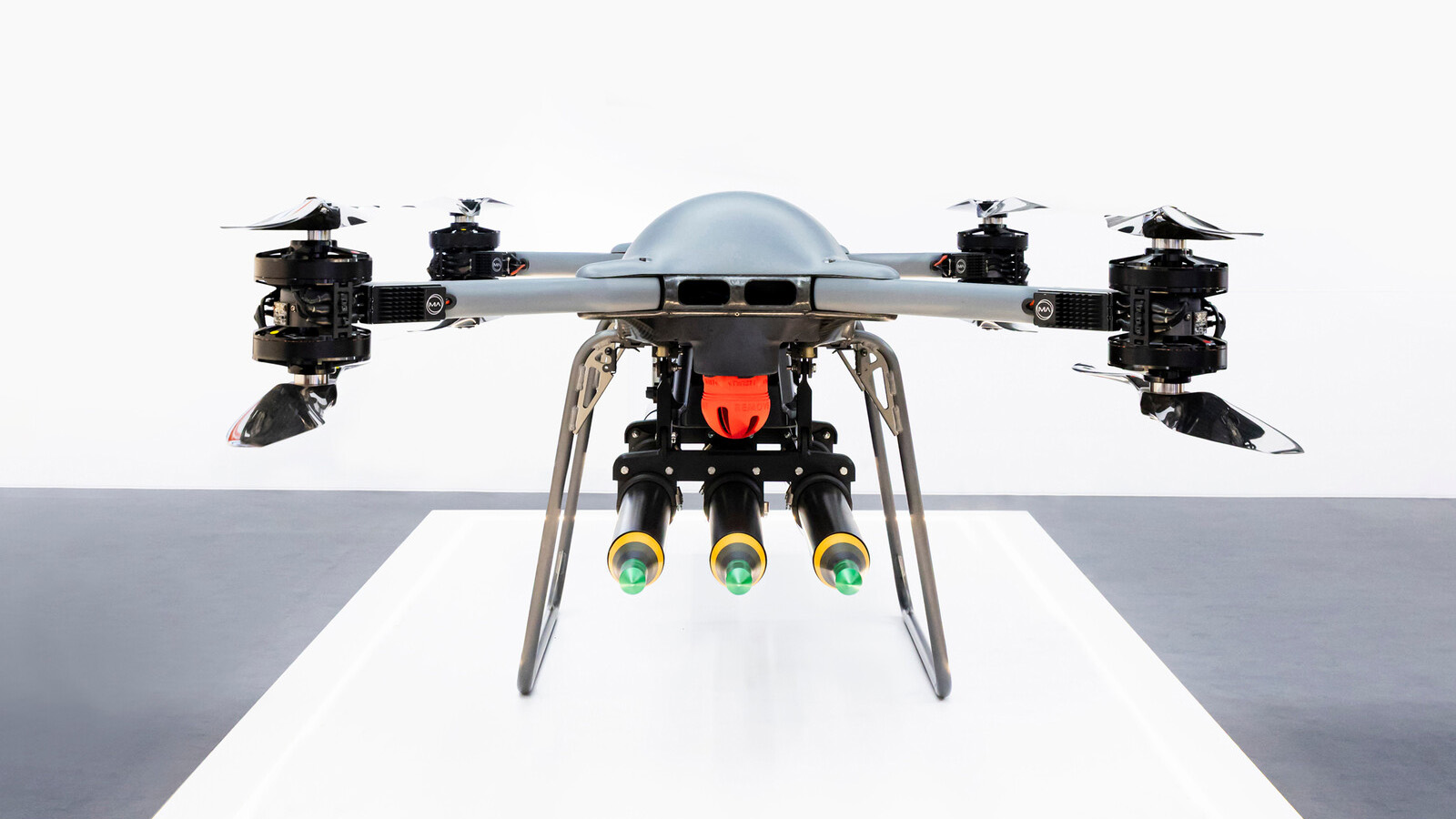
A modified version of the Malloy Aeronautics T-150 uncrewed air system has intercepted multiple one-way attack drones during an American experiment in Florida, firing laser-guided rockets from a three-pod launcher and engaging several targets in succession without landing or reloading, according to BAE Systems.
The trials ran from 21 to 25 September at Eglin Air Force Base during the United States Office of the Under Secretary for Research and Engineering’s Mission Capabilities Joint Readiness Experimentation exercise. BAE Systems conducted them alongside SURVICE Engineering, its Maryland-based partner, using BAE’s own APKWS laser-guided rockets.
Thomas Lancashire, Head of UAS Business Development at BAE Systems’ FalconWorks, said: “Our customers are facing drone threats right now, so we’ve worked at pace with our partners to move from concept to a proven system, which can engage multiple targets in a single mission.
“Military technology is evolving faster than ever and it’s vital that effective capabilities reach those who protect us as quickly as possible. In today’s environment, the speed at which we deliver equipment can be just as important as the system itself.”
Gregory Thompson, President of SURVICE, said: “Supporting the warfighter has been at the core of SURVICE’s mission since its founding over 45 years ago. Bringing the TRV-150 to the US warfighter and now adding APKWS as a proven, precise, and cost-effective capability to our TRV-150 UAS platform is exactly the type of innovation SURVICE was designed to deliver.”
The aircraft is a heavy-lift electric multirotor built by Malloy Aeronautics at Maidenhead in Berkshire, a company BAE Systems took a stake in during 2019 and acquired outright in 2024. The version flown in Florida, designated TRV-150, was adapted to United States Army requirements by SURVICE Engineering, and the APKWS modification kit was developed and integrated by BAE Systems FalconWorks.
APKWS is a laser guidance kit that converts the seventy millimetre Hydra rocket into a precision weapon, built by BAE Systems in New Hampshire. United States Navy and Air Force fighters used it against Houthi drones over the Red Sea in 2024 and 2025, at a unit cost well below that of an air-to-air missile.
BAE Systems said the September trials build on the first firing of a precision munition from an adapted T-150 in July last year, which was a single shot, and that the launcher used in Florida is a production-ready three-pod system.
The T-150 has already served with Britain’s forces in the logistics role. The Royal Navy cleared the Malloy T-150 for front line use and conducted its first drone supply run between warships, and the type carried stores between ships throughout the Prince of Wales carrier strike group’s eight-month Indo-Pacific deployment last year, which this publication covered when drones launched from the British carrier in the Pacific.
Malloy also builds the larger T-650, developed with Royal Navy and Defence Equipment and Support involvement as a heavy-lift aircraft able to carry loads including torpedoes.
BAE Systems said the team will now look to extend the T-150’s use in this role to the maritime environment. The company noted that the imagery released with the announcement comes from an earlier trial.





Welcome news, but why has it taken so long? And why in the states and not here? Are these being used in ukraine?
The article explains why
I’ve read the article again but can’t see the why. But I guess it’s because some moron started a war without any understanding of the consequences or thought about what would be required to win that’s if he ever decides what counts as winning. Now the US is throwing money at counter drone tech. I guess that’s the reason why(didn’t see that in the article). Shame he wasn’t nicer to Zelenskyy he could have got counter drone technology before starting his maniacal war. If anyone else cares to take the time to answer my question I would very much appreciate it.
(We seem to fundamentally agree Chris)
Probably because APKWS is US BAE.inc Ip and BAE have just figured a way to flog more to the US..
Read it twice and can’t say it specifically does. My presumption however is that the US military notably already using the drone adapted to their preferences, have seen the potential for such an adaptation combined with the fact that the APKWS and its Bae smart laser adaptation is a US development while Bae clearly are licking their lips at a sale to the US armed forces far greater than any uk equivalent. So not an actual answer but a pretty convincing reason no doubt. One can equally presume that the UK military (or its political Masters) haven’t pushed for it, couldn’t find the money or urgency (probably stuck in rounds of discussion documents) or simply preferred to let the Americans pay for the donkey work.
Thank you for answering my question – and I think you are right, though my understanding is that the APKWS is a British development of an American rocket for an American program. FalconWorks in UK designed the brain laser and control surfaces of APKWS. The pre-existing rocket was American. The Americans paid for the development of it so we now have to buy this from America. My worry is that although the Malloy is a British drone, and the APKWS has British smart tech, and the launcher is a joint venture we will end up having to buy from the US again, all because we didn’t stump up the money early on. Although we do have lmm.
We were never going to pay for such a system development as we had LMM already.
But it’s nice to have other options for what is a relatively minor weapon system.
Laser guided weapons are all but impossible for an export nation to control once sold.
However, APKWS (Hydra) is fast jet cleared, whereas Martlet is not. Martlet is the better weapon, but is more expensive that APKWS, Martlet = $50k, whilst APKWS = $25k. APKWS is also being trialled on Typhoon, as it was successfully operationally demonstrated on A10, F15, F16, and F18s against Houthis and Iranian drones. It is a cheap but effective means of countering drones, where an aircraft easily carry 7 or more. The F16 in particular, has been fitted with a three pods fitted to one pylon, i.e. 21 shots per pylon. This arrangement has also been seen on Ukrainian F16s.
Nice one! An excellent and cost effective development. More to come and hopefully at pace.
Like to see this or Martlet fitted to the Jet Banshee.
Well a couple of these on each each RN and RFA vessel, even the rivers would make for an effective system against surface and airborne drones and the ability to deliver some kinetic bangs risk free out past the radar horizon is not to be sniffed at.. even if they are not big bangs.
What was lazing the targets? And, what were the speeds involved?
A counter to this would be an “intelligent” maneuvering drone that would make lazing difficult. A drone that could maneuver once laser energy is detected or maneuver in the terminal phase.
We should pair up Malloy T150 with Sea Venom. Imagine a drone swarm coming at your ship each armed with an anti ship missile. None of the current defence technologies could do much about that one.
Sea Venim weighs 120 kg. The max payload of the T150 is 68 kg.
The larger T650 could carry two Sea Venom missiles out to about 35 km.