

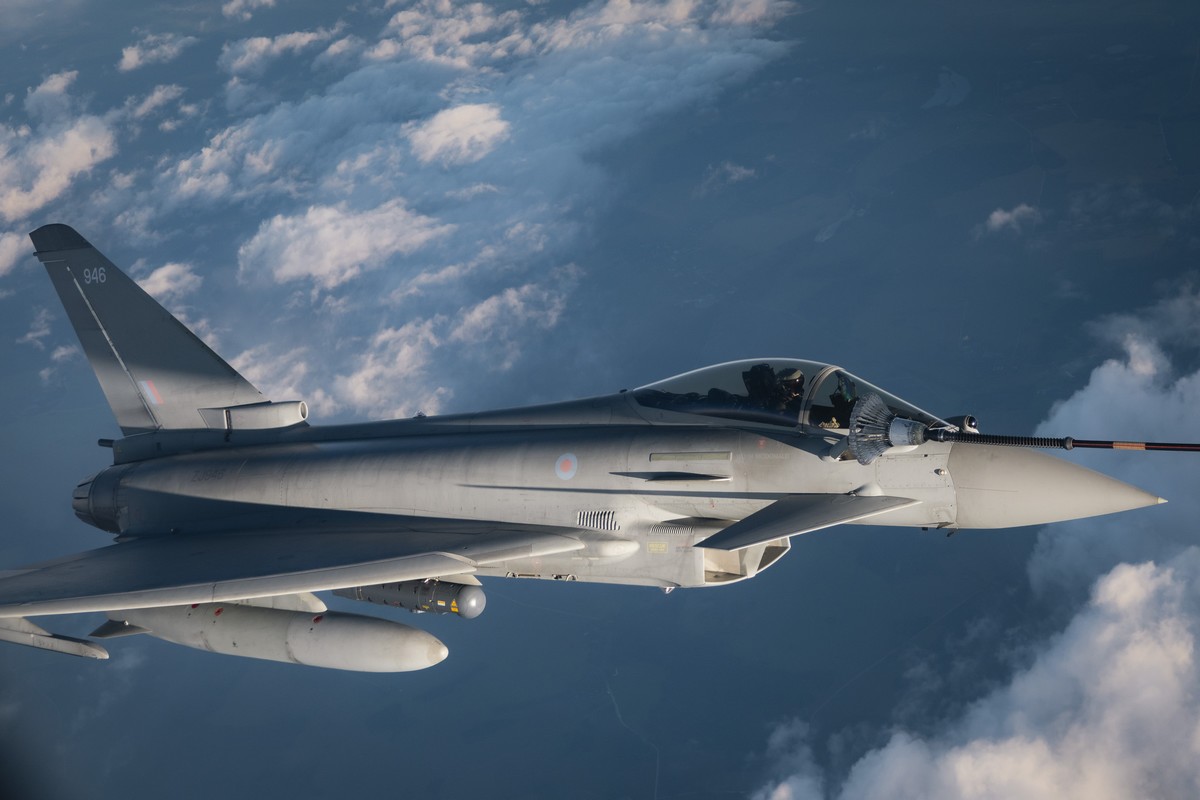
Royal Air Force Typhoon fighters have taken the lead in a recent round of NATO Flexible Deterrent Options training, a series designed to prepare Allied air forces for coordinated operations across the conflict spectrum.
According to the Royal Air Force, FDO activities are intended to strengthen the Alliance’s ability to respond quickly to emerging threats, with an emphasis on readiness, coordinated decision making and the integration of air and ground based defences. A central element is combining fast jets with surface air defence networks to create a layered air security posture.
This iteration involved Italian and Spanish Typhoons working alongside the RAF, supported by a Spanish A400 providing airlift and a UK Voyager from 10 Squadron delivering air to air refuelling. Officials highlight the exercise as a demonstration of multinational air power and the ability to sustain complex air operations across dispersed locations.
Wing Commander Pearson, Officer Commanding IX(B) Squadron, said in the RAF’s release “Participating in NATO’s Flexible Deterrent Options training allows the RAF to demonstrate the exceptional capability of the Typhoon and its integration with NATO’s wider air and ground-based defence systems. Launching from multiple locations, and combining in a complex mission scenario, the involvement of Italian and Spanish Typhoons, the Spanish A400, and the UK Voyager further highlights the strength of NATO’s collective air power and ability harness it over great distances. These exercises are critical to ensuring we remain ready to respond to any threat, while reinforcing the strength and unity of the Alliance.”
NATO frames FDO training as part of a broader set of military, diplomatic and economic tools designed to deter aggression and maintain stability. For the RAF, the latest drills also reinforced interoperability with other European air forces and underlined the importance of sustained multinational coordination during high tempo operations.





So few Typhoons 🕵
After the tranche 1s disappear it will be 101 FGR4s . That’s for 6 front line squadrons, the joint squadron, operational conversion unit, Falklands flight and TES squadron.. as well as the typhoon pool and sustainment fleet.
It’s not great to be honest.. if your running 12 jets per front line squadron that’s 72, the OCU needs 12 so that is 84, the Falklands flight is 4 so that’s 88, the joint squadrons runs 6 for 94 and the TES needs about 6 as well for 100.. that essentially leaves zero jets for the pool or sustainment fleet.. and you should have about 20% for this so that means in future there will only be about 80 jets for squadrons…. And we know that in 2014/15 a RAF frontline squadron would have 12-13 FGR4s and 1-2 T23s for 14-15 jets.. by 2020/21 that was down to only 10-11 jets… it’s likely that squadron jet numbers are now looking more like 8-9 for the 6 front line squadrons.
I simply cannot see the RAF running 6 front line squadron’s and keeping the joint squadron and Falklands flight without 20 more typhoons.. I suspect in the new defence investment plan we may see frontline typhoon squadrons cut to 5.. and I would also suggest that they will not renew the agreement for 12 squadron beyond 2027 as that would free up some jets to cover the Falklands flight tranche 1s that will need replacement.. so beyond 27 I would bet 5 front line squadrons ( 60 jets) Falklands flight (4), OCU (12) and TES (6).. which could be managed with 101 FRG4s.
As an aside today I was researching the little lost typhoon FRG4 that never few…. One of the tranche 1 typhoons was placed in storage strait from delivery from the manufacturer and never left, the RAF never used it ever.. it only ever had 5 hours flight time on the aircraft.. probably the single most expensive capital cost per hours flown of any RAF aircraft ever… I assume it’s now been scraped along with all the other tranche 1s..
Reply
Thanks Jonathan I guess we are were we are sadly 🍺