

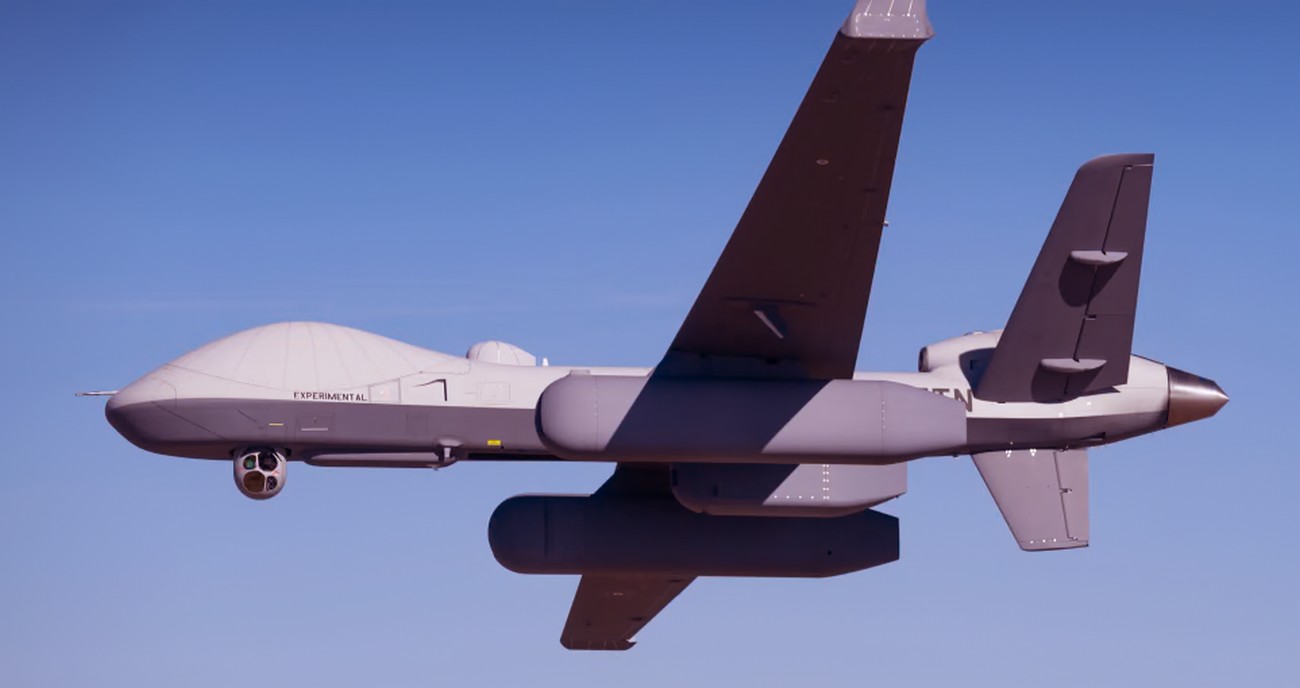
General Atomics and Saab have flown an airborne early warning radar on an uncrewed MQ-9B, the same aircraft the Royal Air Force operates as Protector, tracking fighter jets and commercial aircraft along with maritime targets at long range during months of testing, according to the companies.
The flights used a Saab LoyalEye radar carried in payload pods on a General Atomics MQ-9B operating from the company’s Desert Horizon facility in southern California, and demonstrated simultaneous tracking of several airborne and maritime targets, including multiple instrumented fighter jets acting as targets.
David Alexander, president of General Atomics Aeronautical Systems, said: “This has been one of the most highly anticipated flight tests we have performed. The level of customer interest in AEW capability on MQ-9B throughout the world is extremely high. It just makes sense.”
Carl-Johan Bergholm, head of Saab’s surveillance business area, said: “This flight test underscores Saab’s commitment to evolving airborne early warning capabilities to meet future operational needs. LoyalEye complements existing capabilities by adding flexibility, extending reach, and enabling a more efficient use of resources in demanding environments.”
Airborne early warning has always meant a large crewed aircraft, because the radar, the operators and the fuel to stay up all demanded size, and the number any air force can afford has fallen with every generation. Britain is buying three Wedgetail aircraft to replace a Sentry fleet that once numbered seven. The Royal Air Force will hold one of the smallest early warning forces of any major air arm.
Putting the radar on an uncrewed aircraft changes the arithmetic of that problem, because an MQ-9B can stay airborne far longer than a crewed jet, costs a fraction as much to buy and operate, and risks nobody if it is lost. What it cannot do is carry the battle management staff who make a Wedgetail more than a big flying radar, so the companies describe the command and control function being performed elsewhere, on the ground, on a ship or aboard an existing crewed aircraft, etc.
Protector entered Royal Air Force service at RAF Waddington this year, replacing Reaper, and ministers confirmed this month that eleven of the sixteen aircraft on order have been delivered. The type is certified to fly in civil airspace. Earlier armed drones were not, and that certification is why Protector can fly over Britain.
General Atomics is also developing a short take-off and landing version of the MQ-9B intended to operate from aircraft carriers, a configuration the Royal Navy has watched closely as it works out what flies from HMS Prince of Wales and HMS Queen Elizabeth alongside the F-35B.
Saab’s existing airborne early warning radars fly on the GlobalEye, based on the Bombardier Global 6000 business jet, which Sweden operates and which has been sold to the United Arab Emirates and ordered by Denmark.








First off, increase the Protector buy to 40 airframes.
Buy the STOL maritime kits and procure AEW and Sea Guardian load outs for RAF and FAA use.
Seems like a no brainer to me….
I would be interested to see the carrier limitations of hauling around the heavy radar pods from a QE Class Carrier.
Reported £30 mill plus per airframe, it’ll be a big buy in the current environment. Would need a minimum of 5 per carrier for aew and 10 for cap
No CAP use Brom, that will be the job for the CCA (if the FAA ever sees one)…
That’s the problem I can’t see a cca mate. They’ll bluff then do bugger all
It’s a question of priorities Brom, the Captor E upgrade for Typhoon is a reported £70 Millon per airframe!!!
A ridiculous waste of tax payers money.
I would argue that 2 additional protectors offer an order of magnitude more bang for your buck, than a single upgraded Typhoon.
Upgrade 36 Typhoons instead of 40 and buy 8 more Protectors, no brainer…
What have you been drinking mate?
What usually happens is they’ll use the existing number of frames, for multiple tasks, leaving too few for the roles and wearing them out. And you want more????!
I agree, though maybe getting to the original 24 is more realistic, a FAA Sqn of 8.
Morning mate, I know, an old man can have his dreams…
24 would be a good step in the right direction, in fact, buying 3 more Poseidon and basing a number of Sea Guardians alongside them to do the patrol grunt work would massively increase our Maritime patrol capabilities.
But you are correct, they will stick to 16, they will then under fund their support and spares inventory and fly the arse out of the small airworthy fleet. Same as mate, same as…
As we’ve discussed before the planned Protector force is (whisper it) overkill for the Reaper role it is replacing. There are more airframes and they are individually much more capable.
There is therefore room to steal a few of the drones for roles closer to our current doctrine. The Tory ‘Britannia Shield’ air defence concept proposes using just 6 of the 16 MQ9B in this exact configuration to provide flexible radar coverage over Britain itself, which seems sensible to me and still leaves spare MQ9 AEW capacity for overseas deployment.
If GA get a move on with the STOL variant a FAA buy would also be very helpful in the long term. For that I would suggest another 16 airframes, split between 6 AEW and 10 MPA of which half of the fleet would accompany a CSG.
People aren’t interested in capability and what individual assets can do in this day and age. The just want 1980s numbers.
The unmanned shift is generally an opportunity to return to much greater numbers than previously but in the case of MQ9B AEW the role falls outside traditional AWACS and has a different set of applications. Buying them in huge bulk doesn’t really make sense.
Robert, nobody is calling for 36 Fast jet squadrons!
Anyone with any sense realises however that we blatantly require more than a wholly unacceptable 9!!!
We need a fast force of about 16 squadron, RAF/ FAA to be able to defend UK airspace and have a ‘modest’ offensive capability.
We have allowed our capabilities to degrade to the point that it would be an all out effort to simply protect UK airspace in the event of a War.
Typhoon FGR4 and F35Bs have more air defence capability and capacity to overwhelm any Russian air threat. We do need more and more will come in the shape of loyal wingman. CCA, that will have 80% of the capability of Typhoon and F35 as reported. Typhoon is also getting a massive capability upgrade and more F35s will be ordered. And Tempest further down the line. 50 Bear bombers are not coming over the North sea. Russia just doesn’t have the capability. We are part of a very large network of NATO fast jets and air defence radars, networks and intelligence. The RAF air defence capability today far exceeds what we had in the 80s and 90s. 150 Typhoons and F35s can do what 350+ Tornados could have a achieved. And we are surrounded by friendly nations with F35s, Typhoons, Rafal, Gripens, F16s, F15Es ect. Which is why for decades we exercise relentlessly with allies. Every campaign since the first Gulf War has been with allies. Thats the whole point of NATO. I’m not defending cuts. But capability has come on a very long way.
Agree we must move on from Crowsnest and searchwater radar. The radar dates back to the old Nimrod and is now old technology. The SAAB radar is likely AESA and able to cope witg modern targets. The drone platform is fixed wing and is likely to have a higher operating altitude and better endurance.
The platform has the following stats…The aircraft can remain airborne for more than 40 hours and operate at altitudes of up to 40,000 feet.
This will be a great platform for the FFA and RAF and supplement E7…
The radar is based on the S-band (2 to 4GHz) Erieye-ER radar, which is a gallium-nitride (GaN) based AESA radar. With the STOL wing kit it will have a shorter duration and not be able to reach the same altitude. This is due to having a thicker aerofoil for STOL and shorter wingspan needed for carrier operations wing. Both of which are counter intuitive for high aspect ratio wings used to minimize induced drag and boost fuel efficiency. Although it is still expected to be capable of 20 hours plus and cruise around 30,000ft, which is more than good enough when compared to the Merlin equipped with Crowsnest, which is about 5 to 6 hours.
Will it be a great platform, no. But it will be good enough and better in some areas than the Searchwater radar. Due to the sizing and packaging limitations of fitting an S-band radar to the MQ-9, it won’t have the same performance as when the radar is fitted to the Bombardier aircraft, i.e. the Globaleye. The new Erieye-ER radar fitted to the Globaleye has a published detection range over 400km. Loyaleye is packaged into a much smaller pod (approx 1/4 the size), so the antenna array is a lot smaller. Therefore compared to the full fat version its fidelity and resolution will be a lot less. As there’s less transmitter-receiver modules (TRMs) in the array to generate and shape the beam.
I do expect its detection range to be greater than the Searchwater regardless. But when looking for say periscopes it will struggle, due to the naturally wider beam picking up more surface clutter. Admittedly this can be fixed today by modern filtering and signal processing. But its not always guaranteed.
Wouldn’t a jet powered variant support a greater payload and have a higher ceiling for AEW but maybe not as long an endurance?
Yes, it would also have a longer takeoff run however which would mean you wouldn’t be able to use it on carriers
I don’t understand why never this on the Global Hawk, 30+hours endurance 10K Mile + range, a flight could operate from Uk/ASI / AKT, BIOT and provide cover over RN CSG ( flt of 3 or 4) ywould have 24/7 coverage no weather limitation due to being unable to land/TO. another 10/12 you could have 24/7 cover over GIUK & North Sea?
Because they cost £200m each. Plus costs of designing pods, and still needs humans to handle control.
Google says they have 40,000 flight hour life or 20 years. Commercial airline based platforms would be 100,000 hours plus.
I think they have taken combat losses. Less danger in shooting down someone else’s unnamed platform.
Cost alone for us would be a no chance?
Global Hawk is a pretty unique platform, but as David says its purchase cost approaches or exceeds that of manned aircraft with less performance but much more useful payload capacity and lower operating costs.
I have raised this on a number of occasions and i truly want the answer to be positive, however drones have a limited power generation capacity. The MQ-9B generates a reported 45kVA, this leaves probably somewhere in the region of 30-35kVA for mission systems. This isn’t sufficient for a long range radar system and certainly not one that can operate in contested environments (jamming/low obsverability airframes etc).
I love the concept, i really do but they are going to need an awful lot more power to make this viable.
It has an auxiliary power generator in the centre
Any idea of the output? I have no idea with regards the capability of Aux power units. I assume turbine driven and therefore somewhat limited by airspeed.
The NGO pods on F18 Growler have RAT turbines that gen 82kw.
Google says Erieye requires 60 KvA for its radar and mission systems.
That may as well be in Greek for me but wouldn’t auxilary power gen be sufficient?
Erieye average output is quoted at 60kVA but the peak will be significantly higher. That said, you won’t be getting that scale of unit on the MQ-8B anyway.
Thanks for the info on the RAT turbines, it’ll be interesting to see what capability the unit fitted here is capable of. If they can find something capable of 60kVA then I’ll gladly celebrate as this should power a useful scale of radar……. now can we have some more please? 6-8 split between the FAA and RAF would do nicely.
It was reported back in May the the amount of power generation on this prototype would only allow one pod to be operational at a time.
I’ll have a trawl back, thanks Grinch.
Technically its not a major problem, as you can fit a larger second generator to the MQ9’s engine. The Honeywell engine on the MQ9B already uses two generators. However, it is expected the Saab Loyaleye radar requires a lot more power. In the past, MQ9s have been fitted with a separate underbody (centreline hard point) generators when the aircraft is used for EW missions. All the images of the MQ9 fitted with Saab’s radar, shows it with a centreline pod, could this be an additional generator?
There is a bigger problem with the MQ9’s airframe. In that it is too small to carry the optimal size for a S-band AESA antenna array. The traditional Erieye radar is fitted to the upper surface on an aircraft. On a MQ9 if fitted in the same manner, it would inhibit and block the satcom antenna’s view. Plus the MQ9 engine is fed with an above fuselage intake, so the airflow would need to be very carefully modelled and checked to make sure the antenna doesn’t interfere with it. Hence why the radar is split into port and starboard looking underwing pods. However, due to the MQ9’s low wing height, centre of gravity and departure angle, the pods can’t be scaled to carry the same number of transmitter-receiver modules (TRMs) as the full fat version. By using less TRMs, the beam generation and shape are compromised, making the main beam wider and the detection range shorter.
Skimping on numbers to protect the carriers is a bonkers false economy and ignores the lessons of the Falklands. At 30 million a piece they are cheap to protect a multi billion asset,
To be fair the carrier would likely be out of range of a wedgetail operating 24/7. But agree we need something when crowsnest goes out of service, a capability gap should not be acceptable post Falklands
Agreed. Pretty standard for HMG at the best of times.
First and rather obviously, 2 more E-7 airframes are needed. We already have 5 radars, and 5 is the minimum to have a 24/7 coverage.
After that, our protector numbers are somewhat overkill, both and better aircraft than the reaper. Surely some of them can be converted into the Sea guardian and AEW versions and an extra order for some of those versions.
Because of mistakes in the carrier this is realistically our only way of getting fixed wing AEW, and at least three on board a carrier will be needed to maintain a constant coverage, 4 if we ever do actually fill up the airwing space on board. So probably at least 8 STOL AEW versions. A couple STOL Sea Guardians wouldn’t be a bad shout for the carrier either so again four of those. And then the RAF will want some regular Sea guardian and AEW versions of each to complement the Sentry and Poseidons, maybe another 5 of each.
The two E7 radars under a tarp in a Birmingham lockup have without doubt been flogged off cheap for Uncle Sams two prototypes being assembled in Birmingham jacob.
A decent sized fleet of 40 MQ9B ( Carrier STOL/ Sea Guardian/ Vanilla/ AEW, all reconfigurable as required) would have a disproportionate effect for the size of the fleet, they would be a ‘massive’ force multiplier.
I agree that there is now almost no chance of the RAF getting more Wedgetail’s now that the DESA has apparently – after 5 years of effort – managed to flog off the two “spare” Northrop Grumman MESA radars. Another penny wise but pound foolish decision to add to the very long list of expensive MOD procurement disasters.
Whats the source for the sale of the 2 UK E7 Mesa radars to the USAF? There has been some scuttlebut but nothing I have seen as defintive.
Well, we had two gathering dust in Birmingham, the MoD have confirmed that there will be no more for the RAF, there is a facility and an engineering team in Birmingham and two US green airframes arriving….
So….
It cannot be understated enough, that the performance of the MQ9 AEW platform will be significantly less, when compared to a “proper” AEW platform such as the E2D Hawkeye, E7 Wedgetail or even the Globaleye. To put this in context, to match a Hawkeye or a Wedgetail, you will need at least three MQ9s to cover the same area. If I remember correctly, Crowsnest only covers about 1/8 of the area a Hawkeye can cover. Which will have a factor in how many MQ9 AEW platforms the carrier carries.
There are a number of significant areas where the MQ9 being used as an AEW platform will be classed as a bronze standard. Mind you Crowsnest even though it has some really good attributes, is not even close when used to control 5th or even 6th gen platforms. Using Crowsnest is a serious compromise to carrier operations when paired with a F35B, even when using AMRAAM AIM-120D, but especially if eventually its equipped with Meteor. As the published detection range can’t match the effective range of AMRAAM along with how the F35 would be operating passively and some distance ahead of the AEW platform. I suspect Loyaleye, will have a detection range further than Crowsnest but a lot less than Erieye-ER, so somewhere in the mid 300km ballpark. However, this is probably against a 4th gen fighter with a load of ordinance under the wings, not a stealth aircraft and certainly not a cruise missile.
The problem is, will Loyaleye have enough detection range to keep the F35B out of harms way, whilst still being able to detect threats, and being capable of directing the F35B’s air to air weapons against those detected threats?
I could spin it another way – two (UK) radars used to prove the US E7A and NG then open a new MESA production line for the USAF order which will be significant probably well over a dozen airframes. The USAF will probably keep one prototype as test aircraft for future upgrades , as they did for the E3A fleet. They then might offer one of the test aircraft to the RAF . If the E7A doesn’t meet the USAF requirements (unlikely) there will be two unwanted airfarmes which again they could offer to the RAF after removing the US Eyes Only equipment. The RAF must know that a fleet of only 3 aircraft will not meet any extended 24/7 multiple station keeping requirement at distance from the UK mainland even with AAR (some Voyagers are reported to be modified to operate the boom).