

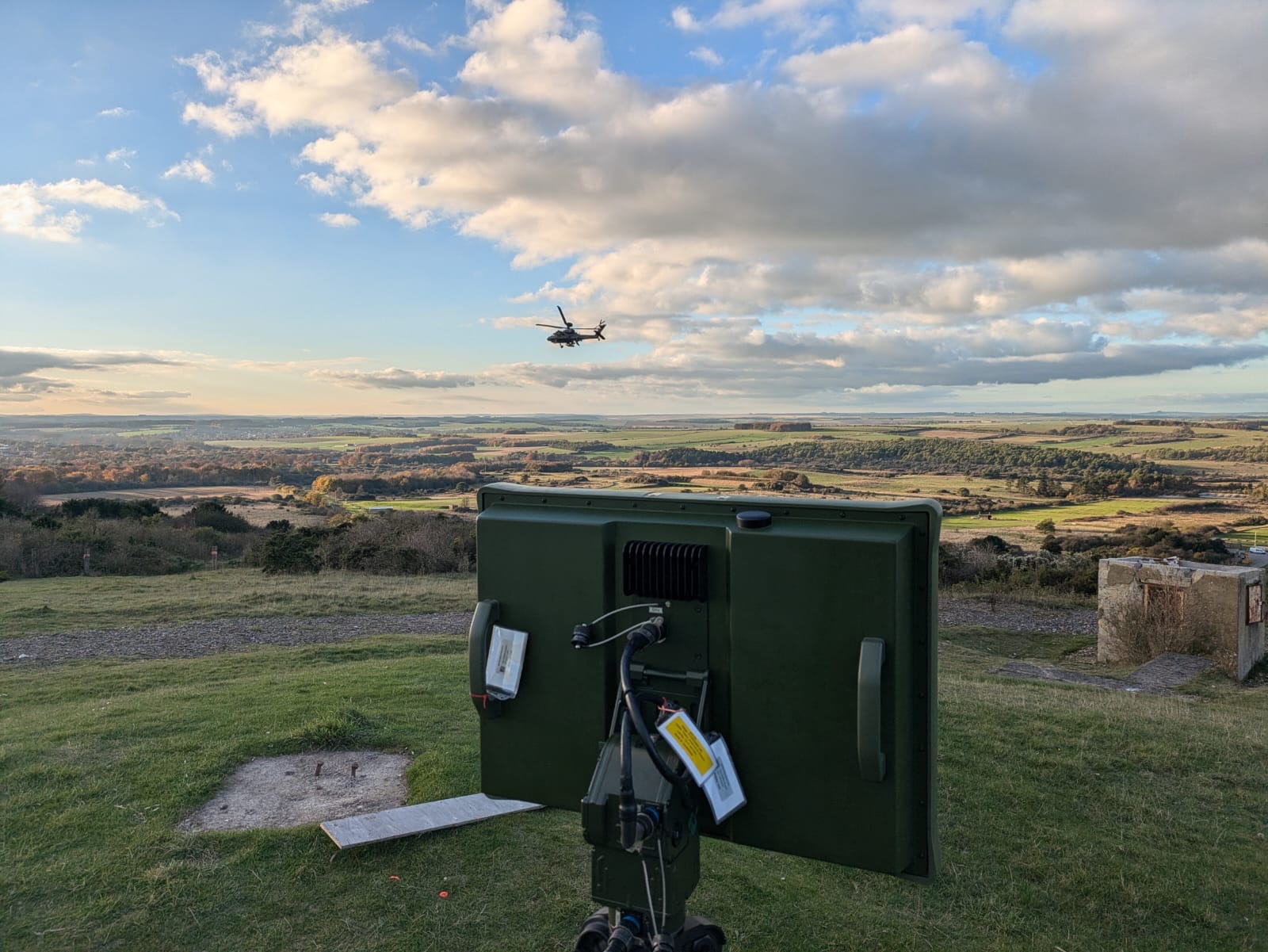
Elbit Systems UK has delivered the first batch of Ground Based Surveillance Radar systems to the Royal Artillery following successful live-fire trials earlier this year, the company stated.
The initial delivery includes 55 radar units and associated support solutions, marking the first tranche of equipment provided under the programme. Manufactured in the UK and Europe, the system was developed to meet the specific requirements of the British Armed Forces and is part of Elbit Systems UK’s “detect and protect” portfolio.
The Ground Based Surveillance Radar, or GBSR, serves two key roles: surveillance and fall of shot correction. In its surveillance role, the system can track and classify personnel, vehicles, helicopters and drones, providing early warning of incoming threats and a clear picture of friendly movements. For artillery operations, the radar detects and locates rounds in flight, allowing mortar and gun teams to adjust fire rapidly and accurately.
Elbit Systems UK said the radar incorporates open-architecture technology to ensure interoperability and adaptability for future missions. The company stated that the system enhances the survivability of front-line troops by improving situational awareness and decision-making speed.
“GBSR will enhance the situational awareness of personnel on the ground, help keep them safer by better detecting enemy threats, and give them the advantage in locating targets,” said Martin Fausset, Chief Executive Officer of Elbit Systems UK.
“The programme is a great example of our Bristol team working with the customer to develop a bespoke capability that meets the end users’ requirements now and into the future. We look forward to delivering the rest of the systems to soldiers across the British Army.”
According to the company, additional systems will be delivered later this year in partnership with the British Army.









I wasn’t aware of this procurement, but sounds like a decent, useful system l. And 55 sounds like a reasonable quantity, for a change, too!
To clarify, does this do counter-battery fire stuff, or is that a different system… We need a lot of those, I imagine
CB is I believe one of the weakest parts of the Army. Just 5? CB Radar Systems in 5RA replacing the old Cobra radars.
This? I’m not sure either, assume it’s more an alerting device for incoming.
It’s also becoming less relevant on a modern battlefield by the day. Drones replacing shells.
Hmmmm. Drones are the in vogue thing at the moment, but I don’t see artillery being any less relevant personally, both compliment the other.
Drones can be countered, a shell, not so easy.
While a Drone is pinpoint, a shell not as accurate.
The Army needs both.
I also believe Russia still places great importance on artillery.
I agree we need both. The advantage enjoyed by drones may be short lived. That said, they do currently account for a large and increasing percentage of casualties.
It’s impossible to verify, but accounts from people at the front suggest as many as 60-70% of all casualties – and I see no reason to doubt that.
There are quite literally fields and fields of fibre optic cables across the front.
Hi Jay.
Yes, I’ve read things have become so static that one cannot move openly in daytime without Drones coming for you.
Only 5?! As far as I can see, they’re one of the most vulnerable but important items along a front line. I’m not certain, but I can’t imagine that number would even cover our battle group in Lithuania, let alone the whole of 3 Div…
I had a bit more of a look and it doesn’t look like it’s a CB radar as such- basically what you describe. Although if it can track outgoing rounds to assist with correcting fires (it secondary role), I’m not sure why it can’t be used for the reverse also. But it’s supposed to provide early warning and fires correction only.
Incidentally, if this is the same contract as the one announced a couple of years back, we’re actually buying 90 with a stretch of another 40. They’re a year late delivering, but that’s not a bad total.
Is this like Two systems for each Artillery piece ? 🫡😉
Ha!
Fall of Shot ! What exactly is supposed to be firing that shot ?
What Gun?!
Another UK specialty and huge export success…small battlefield radars…lost and now having to be purchased from overseas…
And there are still small UK radar manufacturers, alongside Leonardo and BAE, who could have done the job with some investment…
MoD has steadily destroyed our defence industry…
These are built in the UK by Elbit UK.
Under licence?
No, designed and made by Elbit Systems UK Ltd in the UK. You don’t need a licence to manufacture your own kit.
Manufactured by Elbit UK, be sure it’s more British than the Archer manufactured by BAE Systems AB
Sounds like a cross between Cymbaline and the ZB298 (Zebedee) the we had in the RA in the 80’s.
Counter-battery is clearly now a priority….for good reason:
‘….they continue to work systematically against our pilots. And, unfortunately, our losses among UAV pilots are increasing….The issue is with drones; it is necessary to target enemy UAV pilots…..How to do this is a very difficult question, because you cannot effectively work against drones with just drones, you cannot smoke out a pilot who, for example, is hiding somewhere in a basement exclusively with drones. This is a very complex story; sometimes complex and heavy means of destruction are needed, such as missiles and aviation…..we need to fully realize that one pilot, well, a pair of pilots, a crew of pilots, can pose a threat to an entire battalion.’
Vasyl Pekhnio 13 Nov 2025
Plus ca change:
‘When the IDF 190th Armored Brigade counterattacked to recapture part of the Bar Lev Line captured by Egyptian troops, the tanks went in unsupported and got massacred, first by AT-3s, then RPG-7s when inside AT-3 Rmin. After swallowing that bitter pill, the IDF began to use combined arms against the ATGM threat, and the first part was immediate suppressive fire on and near the where the launch signature was detected….’
Other countermeasures are surfacing:
‘The drone wall aims to counter this by launching a collection of first-person-view (FPV) drones from ground stations as soon as radar detects an incoming threat. These drones, carrying small explosive payloads, then form a “curtain in the sky” to neutralize the attack. The system relies on artificial intelligence to adjust the wall’s structure to best respond to the detected trajectory of a threat. A key advantage is its cost-effectiveness; an interception costs just a few thousand dollars, and any drones that do not detonate can return to their platforms for future use. Crucially, the system can operate in GPS-denied environments’
All and all, It’s just another brick in the wall.
London Arena 1987. Shine on.
‘Drone wall’ can it live up to that claim in reality.
Indeed. A lot of Euro/US drone/anti drone technology does not cut the mustard on first contact. But autonomous AI directed counter drone measures, intuitively at least, sound promising.