

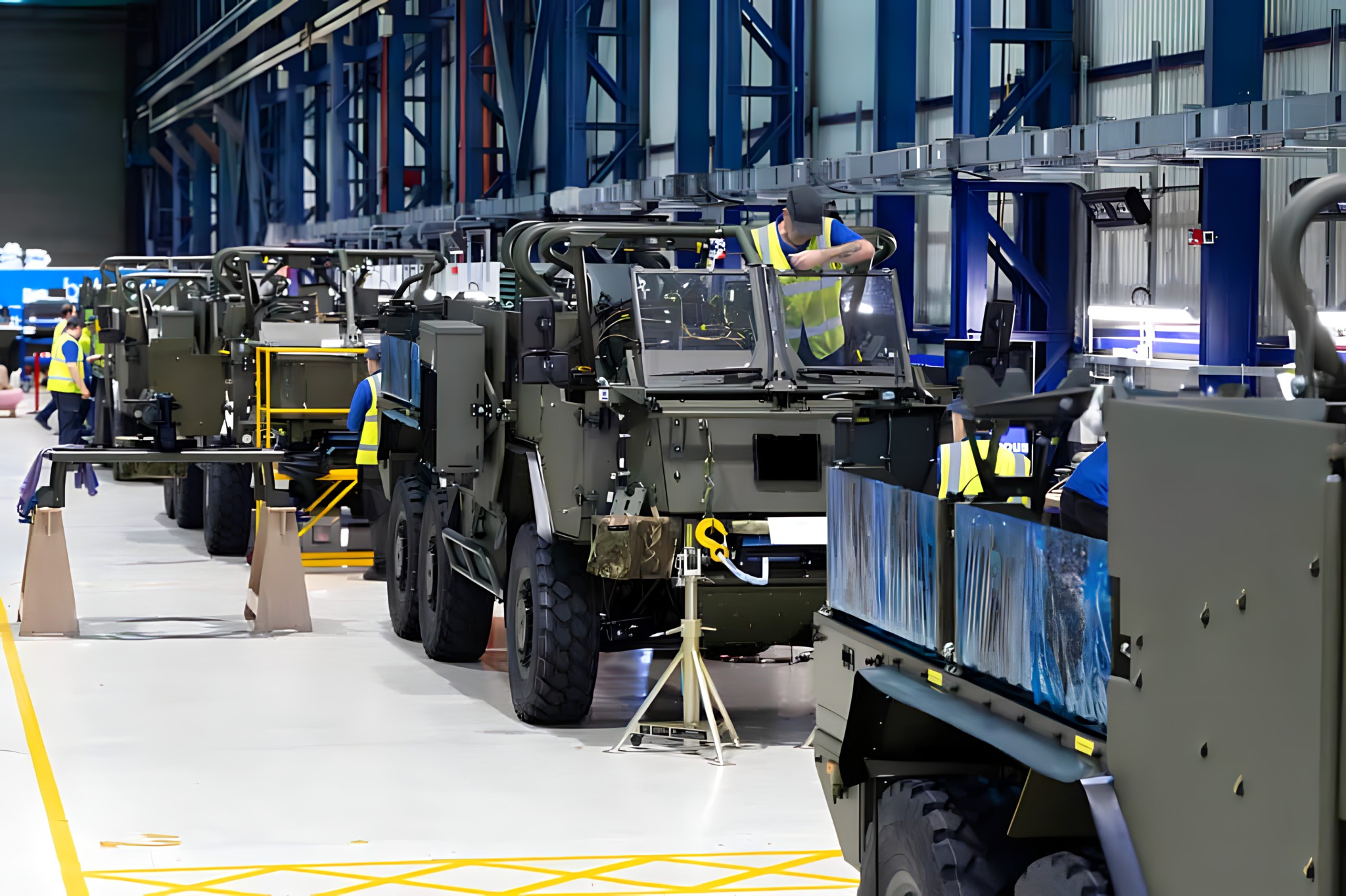
Babcock says the first Jackal 3 Extenda vehicles from the second production tranche have rolled off the Devonport line, marking a key milestone in the programme to deliver new high-mobility platforms to the British Army.
Fifty-three six-wheel Jackal 3 Extenda models are being built in partnership with Supacat, following the completion of tranche one which produced 70 standard Jackal 3s. Designed by Supacat in Honiton and manufactured in Plymouth, the programme maintains engineering jobs in the South West and aligns with the wider industrial strategy to retain sovereign capability.
The Extenda variant adds an extra axle for increased payload without compromising the platform’s cross-country performance. The Jackal 3 family is used for reconnaissance, patrol, logistics and as a weapons carrier.
Chris Spicer, Managing Director for Engineering and Systems Integration at Babcock, said the milestone reinforces the value of the programme to both the Army and local industry. “The Jackal 3 (E) provides the British Army with a formidable vehicle which enables troops to carry out a variety of missions. This is an important milestone in a programme which ensures our Armed Forces have a best-in-class vehicle – while providing skilled jobs in the South West and clearly demonstrating that defence is a real driver for economic growth.”
Supacat’s Head, Phil Applegarth, highlighted the supply-chain dimension. “We are proud to announce that, following the recent deliveries of Jackal 3 vehicles to the British Army, the next tranche of Jackal 3 Extendas are now rolling off the Babcock production line in Devonport. A resilient, collaborative supply chain, underpinned by a secure industrial and manufacturing base is vital for UK defence at this pivotal time.”


I still don’t understand in a war zone why any soldier would want to be in a vehicle with such little armour. Speed and mobility was the reason for using the snatch and that proved fatally wrong. Feels like lessons weren’t fully learnt from past problems with the snatch / original humvee. I suspect in a shooting war more troops will get killed and inquests held. I suspect made worse in the era of the drone.
To be fair, the orders for these were placed before war drones became a thing. What’s a girl to do when this week’s technological advance makes last week’s obsolete?
Before the Battle of Mogadishu?
Or the many deaths /injuries caused by the snatch in irag/afghan.
I do tend to agree it’s rather open which has always surprised me (though there is the cabbed version) but realistically I’m not convinced a cab on a vehicle of this nature gives a lot of protection beyond psychological though I would have expected the doors at least to be higher and thus provide basic protection from splinters and light arms. If it’s doing recon that certainly would be vital in my view.
Jackal was specifically designed to be a better protected WIMIK, not a replacement for Snatch (that was Mastiff/Foxhound really).
Which one?
These? The 53 Jackal E are one of the few orders of kit from this current government, Drones were a thing since 2023 and before.
Jackal have their uses, like all assets.
There is also I understand the option to have an enclosed version, which the Army didn’t take up.
How much of that decision is based on dated thoughts of fast mobility can offset the risk (proved wrong many times in Afghanistan/Iraq) and now much is based on cost. Guess we will never know.
No idea. I always assumed the lack of roof armour was a desire for all round view?
I assume it is, but as with everything engineering choices are a series of compromises, but we seem to be the only country that feels that the increased visibility out weighs the risk of lack of armour.
These are the “Tag Axle” versions I was on about last Week DM. Allbeit I was referring to Motorhomes !
Wouldn’t mind driving one of these though, maybe through parts of Londonistan 😁
I can arrange that !
😀 Oh please !
Clarkson enjoyed driving one I believe.
Ha yes, I remember that ! It’s always a shame to me that he wouldn’t allow Bikes on the show. Especially given that both May and Hammond are big bike fans.
He did like my Cerbera though 🙂
I loved the Cerbera… when it worked. Mind you when it didn’t you could truly admire the front indicator lights inspired by the TVR dog taking a bite out of the mock up.
Steve, Snatch was designed and developed specifically for Op BANNER (Northern Ireland); other than up against occassional massive milk churn IEDs it did the job, providing enough protection.
The issue was deploying them to a very different environment (Iraq, Afghanistan) where IEDs and RPGs were very commonplace.
The US had a small head start on us in developing superior Protected Mobility (PM) vehicles; we obtained ours quite quickly using UOR procedures.
Yes it was but lessons should have been learnt way before they were. Russian involved in Afghan was the first indication that lack of armour was a major problem and then various other conflicts. We waited until soldiers were dying and the media started reporting on them to actually order anything. Now seem to have reverted and only focused on ied and not other threats demonstrated by these various conflicts.
Snatch was a replacement for maclaron piglets in Northern Ireland their use in Iraq etc was always doomed to failure
To be fair most protected mobility vehicles don’t really have much roof protection against a directed blast or blast frag dropped on it..Protected mobility vehicles were and are designed to protect against mine and IED blasts from below and small arms fire, that is it. So the vehicles with lids are really not doing anything other than preventing the operator of a drone seeing the crew and the crew seeing the drone.. to be honest in a drone heavy environments it’s probably more effective to have an open top so you can see the drones coming, the speed to avoid them and weapons to knock them down with.. having a tin lid is probably the worst of all worlds.. adds weight to slow you down, is going to offer scant protection and means you cannot see the threat.. it’s the same reason the open helm has had a far far longer life than the closed helm……
I’ve always thought this too. In any conflict in Europe there’s cluster munitions spitting shrapnel everywhere, thermobarics that do similar, at indirect ranges and before we even start talking drones.
Not to mention bitterly cold and miserable winters.
I have honestly no idea why we are buying more open-topped versions of this…
My guess is they are both cheaper to buy and cheaper to maintain.
On the weather conditions, add to that heat. How many conflicts in the last 2 decades have been fought in the extreme heat.
If a drone can stop a tank, then the armour may not help – the first thing troops seem to do when a drone flies over head is bug out and take their chances on foot. I think a parallel can be found with the demise of the ‘real’ battleships, not T’s wet dream. Missiles made armour on ships obsolete, drones may make armour obsolete on the battlefield. Vehicles will need counter drone weapons and the troops need to be aware of their surroundings. That said the Jackal can take an armoured cab.
Large volumes of drones can stop a tank. Various troop carriers used by Ukraine have taken individual drone hits and survived. Not practical for an opponent to flood every vehicle with 20-40+ drones that is needed for a tank.
For my two pennies worth I think you need a roof for the driver and navigator in an armoured v bottomed box with a gunner separate in a carbon reinforced tub in the back to scan for drones and other ground based threats and taking them out. This I dont think is the answer except for nostalgia for the LRDG and SAS in WW2! Honestly.
A good trailer is a better way to up the load surely? This thing weighs 7t unloaded FFS. It needs to be a half-track at that weight. Call me old fashioned.
Very alarming that these have no armour protection from overhead & little horizontal protection too strikes. A sniper’s dream.
Especially considering they are also a fire support platform, that gunner is going to be extremely exposed.
I mean they’re a recce vehicle, their fire support role is very limited.
They are, but there was videos of soldiers early on in Iraq/Afghan using their snatch for it and the soldiers explaining to the journalist that best not stay near vehicle as it encourages incoming fires but provides no defence for the gunner.
They provide some side ballistic protection but not a whole lot, as half the soldier is sticking up above it and it’s the most sensitive half.
Steve, you’re talking about the Snatch Land Rover — an enclosed, lightly armoured patrol vehicle used in Iraq and Afghanistan, but developed for Northern Ireland. It offered some protection against small arms, but little against IEDs, and as you say, the gunner was very exposed. The government bought Mastiff, Foxhound, etc., through UORs to replace Snatch in both theatres.
This article is about the Jackal, another UOR, which replaced WMIK — an open‑topped, lightly armed Land Rover variant. The open top is deliberate for reconnaissance and screening roles: it gives maximum situational awareness, allows rapid use of mounted weapons, and keeps the vehicle light and highly mobile. In Afghanistan it was used extensively in the fire support role and proved very effective, because it could move quickly to dominant ground, stay outside effective enemy range, and bring heavy HMG/GPMG fire to bear. For the enemy we were facing and the terrain, I don’t see how you could have had a better fire support vehicle, to be honest.
Fair, I’m bundling the issue across platforms including the early humvee’s. However the point remains, not having armour caused huge issues and not just from IEDs. Compound that with drones and this platform seems questionable. The mantra before all the UOR vehicles were delivered was just drive faster, which didn’t work out well, as racing into issues.
I can see a place for these, such as for air drops and rapid deployments, but not as a main patrol vehicle they are being used for.
Again, not being used as a main patrol vehicle. They are Recce vehicles, assigned to a single platoon in an Infantry Battalion, or to Light Cav units providing Recce to a brigade, or for SOF/SF manuever. They are not organic lift for infantry.
Dern, I just received an email for:
“France was doing more than just long range reconnaissance however.
Both the US and France have lightweight recce vehicles for similar roles”
So Steve won’t see it.
I don’t get any email notifications at all despite having the notification box checked, so I don’t really fret about that too much.
I agree. You’d be better off in an open top Ferret. All the same arguments.
Steve, no one is defending Snatch in those theatres — I’m certainly not. My first tour was Basra, so I saw first-hand what a shambles it was.
However, this article is about a high-mobility recce vehicle (as stated by myself and others, used in other specialised roles) replacing or complementing older high-mobility recce platforms, not protected mobility vehicles.
The MoD’s Land Mobility Programme (LMP) is the effort to replace and rationalise utility and protected mobility vehicles across the Army via three strands:
• LMV – Light Mobility Vehicle (Land Rover)
• LPM – Light Protected Mobility (e.g., Panther / Foxhound-type roles)
• MPM – Medium Protected Mobility (replacing much of the Mastiff / Ridgeback / Wolfhound era fleet)
But they aren’t just being used for this role. They were being used for patrols in Mali a few years ago, an area where multiple french troops had been part of ambushes. Also where memories of operation barras should have been in mind.
Steve, yes, UK troops were deployed to Mali on Operation Newcombe, part of the UN peacekeeping mission.
The UK contributed a long‑range reconnaissance group to that mission, conducting patrols to gather intelligence and improve situational awareness for the UN force. Which is exactly why vehicles like jackal and coyote were used…
You seem to want every soldier in an IFV and presumably never dismount…
Anyhow, I have nothing more to add, so happy New Year, Steve 👍
Well compare that to the vehicles France was using or that the US use in similar scenario. Just doesn’t make sense to me.
France was doing more than just long range reconnaissance however.
Both the US and France have lightweight recce vehicles for similar roles.
Greg’s already pointed out some confusion here, especially as Snatch didn’t have a gunners position, so I’m afraid I’m going to have to take this with a bit of a grain of salt.
Seeing these makes me feel we are equipping for the last war, not the next war! Open top in an artillery and drone rich environment, err no thanks!
Got to say weather alone in a European winter doesn’t sound too amusing in an open top vehicle let alone gunfire. Depends on its exact role I guess probably a lot better than a soft skinned lorry or even a MAN truck perhaps. What would be the alternative for their role, feels a bit nebulous as it’s a bit of an allrounder in nature.
Jackal at least has heaters, RWIMIK, which it has largely, but not completely, replaced did not.
Jackal generally operates in a recce role, either as light cav or as RWIMIK replacements within infantry battalions, or as SOF/SF platforms. The alternative would very much depend on what you doctrinaly see your light recce units doing. If you want a fast vehicle, with excellent mobility and that doesn’t have to fret about counter mobility (mines and IED’s), but still carries a couple of dismounts for CTR’s or Drone ops, and providing a little bit of firepower in case you need to break contact, you probably won’t see huge alternatives.
Hi Dern.
Do you know which Battalions use this in their organic recc platoons?
I keep missing that they’re used by Infantry and always concentrate on the 3 Light Cav Regs and the Yeomanry.
Assume Bns of 7 Bde? Any from 4 or 16?
I guess the danger is in thinking that the only role these may ever have is in a large scale european peer on peer war. The army has always needed a range of options as it never knows what war it will fight next. These suited afghan well as far as I know. Maybe the next war will be something totally unexpected where vehicles like these will prove to be just what we need. Who knows?
Not everything can, or needs to be super armoured and impervious to everything. These are meant for recce and resupply where speed and agility are required. If they are spotted they run away. IMO they appear to be good for their designated purpose which is not patrolling insurgent laden territory. My concern for the lack of cover is weather conditions, which I assume will primarily be central Europe. Being cold and drenched all the time would not exactly good for morale or health.
As someone who rides bicycles in all weathers 🙂 I canot see how these open top vehicles are acceptable . Maybe the soldiers like them ? , but these days surely a modified Jackal with 100 percent armoured driving compartment area to level 3 or so is the way to go. I do hope Jackal modifies and does some speedy vehicle research and development as there are many new excellent light vehicles comong onto the market . Would not want to see Jackel left behind and uk buying obsolete kit just to keep factory open
They are generally liked compared to RWIMIK, since even open topped at least they have heaters. The way Jackal is designed though you’d need a rather large armoured cap for the crew, which would take up probably about 2/3rd of the vehicle.
Aah reflected my own concerns and queries above. I guess these fit in between the soft skinned vehicles and the less flexible armoured troop carriers etc. has to be compromises between a range of factors but where they are made is not an easy solution, but in Europe weather protection seems an obvious one certainly, cold, wet and miserable is not going to make for the best fighting condition for sure.
Get these done and then Babcock can gear up for the Patria order👍oh hang on!!
I think Patria will be assembled at the Babcock plant to be built in Sherford; one of the new Freeports. It’s happening; the order is a formality. Checkout the Sherford Council website.
👍🤞
I think they are really niche vehicles for SF and 16 Air Assault Bde. Airportable in good numbers, not expected to take on formed enemy forces, using speed, manoeuvre, concealment to r3ach their objective.
I would still not fancy being in combat in one of these, feel the Foxhound would be a good bit safer with its armoured crew cell and v-shsped hull.
What do you think of them operating as the Recc Regiment for 7 Light Mech Bde and 4 Light Brigade?
Both Bdes attendant FR Regiments had CVRT family before.
Jackal also served in 3 DRSB but I think they’ve moved over to the “new” 1 DRSB now, as that formation steals 3 DRSBs assets.
At least they work! Ajax ISTAR AFAIK works just fine, but the vehicle clearly doesn’t.
A simple and inexpensive way to keep troops mobile, given Warrior is going away soon and Boxe seems no nearer to IOC.
What other choice do we have, bicycles?
I always loved the look of the Fox! ( like Foxes anyway ) but I read it was prone to toppling over?
Seems the simple like the Stalwart, Saracen, worked fine?
Or maybe not?!
Ahhhh the good old Stolly!!! What a vehicle to drive cross country👍👍it would literally go anywhere😉
Yes Fox did have a disturbing tendency to flip!
Happy new year mate👍
And to you mate. 😉
Isn’t the answer meant to be the Patria 6×6 and the Nurol Makina? Insert dots before after the ‘co’.
nmsukcouk
I was thinking about the concept of the open top protected mobility vehicle vs the enclosed protected mobility vehicle and the drone heavy environment.. now the simple truth is enclosed protected mobility vehicles are not really designed to actually protect the crew and dismounts from serious blast from above., very few vehicles actually are… in reality the roof on your 6-8 ton protected is protecting you from nothing but the rain, the armour and protection is designed to keep the crew alive from mine and IED blast from below and limited long range small arms fire from the side… so it may actually in the drone heavy environment to have an open top so you can see the things coming and use speed to try and avoid them and weapons to engage them.. because all the roof on a 6-8 ton protected mobility vehicle is doing is stopping you see the drone, it’s not going to protect from the blast.
Yes, as I suggested, all round view and fields of fire. I’d read that a roof was an option if the Army want it, so there must be a reason why they don’t now it’s back in Europe.
I do wonder if drones become more of a danger than IEDs if protected mobility vehicles will have to change….. the thing about mines and IEDs is they are a relatively predictable threat in that the blast is coming from below.. drones can essentially always be guided to the less protected area. It means I think that defence will by nature have to be more active and then require a level of blast protection to go alongside the distance at which the active protection engages.
Jonathan, before we get the angle grinders out, we did successfully test a laser on a Wolfhound last year as part of the Laser Directed Energy Weapon (LDEW) Demonstrator programme, so at some point, hopefully in the near future, we should see something fielded to help counter the drone threat.
I’ve also been thinking for a while that countering small UAS is probably best done using small autonomous drones as the countermeasure. Having them distributed across vehicles makes sense to me, and I suspect that’s ultimately where we’ll end up.
I came across the systems below a couple of weeks ago. I believe a European NATO country has placed an order, although which country isn’t public.
• Interceptor-MR (Medium Range) a larger interceptor capable of engaging targets at ranges of around 5 km or more, using onboard AI and imaging to autonomously pursue and defeat drone threats.
• Interceptor-SR (Short Range) a smaller, lighter version (~1.5 kg) with about a 1 km engagement range, suitable for vehicle mounting or even man-portable use, autonomously tracking hostile UAS via onboard sensors.
I’m sure there are other similar systems, but these can be found if you type “MARSS interceptor drones” into Google.
Some Russian examples are looking like aviaries.
Yep, but then I suppose all you do is put a directed blast frag warhead on the drone.. you would then still need the protected mobility vehicle to have all round blast frag protection as well as carting a huge cage around with it..
How good is standard issue warfare clothing in terms of waterproofing? In particular sitting in a puddle. Or will the crews in this case need motorcycle level waterproofing (at face, neck, cuffs thighs and butt) and even heated steering wheels or gloves.
Anyone remember the trucks we used to see with no body or cab just a driver exposed to the elements?
Someone at the sharp end will be praying that from now on dry weather will be the norm both in peacetime let alone in action.
At least experience is being gained in Ukraine with exposed crews given the number of quad bikes and WW2 Jeep type vehicles in operation there.
Ref Danieles question about which units use Jackal.
With this new order for the Jackal 3 Extenda, we should have 550 Jackals in service.
I gather that all six Light Cavalry regts are now equipped with Jackal and have binned their Land Rover WMIK. A Light Cav regt has 3 Sabre sqns, each with 16 Jackals, giving a total of 48 per regt. So 288 of the Jackals are with the Light Cav regts.
Regarding the Light role infantry bns, the Jackal is only issued to the bn’ recon platoon. I vaguely remember that the recon platoons used to have 8 Scimitars but suspect this is now 6 Jackals, certainly that is the number in the 3 airborne bns in 16 Air Assault Bde.e
There are I think 34 Light role battalions, inciuding regulars and reserves. Not every reserve bn has a recon pn, depends on recruitment,levels etc.
But if we say that each bn (and the 2 RM Commandos) has a recon pn of 6 Jackals,, that would.total 216.
Which leaves 46 to be accounted for.
Units I don’t know about.are 1 R Irish, which foes the r3con role in 16 Air Assault Bde, the Para’s Pathfinder Pn, which I think uses Jackals, and the 10 regular and reserve RAF field sqns which use Foxhound, Jackal and Land rover WMIK. And of course a batch needed for trials and training.
That’s as close as I can get.to the answer Daniele, others may know more!
I’d broadly agree with that, but I’d say that even the Reserve Units that have the headcount for a Recce Platoon/Troop won’t all have them equipped. 1 R Irish I think is largely Jackal and RWIMIK based, but someone within 16AA probably would know that better than me. I believe a few are still reserved for UKSF, and a small number are used for ASOB alongside RWIMIK. I assume 11X might make a lot of use of them too, but I haven’t seen their mobility plan yet.
I’m trying to understand how you got 34 Light Role Btns though, because that number is way to high,
19 Brigade has 8 Reserve Light Role Battalions
4X has 5
You then have 3 Public Duties Battalions which won’t have Jackal in their Recce Platoons, along with the 3 Garrison Battalions that won’t have Jackal for 19 Light Role Btns. 24 if you consider the everyone in 16 Light Role.
Thanks Cripes. It was the Infantry Bns only I was querying, I know the 3 Light Cavalry Regiments and the Yeomanry use them.
“I vaguely remember that the recon platoons used to have 8 Scimitars”
In Mechanized then Armoured Infantry Battalions, yes, not LI Battalions! They did not use CVRT.
I’m not sure that the 2 RM Commando use them.
Pathfinder Platoon did/does, depending on need.
SF obviously, and I’d seen them with the Para Battalions.
As Dern says, 34 Light role are too many.
My working assumption was that only 7 Brigade Foxhound equipped Battalions and the 3 Para Battalions used them, not Light Infantry, so that was my main train of thought. I’ll have to look deeper.
To add, RM SRS I think also use them as needed.
Yeah, there are I think 34 light battalions, all the regular ones and a few of the reserve ones with.a recon platoon of probably 6 vehicles. But how many of these are Jackal-equipped or still with WMIK is the unknown.
Anyway, I arrive at my 34 bns thus:
4 Light Bde – 5
7 Light Mech Bde – 3
11 Light Strike Bde – 5
16 Air Aslt Bde – 3
19 Light Bde – 8
Special.Ops Bde – 4
Cyprus, Brunei – 3
UkHF bns – 3
… Total 34.
Given that there are about 260 Jackals unaccounted for in my sums, quite a few of these 34 bns must be Jackal-equipped. But hard to say for sure without knowing how many are allocated to 1 R Irish, SF, RAF Field Sqns etc
Hi mate. Some of those 34 are I think categorized as other than Light role, but are “light” to all intents and purposes so I see why you include them.
Remember, 16 AA has 4 Battalions, not 3, and they are not classed as Light role Infantry. 2 and 3 Para ( of which only 1 is Para role ),
1 R Irish, and whichever of 1 and 2 Bn RGR are in the role as Air Assault.
I don’t think 11 Bde are classed as Light role Battalions.
Same with the ASOB are Rangers, not light role.
7 Light Mech Brigades Light Mechanized Battalions should not be in the Light total as they use Foxhound and I also I believe have Jackal.
Also of note, of the 2 Garrison Battalions in Cyprus, one is found from a 1 U K Div 7 Bde Foxhound L Mech Bn, and one is a supposed Boxer Battalion found from 3 UK, but minus its vehicles. This caused confusion when originally under FS 5 Boxer Bns were listed. MoD now say only 4 as the 5th won’t have its vehicles but rotate in and out of role to Cyprus.
So yeah, I’m going to expand on what Daniele said.
“Light Role” Infantry is infantry that is either dismounted or does not have organic lift within it’s fighting orbat. That means for example using TCV’s from a support squadron to provide lift. So from the outset 7 Brigades battalions are not Light Role, but may have Jackal as their Recce vehicle.
The 4 Battalions in 16AA are not classed as light role because they are supposed to be airmobile, but slightly egregious as 1 R irish are a completely different structure. I think their Jackals are not permanently held, but I could be wrong.
11 Brigade (not “Light Strike Brigade” the role is definied as “Tactical Recce Strike”) is neither structured nor equipped along the Light Role model. The 5 battalions within the Brigade currently do not have Jackal, it may be in their future mobility plan, but if it is it won’t be in a small recce platoon capability, it’ll be to lift large portions of the fighting elements of the Battalion.
ASOB is definitely not Light Role Infantry, it’s SOF. Ranger Battalions do not even have a Recce Platoon, so even if you are doing a broad “Light Umbrella” rather than strictly “Light Role” for the purposes of your maths, you have to discount them (I think the same goes for 11 Brigade btw, I don’t think they have anything resembling a traditional Recce Platoon). There are a small number of Jackals within the Brigade, but they are not issued to every Battalion, and they certainly are not issued in a Recce platoon style.
Cyprus, Brunei, as stated are Light Role while in Garrison, but also don’t hold Jackal in Garrison, as stated, same for Ceremonial Battalions.
Ref this concern about the Jackal being a vulnerable open-top vehicle…
The job of the Jackal recon platoons is to be the forward eyes and ears of the battalion. They are scouting ahead to find where the enemy is and in what strength. They get to the edge of their recon zone usually by Jackal, which is fast and very good off-road mobility -.but then park up and do stealthy recon on foot. This may involve lying up in hides for 24-48 hours.
Thus the main threat to the Jackal is getting up to the recon zone unobserved and avoiding mines and IEDs. As they will generally be operating forward of the advancing enemy, the risks are limited. (But in a different scenario, like patrolling in Afghan or behind the lines of a conventional enemy force, I guess the risks increase rathet a lot).
I would surmise that Jackal is a good answer to forward recon as a battlefield taxi and it has a good defensive weapon if the squad runs into trouble.
Why? If this is supposed to be a Light, fast, reliable recce vehicle, buy a bloody dune buggy, or a souped up, funky quad bike… oh wait we have them already!
Jackal or Jekyll or whatever v 50p drone… Might as well go back to landrovers.
They’re ok vehicles for their purpose but not exactly “formidable” come on!
Agree. Thete is a fine balance here between mobility and crew protection.Seems to me that any light vehicle like Snatch, Defender or Jackal is going to be very vulnerable to even small arms fire, let alone drones or RPGs. A medium MR/PPV in the 15 tonne range with a V-shaped hull would at least allow for better armour protection, but would still be vulnerable to drones and RPGs and probably too heavy to be airportable in useful numbers.
Ideally, these lighter vehicles would have automatic protection systems.(APS), but the cost of adding something like Trophy is prohibitive. Would an up-armoured Foxhound be closer to what is needed? It has this protected crew compartment inside the V-shaped hull, but I would guess is still pretty vulnerable.
It is also pretty expensive, nearly £1m a pop or three times the cost of a JLTV. Whatever, I feel that light vehicles like Jackal are probably too vulnerable on the modern battlefield and their day may be over, other than possibly equipping SF and 16 Air Assault for quick in and out actions.
I still remember the Menacity forerunner to the Jackal. Was really interesting watching one of them being squeezed in to a Chinook! There was next to no side room, but it still managed to fit.