

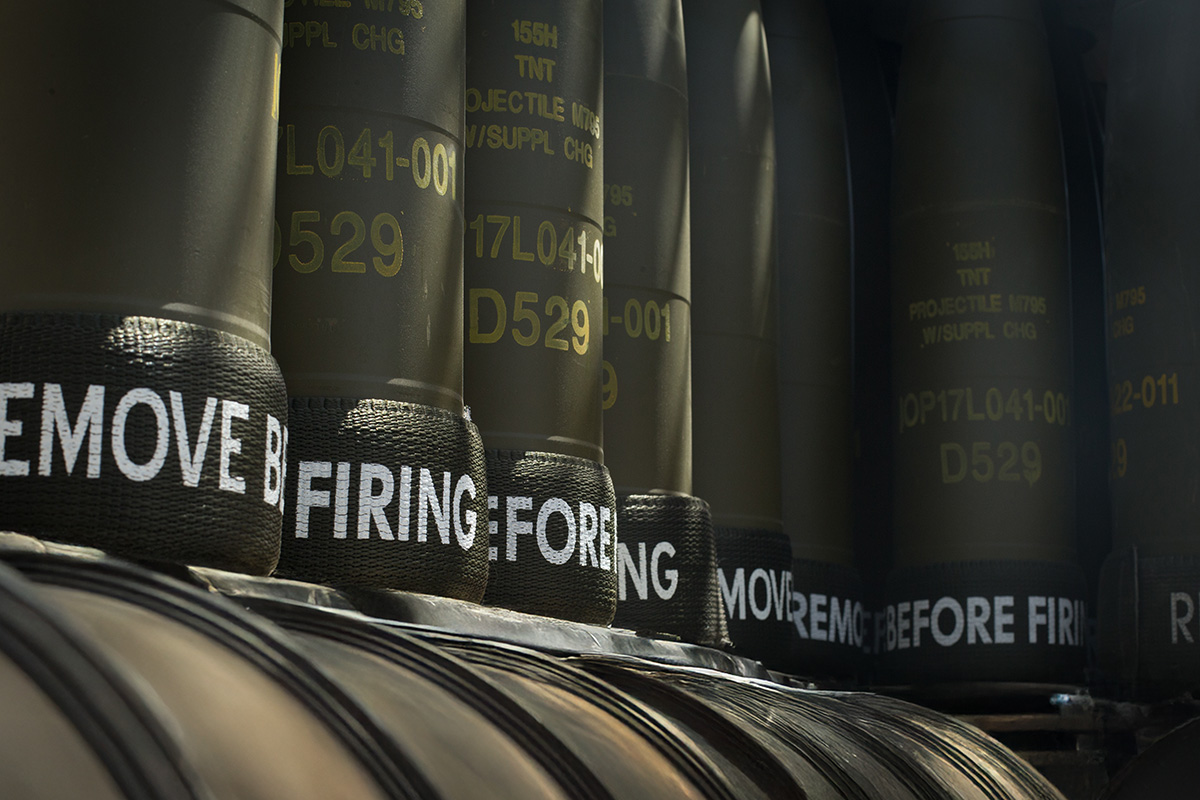
The Ministry of Defence is continuing to face questions over the financial underpinnings of its £1.5 billion plan to build six new munitions and energetics factories, as written answers in Parliament offer little clarity on how much of the investment will go to British industry.
At the same time, planning documents highlighted in earlier reporting show the proposed sites are expected to rely heavily on overseas customers rather than on consistent UK demand.
In a series of written questions on 25 November, Conservative MP James Cartlidge sought details on whether the £1.5 billion allocated to the programme constitutes new funding and what share of both the initial £250 million and the wider investment envelope will be awarded to domestic companies. Defence Minister Luke Pollard replied with the same formulation to each query.
Pollard said the government remains “committed to ensuring the Defence industry is an engine for growth through strengthened industrial relationships and domestic investment,” but added that it is “premature to comment on specific proposals” until preparatory work is finished. He referred repeatedly to the wider £6 billion munitions spend planned for this Parliament and the Strategic Defence Review’s commitment to establishing a permanent “always on” production base.
Questions from Conservative MP Andrew Snowden focused on the potential contribution of existing defence-manufacturing clusters in the North West. Pollard elaborated on regional spending totals and the government’s commitment to munitions investment. Pollard also confirmed in a separate answer that the department has already identified at least 13 potential factory locations and has invited industry to submit proposals. Construction of the first facilities is expected to begin in 2026.
Earlier material reported by the UK Defence Journal offers a more detailed picture of the programme and the assumptions embedded in its planning documentation.
The Information Notice issued to industry instructs bidders to plan for a future in which core MoD demand fluctuates sharply and cannot be relied upon outside crisis surges. It states that “proposals should assume a range of scenarios such as surge demand and reduced or minimal UK MoD demand,” and goes on to make clear that “other offtakes, such as exports and civilian markets, should be considered and are expected to form the majority of the demand signal.”
The financial guidance takes this further. Companies are told that “proposals should be economically viable as further support funding for facilities is not envisioned,” and that “it is expected that MoD funding will not form the majority of funding for proposals.” This means firms will need to rely on private capital, investors and international orders if they want to build and sustain these production lines. The document also notes that UK Defence Exports will support firms in pursuing international sales campaigns, underscoring the outward-facing design of the programme.
Taken together, the parliamentary answers and the Information Notice outline a modernisation drive that is both ambitious and heavily dependent on private investment and export demand. However, it remains to be seen how much of the promised funding will, in practice, flow to UK companies.
Pollard has said further detail will be set out once the technical and commercial assessments are completed. Until then, the new factories remain a flagship programme with clear strategic intent, significant headline sums, and a some unresolved questions.












what is the business plan for an energetics factory ? obviously get uk stocks up but from then on quite volatile demand or no demand
Their “plan” is that the factories will have to compete for global orders with no government subsidy.
It’s the same stupid plan the treasury keeps coming up with all the time.
Post Ukraine war every country in the world will have ramped up munition production and will all be trying to offload that production on world markets. Most will be subsidising it or it will come from countries with a very low production cost base.
More delaying tactics.
This should be a
Government
Owned
Contractor
Operated
Facility.
It will require subsidy ad the world market for this kind of thing will be, as other have pointed out, saturated with dumped production.
Think you’re right, difficult to see this being a successful enduring private enterprise without gov backing. Post office model was proven wrong so need to get it right.
Probably waiting for Chinese investment 👍
Which is why around the world, many military ammunition factories are government owned. Governments don’t have to make a profit. They need the factory to exist when they need it.
So the usual non answers then.
New money? I doubt it, taken from elsewhere and someone else in Defence loses.
“Biggest sustained increase in Defence spending since the Cold War” my foot.
It is the biggest sustained increase since the Cold War. That is on the basis that there has never been any increase in defence spending since the Cold War. 😀
I have actually noticed a huge increase,
Of words. 🫡
This is a neglected but totally necessary asset. Some things demand government subsidies, and a minimal buy plus annual subsidy to keep things at a state of readiness are not, in my view, optioal but essential. Ukraine should have demonstrated that fact by now.
‘Proposals should assume a range of scenarios such as……minimal UK MoD demand……exports and civilian markets, should be considered and are expected to form the majority of the demand’
Short of full on war, the only ‘scenario’ will be tiny MoD demand. Forget export markets. British defence exports have pretty much been regulated out of existence. The competition from overseas of course works to an entirely different rule book.
There is no appetite in Britain for a strong defence industry or a credible conventional deterrent. That is one reason for the collapse of ‘The Long Peace” 1945-2015; war, once again, on Continental Europe.
The panic in the corridors of Whitehall should Britain ever have to put credible formations into Ukraine to man a thousand miles long buffer zone will be a tragicomedy.
Margret Thatcher sold off Royal Ordinance arms factories to then British Aerospace, many were closed down and the land sold off for housing which covered the purchase price. Like selling Brit oil this was a loss of millions of pounds of assets to the country. It also was the end of having the capacity to fight a major war. The scrapping of Antarctica patrol ship was a major factor in causing the Falklands war, this neoliberalism virus continues in Government thinking today.