

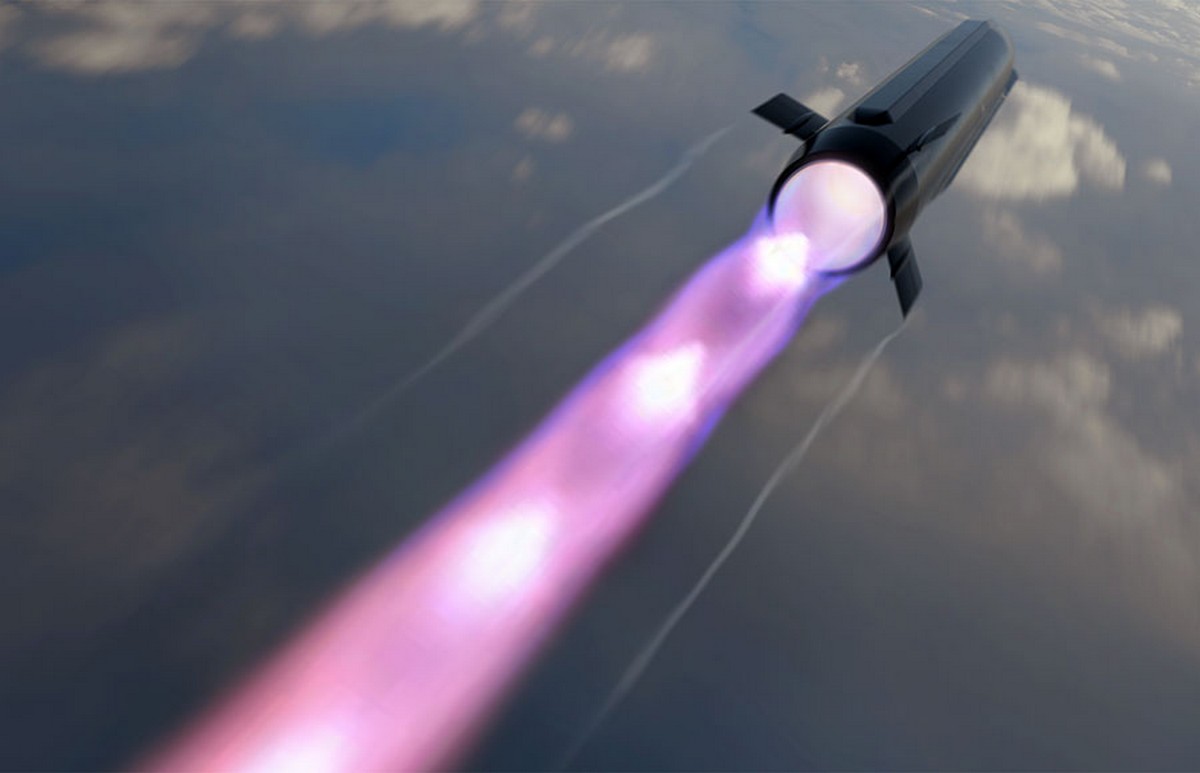
GE Aerospace and Lockheed Martin have completed a series of engine tests demonstrating a liquid-fuelled rotating detonation ramjet intended for hypersonic missile applications, according to the companies.
The testing marks the first technical effort conducted under a broader joint technology development arrangement between the two firms. The work was carried out at the GE Aerospace Research Center in Niskayuna, New York, where engineers assessed ignition and cruise conditions for the experimental propulsion system.
According to the companies, the rotating detonation ramjet uses detonation waves to combust fuel and air rather than conventional continuous combustion. This approach is intended to improve thrust and fuel efficiency while reducing overall engine size and weight.
GE Aerospace said the compact design could allow for greater fuel or payload capacity within a missile airframe, while also enabling ignition at lower speeds. This, in turn, could reduce the size of booster systems required to initiate ramjet operation, according to the organisations.
Mark Rettig, vice president and general manager of Edison Works Advanced Programs at GE Aerospace, said: “GE Aerospace’s hypersonic capabilities continue to advance at a rapid pace, and this collaboration with Lockheed Martin is another step forward in our journey.”
He added: “The testing on the rotating detonation ramjet and inlet exceeded expectations, and we are excited about this collaboration to continue maturing our advanced air-breathing hypersonic propulsion technologies.”
Lockheed Martin said the effort builds on its experience with ramjet inlet design, combined with GE Aerospace’s rotating detonation combustion technology. The inlet is intended to manage high-speed airflow into the combustor during sustained high-speed flight, according to the company.
Randy Crites, vice president and general manager at Lockheed Martin Advanced Programs, said: “Following two years of internal investment, this demonstration is a testament to the power of collaboration, innovation and joint commitment to get affordable capability into the hands of warfighters at the speed of relevance.”
He added: “This compact ramjet applies Lockheed Martin’s expertise in ramjet inlets and offers extended range at extreme speeds.”
During the test series, engineers injected airflow into the inlet to replicate supersonic flight conditions across a range of speeds and altitudes, including higher operating altitudes where reduced air density presents challenges for stable combustion, according to the companies.
GE Aerospace and Lockheed Martin said further maturation of the ramjet technology is planned throughout 2026 as part of continued hypersonic propulsion development efforts.









A flying explosion taking us to mars.
A very clever combustion chamber design that has taken years to get right. As it means the Ramjet/Scramjet’s combustion chamber can be much shorter. Thereby allowing for more room for propellent etc. The rotating detonation combustion driven by propagated waves, significantly increases the efficiency of the combustion process. Which could be used to either increase overall thrust or reduce the amount of fuel burned to reach a specific amount of thrust.
Did this originate with the V1?
In what context?
As I recall the V1 engine was not continuous burning but a series of explosions which souns similar at a basic level of operation.
Correct me if I am wrong. Thanks
You right, the V1 used a pulse jet engine, which is perhaps one of the crudest jet engine designs, but can be diy’d in a shed very easily. Depending on the type of pulse jet, such as using a U-tube design, it operated much like a two stroke expansion chamber exhaust. Where a generated pressure wave would be reflected off each of the open ends of the exhaust, back towards where the fuel was injected to help compress the mixture, then detonated. Which would start the wave cycle again, but you’d have two hot exhausts to deal with, which would be a problem on an aircraft/flying bomb. The V1 got round this problem by using a one way reed valve on one end of the pipe. Giving you only one exhaust outlet. But again used the wave off the pipe end to help compress the mixture so it could be ignited easier. This gave it the distinctive pulsing sound.
The rotating detonation engine sought of uses a similar principle, except the compressive wave is held within a circular ring, rather than a long straight combustion chamber. The ring holds multiple holes around the diameter, where fuel is injected, although they have also injected air/oxygen as well. Much like the pulse jet, a compressive wave is generated by detonating the mixture initially. Which then travels around the ring. More fuel is injected, which ignites thereby increasing the pressure and size of the wave. But unlike the pulse jet, you can generate multiple compressive waves, thereby increasing not only the thrust performance, but also reducing the amount of fuel needed. Tests have shown a rotating detonation engine can be as much as 25% more efficient that traditional rocket/ramjet engines. In theory you could use this technique in a turbojet in place of the normal combustion chamber.