

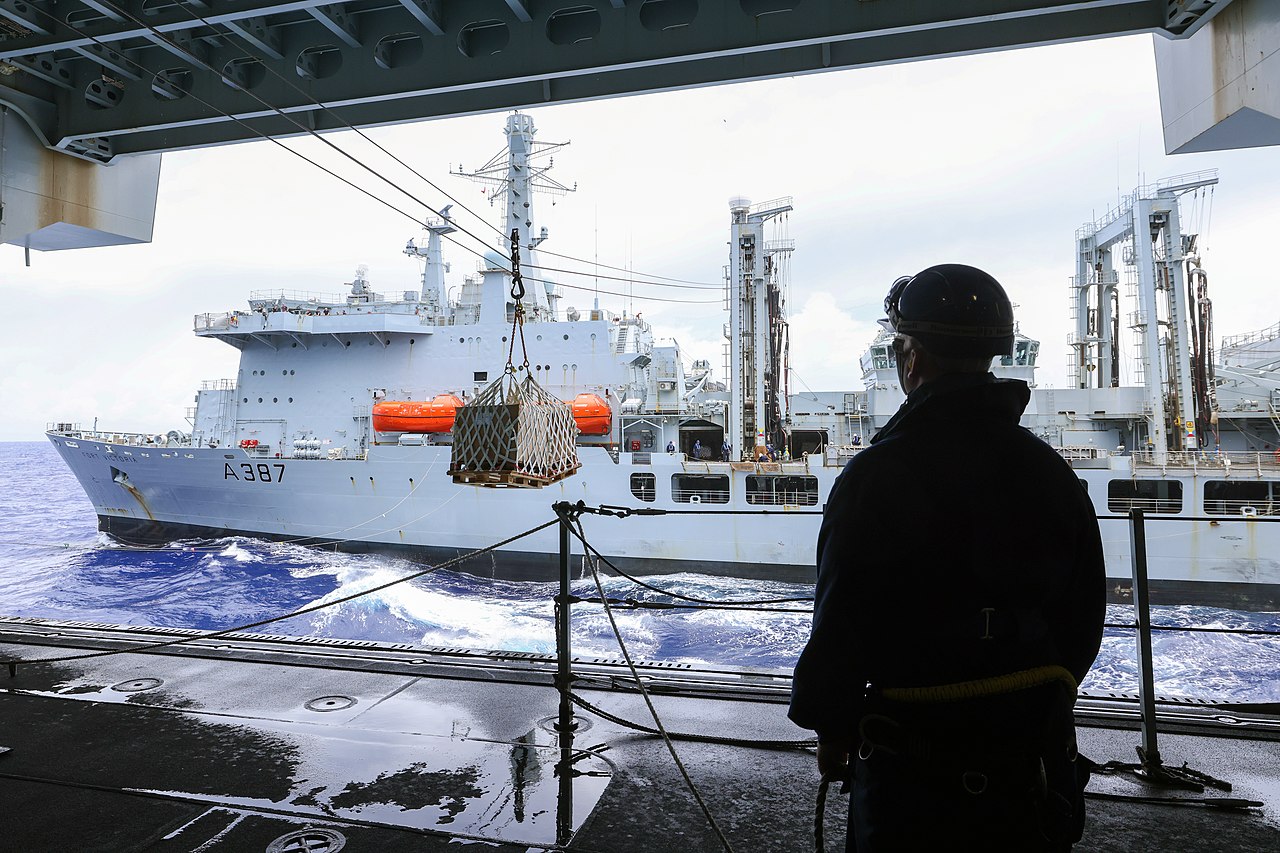
The Ministry of Defence has declined to provide a breakdown of the operational status of Royal Navy frigates, destroyers and Royal Fleet Auxiliary vessels, citing security constraints but pointing MPs to newly released readiness data that offers the most detailed snapshot yet of the fleet’s condition.
In two written answers to Conservative MP Richard Holden, Defence Minister Luke Pollard repeated that the MoD does not publish vessel-by-vessel readiness or long-term schedule information. He argued that availability must be understood as a rolling cycle.
Pollard told Parliament that “around 50 percent of the fleet [is] at high readiness or above at any one timeâ€, and noted that the surface fleet currently stands at 53 ships, with the RFA operating 10.
He also highlighted the ongoing transition from ageing platforms to newer classes. The MoD, he said, is “replacing our Type 23 Frigates with eight of the world’s most advanced anti-submarine warfare ships, the Type 26 Frigates,†with five Type 31s to follow.
Although the minister did not give Holden the granular breakdown he requested, the answer directed MPs to the Defence Committee’s publication of the Royal Navy’s six-monthly readiness-days data. The release includes a ministerial letter and an annex detailing readiness trends across 2024 and 2025.
The documents show significant variation across categories. Type 23 frigates saw a rise in readiness days in early 2025, driven by improved maintenance performance, while destroyer readiness fell sharply due to the high operational tempo in the Red Sea and multiple units undergoing unplanned defect rectification. Littoral Strike readiness dropped as RFA Argus, and the Bay-class ships, entered docking or defect repair. Afloat Support readiness improved due to Operation Highmast, which saw extensive deployment of Tide-class vessels.
The narrative accompanying the data also warns that crew shortfalls continue to affect the RFA’s ability to hold units at readiness.
Pollard stressed that the navy’s long-term fleet plan remains intact, saying the transition programme is designed to protect priority outputs into the 2030s. “The Royal Navy continues to modernise its fleet,†he said, while reaffirming that operational commitments are still being met.
The full readiness-days dataset, including the ministerial correspondence and readiness tables, is available via the Defence Committee’s publication read the document here.





There really needs to be a review of situations where security concerns is used as an excuse to hide data from the public.
Any enemy that we are likely to face that would need to know the info will have it. There are thousands of dock workers, sailors, civil servants and some very old public sector computer networks. It’s not possible that an organised enemy could not get the info out of that if needed. Meaning the only security concern is the public becoming aware and getting annoyed by it.
Ok this government hasn’t had a chance to fix the issues inherited, and don’t want to take the blame for it, but still.
We are where we are. What can be done is being done – T45 upgrades, T26 and T31 programs, AUKUS subs, FSS, MRSS all protected. In the short term the T45s and the Rivers can cover for GP frigates but not the ASW frigates. 🤞 the T26s arrive sooner rather than later. Maybe the T31s for which construction has not started can be fitted with an ASW sonar?
For me UK GBAD and capabilities like Brakestop, Nightfall and the 2000km missile are priorities.
Agree about T31s getting sonar. If the projected operational dates are correct RN could have 2 T31s (Bulldog and Campbeltown) fitted out to support the 5 T26s built by 2030/1.
A Batch 2 T31 of 3 or 4, with sonar, to build in parallel with the Norwegian T26 order wouldn’t go amiss… but money??
Either that or we consider the RN and RNN as a joint force in the N. Atlantic from the get go. Even so there is an argument for giving Bulldog and Cambletown ASW fit. Sell them to the USN as Constellation replacements😂
That all depends on which Navy (US, RN or RNN) needs the hulls quicker, lol.
Got to agree that the funding and lead time for additional sonar sets (and skilled operators) might be a push, but there is no harm is putting the question out there.
FSS and MRSS are hardly protected, both could get cut in number at any point. T31 isnt getting sonar, it hasnt even been confirmed for a weapons upgrade.
Observing the investment Navantia is making in its UK sites I would say FSS is a dead cert and MRSS a better than evens bet; and Juan Carlos LHDs might be a competitive contender.
MRSS is going to be incredibly expensive. 6 ships seems like a stretch at this point. But you can forget about LHDs, the plan is firmly on large LPDs with features like mission bays and other fancy ideas
Ah, yes! I quite forgot; the Mythical Strike Ship.
But 3 mistral style LHD carry as much as 6 Albion style LPD for a lot cheaper. We should just go for LHD
It doesn’t carry just as much, it’s a pretty small LHD. And our future marine strategy is based around water borne raiding not aircraft
1 mistral carries double the vehicles, 200 more soldiers and 8 times the helicopters as 1 Albion.
Helicopters are quicker than landing craft and a better method of getting troops ashore in a fast or high threat situation.
And what about vehicles and equipment? How are you getting those ashore with helicopters. Helos arent stealthy either which is a key part of the Marine raiding strategy.
Jeeps fit in larger helicopters. If you look at LHD ships you’ll notice they still have landing craft for larger vehicles, being able to use helicopters or landing craft gives more options.
We need more amphibious ability than just tiny raiding parties. It’s ridiculous that France, Spain, Italy, Indonesia, soon to be Brazil, can all land more soldiers than we can.
Besides, the range of those landing craft isn’t that high, the MRSS is still going to be detected, and using a ship that will be 20,000-40,000 tonnes for light raiding is stupid.
Go re read those states, the Mistral do not carry double of anything compared to the Albions, not that we have those anymore
40 tanks in the Mistral, 24 in an Albion. Close enough to double. If carrying non tanks the ratio is roughly the same.
16 large helicopters on a Mistral and 2 on an Albion. You’re correct, that’s not double. It’s 8 times as many.
The Juan Carlos which is almost identical price to the Albion is 46 tanks and 25 large helicopters. Fast jets can be swapped in if wanted.
The Royal Marines don’t give a damn about landing tanks anymore so why would that be a factor.
They want boat based raiding so a larger well dock is more useful. The mistral has a fairly small well dock for one thing. Helicopters are also not a major part of the marine raiding strategy or Jet fighters
Our marines were never like the US marine corp.
They might not want to land tanks or large vehicles, but the Army would enjoy the ability to move things about without the need for the Channel tunnel.
What happens if we need to retake the Falklands again for example or conduct a landing anywhere?
The MRSS is overkill for the marines, a 20,000 to 40,000 tonne ship just to drop a couple squads of marines is insanely expensive and inefficient.
helicopters are still pretty good for raiding, say you want to get a bit further inland, but are also very helpful in larger landings.
And no, the jets won’t be used by the marines, but this is the UK. The marines don’t have their own ships, they use navy ships. I imagine the Navy would like it if they still had some fast jets near the UK whenever a CSG is off in the East. not to mention the Juan Carlos does all its things with almost identical price to the LPD of the Albions so for 7 million the ability to carry jets in case it is so wanted or needed is hardly the biggest spending of all time.
The MRSS is under armed for solo operation, too large for a marines raiding ship, and too small a capacity for a proper amphibious assault ship. A classic case of trying to do too many things and failing at all.
The hide behind alleged ‘security concerns’ because the numbers would be a national embarrassment.
Are RFA vessels only crewed by Merchant Sailors, or is the a mix of RN personel too?
Rn personnel will be onboard when weapon systems are fitted.
Security reasons? Bullshit. Excuse is the more likely.
Wow….head slapper….the fleet is being modernised by new T26 and T31, tell us something we don’t know.🙄
World’s most advanced ….tick.
RN continues to meet its ops commitments….tick.
Great. what are they? You could say that if the RN had but a solitary vessel. Armilla gone. APT N&S gone. Ready MCMV gone.
Assume TAPS and FRE remain.
I find politicians evasive answers nauseating. How about admitting we’re at rock bottom and x is in place to, in time, start building up.
But they don’t commit and the DIP remains like some
mythological beast, apparently with all the answers.
What is the betting it’s mostly a package of old news with some confirmations and headline grabbers thrown in? Of the F35A and 12 SSN variety.
This isn’t detterance.
Wow what a load of Garbage, security concerns Anyone can find out pretty what is deployed, what can be deployed and what can’t. They can either get in a car and drive to Birkenhead, Falmouth, Portsmouth and Plymouth and have a look or just go onto X where Britsky does it all for you.
As for the RFA operates 10 honestly did he have his fingers crossed, Fort Victoria and Tiderace are unmanned and at Birkenhead, 2 of the Bays are in Falmouth for refit / maintenance and Argus is presently unseaworthy at Portsmouth so that’s 50% out of service !
OMG over 50% at high Readiness, and surface fleet stands at 53……………….what they counting RIBS now as major surface assets?
Should be criminal offence for MP to LIE
It’ll be those silly little patrol boats named HMS when they’re nowhere near the size of a ship.And some plastic mine sweepers.
Easy to have half the fleet at high readiness if you simply scrap anything at low readiness.
Or you have a really small fleet.
I think the Royal Navy should limit its future deployments to “defencive operations”in the North Atlantic,protecting Great Briton must be a number one priority.Halifax as a regular “port of call”would be better thought of then repeating the mistakes of WW2 .A naval refueling and rearming depot with a drydock and barracks in Halifax could “seal the deal” on our own type 26s for the RCN.