


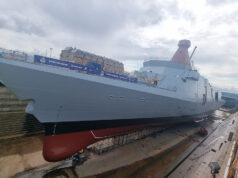
A Type 45 destroyer sent from maintenance to the eastern Mediterranean in seven days has returned to Portsmouth after 214 days away, having shielded the British bases in Cyprus from drone and missile attack, according to the Royal Navy.
HMS Dragon was in dry dock when she was activated as part of the British response to the conflict in the Middle East, which had brought the sovereign base areas on Cyprus under attack. Working alongside Army and Royal Air Force capabilities, the destroyer formed part of the shield against air attack over the island.
General Sir Gwyn Jenkins, the First Sea Lord and Chief of Naval Staff, said: “HMS Dragon’s seven-month deployment has shown the Royal Navy at its best.
“Deployed at short notice, her crew have protected our bases on the island of Cyprus, safeguarded shipping and worked closely with our allies across the Mediterranean and Middle East. They have operated in some of the world’s most dangerous waters with skill and professionalism. Every member of Dragon’s crew should return home proud. And to the families who supported them throughout, thank you for the sacrifices you have made.”
The ship was later sent east of Suez to provide air defence for a proposed international mission to reopen the Strait of Hormuz, sailing through the Bab el Mandeb Strait at the foot of the Red Sea, where Houthi forces in Yemen have been firing missiles and drones at shipping since 2023. Dragon also ran maritime security patrols in the Indian Ocean and spent a period attached to the French carrier strike group led by FS Charles de Gaulle.
Around 950 friends and family met the ship at Portsmouth Naval Base and along the harbour walls.
Vice Admiral Steve Moorhouse, the Fleet Commander, said: “The resilience, professionalism and fighting spirit of Dragon’s ship’s company throughout the last seven months have been outstanding. In an increasingly uncertain world, we need a warfighting ready Navy that can respond at pace wherever the nation requires. Dragon has shown exactly what that looks like. To the friends, families and loved ones who have supported the ship’s company throughout this challenging deployment, thank you, your contribution has underpinned Dragon’s success.”
Dragon is the third of six Type 45 destroyers, all based at Portsmouth, and the class is the fleet’s first line of defence against aircraft, missiles and drones.


if only we could do that with SSN’s and T23
All to get just one Vessel East of Gibraltar..!
And we’re not much better Now…!
Our Conventional Military is little More than a National Guard Equivalent…!
We have 6 destroyers, always needing some kind of upgrade or another. First there was fixing the condensers, then the power improvement programme, then there’s NSM, then Sea Viper Evolution plus Sea Ceptor, then probably Dragonfire. For the last decade, Daring has been sat alongside, storobbed. So getting two deployed at the same time is hard work. Given the lack of cash and the difficulties in running the destroyer fleet, maybe the congratulations on an East of Suez deployment is warranted.
Agreed. Firstly I think we should improve the airfield defences. We need a range of air defences for all our airfields at home and abroad.
Secondly Dragon deployment was quick.
We are getting towards the end of the PIP saga. In theory by January we might have 5 active destroyers many of which will have had decent upgrades. However more upgrades will be needed over time and we should all remember that a third to a half of the fleet on some form of maintenance is normal. Besides it has woken the public up to the fact we don’t have hundreds of ships any more.
In the end the only real comparison is with our likely enemies.. and how many modern AAW destroyers does the Russian northern fleet have ?
So the only threat is another ship? Think again dude.
And it’s Modern SSN fleets ? Exactly how many maritime strike aircraft does it have operational..
Yes we want more, but we do need to “not” be utterly defeatist in regards to the balance of power.
I think Jonathan’s point is that Russia doesn’t have ships that can defend themselves, the rest of their fleet, or adjacent shore facilities from air attack- be that from aircraft or missiles/drones. Or at least not as many as the UK does, nor in comparable quality. So, we can be more confident in our ability to operate in the face of Russian air-based threats because of that. Bear in mind that most threats to a ship are air-based, missiles launched from other ships, aircraft, or shore facilities. That’s a LOT of threats de-fanged just by T45s- and I think that is what Jonathan was referring to.
As far as other threats go, the other obvious one is submarines and their heavyweight torpedoes. Which is what we have ASW frigates, P-8A for. Is that perfect? No. Could we get more stuff for that? Yes. Is it essentially what every other world navy uses for this purpose? Yes.
I don’t think we need to be moaning about ship numbers (a valid complaint, to be sure) on a piece about how quickly the RN was able to turn around a vessel into a conflict zone when they were tasked. Or seemingly discounting the value of a T45 because it doesn’t defend against every threat out there. If I’ve mis-read your post, apologies. But not sure what you were driving at otherwise?
What is the biggest vessels that the Royal Navy have EVER commissioned. I will give you a clue they are currently in service. We have an excellent military and we should be proud of the service provided by our shore maintenance services and our service personnel.
“HMS Dragon’s seven-month deployment has shown the Royal Navy at its best.”
At the bottom of the MOD rabbit hole maybe, but in the real world they should be ashamed of themselves.
“HMS Dragon’s seven-month deployment has shown the Royal Navy at its best.”
No, General, it has not. The attack on Cyprus should have been anticipated ahead of time given the capabilities of Iran’s Lebanon proxies and an asset like Dragon should have been in the area already, given the very visibile build up of US forces in the Middle East in the many weeks which preceded the Iran war.
Yep. Deployed rapidly, weeks after the attack, months after it became clear the threat existed. The deployment showed UK defence at it’s weakest. No real air defences in a major air base in a high threat area of the world and no naval ships that could be deployed until the mod/government was so embarrassed that they had to rush her out.
No doubt in the expertise and professionalism of the crew. Wasn’t there a delay in ordering her to get ready and then depart? Didn’t she also have a an operational problem as well whilst on deployment?
It’s highly likely that Iran and the US (possibly Israel too) will start trading punches again soon.
So, who or what is currently protecting Akrotiri from Ballistic missile attack ?
Potentially not until after the mid terms, so might be relatively stable until November. All depends on if Iran wants to make trump look weak ahead of them or not, guessing they have already made their point.
And it broke down a day later.