

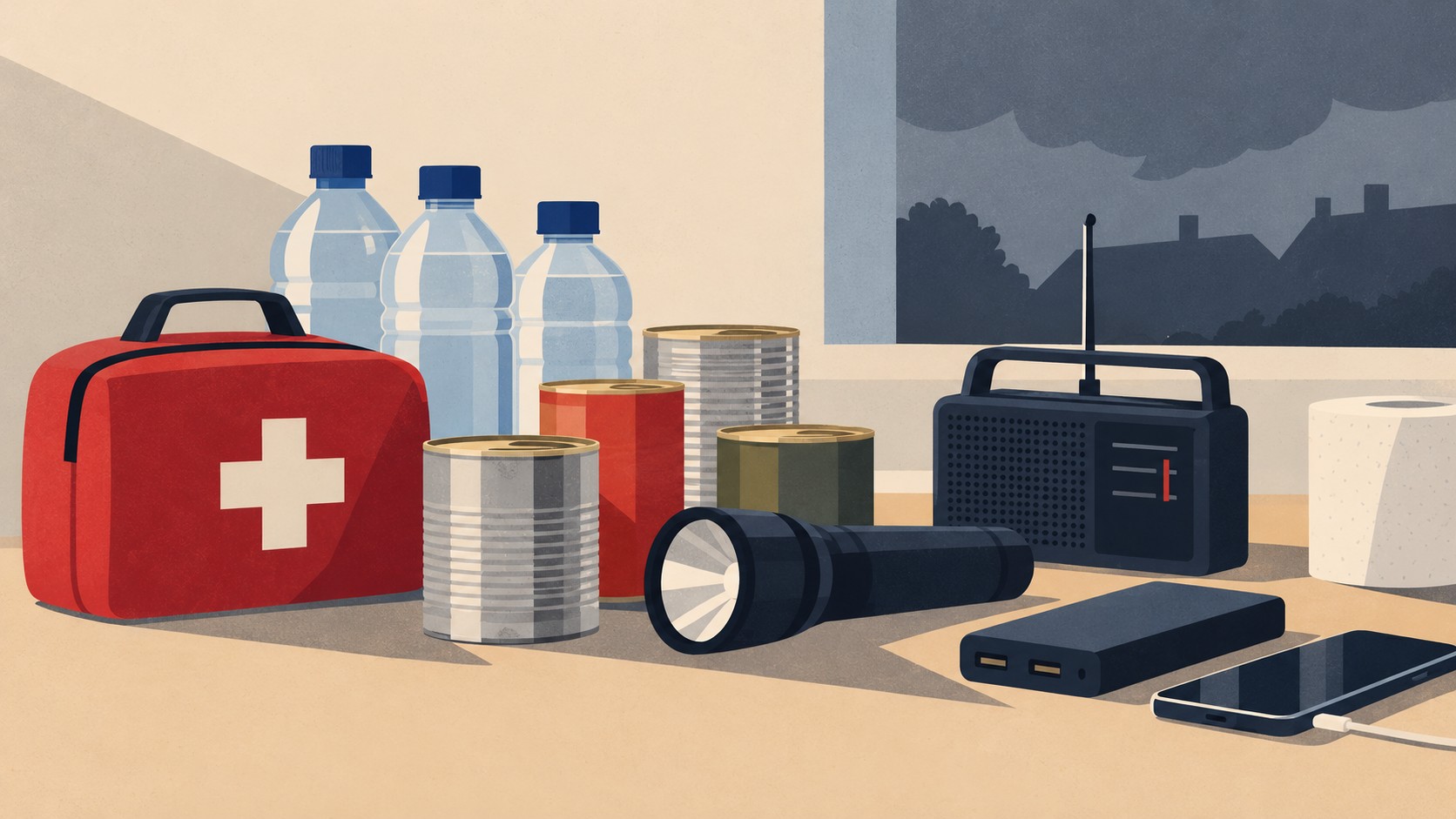
Households across Britain are being asked to keep enough supplies to manage three days of disruption to power, water, phones and the internet, under a campaign launched today that forms the first stage of a three-year programme, according to the government.
The Be Ready campaign is run by the Cabinet Office and published alongside a campaign website and a downloadable checklist. More than five hundred organisations across the United Kingdom have signed up to share the materials.
Dan Jarvis, the Security Minister, said: “Those who can follow this advice should follow this advice.” He said the campaign would bring Britain into line with European counterparts where such advice is part of everyday life, and added: “This is just the sort of community-focused campaign the UK needs to improve our resilience as a nation.”
The three-day figure matches the guidance used in France, Ireland and the Netherlands.
The checklist covers nine categories, and on water it asks for bottled water for three days at three litres per person per day for drinking, noting more would be needed for cooking and washing. On food it asks for non-perishable items with a long shelf life that need no refrigeration or cooking, such as tinned meat, fish or vegetables, dried fruit and nuts, and advises buying food people would usually eat.
Other categories cover hygiene products, a torch with spare batteries, blankets, sleeping bags and warm clothing, a battery or wind-up FM radio and a charged power bank, cash in a mix of coins and notes alongside cards, copies of identity documents, important phone numbers including regular medication and doses, a first aid kit, essential medication, baby formula and nappies, and pet food.
On formula the checklist specifies ready-made or ready-to-feed products, because households may not be able to boil water safely to make up powdered formula.
The guidance tells people to check cupboards first, build the kit gradually during regular shopping trips to spread the cost, set a reminder every six months to check expiry dates, and talk to neighbours about what support they could share during an outage. It also suggests donating spare items to others who might not have the means to prepare, or printing documents for them.
Laura Scott, British Red Cross Director for UK Resilience, said: “We can’t control when emergencies happen, but we can all take some simple steps to be prepared.” She said local people know their communities best and want to play a part when a crisis happens, and that clear and trusted advice, especially for those more at risk, could reduce the impact of crises and save lives.
The campaign also directs people to the Priority Services Register, a free scheme that helps utility companies identify customers who may need extra support during an outage, and to Met Office weather warnings. Scotland and Northern Ireland have their own versions of the advice. Social media and radio advertising over the coming weeks and months will target families with young children and older people.
The campaign arrives alongside a substantial body of government work on resilience, and ministers confirmed this month that a Defence Readiness Bill will be brought forward before the end of this Parliament to give government the powers it needs to respond during escalation towards war, and that government messaging on defence and security will continue to build ahead of Exercise ALBISTON SHADOW, a major British home defence exercise, and NATO’s Crisis Management Exercise in spring 2027.










Preparing us for a tactical nuke in the event our Govts policy of welfare before defence doesn’t actually deter Putin?
Or perhaps in case our diverse and strong communities start looting and setting fire to stuff?
Or they know wind turbines and solar doesn’t produce enough energy, lack of back up sources crash the grid and prove that net zero is a farce?
AI cyber attack crashes the benefit system and there are angry mobs of the anxious, ADHD and bad back claimants?
If things are looking that serious shouldn’t the Gov stop cutting defence capability?
@David.
If war were genuinely imminent, the government wouldn’t be asking you to … “gradually buy an extra tin of soup during your weekly shop to spread the cost”. The “Be Ready” campaign is a sensible, somewhat boring piece of civic housekeeping designed to stop people from stripping supermarket shelves the next time a bad winter storm cuts the power. It’s just aligning the uk’s civic planning with most of Europes public resilience plans.
Here in Australia, the gov does suggest preparing, but it handles the message very differently to Europe by focusing almost entirely on regional natural disasters rather than national, war-footing (trench war or missile strike) security threats. The federal government avoids launching loud, television-wide campaigns telling the entire nation to buy up extra groceries out of fear of causing mass panic-buying, official emergency agencies absolutely recommend that households maintain local readiness kits. The Australian approach is structured around two distinct themes.
The 14 day isolation guideline. When Australian state and federal agencies issue official preparedness checklists, they actually recommend a timeline that is much longer than the UK’s new 3 day rule.
The official advice through the FDA, NSW Health, and the NSW Food Authority is that households should hold a sufficient supply of food, water, and essential items to remain completely self-sufficient at home for up to 14 days. Because Australia is prone to extreme weather; extreme bushfires, widespread flooding, and severe cyclones, communities can easily become physically cut off from transport infrastructure for weeks at a time. The 14 day window is designed to ensure people can survive until rural roads can be physically cleared or rebuilt.
The localised “Emergency Kit” message in Australia is targeted through local emergency networks like the State Emergency Service (SES – 43,000 SES volunteers spread across the country) and Rural Fire Services (RFS over 70,000 volunteers spread across NSW, Australia). The standard NSW SES Emergency Kit Checklist details exactly what households should keep packed in a dedicated waterproof container, stuff like –
Water – a baseline of 3 litres of ‘drinking’ water per person, per day.
Pantry items – non perishable, ready to eat canned or boxed foods that require no electricity to cook.
Power and comms – A battery-powered or hand-crank radio to monitor emergency broadcasts when mobile towers melt or lose power, torch, first-aid kit, and vital documents packed alongside physical cash.
The reason it feels like Australia doesn’t suggest stockpiling is down to the tone and the narrative.
In Europe, campaigns like Sweden’s “If Crisis or War Comes” explicitly warn about foreign state cyberattacks, military escalation, and global conflict. However, in Australia, the advice is framed strictly as a practical response to severe climate and seasonal weather events, the government deliberately leaves it to the local emergency services to quietly publish the checklists on their websites rather than making it a major headline issue, keeping the public calm while still ensuring that regional and suburban households have the resources they need to look after themselves if a major flood / fire / major industrial accident / solar storm / biological and/or health outbreak etc. etc. hits and affects “grid” aka …
The Energy Grid – Electricity, Gas, and Fuel.
The Digital Grid – Communications and Data Centres.
The Utility and Logistics Grid – Water, Food, and Finance.
Disrupts the weekend footy, or even worse the … bottle-o!
The idea that it’s a secret nuclear warning belongs firmly to the comment sections of UKDJ … You’re entirely bonkers. But I’ll tell you a secret. All the best people are.
Hi Mate, I think the mantra that UK Gov are pushing out, doesn’t seem to have any weight behind it and is a mixed or even confusing message. On one side of the coin they say prepare and stock up, as war with Russia is becoming more likely. Yet on the other side of the coin, they say we don’t want to panic people, so don’t rush out an panic buy. In the past, the UK has had power and water outages for 3 days or more. With those on the West coast usually suffering the worst, due to storm damage. So in the natural disaster context, stocking up on essentials makes sense and should be the narrative. Especially as its an El Nino year, which typically means for the UK more severe storms during winter. Though 3 days seems to me to pretty light. As per Oz, 7 to 14 days should be the target. However, if you are prepared for an outage of services for 7 days or more, this would work equally for a conflict with Russia, who have a history of targeting essential services.
@DaveyB,
Who is saying “prepare and stock up, as war with Russia is becoming more likely”? is the gov. saying that?
The recent three day resilience campaign is far more about subtle public conditioning than it is about an imminent nuclear strike. Government communications rarely drop major shifts in public posture overnight because doing so would simply trigger widespread panic, empty store shelves, and spark unnecessary chaos.
Instead, using a manageable 3 day target based around everyday disruptions like severe winter storms, localised flooding, power outages, and digital infrastructure glitches serves as a classic psychological nudge … It normalises the fundamental concept of household self-reliance without causing mass alarm.
Once the general public breaks the barrier of keeping basic water, non-perishable food, and a torch in the cupboard, the baseline shifts. Moving that mindset from three days to a week or more becomes a natural progression down the track rather than an alarming demand much later in the process.
I’m of the opinion that Western national security planners are well aware that modern hybrid threats and gray-zone warfare do not start with a grand military invasion. They begin with cyber disruptions to power grids, undersea cable sabotage, or supply chain bottlenecks, basically civic disruption. We, Europe and the UK by definition are well into a grey-war.
Conditioning society to expect occasional utility breaks builds a baseline of resilience so that if a hostile state or severe storm knocks out a substation, the population remains stable rather than immediately overwhelming emergency services (people will panic, they will panic buy, it’s their duty to protect themselves and their families).
The doom-mongers online who immediately claim missiles are inbound tonight are simply missing the point, this is a quiet, long-term effort to undo decades of public complacency and gently reintroduce basic self-sufficiency for an increasingly unpredictable world.
In the UK, I wouldn’t worry about El Nino so much, especially as not all El Ninos are created equal. For the UK they happen thousands of miles away in the tropical Pacific, in my patch, its energy has to travel through global air currents to reach parts of Europe, meaning its influence on the UK is indirect, diluted, and far harder to forecast with precision. Instead of dictating UK weather directly, El Nino simply … “loads the dice” for how the North Atlantic Oscillation might behave.
The El Nino–Southern Oscillation, ENSO loads the dice, rolling a 6 (hot, dry, bushfire conditions) becomes far more likely, but you can still roll a 2 or a 3 (a normal or even wet week).
For instance, during an El Niño, a sudden coastal low or tropical cyclone can still dump huge amounts of rain over part of Queensland or NSW, breaking up what would otherwise be a dry spell.
… With a standard die (A neutral Year ) you have a 1 in 6 chance of rolling a 1 (unusually cool/wet), a 1 in 6 chance of rolling a 6 (extreme heat, drought, fire weather), and a 4 in 6 chance of rolling something in the middle.
… With a loaded die (El Niño Year) the ocean and atmospheric setup essentially “loads” the die. So, instead of one single 6 on the faces, the die now has three or four 6s. Thus, “rolling a 6” in that context means actually landing on one of those extreme, high-impact climate outcomes, such as severe, multi-day heatwaves, flash droughts, or extreme bushfire danger.
Even with a heavily loaded die, it is still statistically possible to roll a 2 or a 3 e.g, getting a sudden coastal trough that brings localized heavy rain, or a moderate stretch of weather. But because the odds are weighted, the likelihood of landing on a “6” throughout the season goes way up.
Statistically, an El Nino winter tilts the odds toward a stronger +NAO Atlantic storms in early winter, followed by a higher chance of a atmospheric block -NAO and cold snaps by late winter.
… Positive NAO (+NAO) is a big pressure gap that steers a powerful jet stream straight across the UK. This locks in mild, wet, and stormy Atlantic weather.
… Negative NAO (-NAO) is when the pressure gap weakens or reverses, slacking off the jet stream. This causes a “blocking high” over Scandinavia or Greenland. (Blocking high is when a high-pressure system becomes exceptionally strong and massive, it “blocks” or splits the jet stream. Instead of weather systems flowing across normally, approaching low-pressure storms are forced to detour around the high, either diverted far up to the north into the Arctic or pushed way south into North Africa). Because high-pressure systems feature sinking air that creates clear skies and light winds, the weather underneath a blocking high stays essentially locked in place for days or even weeks at a time, opening the door for Arctic northerlies or Siberian easterlies, bringing severe cold snaps, frost, and snow, like the 2018 “Beast from the East”.
If you want to know what next week’s or next month’s UK weather will actually do, watch the NAO. El Nino sets a vague background climate trend for the hemisphere, but the local pressure setup of the North Atlantic is what determines whether the UK gets battered by Atlantic gales or frozen by a continental Arctic block.
Sorry, went off on a tangent, I had to know my Australian / UK weather scenarios due to location filming. It’s all all on apps these days, very handy.
17,000 toilet rolls.
I saw that at the beginning of COVID.
Well it is back to the 70’s. You might want to dig hole in the garden too, just in case.
So HMG now want us to stack up on physical cash ? Maybe they should stop driving us towards digital payments only and introduce legislation that prohibits businesses from refusing to accept cash payments for goods and services.
@Steven,
the UK will not go entirely cashless anytime soon becuase the law strictly forbids the banking sector from abandoning cash users. The Financial Conduct Authority (FCA) enforces a robust ‘Access to Cash Regime’. By law, major banks must ensure that free cash withdrawal and deposit services are available within one mile for the vast majority of urban residents, and within three miles for rural communities. A bank can no longer shut a high street branch and walk away. If a closure leaves a local community without cash access, the bank is legally required to fund an alternative, such as a shared “Banking Hub” or a deposit-taking ATM, before they are allowed to close their doors. the gov has committed to opening 350 of these banking hubs over the next five years to keep high streets functioning.
The perception that the government is driving a cashless society comes from businesses and banks, not the law. Only about 12% of UK transactions are now made using physical cash, while over half of British adults now routinely use mobile wallets like Apple Pay. Because handling cash costs money … security vans, bank deposit fees, insurance, many private shops, cafes, and transport networks are independently choosing to go card only to save on administrative costs.
Here is the perverbial ‘fly-in-the-ointment’ … In the UK, a private business is legally allowed to refuse cash if they wish!!!
Complain!
[Your Name]
[Your Street Address]
[Your Town/City]
[Your Postcode]
[Your Email Address]
[Date]
To: [Insert Your MP’s Name] MP
House of Commons
London
SW1A 0AA
Subject: Urgent need for a “Right to Use Cash” Bill to protect consumers and businesses
Dear [Insert MP’s Last Name],
I am writing to you as one of your constituents to express my deep concern regarding the accelerating trend of high street businesses, public transport networks, and local services refusing to accept physical cash payments.
While I welcome digital financial innovation, the current legal framework is creating an invisible wall of exclusion in our community. Under current UK law, private businesses are entirely within their rights to refuse banknotes and coins, stating “cards only.” This is causing genuine harm to several vulnerable groups within our constituency:
– Financial Exclusion: Over three million people in the UK rely entirely on physical cash to manage their daily lives, including the elderly, low-income families budgeting through a cost-of-living crisis, and individuals without access to standard bank accounts.
– Grid Vulnerability: Forcing our entire economy onto a digital-only system leaves us entirely exposed to IT failures, power cuts, and cyberattacks on our critical infrastructure. When the digital network fails, cash is the ultimate backup utility.
– Privacy Erosion: Citizens must maintain the right to spend their own legally earned money without every transaction being tracked, logged, and monetized by private tech platforms and banking corporations.
While the Financial Conduct Authority (FCA) has implemented rules to protect the supply of cash at ATMs and banking hubs, these protections are ultimately meaningless if consumers are legally stripped of the demand to spend that cash on the high street.
Other European nations, such as France, have successfully legislated to make the refusal of physical currency illegal for routine retail purchases. I believe the UK must follow suit to protect our high streets and our citizens.
As my representative in Parliament, I urge you to raise this issue with the Chancellor and the Treasury, and to publicly back a “Right to Use Cash” / Payment Choice Bill that legally compels retailers and essential services to accept cash alongside digital payments.
I would be grateful to hear your thoughts on this matter and to know what steps you are taking to ensure cash remains a protected, permanent fixture of our society.
Thank you for your time and your continued service to our constituency.
Yours sincerely,
[Sign your name here if printing, or type your name]
They seem to be confident that it will only be at least 3 days. How do I say this without getting in trouble? Put it this way, don’t expect the police to be available to help, which is nothing new.
Hoping that people just push that out to 21 days without the gov saying it so’s not to incite a panic. At least your gov talks about this, mine says nothing.
Come on don’t join in the tabloid screaming hysteria. We are the only country in Europe who never mentions preparedness for even the most trivial issue let alone crisis. We are becoming a nation of milk sops and fools. During the last water outage around here people queued for hours for free water when the supermarkets had just re-supplied after the morning rush and the mains were back on 12 hours later.