

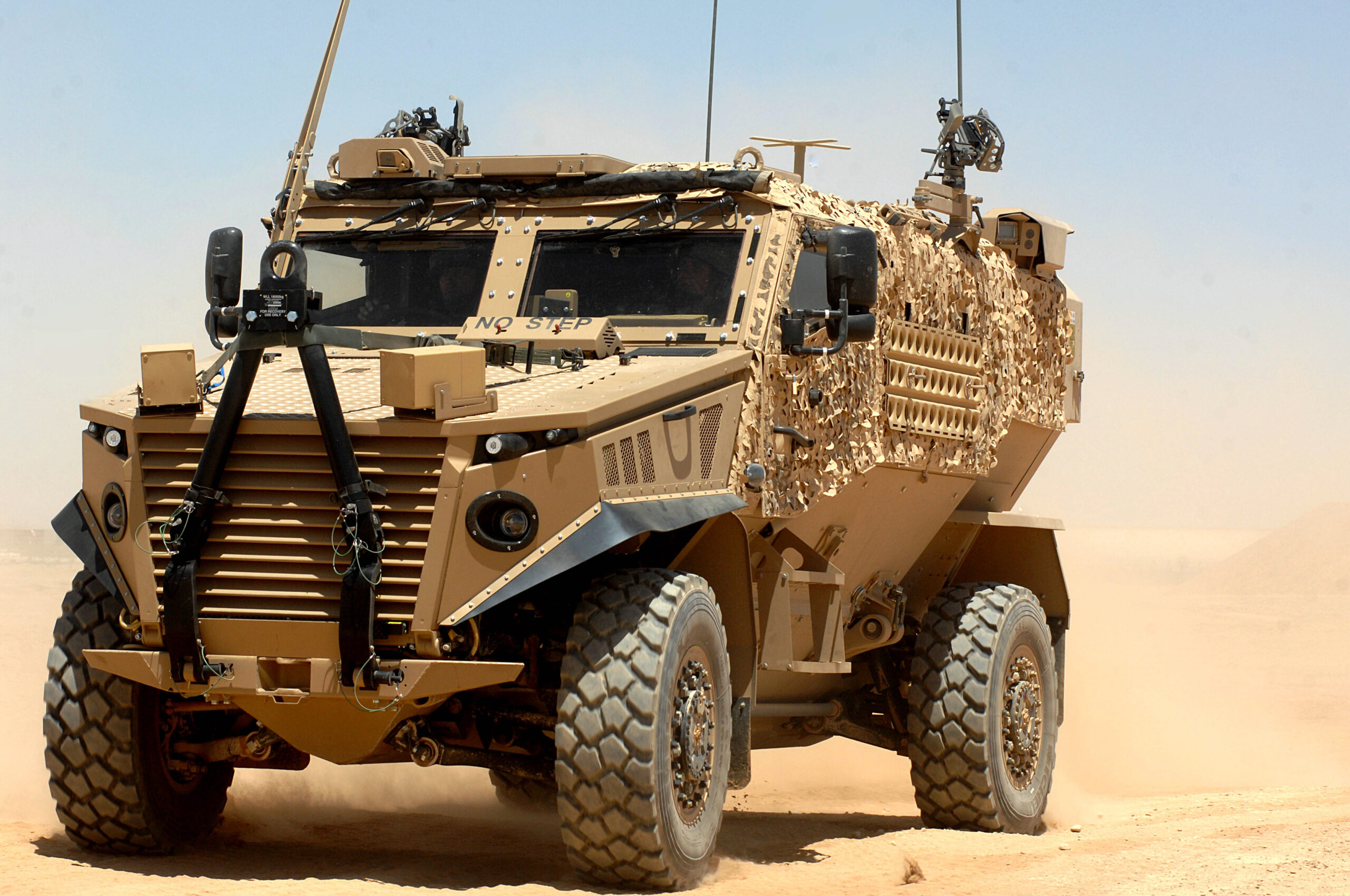
Hybrid versions of Foxhound and Boxer could each carry a high-energy laser within the mass the platform is already built to take, according to a paper presented in Michigan today. The hybrid variants are modelled rather than built, though the MOD has already developed an experimental hybrid Foxhound.
A technical paper presented at the Ground Vehicle Systems Engineering and Technology Symposium in Novi, Michigan, today argues that hypothetical hybrid versions of Foxhound and Boxer could both carry a high-energy laser inside their existing payload envelopes.
The paper, by Rupert Tull de Salis of Power Size Technologies and presented by the company’s chief executive Wiktor Dotter, screens five classes of laser against both platforms using the firm’s powersize.tech simulation software and vehicle data already in the public domain.
A hybrid Foxhound could support a 60 kW laser with almost no further change to the powertrain, and 150 kW with the engine uprated from 160 kW to 228 kW. A hybrid Boxer could support 300 kW with no engine change at all, and 500 kW with an uprate from 600 kW to 704 kW. On Boxer, the paper finds the 15,000 kg mission module payload is never the limiting factor.
Both vehicles are in British Army service with conventional diesel powertrains, and the hybrid variants modelled here are hypothetical. The company states plainly that they are not proposed, funded or under development by any manufacturer or by the Ministry of Defence, and that the results are concept-stage screening outputs intended to guide early design decisions rather than detailed engineering figures.
The MOD has, however, developed an experimental hybrid Foxhound through Technology Demonstrator 6, which makes the Foxhound case less abstract than it might otherwise sound.
Why the hybrid gets the laser cheaply
The paper’s central argument is that hybridisation and laser integration are not two separate bills. Fitting a laser to a conventional diesel vehicle means bringing its entire power supply along: a dedicated generator, its own electrical distribution and the equipment to convert that power into a usable form. A hybrid has already bought most of that, because generating and moving electrical power is what its powertrain does. The paper estimates the laser’s remaining power supply requirement shrinks to little more than a converter and a filter, roughly half the weight of the standalone equivalent, and that the saving grows with the size of the laser.
The batteries are the second dividend and sized so the vehicle can observe or move without running its engine, they hold enough energy to fire the laser as well. Either vehicle could therefore engage a target with the diesel switched off, which matters because noise and exhaust heat are what give away a parked vehicle.
“Everyone in this industry knows that lasers need power and that power means hybridisation, but until now there has been no quick way to find out whether a particular vehicle can carry a particular laser before either design is frozen,” Dotter said. “If you have already hybridised a platform for silent watch and silent mobility, you have paid most of the price of putting a laser on it.”
The Foxhound squeeze
The harder problem is not the laser but the conversion as hybridising Foxhound adds around 1,100 kg of powertrain against a 2,000 kg payload, and its 7,500 kg gross vehicle mass ceiling cannot simply be raised, because heavier vehicles fall under different driving licence rules in the UK and Europe.
The paper handles this by assuming, as is normal in vehicle redesign programmes, that weight is recovered elsewhere to preserve the original payload target. That assumption is doing a considerable amount of work, and it is the point at which a sceptical reader should press. Boxer faces no equivalent pressure, with an order of magnitude more payload against a much smaller powertrain addition.
A grammar for laser weapons
Alongside the vehicle analysis, the paper proposes a classification scheme the field has so far done without. Existing discussion relies on informal shorthand such as “the 50 kW class”, which describes what a weapon draws rather than what it can defeat. The five classes set out here, A to E, run to 500 kW and are defined by target: optical sensors and small drones at the lower end, through loitering munitions and rockets, up to helicopters, fast jets and supersonic cruise missiles.
Underpinning it is a measure the paper calls the Sustained Firing Fraction. A laser cannot fire continuously, because most of the electrical power it draws becomes heat that has to be shed before the next shot. How much of an engagement a laser can actually spend firing therefore determines how much power the vehicle must supply, and the paper argues this is the least published and most important number in the entire calculation.
Timing
The analysis arrives against firm procurement signals, the 2025 Strategic Defence Review committed close to £1 billion to directed energy capability, and in June 2025 Defence Equipment and Support issued a market engagement notice for a vehicle-mounted land laser with a £20 million budget and a requirement to deploy within twelve months of contract award.
In the United States, the Army has fielded a 50 kW system on Stryker and is pursuing a 300 kW-class programme. The German Bundeswehr has ordered Skyranger 30 HEL systems on the Boxer chassis.
Dotter offered the same analysis on Stryker, a pitch as much as a finding, though the company is not without hands-on credentials in the field: Power Size personnel were previously involved in Project SWINTON, mounting and trialling a directed energy laser on a Wolfhound.
“We have built the whole analysis on open-source vehicle data so that anyone can challenge the numbers or rerun them with their own assumptions,” Dotter said. “I would far rather have that argument in a conference room than discover the problem later in a programme.”








One way to retain the excellent Foxhound….well at least a few.
I vote they use the foxhounds as protected mobility vehicles..
Mmm another role for the boxers we don’t and won’t have enough of👍of course there is always the not gold plated Patria 6×6!
Buy a tracked IFV and give it to the 4 Battalions of 3 Division.
4……
Which then allows Boxer to go to 7 Brigade, a vast upgrade on Foxhound.
Which then allows the Foxhounds to pass to 4 Brigade,which is an upgrade on walking or nothing at all.
Or….in buying the new LPMV give that to 4 allowing the Foxhounds to go to the 2 Reserve Brigades being organised, so they are a modern version of Saxon which also was to rush to BAOR,.
Or, the 5 Battalions of Reserve in 3 Division, if their conops isn’t just BCR and they can make use of them.
But FFS, don’t just throw them away.
I’d be happy with any or all of those scenarios.
Did you say war footing Mr Starmer?
On lasers, they were trialling on a much bigger vehicle before Wolfhound.
I wonder if there’s a way to construct useful armour material out of lithium iron phosphate electrolytes
…and a bit of Googling says yes there is and they’re already developing it
* frikkin’ lasers
Good grief just get thousands of the dam things and try them everywhere.
Why do we have to turn everything into a 10 year project.
JCB just beat the landspeed record for a hydrogen power vehicle showing its potential. The government needs to get behind JCB on this. Why? Not because the miltary need hydrogen ICE. Because Britain needs internal combustion engine manufacturers, a Hydrogen ICE production line is far easy to covert to manufacture diesel units which will be needed in wartime scenario. Fossil flues still offer massive advantages 1. very portable 2. the physics are undeniable they offer a fantastic mass to energy ratio. 3 easy to store in volume or in a distributed model.
Expat, that is the least of our military’s pressing needs.