What capabilities does NATO actually need from events like NATO Edge, which are most urgent, and what is missing?
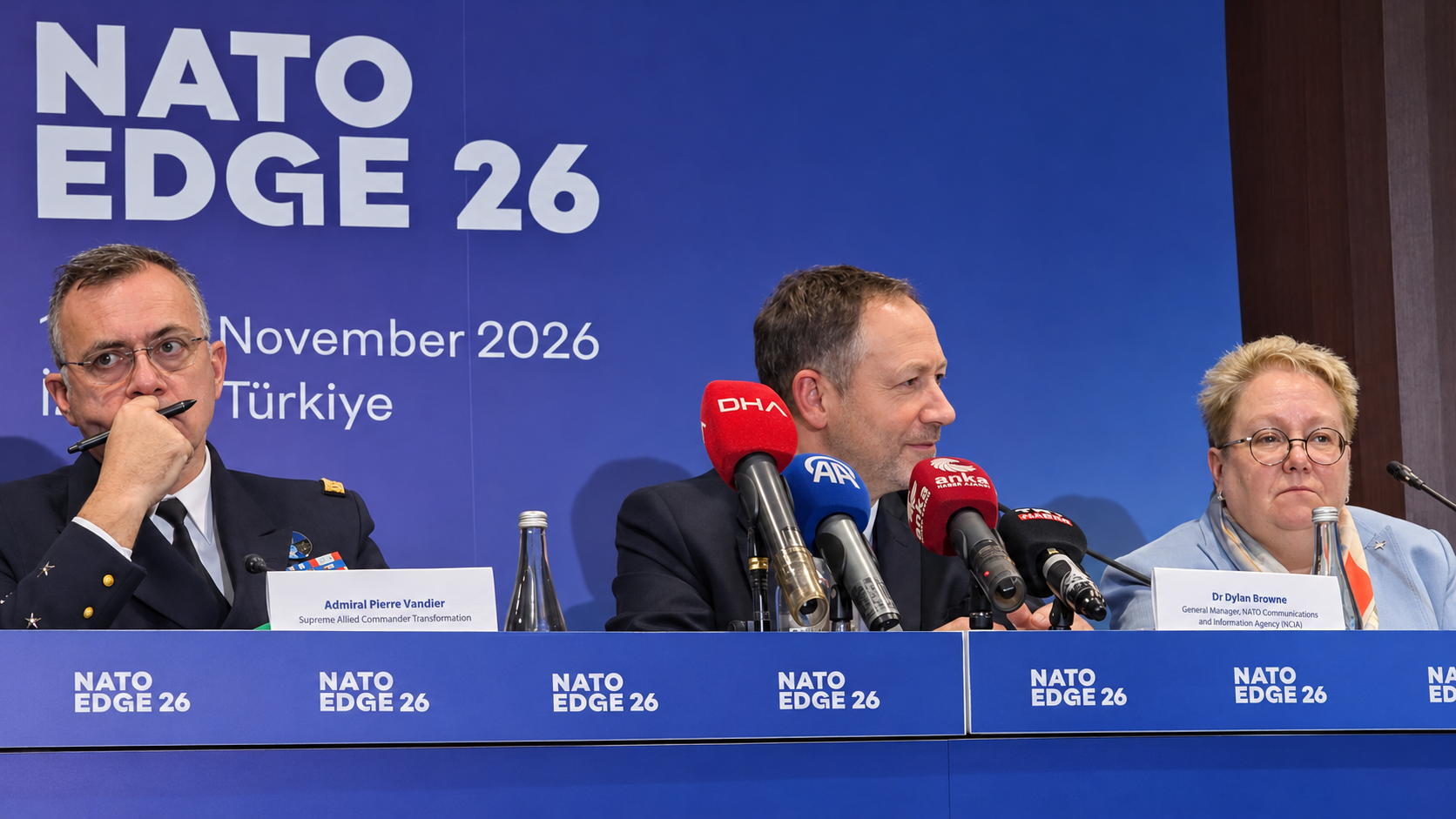
That was the question put by the UK Defence Journal at a joint press engagement at the close of the first day of NATO Edge 26 in İzmir, drawing on a remark by Dr Dylan Browne, General Manager of the NATO Communications and Information Agency, the day before, that the event would help deliver the future capabilities the Alliance needs to defend itself.
Browne’s answer was that NATO was not short of capability but of scale. “I wouldn’t say anything is missing. I think we just improve it,” he said, adding that NATO had executed a robust strategy in communications and information systems and had the capabilities it needed. NCIA undertakes more than 200 exercises a year, he said, but it needed the opportunity to scale up. Recent global events had shown the value of cloud-based applications for intelligence and AI-driven insights, which allowed NATO to draw on “our 32 allied nations’ brightest brains and smartest intel analysts” to make the right decisions.
Browne then passed the question to Admiral Pierre Vandier, NATO’s Supreme Allied Commander Transformation, who said the Alliance was at “the beginning of the new age” and that there was a lot still to build. He set it in historical terms. The First World War, he said, was fought by farmers with bayonets, rifles and tractors, and the Second World War was a contest between rival industrial systems. “Today we see that we are turning to a digital competition,” he said.
That did not mean the physical battlefield had gone, he added, with ammunition, missiles, tanks and rifles still needed, but digital was now the enabler and AI was at its centre. He pointed to Ukraine, saying Ukrainian forces had disabled 54,000 soldiers in October, a figure he attributed largely to AI accelerating the OODA loop, the cycle of observing, orienting, deciding and acting. “So it’s not really new capabilities,” he said, “but putting the digital and the AI centric in a lot of sectors of warfare.”
That view was echoed across the first day of the conference. Ukraine’s digital transformation minister, Oksana Ferchuk, told delegates that Ukraine’s front line was now “fully online”, with AI embedded across its equipment, and urged European allies to stop debating whether to use AI at scale and focus on using it faster than their enemies. NATO’s Assistant Secretary General for Cyber and Digital Transformation, Jean-Charles Ellermann-Kingombe, said on the same panel as Browne and Vandier that the biggest obstacle to NATO’s digital priorities was the speed of adoption, because technology was advancing faster than the organisation.
Others framed it as a question of mindset. NATO’s Deputy Supreme Allied Commander Europe, Air Chief Marshal Sir Johnny Stringer, said earlier in the day that digital capability was not merely enabling but “foundational”, and that commanders’ ambition and imagination must stay ahead of the technology. Major General Rainer Beeck, Deputy Chief of Staff Cyberspace at Allied Command Operations, put it more bluntly in his own remarks to the press: “The warfighter needs capabilities, not promises.”