

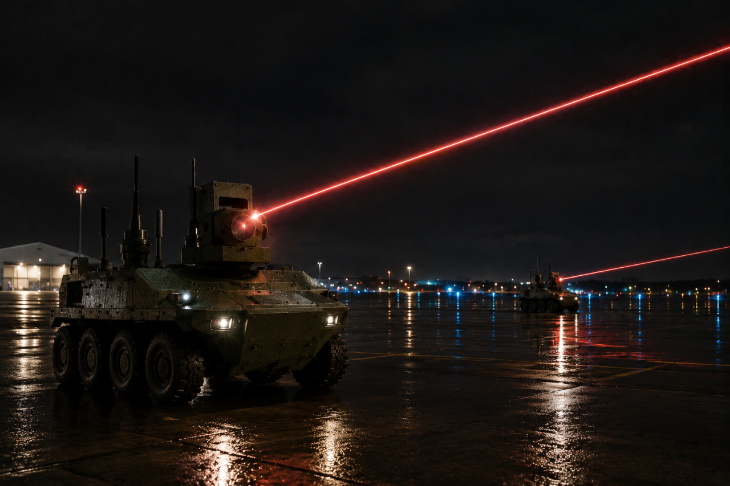
The Ministry of Defence continues to assess the most effective ways to deploy and integrate directed energy weapons across different environments and platforms, in response to a question asking whether lasers will be adapted for use on autonomous vehicles, according to a written answer published on Friday.
Luke Pollard, Minister of State for Defence Readiness and Industry, was responding to Andrew Rosindell, the Reform UK MP for Romford.
“Recent conflicts in the Middle East have highlighted the growing threat posed by low-cost, massed drone attacks. Directed Energy Weapons (DEW) have the potential to provide a highly effective and cost-effective response to these threats, which is why the Ministry of Defence is investing £490 million over the next four years to bring these capabilities into service.”
On where they might end up, Mr Pollard said: “DEW technologies have the potential to operate across a range of operational environments and roles. The Department continues to assess the most effective ways to deploy and integrate directed energy weapons across different environments and platforms to address threats and meet evolving military requirements.”
What makes lasers attractive against drones is the price of each engagement. A shot costs a few pounds in electricity, against a target that may cost a few thousand, which reverses an exchange that has troubled Western forces since Houthi attacks in the Red Sea saw multi-million pound missiles fired at aircraft worth a fraction of that.
The constraints that have held the technology back are power, cooling and weather, since a laser needs enough generating capacity to charge between shots and enough cooling to avoid damaging itself, which is why the systems have appeared first on ships, where both are available in quantity, and why fitting one to a vehicle is a harder engineering problem than fitting one to a warship.










More shit, guff and spin by our current communist shit lizards in charge!
Another bad morning Donny?
Every day these spaz crew are in charge is a bad day for all!
Blah blah blah
Interesting link in the article. I didn’t realise “parallelparliament” let you delve into background docs.
Well knock me down with a feather.
Absolutely no reason why we shouldn’t order loads in quantity and try them everywhere.
Not sure quite what value politicians might add to this other than supplying the money to give it a shot.
I don’t quite see what the grumble is here. Using lasers for short-range target designation from your Challenger is one thing, turning the same laser into a longer range, powerful AA weapon.is quite another.
The USN ran a DEW R&D programme but it proved unsuccessful and was terminated, defeated by the physics. We obviously think that we can maybe crack the problems of the beam diffusing over anything beyond very short range, of being ineffective in cloud, dust, rain or snow, of the considerable power resource needed, which makes it a challenge for mounting on a Stormer/Ajax/Patria-type land vehicle and the consequent problem of the launcher over-heating, etc., etc.
Even if the physics can be solved, the cost of a Dragonfire-type launcher is apparently considerable compared to a 30mm or 40mm cannon.
This whole DEW programme sounds like a cutting-edge research project, which may or may not deliver an effective, affordable weapon system. It is worth doing, if we want to produce top-end kit to equip our forces and win export orders.
Rather than blah blah, i think the MOD is rather rushing into talking about installing Dragonfire on T45s etc, do we know that it actually works better than a lowly Phalanx and is actually affordable? Even moreso with ground-based SHORAD/C-UAV, where the power supply and mobility are going to be issues.
People bleating about something that is a research work-in-progress ne3d to ease off. I would think there is a team of pretty bright scientists and engineers working hard on this behind the scenes, overcoming the limitations imposed by physics and endeavouring to produce something that is affordable.