

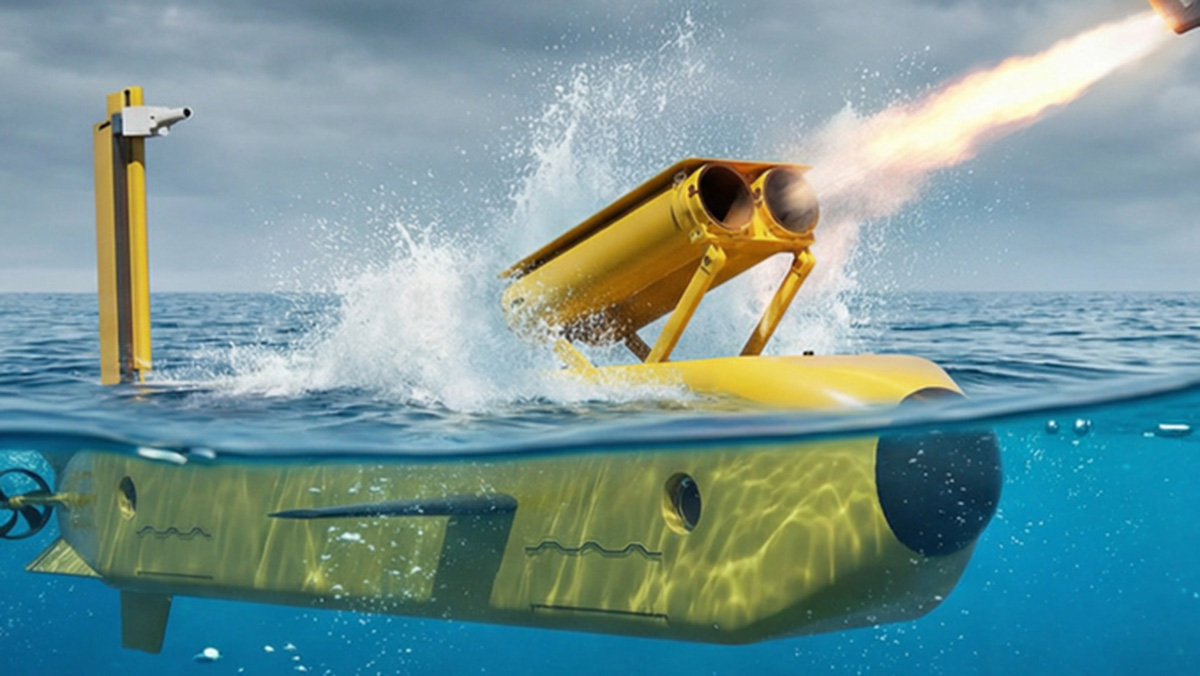
Lockheed Martin has unveiled a new autonomous undersea vehicle it says could give the U.S. Navy and allied forces a flexible platform for surveillance, seabed operations and the delivery of weapons, including the potential deployment of unmanned aerial systems.
The company announced the “Lamprey” Multi-Mission Autonomous Undersea Vehicle (MMAUV) on 9 February, describing it as a plug-and-play system designed for covert access and sea denial missions in contested maritime environments. Lockheed said the vehicle can be transported into theatre by attaching itself to a host surface ship or submarine, without requiring modifications to the host platform.
The company claims Lamprey is capable of arriving with fully charged batteries and can recharge while deployed using onboard “hydrogenators”, enabling longer endurance operations without returning to a support ship. Lockheed said the design is intended to support assured access missions such as intelligence gathering and persistent surveillance, as well as sea denial activities including electronic disruption, decoy deployment and kinetic attack.
“The modern battlespace demands platforms that hide, adapt and dominate,” said Paul Lemmo, vice president and general manager of Sensors, Effectors & Mission Systems at Lockheed Martin.
Lockheed also said the vehicle includes an open-architecture payload bay allowing it to be configured for different mission sets. The company suggested this could include payloads ranging from anti-submarine torpedoes to UAV launchers, indicating the system could potentially act as an underwater “carrier” for deploying other effects or platforms.
“LampreyMMAUV was internally funded, letting us iterate at lightning speed and hand the Navy a true multi mission weapon that detects, disrupts, decoys and engages on its own,” Lemmo added.
Lockheed described Lamprey as capable of delivering both kinetic and non-kinetic effects, collecting multi-intelligence data, supporting targeting, and deploying equipment to the seafloor. The firm said the platform is designed to provide persistent autonomous presence while reducing reliance on traditional manned undersea platforms.


Gerry Anderson was way ahead of his time.
Excuse me halfwit he came up with a pink Roller that pre dated Homer Simpson’s similar efforts on automobile design too, but hey I lay claim to inventing this idea and indeed raised the possibility of such a platform on here a number of times over the last 2 years whenever the subject of Sea Babies or similar came up, though I did suggest Brimstones, light torpedoes or something similar as a potential armament but must say drones have become the weapon of choice over that time. Seriously though I’m glad someone has picked up on the concept, just surprised smaller companies European or wider afield specialist companies didn’t propose it first rather than a less flexible giant like LM. To me when you see what the Ukranians have done it appears pretty obvious a craft of this nature (in addition to one way sea drones) could be extremely effective and more stealthy. Indeed the Ukranians have sort of covered much of this with their underwater drones that recently sank the submarine and the Sea Babies armed with adapted air to air missiles. My only questions were about potential size, range and guidance for an underwater platform to get it to where it needs to be to use whatever weaponry it’s fitted with.
“Thunderbirds are go” was my first thought when I saw the picture, the marketing department strikes again….anything can happen in the next……😝
Bit of a gold plated, low saturation strike “carrier” that can hold some torpedoes for Patrol boats and supposedly a pair of drones that would attack a frigate high and head/side on… Deck cannon would have ripped those apart. Then once the small drones and small torpedoes are launched, you’ve got an high cost “asset” that’ll need recovery or just sinks like disposed weaponry.
Why didn’t deck cannons do that to many of the Ukranian Sea Babies that hit, damaged or sunk Russia assets? And they traveled hundreds of miles on the surface. Equally Ukranian underwater drones managed to sink a submarine in a ‘protected’ harbour not long ago. So I would say this idea has leges and is less expendable than either of those two platforms. Certainly worth exploring.
I know… Is It because those weren’t Bright Yellow ?
5-4-3-2-1 Thunderbirds are Go.
FAB
… well it is Lockheed Martin. Maybe it’s their version of dazzle camouflage.
Trump Yellow ?
Difference there was the fact those weapons you just mentioned were designed as Suicide Boats and RC Torpedoes… This Lockheed Martin is neither, it’s trying to be a Mini Drone carrier underwater and a Mini Torpedo carrier, which the payload looks like it could only annoy the Frigates and sink a 50ft patrol boat… Then once both are deployed, it has no other use and limited power options.
Poorly trained drunk crews with 1970s radar isn’t actually a real test
I wonder how much better a modern radar would do. These targets are very small and run very low and can easily get mixed up in sea/ocean surface noise. Modern military radars are designed to spot much bigger targets. One of the theory why the russian air defences have performed so badly against drones is they were designed to filter out small slow moving targets to avoid false positives from birds etc.
Hopefully we will never find out the answer, as to do so would involve a war involving a modern navy.
Meanwhile in the real world. There’s 40 years of technology between the two. Its the signal processing that makes the difference. That is it what allows targets to be broken out of surface clutter.
In theory yeah but what is likely occurred is that software is designed to spot fast moving targets, as focused on sea skimming missiles and larger vessels and filter out the rest. Hopefully they have been upgraded to deal with the drone era, however we have no way to know until one attacks a ship.
Yeah mate because the Iranians have spent the last 40 years harassing merchant ships with speed boats that are the same size.
Speed boats are much bigger and far higher. Not comparable.
Donate some to Ukraine, they’re be able to test just how good these are.
They’ll probably come up with some innovative uses of the payload bay too, eg a comms repeater for airborne drones to reach across the Black Sea to where the Russian fleet is currently skulking.