

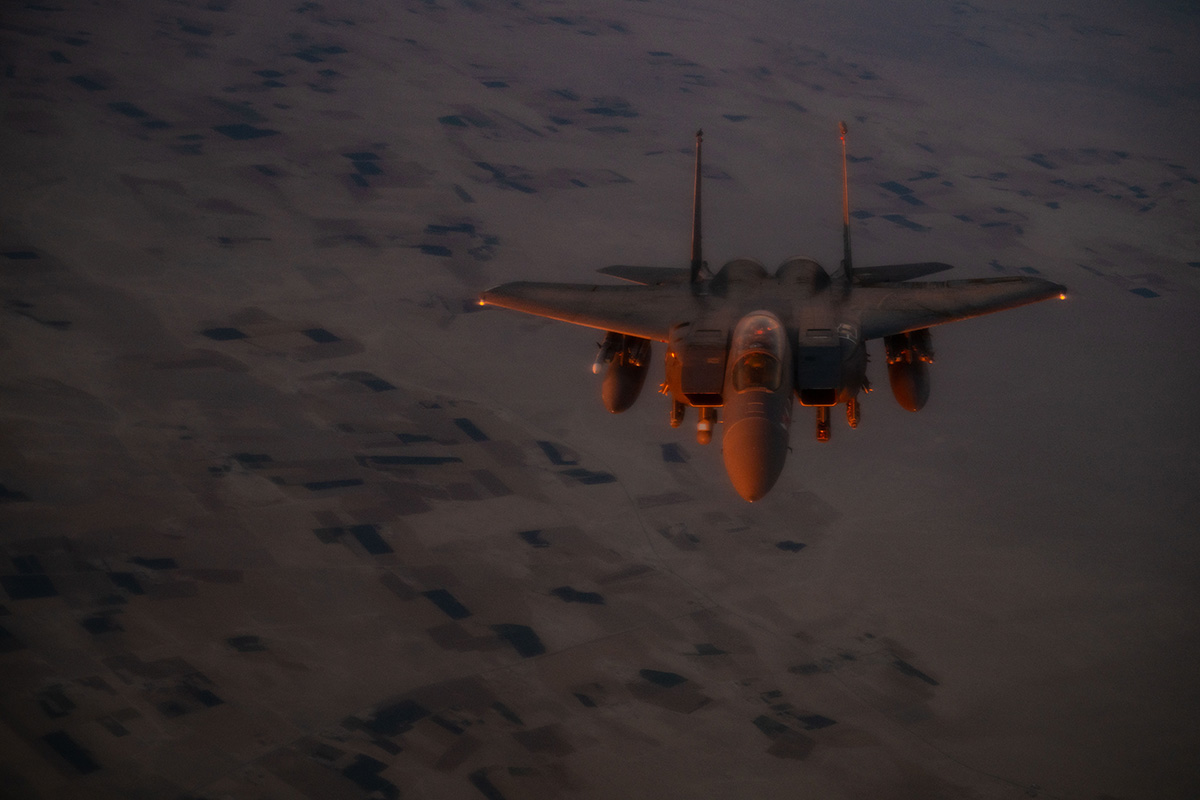
A surge in US military air activity across Europe and the Middle East is underway alongside rising tensions with Iran, with open-source tracking showing increased tanker, transport, and support aircraft movements over recent days.
Data compiled by the Military Air Tracking Alliance and shared by multiple open-source analysts indicates a sustained flow of US Air Force aerial refuelling aircraft transiting from the continental United States toward Europe and onward into the Middle East.
As of 31 January, analysts reported a tanker fleet of around 20 aircraft positioned at Al Udeid Air Base in Qatar, alongside continued movements involving KC-135R Stratotankers and KC-46A Pegasus aircraft operating between the US, Europe and forward locations.
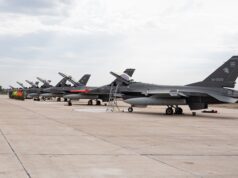
Fast-Jets ready to move on!
KC-46A “GOLD74” 18-46054 #AE5FA1
KC-46A “GOLD31” 17-46027 #AE5E08
KC-46A “GOLD32” 18-46044 #AE5F97Expecting:
KC-46A “GOLD42” 11-46059 #AE5FA6Arriving from CONUS:
KC-135R “?” 62-3502 #AE0377cc: @MATA_osint @ArmchairAdml @air_maritimepic pic.twitter.com/1MsgPlH99s
— DefenceGeek 🇬🇧 (@DefenceGeek) January 31, 2026
One of our team, Jon, aka ‘DefenceGeek’ in the OSINT community, noted that several KC-46A aircraft operating under the “GOLD” callsign series were positioned and ready for onward movement, with additional assets expected to arrive from the United States.
Posting an update early on Saturday, DefenceGeek said activity had been relatively limited overnight, with aircraft that had deployed into the Middle East late on Friday returning to Europe during the morning hours, while attention remained focused on reports concerning potential fighter deployments via Lajes in the Azores and electronic warfare aircraft in southern Europe. The movements come as US Central Command confirmed that Iran’s Islamic Revolutionary Guard Corps is conducting a two-day live-fire naval exercise in the Strait of Hormuz, a critical international shipping route through which around 100 merchant vessels transit daily.
In a statement, CENTCOM urged the IRGC to conduct the exercise “in a manner that is safe, professional and avoids unnecessary risk to freedom of navigation for international maritime traffic”, warning that unsafe behaviour could increase the risk of escalation or collision. CENTCOM added that it would not tolerate “unsafe IRGC actions including overflight of US military vessels engaged in flight operations, low-altitude or armed overflight of US military assets when intentions are unclear, high-speed boat approaches on a collision course, or weapons trained at US forces.”
While many of the aircraft observed are routinely associated with regional deterrence missions, the scale and timing of the movements have prompted wider analysis among defence observers.
Writing earlier this week, analysts noted the arrival of the USS Abraham Lincoln carrier strike group into the wider Middle East region, joining air and missile defence systems already deployed, including Patriot and THAAD batteries, as well as combat aircraft such as F-15E Strike Eagles. Additional reporting has pointed to the presence of P-8A Poseidon maritime patrol aircraft, MQ-9 remotely piloted systems, transport aircraft and aerial refuelling assets supporting the broader posture.
Earlier this month, the United States also established the Middle East Air Defence Combined Defence Operations Cell at Al Udeid, intended to strengthen regional air and missile defence integration among US and partner forces.
Jon said the overall posture “suggests that the US intends to carry out an initial strike to neutralise key targets like air defences and airbases, possibly using a mix of B-2s, F-35Cs and EA-18Gs, followed by several days or even a couple of weeks of further strikes using F-15Es and other assets.”
He added that tanker and cargo aircraft would be essential to sustaining such operations, and that F-15E aircraft could also be tasked with regional air defence roles, including countering cruise missile and drone threats.







So what is it,stop killing your people or we will bomb you or sign a nuke deal or we will bomb you?
American culture is deeply weird, an ostensibly Christian country completely addicted to violence and its enjoyment.
MAGA is nothing unusual from a historical perspective: while it marks a return to the endemic and institutionalised racism of the mid-20th Century, it still has that core underlying addiction to violence.
To be fair, they’re not quite as weird as the Russians, who are completely bat-s**t crazy – being a bizarre combination of aggression, paranoia and fragility.
If you look at America from an HDI perspective it looks very much like a developing country as opposed to a Northern European Developed country. It’s suffers very low in things like democracy, safety, take home income and life expectancy.
It never use to be like this. Before the 80’s it looked just like or exceeded most Northern European countries. It does have a very high GDP per capita however this figure is inaccurate as it’s massively inflated by business investment figures that don’t translate into prosperity for the average person and Offcourse massive borrowing by both corporates and the US government.
In many ways the US economically increasingly resembles a Petro state.
The real outlier for the USA vs Northern European states has been religion. However religion is in full scale retreat in the US and its rapidly catching up with other developed countries.
However the US remains and outlier with other industrial countries much like Japan does. It’s very different make up from everyone else.
The USA is not a white, homogenous country. Comparisons to Europe are comical.
In 30 years Europe will look like the USA, and have the same problems. Diverse societies are low trust, high violence societies. Rome was the same.
Europe is about to learn this the hard way, it’s inevitable.
Europe already has massive problems, which are mostly unaddressed. It has no ability to defend itself (see Mark Rutte’s recent comments), it has no capacity or will to address illegal migration, it is increasingly divided internally and yet it has the laughable audacity to lecture other countries (in particular the one country that actually protects the continent) how they should conduct their internal affairs. Well, the chickens have come to roost. The one country protecting the continent has had enough and is now pursuing predatory policies against its allies. I completely agree that this American policy is ultimately going to prove to be self-defeating, but how is that the Europe (and of course the UK is no exception to this) has been so collectively stupid as to make itself so vulnerable?
Since the Munich Summit, it’s clear that USA is not protecting Europe, just looking after USA national security interest by forward deployment closer to the operational theatres they expect to use.
US NSS went on to put that in the written word so everyone can understand it, though Congress disagrees with USA leaving NATO or reducing their forward deployment.
Disregard for Article 5 is sufficient to ensure that USA no longer has real leadership, and Europe sees that This US is unreliable. The only member to invoke Article 5 was the USA 9/11 thus proving that irony is unknown to them.
Europe has drawn their own conclusions and is making independence from USA their objective and plan for the next decade. I doubt that’s quick enough but the reality of Industrial Capability and Capacity is that it takes time to invest and build at scale.
Agreed, however the big question is, why should the US protect Europe anyway and why should any nation not defend and priorities their own interests? Shouldn’t membership of NATO be an equal in all things? We in Europe have relied on the US for too long and now their protection may be withdrawn due to the orange clown, we are all slagging him down, as opposed to gripping our own leaders for their stupidity, laziness and tardiness in thinking about our own defences.
The Peace Dividend delusion has allowed politicians to safeguard their electoral prospects by shifting Defence spending to social provision and even war in Europe hasn’t enabled them to pivot back to Defence.
We bailed out the bankers in 2008 and now its their turn to invest in Defence since their business depends on peace and stability. Lower risk means lower cost for Defence Investment Bonds than standard Gilts.
Thus the 3.5% GDP Defence spending target for 2030, and 2.75% GDP for 2026 are affordable without tax increases. A long term investment plan for national security. A long term defence growth opportunity.
A requirement for a banking licence. The duty of ethical investors who profit from the nations citizens.
Over to Finance Ministers to make it happen.
For a very very long time I have always said that an alliance can only work if each nation still focuses on its core ability to defend itself.. NATO in the end because profoundly damaging to Europe because it allowed the illusion of collective military power .. and military power is only relevant when there is the political will behind it.. NATO itself has no political will because it is not a nation it is simply an alliance and in the end there has to be some form of peer or near peer relationship in an alliance.
Because in the end and in the final reckoning every nation will always look to its own survival..
I have always said the US was never engaging in a nuclear war for a random Baltic state.. I doubt France would either.. as for us, we’ve always been a bit more aggressive than was required for our own good.. so maybe we would, but I doubt in the end even we would be willing to engage in a nuclear exchange for someone else. It’s why I think in the end Europe needs to throw out the nuclear NPT and develop a more diffuse deterrence..
Very well said indeed.
Agreed, spot on.
Russia is a bit easier to understand really.. it’s a profoundly damaged culture essentially western and Central Europe and East Asian kept invading it and slaughtering its population..
The Mongol invasion and occupation killed about 5% of its population
Napoleons invasion probably killed about 1 million
WW1 killed about 3 million Russian soldiers and 1.5 million civilians the destruction essentially destroyed the nation and it lead directly to the Russian civil war that killed up to 12 million
WW2 lead to about 27 million Russian dead…
Essentially the Russians are waiting for the next invasion and mass death event.. it’s engraved on their culture by generations of trauma.. this makes them essentially hyper aggressive in regards to what they see as the Russian near abroad.. we now know that the Soviet Union had by the 1950s abandoned the idea of claiming Europe for communism through invasion.. but they continued to consider and develop invasion plans based on the completely faulty assumption that the west was going to invade the Soviet Union and so Russia.. we saw that assumed they planned to invade and so it goes.. everyone on a hair trigger.
The present issue is the Russia near abroad is now made up of independent sovereign nations that are not aligned with Russia and they simply cannot cope it’s essentially driven them into a sort of cultural psychosis.
Who has invaded Russia since they had nuclear weapons and killed millions of civilians? Ah yes, no one.
And what has that got to do with cultural trauma.. the US sat there with MAD and every weapon pointed at the Soviet Union.. nuclear weapons were not a magic pill to cultural trauma, they just reenforced it..
It’s the Tangerine Terminator’s Nobel Peace Crusade.
“I’ll be back”.
nomb them anyway
So much for the story that America doesn’t need Europe.
It doesn’t. What is Europe doing? nothing.
Continuing to enable American forward deployment despite the direct and indirect costs that put Allies personnel at risk.
Not holding US administrations to account for foreign interference in other sovereign countries as per UN Charter which seems to undermine the international rule of law. Might come to be an expensive hypocrisy when confronting aggressors for their illegal actions.
Nobody admires the “Do As I Say, Not As I Do”..
Please…they could easily just use saudi arabia and tankers to get there. They are just saving costs with stops in europe.
Not really no.. you need infrastructure for mass movement of troops.
So… Nothing.
Europeans do not seem to understand. America is dumping you, not the other way around. They do not care what you admire, like or respect.
The US can do what it wants, but.. stop pretending Europe did nothing for the US.. the UK deployed 150000 personnel during the US war on terror.. spent about 60 billion in total and had 600+ personnel killed and many many thousands injured.. that was not nothing and it was all because the US asked nothing else..to say it was nothing makes your nation small.
That sacrifice will not be forgotten. USA didn’t even say thank you, rather #47 just gave offence. That won’t be forgotten either.
Wilful ignorance has transformed a super power into a regional power only relevant to the Americas no longer having power and influence globally. Worse, now attempting to defund and devalue the United Nations, so international rule of law.
American power and influence depends on global trade and stability, always has and always will, whatever poorly educated isolationists imagine. Voting against their own interests while the tech bro oligarchs continue to make billions globally. That will change as technology sovereignty becomes an increasing issue and Europe decides to build sovereign capabilities. It remains to be seen if the poorly educated can figure out the the 1% (billionaires) are the problem, not minimum wage seasonal workers from Mexico, as xenophobia and racism continue to provide diversion from the real problem.
Cloud computing already has data sovereignty due to EU GDPR, and more will come as people start to understand that Artificial Intelligence depends on data quality and locality. Businesses are starting to wake up to their responsibility for data privacy as the cloud platforms get to hold more and more of it. For example Google Gemini AI wants to read all user data to provide assistance and automation, obviously to the advantage of Google in developing their platform and algorithms. Despite the relevance of GDPR, there’s no sign of Personally Identifiable Information PII (You) or Special PII (Your medical, political etc.) data being classified and managed appropriately..
Is something afoot? Slowly but surely a dark shadow is descending across our World and it’s not an international coordinated effort as the US intends to use its huge military machine to draw lines in the sand. The rest of the Western nations can only guess what Trump will do next and cower to his doctrine, whether they like it or not. These actions will determine the boundaries for a new era in World history and are designed to restrict US enemies from gaining strategic advantages. God only knows what 2026 will hold for our country that has allowed our defences to rot on the vine.
Don’t worry, 2026 will be put off untill the 2030’s.
Thank God for that!
As per Labour election and defence policy!!!!
There is a strong correlation with American military “action” and the release of Epstein files.
No idea why.
Don’t think there is any connection…. One former democratic president caught in multiple possibly criminal situations with possibly juvenile girls and refusing to be questioned about it….
Didn’t dementia Joes son get clocked misbehaving in a serious way with his laptop? No different between Republicans and Democrats, all full of shite very much like our clowns!
I believe Obama deported more illegals than Trump, there doesn’t seem to be much mention of that on the BBC.
Too long ago to recall details so don’t know if ICE knocked on doors more nicely then or not.
Probably more to do with methods employed mate, the ICE blokes do seem a bit gung ho, and it became apparent not many are ex law enforcement, many of them are just recruited purely for the ICE job.
Well, I watched that shooting the other day when the guy was shot while on the floor and an ICE agent had already removed the gun he was carrying in his belt.
So no threat.
Bloody outrageous. Police SFOs here have been removed for far, far less.
Shocking stuff.
The difference between using the rule of law correctly and the application of mass thuggery to subdue a population.. the fact is ICE is deployed against certain parts of the US ( the liberal cities).
Bombing other countries while the US implodes internally.
I am no fan of Iran, I would like to see the Theocracy fall, but if the US attacks them using
the dead protesters as a reason, then Iran has a reason to shout hypocrisy.
America implodes sounds wonderful, can we help?
If America implodes then we are all fucked, wether we like it or not!
We would get over it.. empires fall, it’s an inevitable part of human history.. we just need to make sure we are big and mean enough ourselves.
Just so long as that moron Starmer keeps us out of this nonsense but I doubt it.
Grandstanding as a world power!
We’ll see, theres not much we have left to help beyond access to bases.
The left of his party will be imploding given their much highlighted ant western imperialism, support for Gaza, Hamas, and all the rest, and hypocritical silence on what is happening to Persians in Iran at the moment.
The BBC seems to have difficulty expressing the word Islamic in their articles on the IRGC I read.
I’d lose no sleep if the mad mullahs were sent packing and Iran welcomed back into the western fold.
He will turn up to the global press conference for another free trip away, im sure he just likes a free meal and hotel stay, is never in the UK.
And we see why the US cannot truly rupture with Europe and why the MAGA world view is simply a fairy tale to destruct.. without Europe as a willing partner American will no longer be able to power project into the European, African and Indian Ocean regions.. that would leave China to run rings around it.. essentially giving China everything it wants… instead of US hegemonic power surrounding and controlling China you would have a free China…
Looks like the Iranian mad mullah squad may be getting the good news, no loss for me! However, let’s be very careful that we don’t try to do the “regime change” thing, as we know it does not work and the West are not the arbiters of political change in other countries. Get rid of one madman/group and there are many more waiting in the wings to go for the top job, which inevitably means civil war, chaos, confusion and more death.
Change should be internal, and if the US and the west can support and assist, then good, but it cannot and should not be in control of events. Who is available to replace khamenei? the Shahs son? May seem an ideal easy option for the west but not for many Persians. A can of worms may be opened in the near future. However whatever the orange man is going to do, wether it’s for personal, political or other reasons, getting rid of the main player for instigating, supporting and organising terrorism locally and around the world will be a good thing, we just need to be very very careful in the immediate aftermath of any military action taken.
As an aside it has been noticeable the lack of criticism and condemnation of the killing, murder and oppression of thousands of Iranian people by the authorities, both in the media and online. Maybe it’s because there are no Jews to blame, and therefore the murder of moderate Muslims/Persians by other extreme Muslims seems acceptable? But along the line I’m sure the same silent ones will pop up and go mental in their hatred of the orange one whatever he does! And it would appear European NATO partners can be useful eh 👍
I hope they get the ‘good news’, but hopefully any attack will be limited to targeting:
The top mullahs
IRGC
Basij
Missile launchers/sites
Missile production.
Nuclear enrichment sites
Agreed mate 👍
Yes the leftie Islamic pro pal parties don’t give a toss really it’s just nice to hate. Loot at Turin Italy today…
👍
Ha!! I’ve just been prattling on about this further up the thread, but I see you’ve expressed it all here a lot better than me mate.
Sheer utter hypocrisy. Standard.
It’s hard to fathom but there are worse out there than the Iranian government.. they are not completely Nihilistic.. I’m not sure the same could be said for the utter nutters they have feed and encouraged..
Not really sure what the objective will be. You can’t do regime change by bombing a country. Isreal already tried that and got no where.
For sure they can weaken Iran’s military but realistically it’s military was never really a threat to anyone. It’s threat came from gorilla /terrorist tactics.
Maybe the aim is to weaken the regime enough that the protesters have a hope, but that would be very difficult to achieve from just bombing
I would say Iran’s ballistic and cruise missiles are an existing threat to anything within range.
Before 2024, it was estimated Iran had some 3000 missiles, some with 500kg warheads.
Post June 2025, it is estimated they may still have up to 1750 missiles of all types, although a number of those may be damaged / unusable now.
Isreal demonstrated the missiles werent much of a threat, very few got through.
It’s also unclear how many launchers they have left, after they lost a lot to Israel bombing. Having missiles without launchers doesn’t equate to much.
I guess still a threat to merchant shipping, but don’t need missiles for that.
I wouldn’t say that. At the end of the 12 day war, Israel was running short of interceptors
Iran was firing less missiles but, more missiles were getting through.
Don’t forget Israel’s Arrow 3 Air defence is the world’s best, the surrounding countries in the Middle East have no such systems.
Iran isn’t really concerned about the other surrounding countries, it’s pretty much just Israel and their proxy the US
They would willing target any of those countries where there are US or UK bases.
The UK part of that equation worries me. We seriously lack air defences and would be a way to attack the US without going after them directly.
They are worried about Isreal for the simple fact mate Isreal does not fuck about! 3000 years of being screwed over and being everyone’s slave gives you that mental and physical strength! Also a massive smatter of routine anti-semitism also helps for Isreal, cheers.
The UK SBAs in Cyprus don’t have GBAD that Israel relies on though Steve.
Alot more missiles got through than in the global press, that was with the help of the West and some regional air forces shooting hundreds down before they reached Israel. Israel will have had a sense of reality in those 12 days that they arent invulnerable with the systems they have, plus as mentioned they had virtually ran out of interceptors to keep firing.
Managing to fly around Tehran for 12 days straight isnt much of a feat considering the size of Iran, Iran clearly planned a longer than 12 day stint at it.
Epstein files looking uncomfortable?
Bomb someone.
Unpopular at home travel the world 35 times pretending to be a statesman!
I think with Iran you can use the political.. but you would need to be clever.. you want to weaken the regime, support the population with arms and not utterly shatter its infrastructure.. then be ready at the change of regime to offer a shit load of aid to get the infrastructure back up.
Or a novel idea would be to not rip up the treaty signed by Obama just because it was something Obama agreed and find a peaceful way out of this.
Nobel peace prize hopeful trump, starts /encourages a surprising number of wars /deaths.
I’d love to see the fall of Iran’s Islamic oppression, but funny how MAGA love agents shooting American protesters. Shame a similar build-up wasn’t enacted when Putin was swearing blind he wasn’t about to invade ukraine(again) in 2022, or any time since to make Putin sweat. I wonder how many 1,000s of Iranians died or will die between Trump egging them on with “help is coming” & when any actual strikes take place? I bet many Afghans wish Trump was pro-active when Biden copied Trump’s plan to pull out of Afghan & wash their hands of it? Probably some means of making himself loads more money involved in putting the frighteners on the mullahs.