


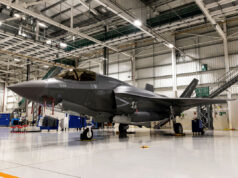
Concerns over the UK’s planned procurement of 12 F-35A fighters dominated the latter part of the Westminster Hall debate on Typhoon sovereign capability.
Ben Obese-Jecty, Conservative MP for Huntingdon, argued that the Government’s announcement of the A-variant risks masking deeper questions about the UK’s combat air posture.
He described the F-35A plan as “a red herring”, noting that the aircraft are intended to substitute directly for 12 F-35Bs from a future tranche and will not arrive until the 2030s.
Obese-Jecty highlighted confusion over the aircraft’s proposed nuclear burden sharing role within NATO. The F-35A has been presented as the platform that would deliver the UK element of NATO’s dual capable mission, yet it is slated to join 207 Squadron, the Operational Conversion Unit responsible for training new F-35 pilots. He told MPs that “using the planes as a training fleet workhorse does not scream nuclear readiness” and asked the Minister to confirm how many of the aircraft would be held at operational readiness.
Labour MP Calvin Bailey, a former RAF pilot, responded that the OCU instructors represent the highest-skilled cadre within the force and argued that placing the nuclear capable aircraft in that unit “makes eminent sense”. Obese-Jecty replied that this amounted to implicit confirmation that instructor pilots could form the core of the UK’s nuclear readiness force and pressed Ministers to clarify whether a certification timeline exists. He added “I do not think the RAF knows either, given there is currently no timeline for gaining nuclear certification.”
Capability integration formed a central part of his critique. The MP warned that the F-35 remains unable to field the Meteor beyond-visual-range missile, noting that “our top-of-the-range jet fighter currently has no stand-off air-to-air missile capability”. Government statements suggest Meteor could enter service on the aircraft in the early 2030s, but Obese-Jecty drew attention to a Public Accounts Committee report that highlighted uncertainty around the timetable and the need for interim weapons. He asked the Minister to identify any off-the-shelf systems being considered and how they might be integrated.
He also argued that the F-35’s reliance on support from fourth-generation fighters undermines the planned hybrid air wing. “In order to use our very expensive, top-of-the-range… fifth-generation F-35s, we have to fly them alongside… Typhoons, because only they can carry the payload to defend them in air-to-air combat”, he said.
Obese-Jecty questioned the long term sustainability of the F-35 fleet, whose out-of-service date extends to 2069. “By that point some of our 138 airframes will be over 50 years old”, he warned, asking whether such ageing jets can realistically remain the backbone of UK airpower as uncrewed systems mature.
He concluded by calling for a coherent airpower strategy, referencing remarks by the Chief of the Defence Staff earlier this year that the RAF has “no major equipment programmes planned for the next 15 years”.
Responding for the Government Defence Minister Al Carns replied:
“We set out in the SDR that the RAF’s future lies in accelerating its adoption of the latest technology and innovation, and setting the pace for warfighting as the leading European air force. The Typhoon is central to delivering control of the air for the RAF and is undergoing a comprehensive set of upgrades to deliver operational advantage to meet evolving threats.
The Typhoon will continue to underpin our combat air capability into the 2040s; it and the F-35 Lightning form an interoperable, complementary and extremely potent mix of UK combat aircraft. That means that the Government will continue to make significant investments in the Typhoon through-life programme, with the new electronically scanned radar programme alone underpinned by a £3 billion investment. This programme with our Eurofighter partner nations is on track for delivery in the next decade and will continue to sustain 600 jobs across the UK, including in Edinburgh.”







Wow, a former RAF pilot who is a labour MP think it’s a good idea.
Any Tory or Reform MP’s former RAF pilots? Or do they not like to get their hands too dirty, most of them seem to be former “journalists” or Tory staffers now.
Well there was Norman Tebbit, he also got blown up by the IRA.
Conservative Party (17 MPs)
Labour Party (14 MPs)
Liberal Democrats (8 MPs)
I seem they are mostly ex-army. I could be wrong.
” No Major RAF Equipment Programmes planned for the next 15 years”.
Well Blimey, I guess that’s Tempest maybe in the 2040’s then !
I think they separate equipment from aircraft, right?
If the CDS says Major Equipment, I’d be thinking Aircraft personally.
But you probably are correct.
So what Aircraft are we Purchasing in the next 15 years ? I’m thinking a steady drip of B’s to help keep o/a levels at a historic low given Typhoons will keep being axed in that same time span.
Yeah, I imagine that there’ll be further purchases of the F-35, given that’s what the RAF wants. I also imagine they’ll be split in the same ratio as the planned order between A and B models.
Then, Tempest orders will start to arrive (with the initial order for all three partners expected to be about 350), accompanied by unmanned aircraft, which will be used in a similar way to those going to the RN – to build mass without manning costs.
I don’t see Typhoon getting any further orders.
Roll on 2040 then.
May I ask were you saw the 350 figure for Tempest?
I can’t post the link on here (it’ll block the comment), but there’s a FlightGlobal article in which Leonardo officials divulge that 350 airframes are the expected initial order for the UK, Japan and Italy combined. If you search ‘FlightGlobal GCAP 350 order’, you should find it. Hope that helps! 🙂
That’s 200 for Japan, 100 for Italy and 50 for the RAF then 😵💫😵💫😵💫😵💫😵💫🫣
50 ?
Surely you’re Joking ?
(come on, you know the reply !)
Don’t call me Shirley 🛫🛬
😁
Rodger that. Rodger. Give me a vector Victor. 😊
Thanks. I’ll take a look. Interesting the official requirement around numbers hasn’t been announced so far by the MOD/RAF.
No, future buys after the initial 12 are planned to be 100% F-35As. No more Bravos.
Plans. Secret plans, no doubt, in the bowels of Main Building somewhere near the wine cellar. Are you sure you are allowed to reveal the plans of the next government but one?
Published in reputable aerospace magazines. All the future UK costing for F-35 is based on 100% buys of F-35A.
No doubt we will see this in the forthcoming defence plan.
I’d go for the C model. It has the larger weapons bay, longest range, heaviest payload and a stronger U/C and we can use it to fly off carriers. Seems it can also fly off land. Whoopee.
I’m not sure you can drip a B as it’s a solid.. I suppose you could always melt it down and drip it, but that would be a bit of a waste of a really expensive aircraft.
Maybe a Plop then ?
Plopping a few F35’s
💩💩💩 will three plops do
I think the drip is a reference to the standing of whoever agreed that buying a very small number of F35A was a good idea and then didn’t realise what they had done as the RAF boys were whooping and banging the walls down the corridor at having got away with it?
The 12 are the thin end of the wedge.
A Bennite solution?
So what determines ‘equipment’ exactly if aircraft aren’t included I wonder. Missiles? If so there are programmes present and planned, radar well we know that’s also progressing both for Typhoon and Tempest, sensors the same. Ejector seats being developed for Tempest. So what else? Drones, well plenty of proposals who knows what actually gets produced but clearly something will be by 2040 even in my most cynical mindset. What am I missing and what’s being referred to that we have nothing taking place or so far planned for introduction come 2040.
You have to have Imagination !!!!
I can Imagine all sorts, not neccessarily anything remotely related but I’m happy in my own little bubble.
Anyway, someone will know exactly what equipment we will be getting, it normally starts a little later after the corks start popping.
I’m probably going to miss it though as It’s raining hard now and my rook leaks and I like counting the drips.
Huh? The RAF does have a stand-off air-to-air capability in the form of the AMRAAM-C and AMRAAM-D.
Are we just lying in the HoC now, or does they know something that we (and the RAF) don’t?
*a stand-off air to air capability for the F-35B, specifically.
Yep I think basically it’s just make up whatever BS you want to throw at the other party.
There’s another high functional political system that functions on spewing lies about the various parties across the pond, as well.
That’s my real fear with regards to the British political system. That it will go the way of the American equivalent.
All sounds rather confused to me I have to say, Indeed there is AMRAAM, decent enough though arguably a little range deficient these days, but that’s another story. Ironically that’s one of its more effective weapons, stand off ground attack seems to be the real weakness which after all is the aircraft’s prime role in reality. Maybe someone confused with part knowledge and not doing their homework who knows.
I agree, and I think you’re right about the confused minister as well.
so no new Typhoon orders. What a useless bunch of politicians churning out a meaningless word salad.
Shows how little some of these guys know. Id take a F35B with AMRAAM against a Typhoon with Meteor any day of the week in a BVR engagement.
Exactly. It looks like the RAF are realising that as well. The Typhoon is just no longer tenable in modern air-to-air combat, at least not alone. It’ll become a similar system to the F/A-18E, a missile truck for the F-35 and Tempest.
Stealth is the price of admission.
Exactly, we should scrap the Typhoon upgrades Imediately, bloody waste of Tax Payers money, makes me proper Irate.
Haha, not quite. The Typhoon has, and will continue to have, a place in modern air-to-air combat. There’s also a constant requirement to maintain QRA, which the Typhoon is exceptional at, and won’t have a competent replacement in that role till Tempest arrives from 2035.
The F-35 production and maintenance schedule is also not brilliant, to say the least.
But from a pure capability standpoint, I’d push for further F-35A and F-35B procurement over Typhoon procurement, especially now the Turkish order is secure.
Over 1,300 F-35 have been built. The build schedule is fine. The rate at which it is bought by the UK, is a different matter.
Well there was a rather big hiccup a year ago for much of the year over US refusal to accept airframes till they were deemed met updated spec not sure how much it’s affected deliveries since.
Typhoon is an amazing capability. But that all aspect stealth, sensor fusion and very very capable APG-81 radar makes a big ole difference.
APG-85 is coming soon, and will be even better.
Last I heard it was being delayed from Lot 17 with a potential to arrive as late as Lot 20 (with no certainty even then, but they hope to have a work around).
But it brings up a question. When will we need to put aside the money needed to upgrade our first batch, how much will that cost and how will it affect availability? I read mission availability for British F-35B is around 30%. Would it drop significantly during a upgrade programme or will they be simply run “as is” like we plan to with the Typhoon second tranche?
But the APG-85 will not be available for export. So none for the UK.
Yep. That will be a monster of a radar.
The MK2 is better than the APG 81 and the typhoon has sensor fusion too.
You have zero evidence for that statement.
Anyone with a brain who understands the technology behind both radars knows the MK2 will be in another league of capability when compared to the apg-81 and yes the Typhoon does indeed use sensor fusion with data from external tracks AND it’s own sensors. The evidence for both statements is all over the internet and stated by people who are actually involved in building them.
Hmmm…still believe there is a role for limited numbers of bomb/missile trucks in future disputes. Not every sortie will be against peer opponents, nor Day1, kick the door in, missions. Hence the USAF F-15EX order. Additionally, there is an obvious maturation curve for 5th/6th gen a/c. All the “ilities” are royally biting us in the collective ass w/ current/next gen. Really is a role for “kick the tires, light the fires, at ’em gentlemen, time to f**k the bandits.” Believe that mission is in the ops manuals under the heading “in case of war, break glass.” 😉😁
Yes, a mixture of things that work and you have the knowledge, stockpiles and logistics is rat her essential.
As you say there is IRL a Hi-Lo mix needed as not everything is high end. And to mangle a great saying a ‘good platform in hand is worth 10 in the DIP.’
Joking apart we have a fully formed Typhoon operation with 100+ great jets and allies that have 100s more so the R&D and spares are going to be going for some decades yet. We also have full sovereign access to code and the ability to do our own modifications and enhancements if needs be.
Then you have this whole BlockIV malarky. Which everyone is suffering under. Now that may produce the most amazing aircraft ever: I really hope so. But LM’s track record on this is not stellar. And there is also the issue of getting the new weapons fits up to FOC which will take even longer.
I suspect that RAF have bought David Cameron’s abandoned war predicting crystal ball at a knock down price from Mystic Meg’s estate. [Remember this is the one that was consulted regarding aircraft carriers and came back with the answers,’we cannot see a use for an aircraft carrier in the next 10 years’ – cue one war in Libya – ‘err, Admiral, can we send a carrier’ – ‘no we cannot, Prime Minister’].
So a hedging of bets is needed: which is the direction everyone else has gone in with ordering 20 or so new Typhoon except, of course, UK. Germany ordered a real number of F35A as well as more Typhoon.
It’s not just hedging bets. The F-35s can act as data nodes for the Typhoons, sharing sensor fusion. I don’t know what kind of ratio we should go with, maybe one F-35 for three Typhoons, but I haven’t heard of us doing this, flying heterogenous groups. Logic suggests that should be a thing, doesn’t it?
That is just so erroneous. It’s only true in the forseeable future in any conflict with China who are obviously going to be the biggest operator of 5th Gen and beyond military aircraft. But the quality of those aircraft is as yet unproven but by 2030 will be a very difficult proposition. But China is far from being a likely opponent for Britain. The Typhoon will be effective well into the thirties in respect of any other opponent. Equally as we don’t know the implications for such technologies that China is developing around Quantum and other sensor technology Stealth could be anything from the minimum for survival to being of little value, certainly as stealth is known today, which means compromised airframes with relative short range might become untenable too, or other factors may take primacy. Certainly not worth making presumptions at this stage other than to focus on our most likely adversaries be it Russia or non peer adversaries who will only be heightened threats if they get much of that Chinese advanced technology. Only speculative at this point.
You think that the only scenario in which the ‘Typhoon is untenable in modern air-to-air combat’ is in a Pacific war against China? Really?
Firstly, I’d argue that the quality of Chinese manufacturing, systems integration and missile technology have now been proven in Pakistani service. It makes sense that those features would translate through to the far more modern J-20/A/S and J-35/A, and given the Chinese have proven their claims about those systems are valid, I think its reasonable to take their claims around other technologies seriously as well.
I agree that war with China is very unlikely, both with regards to the UK and now the USA. A military action against Taiwan now seems distasteful to CCP leadership, with the preference instead being for a political and economic campaign to force Taiwan’s hand. For the USA’s part (and by extension the UK, Japan, SK and Australia), war with China increasingly appears economically and militarily impossible. The manufacturing capability, political drive and economic conditions simply are not conducive to a successful campaign in the SCS or around Taiwan.
This is where we have a disagreement, primarily because you’ve not actually responded to what I’ve said. The Typhoon will be effective into the 2030s, yes, but not because of its inherent capability, but rather because it will be backed up by a host of more capable or more attritable assets. The Typhoon alone, without the low-observability of the F-35B, would suffer significantly at the hands of Russian ground-based air defences, the same systems that have mauled the fourth-generation aircraft of the UkAF and now essentially deny the skies over Ukraine. Look at the recent conflict between Israel and Iran, for example. Despite Iranian air defences being dated, Israeli fourth-generation didn’t even attempt to penetrate their bubbles, leaving that job instead to specially-modified F-35Is with extended ranges. So yes, the Typhoon will have a role. But, like I already said in my comments, it will not be a front-line air combat system. For that role, stealth is the price of admission, even against a Russia air force dominated by fourth-generation systems. Instead, Typhoons will be interceptors, missile trucks, cruise missile trucks, et cetera.
You claim future technology could change the role of stealth. In response, I ask you to consider whether, if the Chinese, or the Russians, developed a counter-stealth radar, would we stop building stealthy planes? We wouldn’t. It would simply become another basic feature of combat aircraft.
With Wedgetail? I’d take a FGR4 with Meteor
The Meteor really isn’t the wonder-weapon it’s made out to be. It’s good, yes, but not enough to swing that battle, when the F-35 could detect something like a Typhoon at ranges far beyond that which the Wedgetail could find the F-35. The AMRAAM still has 200km of range to work with – the F-35 could feasibly engage the AWACS before bothering to find the Typhoon, and never be seen.
When would we be fighting Typhoons against F-35s (or vice-versa)? The question is can upgraded Typhoons with Meteors defeat the enemy (almost certainly Russia) better than the F-35s AMRAAMs can, given the respective costs and availability in running the two different planes?
Over the Adriatic, if we’re being specific.
But that’s far from the point. You could substitute the Typhoon with any comparable fighter and the point would still stand.
I would argue that your second question is entirely context dependent. What’s the opposition? Where does this take place? Is the Russian IADS active in that area? Are the opposition armed with their VLRAAMs?
The fate of the Typhoon is very much variable in that situation, whereas the F-35A could cope well for far longer as the threats mounted.
But again, since people seems desperate to misconstrue what was said – the Typhoon will have a role. That role will not likely be frontline A2A combat.
Typhoon is very very good. But the F35 would have an AMRAAM in the air before the Typhoon knows its being engaged. Luckily for us. They will work together and make a deadly combination.
Agree – which of these could we acquire more quickly to build mass?
I don’t know. If we ordered 24 of both tomorrow, they probably wouldn’t arrive a day before 2030. The F35 certainly has the longer term growth and development potential.
It does irritate me when our MPs who are meant to represent us spout utter ill informed rubbish, “our top-of-the-range jet fighter currently has no stand-off air-to-air missile capability” so much BS is equipped with AIM-120D which is a missile with a 100 mile range that is most definitely stand of range.. it may not be the very best western BVR missile on the toolbox but that does not stop it from being very good.
Most MPs are clueless and are only interested in Defence regards jobs for their constituency, not the wider wellbeing and capability of their nations military.
They should read in on here.
Considering emailing Mr Obese-Jecty to explain his mistake, not sure he’ll read it though.
He’s ex military himself I recall, disappointing.
He does ask a lot of defence questions though, which is good.
Pongo, & a “breath of fresh air” for his Constituency.
Though there are some inaccuracies, the general sense of what he’s saying is correct. F35A is a foolish purchase designed above all to appease Donald Trump. The real world utility to the RAF is minimal, even in it’s intended role as part of our (or rather, the increasingly less morally resilient, less dependable American) nuclear deterrence. What’s it for? To provide a capability already provided by, what is it… 6 or 7 other countries in Europe?
I’d be satisfied if they cancelled F35A tomorrow. There are more pressing places to spend such vast quantities of cash, which could add real depth and resilience. Including, ironically, the purchase of additional F35B.
If we want to bolster our nuclear posture, which I believe we should – then we ought to do it properly. Not by way of a hand-holding exercise with a decaying US security guarantor.
I can make no sense of this drip feed of confused plans for our defence. Fortunately the Russians are in even worse condition and unlikely as we are to remedy their severe deficiencies any time soon.