

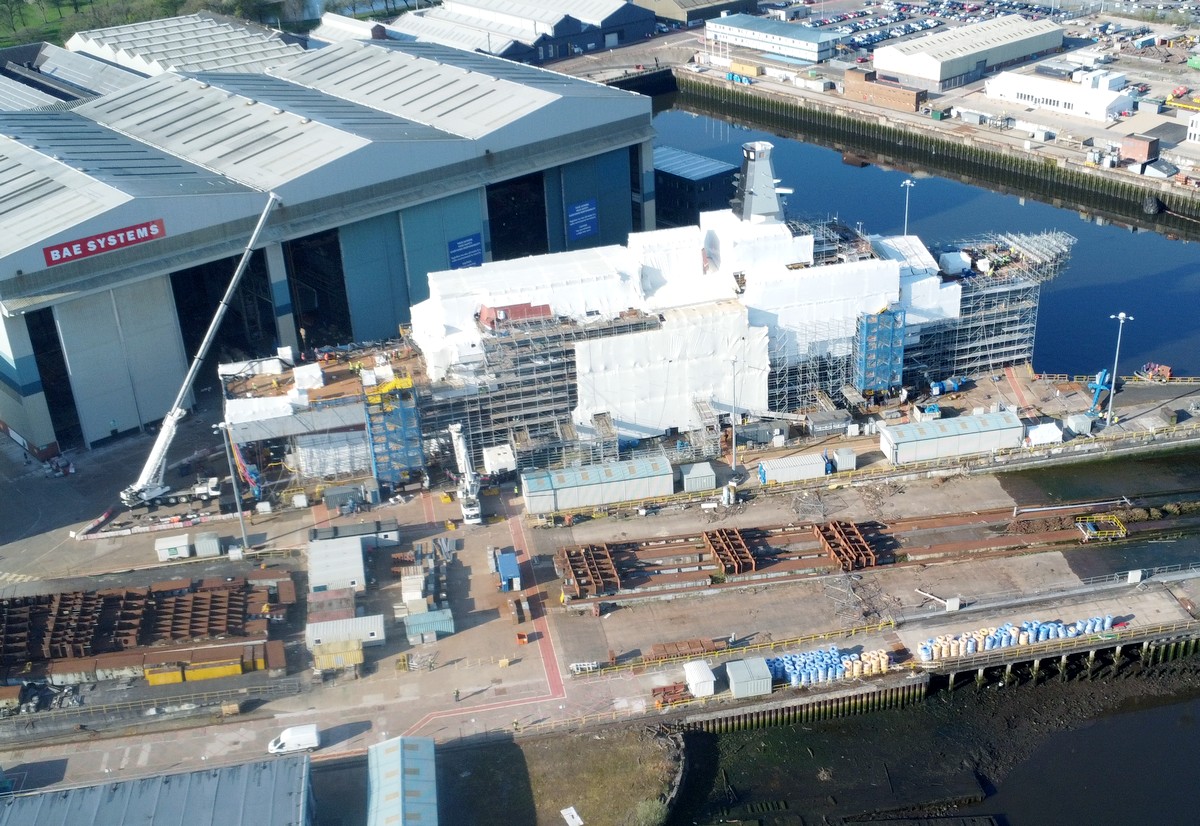
Efforts to recreate the UK’s complex warship manufacturing capability outside Scotland would face major structural and skills barriers, industry representatives have told MPs, underlining the strategic importance of shipbuilding centres on the Clyde and at Rosyth.
During evidence to the Scottish Affairs Committee, Andrew Kinniburgh, Director-General of Make UK Defence, said that relocating or duplicating the industrial capacity that supports complex warship construction would be exceptionally difficult. Asked whether a future government could realistically build equivalent capability elsewhere in the UK, he replied: “Absolutely huge, a huge mountain to climb to recreate that.”
Kinniburgh stressed that Scotland’s shipbuilding strength rests not only on physical infrastructure but on deeply embedded skills, supply chains and long-running programmes. He noted that complex warships are assembled from large numbers of specialised subsystems, making concentration of expertise a decisive factor in efficiency and delivery. “The nature of a big warship is a series of relatively small subsystems that all come together into one great big warship,” he said.
MPs also raised concerns that the economic benefits of shipbuilding remain heavily concentrated in the central belt, with limited visibility of small and medium-sized enterprises outside those hubs. Dave Doogan MP argued that while Clyde and Rosyth shipyards were a strategic asset, more needed to be done to ensure that defence spending generated wider regional impact across Scotland.
In response, Kinniburgh pointed to Barrow-in-Furness as a potential model for strengthening SME participation around a major shipbuilding programme. He said the success of the submarine enterprise there was rooted in close coordination between local authorities, education providers and prime contractors. “The local council, the college, the university and BAE Systems have all come together,” he said, adding that such alignment had helped support SME engagement despite geographic and workforce challenges.
However, he cautioned that replicating this approach was not straightforward and required sustained investment and long-term planning. Remote locations, competition for skilled labour and pressure on housing and local services all shaped industrial outcomes. “It’s a hard place to operate,” he said, “and you’re in a real race to bring talented young people in and hang on to them.”










TBH this is a load of nonsense.
Handwringing at its best.
The suppliers will still supply components and most of the bits are palletised so can be moved North -> South overnight as needs be.
The bigger issue is persuading the workforce to move en mass. That is down to generous relocation and wages plus incentives. Some will take it – others won’t.
You could run the exact same argument around H&W Belfast as there is only a core group of people there. The mass is trained from scratch.
If it is essential to make it work you figure out what you need to pay to make it happen – it is called reverse engineering.
You think you can rapidly build a 20,000 ship lift and 6 acre hall like they have at Barrow
Ron China rapidly build an SSN building capacity larger than the rest of the world combined.. so yep where there is a will ( and money) there is a way.
Once again you think you can build a 6 acre ship hall and 20,000 ton shiplift quickly. China does it by killing the work force in avoidable accidents. Turns out a totalitarian state that is unaccountable in court or at the ballot box is free to use safety standards that would result in criminal prosecutions here. Are you volunteering to take that risk or is that only for lower orders?
Lower orders….sounds like a communist pamphlet.
Or smug self righteous arm chait experts are quite comfortable with putting other people’s lives at risk in pursuit of a fantasy
Yes you are funny’s
Instead of getting in convenient tit for tat ad hominem attacks, why don’t you really react to the argument also contained in ‘Ron’s’ posts?
Do you think it is that easy to build the facilities needed?
I happen to agree our governments should push to restore these strategic industries, but comparing to China is pointless.
Not just because of the much lower standards we should not want, nor can afford to use, but also because China has a much, much bigger pool of people to use and abuse.
And still China is actually starting to feel the pinch also..
Because Ron did not engage in polite discussion, he was personally insulting and degraded the discussion.
To consider the discussion point “ comparing our industry with china is pointless” I’m afraid I strongly disagree with that point. I’m afraid we do need to compare and contrast ourselves with china as china is our true major geostrategic competitor. We may not wish to follow their methods but as we seem to now be in a major spilt with the US, Europe as a whole needs to be able to at least compete with china and find a way that our maritime industrial output and naval construction can be sustained in a relevant way.. the simple fact is china was building 5% of the worlds ships in 2000 and 25 years later it was north of 50% and in 2026 is possibly heading north of 65%.
To pretend that chinas utter domination of all maritime production is not a catastrophic risk to European democracy and that we can ignore what is happening is profoundly short sighted. I’m afraid there is a very simple truth the world is changing and not in a good way.. we have an authoritarian communist power that is now the defacto maritime superpower and its lead is increasing in pace not slowing.
If we continue in the way we have with the same solutions with just slight tweaks our western liberal internationalist values will be buried and we will be isolated surrounding by a world controlled by an authoritarian maritime state as the U.S. likely moves into a time of isolationism.
So I found Ron’s comments both fatuous and personally insulting, which is why I responded with light hearted comments. Because actually I found his comments profoundly personally insulting ( he does not know me and does not have any understanding of my background) and not something I actually wished to engage with seriously and I did not wish to engage angry commentary because it’s counterproductive.
And finally getting the skilled personnel to Scotland and the high north of England is very very difficult, because that’s not where the bulk of the Uk population live and it’s got very little infrastructure to want people to move their.. a skilled person would not by choice move their family to Barrow from the south east of England.. one area is wealthy with all the opportunities our nation can offer, the other has very little.. so unless you want your kids to do what you did or move back down south when they are older.. you don’t move to barrow. As I said it’s the same issue in my industry where I was a recruitment leader.. if your children have no opportunity you don’t move there is their are other jobs you can do where your children have every opportunity.. it’s human nature.
So unless we re sculp our entire country.. places like barrow will always struggle with a mass of very skilled workforce.. because there are far far better places for families to live in the UK and a skilled welder for instance can work in so many places.
Firstly you don’t need a 20,000 ton ship lift or a slipway to get a ship built and launched you either block assemble in a Drydock (see QE class for details) or use a an assembly quay with a Ro Ro capability and use a submersible Barge (see T26 / T31 for details).
FYI the largest can lift 117k tons.
Secondly yep the DDH is mighty impressive and I’ve had the privilege of visiting for a Rollout The thing is when it was built far fewer large steel framed buildings were being built, these days they are 10 a penny and far easier / cheaper to build most are CAD designed, factory cut, drilled and treated and then just assembled on site. To give you some idea of what’s possible the Meyer weft Dock Hall 2 took just 2 years to build and it dwarfs the DDH and it has a 500m Dry dock inside 😱
It’s not easy or cheap but it’s possible but then again why bother when H&W is being regenerated to build and future large ships such as the FSS at 40K tons and can build far bigger ships than that.
Just don’t let the HS2 planners anywhere near it.
What you need is will, money..AND time…but also regardless of the methods used skilled labor.
The potential irony here, seeing as who mainly pushes for these more nationalistic ideas, likely migrant labor also.
I personally still want our governments ( I am not British, but the Dutch are in the same predicament) to invest heavily in modern highly automated methodes. Think among others weldjngrobots.
But lets not pretend it’s easy or that hard choices don’t need to be made after many decades of decline and neglect.
this isn’t rocket science it is the result of successive governments red and blue that have thrown money into the Clyde yards and allowed shipbuilding elsewhere in the UK to whither on the vine the navy needs a new yard dedicated to warship production
Have I missed something in terms of long term funded commitments that’s going to require the UK having additional ship building capacity in the long term?
With a £28bn black hole in funding and T32 effectively frozen before it was even drawn up I’m struggling to see what these additional yards are supposed to do.
Or are we aiming for build 13 ships fast then have a decade of no work and play yank the chain all over.
There’s something of a fragile plan emerging right now, if we can commit to producing a new ship every 12-18 months with a 25 year life that gives 20 surface combatants.
Separate to that a new submarine every 24 months gives 12 with a 25 year life.
We just have to get that going consistently and I would argue stop producing handfuls or a single type and try and get a solid production run out based around common hull / propulsion.
If we get export orders from there on you can think about additional yard capacity but right now the focus has to be on getting the present yards assured of work with funding commitments over 25 year time scales.
Regarding relocation terms, given the SNP’s hatred of industry or success, I think a large part of the existing workforce would move anyway. No jobs, high tax and no hope drives movement.
Oh and I was born in South West Scotland but raised in Derby where my entire family relocated to in the early 60’s due to the above reasons. One big Pickfords Lorry and 23 people on buses and trains. No relocation package, just hard work, guts and RR, International Combustion and The BR Carriage and Wagon Works ! k
Kilted Ram and proud of it.
My great grandfather certainly did in the 1880s from the Clyde to the Tyne and then to the Thames as a shipwright, indeed East London was full of Scottish and Northern English workers who moved, be it in general engineering, aviation, electronics, shipbuilding to Jam making. No idea how that reflects on modern times mind though I suspect many Scottish skilled workers would move south if ship building was closing down there, many of those skills would not be easily transferable in the region, but always thought it would be a big, multi decade and very expensive process if military ship building was relocated away from Scotland with inevitable effects on delivery so best to get as many ships into the water over the next ‘safe’ decade.
I agree SB,
I have been wondering / dreaming 🙂 about creating a new shipyard in the North East of England and how would that be done. Re-creating the skilled workforce and the support network for those people is the biggest challenge. Rather than say,”Ooo it’s all too hard, too expensive,” which is our usual response we should develop a plan and get on with it now.
Despite what everyone says I do not think the RN / RFA are going to be anyway large enough to defend us if we end up in a scrap anytime soon i.e. in the next 10 years, which increasingly and frighteningly likely the way things are going! We are simply incapable of building a sufficiently large enough fleet in the likely timeframes given current infrastructure capacity. If was does breakout (god forbid) just having two yards building complex warships will be far too little and far too vulnerable. I am probably talking in terms of the unrealistic, but I do believe that we need to significantly increase fleet size quickly and that will mean more shipyard capacity way beyond what is possible on the current yards even if they are expanded. Another major shipyard turning out complex warships, one designed and built for 21st century production techniques from the get go is needed. Need is the operative word in my mind.
We, Europe, need a huge increase in capacity given China is building another 4 or 5 super shipyards if I remember Jonathan’s recent post correctly. They already have more capacity then the west as I understand it! That fact alone should be scaring the hell out of Admirals and politicians across Europe and western aligned countries the world over because China has repeatedly stated that they want to avenge the 200 years of shame as they it and as I have reminded people before, the Opium Wars and Boxer Rebellion put us firmly in their sights even though those events happened during Queen Victoria’s reign! Those huge Chinese shipyards will give them the industrial capability to out build any other navy or potentially any group of navies on the planet making China by far the dominate naval power on the planet in the very near future.
We need to stop thinking stuff is too hard, especially when it undermines our ability defend ourselves. We need more shipyards, because we are going to need a much bigger navy. Even if we do get plenty of drones I think we will need surface ships to act as command ships for the drone forces. Russia demonstrated an effective Anti-SATellite (ASAT) weapon just before they invaded Ukraine. They destroyed one of their own satellites with a missile which many said could and might still cause a cascade effect in low earth orbit denying satellite communications using current low earth orbit internet satellites. OK the geostationary satellites will not be affected directly but we will be unable to replace them once they reach the end of their lives or otherwise fail all of which means shore based satellite enabled control of drones will not be possible accept in coastal waters. Hence a bigger fleet will be necessary even for a drone enabled navy, as I believe that Russia has decided that it’s adversaries need space assets more than they do so they will use ASAT’s if they think it will deny their enemies a significant advantage.
All of which takes us back to the need for way more shipbuilding capacity in the west. It is the one area where the UK have made a truly promising start so re-enforce strength and double down on the National Shipbuilding Strategy and build another big shipyard in the North East, for example, as well as expanding the existing yards to the maximum capacity that they can achieve. The North East is a region that needs more investment and Sunderland docks look rather under utilised at the moment so a possibility(?). I am sure there are other opportunities to build new or refurbish existing assets as well.
I will now sit back and await the nay sayers to shoot me down 🙂
Cheers CR
The only thing I would say is many be Portsmouth would have been the best bet for a shipbuilding hub.. strategically it’s tucked away more and it has access to a vastly bigger population base and transportation network that Cumbria and Scotland… for easy development of a large skilled workforce population base and transport is fundamentally important.
There are problems with Portsmouth, though.
1. It’s already quite heavily developed. Look on Google Earth, basically the whole harbour is ringed with marinas, naval shore infrastructure and housing developments. There’s more room at the inner end but Portchester lake is very, very shallow and would require a lot of dredging (more on that later). The VT Portchester yard was up there but there’s a reason they specialised in hovercraft 😉
2. The harbour actually isn’t that suited to shipbuilding. Apart from the channel from the ferry port to the entrance it’s mostly shallow with winding channels and incredibly busy; a barge launch as BAE are doing with the T26s would cause complete chaos blocking ferries, cargo ships and recreational craft in the very congested main channel (I would be surprised if isn’t the most densely used waterway in Britain) as it was towed out into the Solent. The same goes for barges bringing ship modules in.
3. History. Basically everything in Portsmouth is ancient, any move to rebuild a large section of the harbour as required for shipbuilding (QE docks are easier as the naval base is there) would be horrendously difficult to plan through the impact on historic buildings and old infrastructure, not to mention that a lot of the places have immense RN tradition associated with them. For example IMO one of the best places for a carrier dock would be next to Fort Blockhouse and inside Haslar Lake in place of the marina, but the fort itself has had a lot of controversy around it, the cadets sail from there, the pilot boats are based there, the old SETT tower is there, the submarine museum and so on and so forth.
Also, according to N-A-B Portsmouth harbour is riddled with unexploded bombs as a result of being a big naval base close to occupied France so nobody wants to do too much digging in the mud. There were a couple when they dredged the main channel for the QEs and there’d need to be a lot more dredging for a facility further North.
So as not to seem too downbeat, I would point out that Portland has a wonderful deepwater port, largely neglected infrastructure, excellent sea access and reasonable local population.
Also a quarry for some really nice-looking dry docks and a large group of local ne’er-do-wells in the young offenders’ institute who could be trained as welders to turn their lives around, perhaps?
Ahh, Portland. Yes It’s a great big Port with lot’s of deep water spots, great shelter and easy access to the English Channel(unlike Devonport). Even now It’s a private Port, there are always RN ships there everytime I visit, It seems to be a firm favouride of the Tides and Castles with Bays and T23’s often seen in the recent past.
A few transport Issues though, the roads from and around Weymouth and Wyke Regis are a little Interesting, especially In summer and rush hour (even after all the work carried out for the Olypics).
The old HMS Osprey area Is still mostly empty and the Heliport Is still busy but much rebuilding has occured around the main approach road and Marina.
The Port area Is very run down but still ocupied and the Quarry area Is still being used so a few deals would have to be done and much upgrading work would need to be carried out.
In WW2 a ship loaded with munitions was attacked by the Luftwaffa, exploded and showered a wide area of the port with some rather dangerous stuff which (according to a diver pal) is still there in quantity. Plus there are two large Mulberry Sponsons stuck fast in the mud which might cause Issues in a few different ways. Oh and HMS Hood Is still mostly there in the breakwater gap right next to Sir Tristram which is still used for training.
Good point about the “Young offenders” though, a great opportunity for some and there Is a “Leader” just up on the hill who can be heard singing “do you want to be In my Gang” on occasions. He’s always keen to work with young people ! 👀👀
Biggest problem though, would be If our free overnight parking area was taken over, that would be a real shame.
Great assessment I think CR. I think an assumption that we are safe-ish from Chinese naval assets here, or Europe generally is very naive. They will have immense assets to deploy and the only real restriction will be the ports to support them out of their region. South America is probably cut off from them for a while at least, but Africa, the way they are being treated like inferior, unimportant effectively vassal States by the US and pre existing deep rooted distrust and historical animosity towards Europe and the West generally, well many will jump at the chance to allow Chinese bases to be established if gradually and through stealth if necessary.
What worries me and especially seeing Badenoch’s naivety around the greater picture shown by dismissing the Greenland affair relative to the supposed greater threat of Iran, is that politicians don’t understand the full wider implications of the former move and potential for great threat that Iran can’t remotely generate for the foreseeable future if ever, whatever its paper tiger talk. If Trump takes Greenland and especially if he starts killing the locals or god forbid NATO troops that are being moved there now in small numbers, that alone will create irreconcilable fissures in the Alliance that can only be pasted over even short term. The US will never be trusted by anyone again and who knows what internal ructions and amongst a far more realist US military might be, can we dismiss civil war? But worse still he is now rambling about Iceland, something I predicted weeks ago and you can guarantee if he and the hawks go there the Faroes will follow. What does he, or more likely perhaps follow on far right types do then, offer to buy Scotland?
What seemed a joke scenario a few years ago is already looking a lot less so in just a year of this mad President and in reality Trump is rapidly becoming just a buffoonish popularist front man for the true players behind the scene like Miller, as shown by him not even knowing Iceland had a Premier, let alone who he is just that ‘it won’t go well for him if he gets in the way’ when he was mentioned. Fact is we have no idea where this ends just that if Europe is forced into opposing the US short of or not of actual conflict, China will certainly benefit in Africa militarily as well as even more economically than now. I simply don’t think powers that be in the West, let alone the population have got even an inkling of the potential dangers ahead. Going from kowtowing, which inevitably only strengthens Trump to standing up to him could be a fatality curve moment, so better to start modifying, indeed dismantling gradually the former approach as much as we can. In the end being firm is the the only language he respects picking us off one by one his aim, we do not want to let him and the hawks push things so far before we stand firm that it’s too late for him to step back and he makes a dementia fuelled decision that benefits only others around the World and potentially the end of democratic civilisation.
You’re in fantasy land if you think you can easily move two shipyards and two naval dockyards anywhere else in the country. You only have to look at the evolving cluster f**k that is the US ship building industry or our own trials in Barrow to realise that throwing money at ship building will do very little for you.
Only a multi decade process will generate ship building of complex warships.
Spot on and we better have that in mind if Scottish Independence becomes inevitable, because we can only put off another referendum so long. We have been lucky that the SNP have been so rabidly incompetent in recent years but the incompetence of Westminster parties and the growth of Reform could make the environment majorly different by 2028 and beyond. How long can you maintain the argument the last Referendum still counts? Burying heads in sand doesn’t really add up to a sufficiently viable policy.
I would just like to say that I worked on HMS 0cean,HMS Wave Knight ,HMS Albion and HMS Bulwark.all at Barrow -in-Furness the last three I helped in the construction of. I fact we got an award for the fastest assembly of a ship in the west from.blocks into a complete ship which took us 7 weeks from.start to finish.Obviously some of the internal work had to be finished,but each block was kitted out with it’s cabins and equipment prior to it being joined to the next unit.All in all it took us 6 years to complete 3 capital ships from 1998 until 2004 when HMS Bulwark was handed over.Alongside these ships there were still a submarine being built.There is still a slipway at Barrow big enough to build any capital ship and there is now a second build hall directly behind the slipway across the road and there is talk of a third one being built.
So as you can see there is plenty of capability in Barrow for expansion if it,s needed plus it is a massive site to allow for new facilities to be built.
. In the past when I worked there we built submarines ,frigates,air craft carriers, diesel engines and guns,a lot made in-house.Scotland is not the only place where the capability exists.
Cammell Laird used to build warships. AFAIK they are still in business and contributing some modules to T26.
Is there any reason why they are not building complete warship hulls anymore?
Modular ship building is quicker. By building in parallel you cut time taken
Yes their owners decided to get out of the shipbuilding industry after the Attenborough was launched, for shipbuilding it’s very cramped for space as a lot of the land has been redeveloped and it’s very busy refitting etc. It’s far better building modules to be assembled elsewhere, same for Appledore and A&P.
“Their owners decided”…you hit the rivet on the head there. Decision in interests of shareholders and accountants…very little to do with “in the national interest” and defence is clearly “in the national interest”. So the helm must come from government.
Again this is spot on, a lack of a National and viable plan in the past has led us to a spot between a rock and a hard place.
Spookily they are the same owners who have done absolutely nothing with one of the UKs maritime Crown Jewels namely Inchgreen dry dock.
They bid for the T31 program and lost, they bid for the FSS program and lost. That’s why C&L is not building warships.
Babcock and BAE build warships, C&L doesn’t.
Much the same reason Aston Martin doesn’t make Trucks.
Ha, David Brown and Lamborghini spring to mind ! 🚜
Yes it would be difficult, yes it would be a Mountain to climb but this is an answer given by someone who is deeply imbedded in the UK MIC to a bunch of Politicians and as we all know UK Politicians don’t tend to have any background in Manufacturing, engineering or even Science (Mrs T was an exception).
The fact is that yes it can be done and with the right management structure it’s not actually that hard, the key bit is to pick a location with the right key attributes.
So you need a site with excellent access to deep water (near the sea), physical growth potential (land), a nearby population centre (recruitment). preferably some existing infrastructure (docks, quays and transport) and probably most important of all the core of a workforce with some transferable but related skills.
I’m going to completely ignore the bit about the supply chain as it’s just irrelevant as the supply chains for Barrow, Rosyth and Clyde are scattered all over the place and it’s pretty well the same in every other country.
So to prove my argument that it can be done and not break the Bank let’s just consider Babcock at Rosyth, no ship of any description had been built there from scratch. But they had all the above listed attributes and what’s more they completely skipped the established RN/BAe supply chain to cut costs by using a lot of COTS equipment.
Anyone who has been following the progress of the T31 (or read any of my earlier comments) will know it wasn’t easy and a lot of us were rather sceptical about Babcock pulling it off, but it’s all starting to look rather hopeful.🤞🏻
So if some Political Earthquake were to happen (SNP gets its way), what could happen ?
Let’s think about the possible sites that could be suitable for Naval Shipbuilding outside of Scotland.
1. Belfast is already going through this process of regeneration so a pretty good candidate for future 20k+ warships. It has nearly all of the attributes needed except a workforce and that’s being worked on.
2. CL at Birkenhead, IMHO its biggest issues are the availability of land for new construction and it’s already pretty busy on refit work.
3. Appledore, yep it’s lovely and ok for building smaller ships and blocks but how expandable is the workforce and with the best will in the world fitting out on mud is just “so 19th century”.
4. Falmouth it has the lot except land to expand on and getting round that is geographically very difficult (very expensive) to rectify (I’ve visited it and it’s pretty impressive to see how it’s all shoehorned in). Besides which when they did the relocation exercise in 2014 it was identified as one of the 2 best alternative location for the SSBNs to be based in the UK (Milford Haven was the other but someone pointed out that Tankers and Subs don’t mix well).
5. Devonport, it’s built ships before including light Fleet Carriers. It’s got everything attribute wise and let’s face it you do not need 2 massive RN Bases on the South Coast anymore (which does seem to be way HMG / MOD / RN thinking is heading anyway). The North yard is full of stored SSN’s but that number will decline once the decommissioning process gets into its swing and that will free up some space. But meanwhile the South yard is just sat there waiting to be rejuvenated. 🤔
B
Ones I have excluded.
1. Portsmouth it has all the attributes including a history of shipbuilding but it’s the only HMNB that can dock the QE’s and they do take up a hell of a lot of space. And as the T26 and T31 will be based there it’s going to be busy and space wise it’s now getting a bit limited.
2. The former Swan Hunter Yard, the land is still there but nothing else, and the debacle over the Bay class hangs over its head like the Sword of Damocles. But yes if it included A&P in the mix, shipbuilding on the Tyne could be regenerated but it would be a a very large task and very expensive. IMHO an option would be to get one of the Japanese shipbuilders to run it as they just seem to have a knack of handling UK industry’s (single Union agreements, closed shop and everyone eats in the same canteen. See Nissan and Toyota for details).
Hi Rodney,
According to the DE&S website the T26 will be based in Devonport so perhaps thinking around closing or running the base down is changing. I certinaly whop so as I believe we need a much bigger navy and 13 frigates just ain’t going to cut it.
I would also like to suggest Sunderland as a possible site for a new shipyard. The docks looked very under utilised last time I looked, although I am aware that there where efforts to redevelop, but they fell fowl of COVID. Not sure if they have been restarted, but they could probably be over ridden if someone decided that the need to urgent enough, which I believe is a point that was reach 10 years ago..! (Allowing for the time it takes to regenerate an entire industry.)
Cheers CR
Hi ABC, I don’t disagree that it can’t be done given enough money and time. However the Rosyth analogy is not a realistic case. Rosyth is an existing active facility that had just spent the last ten years building two aircraft carriers. Rosyth is also a 45 minute drive from Glasgow. Trained ship workers can and did commute between BAE yards and Rosyth under aircraft carrier alliance and Babcock was able to capture a fair bit of the workforce. That’s pretty different from shifting shipbuilding from Glasgow to Liverpool.
Very few people in the UK are mobile, most people in the ship building industry willing to move get snapped up to places like Australia, Singapore or Dubai working in offshore oil and gas projects.
Hi but the thing about Portsmouth is it’s got access to massive population centres and is part of the best transportation infrastructure we have.. in the end RN basing could be shifted around a lot and in a world of cruise and ballistic missiles it may even be better to have more distributed naval basing.. clearly the carriers cannot be distributed nor the nuclear fleet, but the T31, T45 and T26 fleets could be shifted around.
Interesting overview.
Silly stuff !
What major shipbuilding program is envisaged that Isn’t already happening or planned for ?
Oh hang on, maybe some reverse engineering facilities for the dismantling of the rest of the Fleet !
Such a pity we were so short-sighted and allowed places like VT Southampton and VT Portsmouth to close then, isnt it ?