

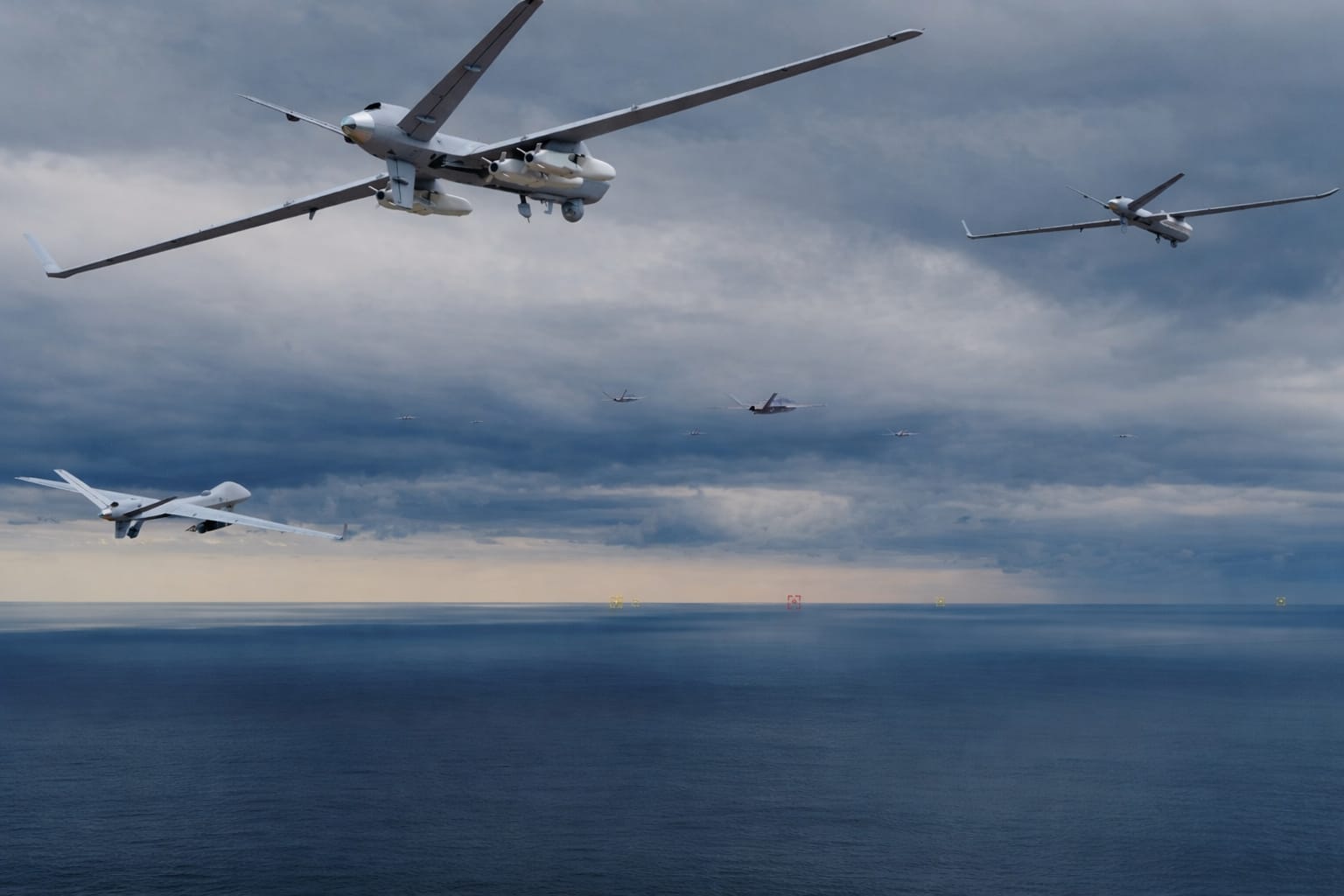
General Atomics Aeronautical Systems (GA-ASI) is developing a long-range strike missile capability for its MQ-9B drone, expanding the aircraft’s mission set to include naval and deep standoff attack roles.
The company said work is under way to integrate extended-range precision weapons onto the MQ-9B SkyGuardian and SeaGuardian variants, responding to demand from air and naval forces for platforms able to hold targets at risk over vast maritime and air spaces, particularly in the Western Pacific.
“MQ-9B continues to impress in the field and we keep adding to our global customer list,” said GA-ASI President David R. Alexander. “We want to continue to build value in the aircraft by expanding into more missions. MQ-9B features extraordinary payload capacity, so it only makes sense to add to our mission sets with the ability to carry long-range weapons.”
According to GA-ASI, performance analysis indicates the aircraft can carry such weapons over long distances while retaining endurance and persistence. Engineers are continuing integration work and refining potential concepts of operation.
Weapons being examined include the Lockheed Martin Joint Air-to-Surface Standoff Missile (JASSM), the Long-Range Anti-Ship Missile (LRASM), and the Kongsberg/Raytheon Joint Strike Missile (JSM). The company said it intends to conduct a flight with at least one of these weapons as early as 2026.
A notional operating profile described by GA-ASI would see MQ-9Bs launch from friendly bases in the Western or Southern Pacific, fly to a holding point outside an adversary’s weapons engagement zone and, if directed, release long-range munitions in coordination with U.S. or allied forces.
The MQ-9B family includes the SkyGuardian and maritime-focused SeaGuardian, as well as the Protector RG Mk1 currently entering service with the Royal Air Force. The platform has secured international customers including Belgium, Canada, Denmark, Germany, India, Japan, Poland and Taiwan, alongside U.S. operators, reflecting its growing role in allied air and maritime operations.





…..and after several meetings about meetings we will buy a missile for evaluation, or am I being optomistic.
whinge, whine, moan 🥱
Absolutely, my alien friend. Tell me please what I have to be happy about in defence terms. 🙃
Exactly what has that to do with the subject of the article? Assuming you bothered to read it…
I think he read it and his response was based on historic evidence there will be a long drawn out process of deciding perhaps even testing with no certainty it will be acquired. Now you can agree or disagree with the assessment, no problem there but to claim it has nothing to do with the article or claiming he hadn’t read it is patronising, and frankly ridiculous and does you no credit if you yourself wish to be taken seriously. Not that I suspect you care as I have yet to read anything constructive in any of your inane responses.
He clearly didn’t read it, or comprehend it, or both. It was a whinge about U.K. defence procurement when the article is completely unrelated as it is about a drone manufacturer conducting its own tests. But as you’re an inveterate whinger too, I can see why you might want to side with him.
If you haven’t seen anything constructive then that’s due to your omission. For example, you obviously didn’t check the article on atomic clocks published two days ago.
So much anger 🤦♂️
I blame the parents Halfwit, we didn’t get this sort of behaviour back in the day did we.
We had jumpers for goal posts, space dust, top trumps, save it stickers over the light switches, rolling power cuts, 3 day weeks…
Where was I again?
Ah yes,
Spock 🖖 he does seem to be angry all the time, not much ‘live long and prosper’ going on if you ask me…
Thanks for trying, my friend. Can’t be helped. 😊
About as much as your sarcastic post 😊
No sarcasm, pure factual observation. My comment wasn’t about the article, it was about your comment. I guess you’re too dimwitted to understand the difference.
O.K. Whatever suits you. I can’t be bothered..
Hey Geoff, take a look at Chat GPT and see what AI has to say about “Spock”
Hilarious 😁🤦♂️
I like this new site !
I’ll have a look my friend. Cheers😁
Sounds like it’s company led so it will likely be quick not the usual drawn out government procurement process.
I can’t imagine an MQ9 B is ever going to be able to carry anything as big as LRASM however a single JSM may be possible on each wing .
Soemthing smaller like Sea Venom or Marte ER might be more practical.
The UK really needs to figure out a way to get MQ9 on the carrier. It fulfills a number of required roles. It will mean that even when not armed with F35B the Queen Elizabeth class is still very useful.
Risk is that RAF then appears on QEC even less often.
Well, the RAF has been trouble trying to find Pilots that want to sit about on a Naval Asset for months without seeing their families… So I wouldn’t be opposed to F-35Bs being directed to Fleet Air Arm making a comeback in the future with new planes. Sure, they’ll be functionally identical and based at the same bases as the RAF, but they’re all Navy personnel. Hell, I’d match their pay with RAF counterparts on land and give them a reduced 0% Taxation on their paypackets for time served at sea. (Like commercial offshore/ship workers outside the UK’s tax boundary).
RNAS Marham !
Well, yeah… Thought they could combine their maintenance cycles and stuff… If it were up to me, I’d have all the F-35Bs as FAA and have the RAF operate the F-35A.
And if I’m allowed to imagine, the UK 35A being powered by a RRs powerplants instead of P&W PP. Oh well.
I think we will go with Stormbreaker for our F-35s. It’s reported as being currently integrated on all F-35 variants.
Would we go with Stormbreaker or Spear Glide from MBDA? Or perhaps we’ll do neither and go all on on Spear 3.
Reportedly, Stormbreaker is in the DIP as a intermediate measure.
Yeap I’ve read the same from several sources. An interim purchase of Stormbreaker to cover the gap until SPEAR 3 is operational and integrated.
The amount drones like this can lift is related to the length of the runway. The QE’s runway is too short to get the maximum out of these. We need something on the QE, but whether it’s this particular drone will be up to the spec of the STOL version that I still believe we have no published date for. The maiden flight for the Grey Eagle STOL is hoped to be towards the end of 2027, and right now the smaller Grey Eagle is expected to come some time before the MQ-9B STOL. That suggests to me the MQ-9B STOL won’t be carrier operational before the end of the decade.
Project Vanquish hopes to have a technical at sea demonstration by the end of this year. If the RN manages that (and that’s a big if), MQ-9B STOL may get left behind.
The carrier however has the advantage that there is more wind over the deck, which has a disproportionate impact on these STOL drones with their low take off speeds. The carrier could definitely do a full speed charge into the wind in order to get a ‘bomber’ flight of MQ9 away carrying anti ship missiles.
Your timetables are also off; Grey Eagle STOL is now merged with Mojave, which has flown extensively and done carrier landings and take offs. MQ9B STOL is supposed to fly some time this year, so we could see it on the carriers early next year if we really pull out the stops.
You make good a point about wind over deck. Good news if MQ-9B STOL flies this year. Hopefully we’ll see what the specs are like fairly soon, and how much weight the AEW version has to lift.
Agree with your points. Jim. I was obviously trying to a bit ironic with my comment but I don’t know where were going with UAV’s, especially for the carriers. When did the idea first come up? Ten years is it now? There has to be a UAV that would do the job. A mix of say 16 F35’s and similar number of drones perhaps.
I liked the MQ9 concept from GA just changing Protectors wings and adding AEW and ASW capabilities.
Our American cousins haven’t progressed anything I’m aware of though. At least I don’t think so. Turkey are running up the drone carrier concept with the Bayractar but would that suit? Maybe..
Fitted for but not with a warhead.
ZOOM…🚀
Hmmm, considering we already have these with the RAF, if the Fleet Air Arm actually reformed into something, I’d acquire quite a few of them to actually focus on carrier and surface naval aviation ops. You’ve got Long Range Strike as a possible use, you have separate loadouts for ASW and AEWC as well as the long endurance recon aircraft with just the nominal kit or smaller quad racks of Hellfire or JAGM to make smaller strikes on items like skiffs or fast patrol boats.
Course, that relies on the government and the government aren’t sensible or switched on people.
Yes, GA are developing MQ9B into a really well rounded aircraft for all of the roles that require endurance and range more than speed and stealth. ASW, AEW and long range strike are the things the FAA really need and we can get them all in one air frame.
Conservatively, MQ9B STOL will probably have a 2500km mission radius; 5000nm mission range is claimed for SeaGuardian, dropping a lot for carrying heavy weapons and the STOL wing’s extra drag. That’s enough to fly from the GIUK gap to the North Cape to release cruise missiles against Murmansk (and back again, of course).
So a single fleet of 12-24 aircraft could give our carriers longer reach than any other in the world.
If they had a Bi-plane wing set up, they could launch off the Carriers. 😎
I know, lets call them “Swordfish 11”
Brilliant ain’t I 😁
(They could even carry Torpedo J’s)
Don’t need a biplane for that, they’re STOL already! (apologies if you know that, it’s hard to tell sometimes)
GA think they can integrate mk54 torpedoes on SeaGuardian and their system is open so they could do Stingray too if we liked. Unfortunately Spearfish weighs nearly 2 tonnes (4 times as much as JSM and twice as much as LRASM) so ‘sink the Bismarck’ exploits are unlikely to be repeated.
Yup, I was just doing that thing again, the thing I do when seing similarities with stuff from many decades back.
Swordfish could take off from small carriers with a little forwards motion into the wind even armed with the Torpedo and three crew.
Similar enough in size and weight but a Double Decker would make takeoff, landing and handling a fair bit easier than the MQ(B’s rather longer wingspan.
Speed would be the Issue though.
WW2 Torpedos were of a much lighter weight than Spearfish so maybe a couple or three Stingrays ?
Biker Interest fact. A Stingray weighs pretty much the same as my Hayabusa !