

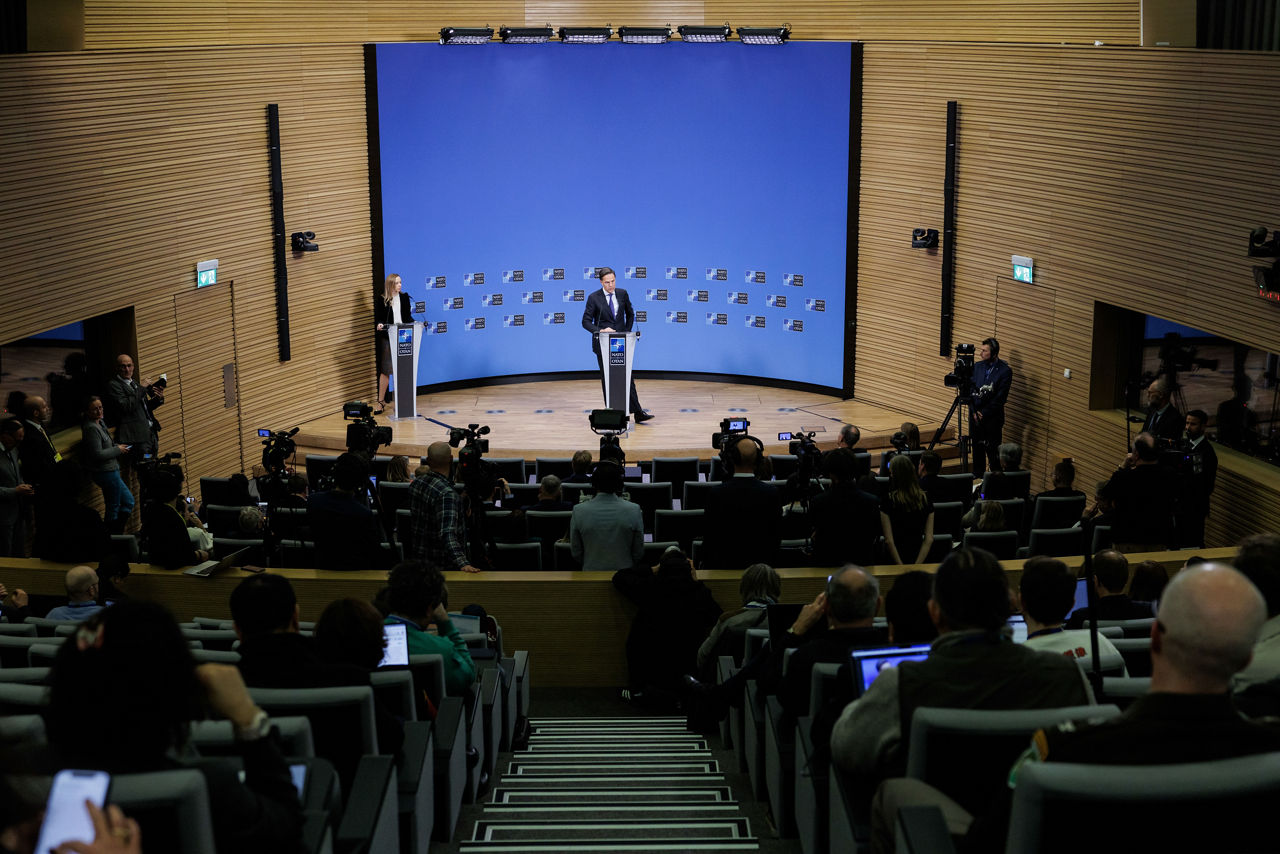
NATO foreign ministers have endorsed work on a path toward spending 5 percent of national GDP on defence and reaffirmed continued support for Ukraine.
Speaking after the meeting in Brussels, NATO Secretary General Mark Rutte said Allies face “real and lasting dangers” as Russia steps up missile and drone strikes on Ukraine and engages in “increasingly reckless behaviour” toward the Alliance, including airspace violations, cyberattacks and the deployment of intelligence ships near Allied infrastructure.
On defence spending, ministers discussed implementation of the commitment taken at The Hague Summit to reach 5 percent of GDP for defence on a “credible path”, according to Rutte. He said this should fund “core capabilities essential for our collective defence, including advanced systems for air defence” and stressed that contributions to Ukraine count toward the target because they “directly contribute to our own security”.
Rutte underlined that spending is not only about hitting a figure, saying ministers highlighted how higher budgets are already “translating into tangible enhancements, such as bolstering forces on the eastern flank and modernising equipment”. He linked this to wider efforts to address hybrid threats, including sabotage and cyber operations aimed at destabilising Allied societies.
Ukraine remained at the centre of the discussions. Rutte said all Allies want the fighting to stop and “strongly welcome President Trump’s continued efforts to bring about a just and lasting peace”, while stressing that support for Kyiv cannot slacken while negotiations are under way. “Ukraine’s security is closely linked to our own,” he said. “Our support must continue unabated to help Ukraine defend itself today and deter tomorrow. For their own sake, and for ours.”
During the NATO Ukraine Council session, Ukrainian foreign minister Andrii Sybiha briefed Allies on the situation on the ground and “Ukraine’s urgent requirements”, while EU High Representative Kaja Kallas underlined EU NATO coordination in supporting Ukrainian resilience.
Rutte highlighted the role of the Prioritised Ukraine Requirements List (PURL), the Alliance vehicle for coordinating and funding military aid. He said NATO is now delivering “essential, lethal and non-lethal U.S. capabilities, including desperately needed air defence, to help Ukraine hold the front line and protect its people”. According to the Secretary General, over two thirds of Allies have now committed to PURL, alongside partners Australia and New Zealand, with more than 4 billion dollars already pledged toward a 5 billion dollar annual goal. He urged capitals to “accelerate their pledges not just for this winter, but planning ahead also for 2026”.
Rutte argued that Moscow is misreading Allied resolve. “Putin believes he can outlast us, but we are not going anywhere. Today is yet another clear sign that he is wrong,” he said, adding that ministers also discussed measures against Russia’s so-called shadow fleet and other steps “to pose strategic dilemmas for the Kremlin”.
Looking ahead to the Ankara Summit, Rutte said the Alliance’s priorities are “investing in our security, strengthening our industry, and sustaining our support for Ukraine so it has the means to endure this tough winter and beyond”. He closed by restating NATO’s defensive posture while emphasising readiness: “NATO is a defensive Alliance. We will remain a defensive Alliance. But make no mistake, we are ready and willing to do what it takes to protect our one billion people and secure our territory.”






All talk.
“Putin believes he can outlast us, but we are not going anywhere.”
I’m worried about the influence he has on Trump.
If the US breaks away from NATO, then that is a strategic victory for Putin
and weakens us against the CRINK alliance.
It’s truly pathetic to see how easily Trump is manipulated by Putin and his cronies. Even now, the supposed ‘envoy’ Witkoff is being played by the Kremlin as they dangle the prospect of rare earth mineral deals to him and Kushner and other Trump family members. They will eventually throw Ukraine and Europe under the bus as they enrich themselves. Trump’s entire cabinet is a gallery of sycophants, incompetents, drunks and felons who couldn’t run a bath without help.
This current administration will only be known as a stain on the US ‘s reputation..
Note the latest US National Security Strategy
Yes. And it needs to be read and taken seriously by every NATO member. The current US administration is not an ally or even a friend. It plans to actively interfere in domestic European politics, disavow any military agreements, and is only interested in geo-political military mercantilism.
The document reads like it was written in the Kremlin, same as almost everything else coming from the White House.
The US has fallen.
CRINKUS becoming far more likely daily. Trump is a traitor. Rather than a peace prize he should be getting a prize for wasting the time & energy of allies just pandering to his latest insanities rather than addresing a very dangerous world for free democracies.
NATO without the USA must & can stand up to Putin. Putin needs confronting kinetically asap. Otherwise he get emboldened by our excessive caution.
The UK will spend 5% on defence and I’m going to be the next British astronaut. Watch this space!!
As another comment said, I read elsewhere ‘Why are 500m Europeans dependent on 300m Americans defending us against 140m Russians who can’t easily defeat 40m Ukrainians’
RussIa would probably have collapsed by now if it was not getting more real help from China, Iran and North Korea than we are from the USA.
The US and Russia are single countries. Europe is many countries, and it takes a lot of diplomacy to get agreements on things.
After the cold war, most of Europe started disarming and running down it’s military industries.
The US and Russia kept large reserves and their military industries.
So it’s no surprise we find ourselves here today, where Russia can outproduce Europe in certain ordnance and weapons.
Hence, we still need the US
To use that idiom another way, why did 500m Americans need 300m Europeans to help them fight tens of thousands of Taliban in their ‘ Global War on Terror ‘?
You recall the NATO article 5 being invoked?
But at least the USA was a common enemy of Russia back then & a reliable ally. Today it is neither & has an insanely toxic, Putin loving, stupid POTUS.