


NATO Secretary General Mark Rutte has stated that the alliance has overtaken Russia in ammunition production, a huge milestone in its industrial mobilisation since the invasion of Ukraine.
Speaking at the NATO-Industry Forum in Bucharest on 6 November, Rutte described the shift as proof that NATO’s collective rearmament is accelerating after years of under-investment.
“Until recently, Russia was producing more ammunition than all NATO Allies put together. But not anymore,” he told the assembled defence ministers, military leaders and industry executives. “Across the Alliance, we are now opening dozens of new production lines and expanding existing ones. We are making more than we have done in decades.”
Rutte’s comments came as NATO pushes ahead with new defence spending goals agreed at its 2025 summit in The Hague, where leaders committed to investing five percent of GDP in defence by 2035. “Five percent is serious money, but it is what we need to stay safe,” he said, adding that this level of commitment is necessary to rebuild Europe’s military strength and meet modern threats.
The Secretary General framed his remarks around three principles driving NATO’s industrial strategy: “quantity, creativity and cooperation.” Quantity, he said, meant scaling up production and shortening delivery times across the alliance, while creativity required harnessing innovation from both established defence firms and new technology start-ups.
“To stay safe in the future, we need to outsmart our adversaries,” Rutte said. “There are creative minds in this room, from large corporations to small startups. We need what you have to offer, and we live in free societies where your creativity can thrive. So bring your ideas, put your ingenuity to the test, and use NATO as your test bed.”
He pointed to the Defence Innovation Accelerator for the North Atlantic (DIANA) and the NATO Innovation Fund as examples of how the alliance is investing in dual-use technologies and emerging industries. “Through this fund, we invest in deep-tech startups that can support our defence, resilience and security,” he said. “We can help develop the next generation of innovators.”
Rutte’s central warning was that Russia’s threat to Europe will persist beyond the war in Ukraine. “The danger posed by Russia will not end when this war does,” he said. “For the foreseeable future, Russia will remain a destabilising force in Europe and the world.” He also highlighted the growing cooperation between Moscow, Beijing, Tehran and Pyongyang, describing their joint military and industrial efforts as “preparing for long-term confrontation.”
Against that backdrop, Rutte urged NATO allies and defence industries to move with urgency. “We cannot be naive. We must be prepared,” he said, quoting Franklin D. Roosevelt’s 1942 statement that “powerful enemies must be out-fought and out-produced.” He linked that idea to NATO’s own philosophy of deterrence: “We call it peace through strength. NATO will do its part, and we need industry to do yours.”
He acknowledged that many defence manufacturers are reluctant to expand capacity without firm government contracts but insisted that political and financial commitments are now in place. “Sometimes governments need to sign long-term contracts,” he said. “But I can tell you the political will is there. The money is there, the demand is there, and our security depends on it.”
Rutte urged industry leaders to “step up supply, expand existing production lines and open new ones,” adding, “Don’t let the fear of future surplus capacity keep you from meeting the real needs we face today. I have every confidence that what you produce will be purchased.”
He also noted that Europe’s defence expansion brings economic benefits as well as strategic ones. “There are great business opportunities for all of you, and real benefits for us all, because when industry steps up supply, the result is not only more security, also more economic growth and many more jobs,” he said. “The defence dividend is real, and our mission couldn’t be more worthy.”
The NATO-Industry Forum, co-organised by Allied Command Transformation and NATO Headquarters, is the alliance’s largest industry event and serves as a bridge between governments and defence companies. Rutte’s speech underscored NATO’s message that the alliance is no longer in reactive mode but is actively rebuilding its capacity for long-term deterrence.
“Dangerous times call for bold action,” Rutte concluded. “As leaders, we must take political risks. Industry must take business risks. Together we can deliver a safer and more prosperous future for us all.”

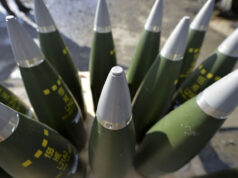

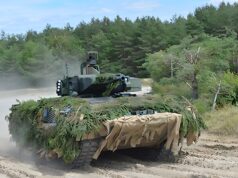





Great we can now produce the ammo. Can we now see an uptick in vehicles and weapons that can actually shoot said ammo?
And more personnel.
Don’t get personal…
Sorry I couldn’t help it 😂😂😂
Stop that right now.
This is a serious place for debating en masse.
But so many people are getting personnel when we should be objective….
There is already an abundance of artillery systems in Ukraine. Its ammunition has been the constant limit. Modern NATO 155mm self propelled guns can expend ammunition and very high rate.
I was more thinking of NATO countries more so than Ukraine.
Not all that artillery is automatically being sent to them obviously
The question is what percentage of that ammo is being made by the US. I suspect a large %, which means it’s not headed for Ukraine due to Mr trump.
The US is producing about 30% of the total in 155mm shells and less in other areas, their target is 1.2m a year by 26 and just the EU is 2m. The UK target for next year is 500,000 and other non EU members make up a similar amount.
ENATO round 3m per year USA 1.2m
US shells are all going to Ukraine it’s just that the EU is paying for them.
Is there data to back that up beyond targets and political statements?
Sounds promising that the EU is looking after itself but would like data to back it up as I have reservations.
Same with the UK volume. There is evidence that the expenditure has increased significantly but data on where that money has gone is as far as I know lacking. Hidden under national security reasons
Hi Steve for obvious reasons the UK and EU won’t give exact data publicly however by the Secretary Generals comments it appears the production increase is now on track and inline with the desired ramp up.
The US did state it was producing 40,000 a month last September and it hoped to get to 100,000 so it’s a fair bit behind Europe which is not surprising given the smaller industrial base of the USA relative to ENATO.
Russian production is estimated at 3 million a year so if Europe is not close to 2 million a year then the Secretary General would not be able to make this claim.
In monetary terms the USA has a larger industrial base than ENATO. Look at the difference in Missile production; SM2, SM3, SM6, ESSM, Tomahawk, THAAD, Patriot, the new hypersonics.. It’s over 150bn a year alone.
I’m not criticising the US industrial base, it’s just no where near as large as Europes, Europe has far more people and is less service based with lower wages so retains a larger industrial base better suited to making things like artillery shells.
ENATO produces approximately three times more steel than the USA for example.
The EU produces almost twice as many cars as the USA
Airbus makes almost twice as many planes as Boeing
But the US is clearly far ahead in services, software etc as war planes and missiles.
ENATO is way ahead in armoured vehicles and especially artillery
I assume the obvious reason is national security reasons, which is just a smoke screen. Our enemies will have the info, form a combo of local assets, spy sats and hacking. The only ones that don’t are the tax payers that pay for it.
Certain things I agree need to be kept secret but not things that our enemies have easy access to the data.
I think you give the Russians too much credit
Russian spy network I suspect is the only thing that has saved them. No idea what they have over trump, but it’s clear they have something.
If the US had gone full in to support Ukraine with weapons from the start Ukraine would have won ages ago. It is however clear multiple US senators and the president is in trump’s pocket.
In the UK we have the reform UK Wales leader admitting in court he took russian money for raising questions in parliament and the media, a guy that followed farage from ukip and personally appointed by him and the same talking points that farage used. We have Boris that slipped his security detail when NATO was meeting over Salisbury attacks to party with a russian kgp officer.
Russia as a spent power but if they have that much influence in our government, you can guarantee that china also has it.
Outside china and russia, which other country would we be bothered with knowing our production rate, as no other country is a risk of long term war that would deplete reserves.
Oh and of course we have May who told the security service not to investigate Russian interference in our elections. All publically and proveable. Who knows what else they have been up to.
This is great while we are shipping it all off to the Ukraine. The moment peace breaks out you just know Governments will have an instant and dramatic attack of austerity and we will be back to square one. I struggle to believe that Western Govts, and ours in particular, will have learned that having the bear minimum stockpile of ordinance is not a good idea. Apart from anything else, we have nothing to shoot it so it will be a waste of money 🙂
Still less than china and North Korea are supplying
How much of it is DPICM though…? Reports from Ukraine seem to suggest that it is far and away the most popular type to use- yet half of NATO don’t produce it, let alone use it. We either need to reverse that decision, or come up with an alternative.
There are only 17 countries who still could, or can, produce cluster munitions….but just because they’re not signatories to the CWC doesn’t mean they have active production. in NATO I suspect its only Turkey at present.
Brazil
China
Egypt
Greece
India
Iran
Israel
Myanmar
North Korea
Pakistan
Poland
Romania
Russia
Singapore
South Korea
Turkey
United States
I’m thinking we want to be getting back on that list…
The ramp up is significant. If you check Rheinmetall Unterlüß, you see substantial investments there. We Germans are slow, but once we start rolling it usually gets going.