

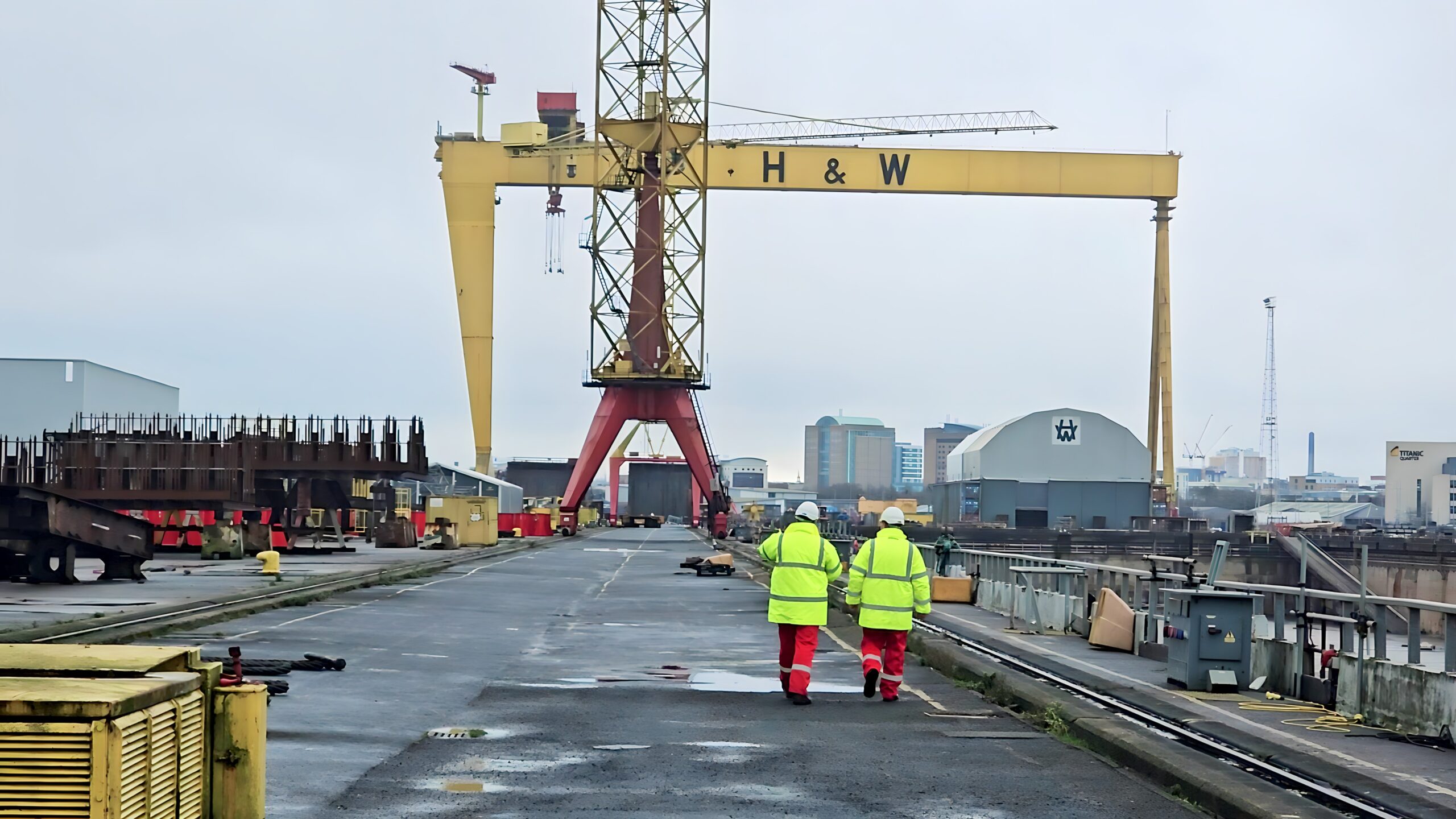
The discussion around Harland and Wolff still rests on the obvious markers: the cranes, the dry dock and the sense of a famous Belfast yard returning to naval work. Yes, that captures the surface of what is going on, but it does not explain what is changing inside the yard, or why the scale of work now underway is being treated as a reset rather than a refurbishment.
I spent the day at the Belfast yard speaking with executives and engineers to understand what is actually taking shape behind the headlines. The ambition being set out is for Navantia UK to develop into what it describes as a “third UK naval prime”, reflecting a long-running debate about the concentration of British warship construction and the intent behind the National Shipbuilding Strategy to broaden the industrial base. Within that context, the company presents Belfast as the centre of a new prime-contractor footprint rather than a yard focused on producing sections for other programmes, arguing that it fills what it sees as a structural gap in sovereign capacity.
You can watch our report below.
Ben Murray, Chief of Staff at Navantia UK, put numbers on what is happening across the former Harland and Wolff group. He said the four yards at Belfast, Appledore, Arnish and Methil were undergoing a significant transformation since their acquisition by Navantia UK, backed by £115 million of investment, including £90 million at Belfast, alongside new equipment, new machinery and a substantial transfer of knowledge, systems, process technology and tools from Spanish colleagues. He linked that directly to the role the company sees for itself in UK shipbuilding. “All of that is about creating a third credible prime here in the UK, the capability and the capacity to support the country with its requirements, what it needs, what the Navy needs, in an increasingly uncertain geopolitical context.”
Navantia’s role in this goes beyond ownership in name. The company is drawing on a parent with recent experience of running large naval programmes, and using that backing in two ways that matter on the ground. One is financial: recapitalisation only works if investment decisions can be taken and delivered without the stop-start pattern that has shaped many UK yards over the past decade. The other is industrial. Murray’s emphasis on knowledge transfer from Spain sits behind the practical changes now visible in Belfast, from the panel line and cutting capability to the push for more integrated production control and a workforce trained to operate modern equipment rather than rely on workarounds.
That UK-Spain structure also came up when I asked where design authority and intellectual property sit. Derek Jones said Navantia UK is a separate UK company, but argued that the wider group relationship gives the British yards access to proven designs and know-how when needed. “If we wanted to build one of those Spanish… design vessels here in the UK, the IP is unrestricted from Spain, we could get free access,” he said, while noting that there would be security limits in some cases. He added that the principle can work in the other direction too, with UK-developed work shareable within the group subject to customer and security constraints.
Jones, Navantia UK’s Chief Commercial and Business Development Officer, used the same language as Murray but pushed it into the practical consequences for the wider fleet. He described Fleet Solid Support as the beginning of a broader recapitalisation of the RFA, with strategic sealift and the rest of the fleet expected to follow.
The main part of the day moved from briefing into a tour. Jones described the new hall as “the showstopper” and explained its importance in simple terms. Navantia UK had issued plenty of press releases about the investment, he said, but here people could actually see it.
Peter Rusk, Programme Manager at Harland and Wolff with responsibility for recapitalisation activity tied to the FSS programme, then took over for my tour. He began with readiness and certification, saying the building control certificate for their new facility extension had been received on 12 February and that the project was now moving into the practical completion stage.
Rusk’s explanation focused on production flow. He described the extension as the front end of a new sequence, with steel arriving into a mini stockyard before moving onwards to the profile line. Alongside that, he said, the yard is refurbishing one of the greens at the commissioning quay to handle steel deliveries, with additional work already carried out to level and improve the stockyard area. That matters because this is not just new machinery. It is a reorganisation of how steel is received, staged and turned into parts.
Rusk then moved to the condition of the existing halls and what is being fixed alongside the new build. One roof has already been replaced, he said, and further investment has now been approved to replace what is known as a cathedral roof. The reason is obvious enough on site. “If you’ve seen it before, even now, you’ll see the puddles,” he said. He also pointed to the reality of dealing with legacy materials, including asbestos on the outside and older roofing and cladding products. As he put it, modernising older yards means going through all the proper treatment and associated work rather than simply dropping new machinery into old buildings.
The equipment discussion then became more specific. Rusk talked through new cutting machinery, including delivery dates and configuration. He referred to new burning machines with twin capability and said they were due on 17 April, adding that both were a little ahead of schedule. Inside the extension, he set out what is being installed and how it fits together. Smaller burning machines are already in place, while two new cranes have been installed with further lifts due shortly. He returned several times to the central figure of 450 tonnes per week, which is the processing capacity the investment is intended to support. More broadly, he said the purpose of the recapitalisation was to transform the yard into something more digital and more automated, echoing the “shipyard 5.0” idea raised earlier in the day.
Rusk also spoke about suppliers and the extent to which work has been delivered locally. A large share of the extension, including cranes and associated civil work, has gone through local suppliers. Jones later sharpened that into a political point during the briefing. “This civil works, I think all the contracts were placed with Northern Ireland businesses,” he said. “When the politicians stand up and talk about defence being an agent for growth… this is the sort of thing that it translates into.” He added that the main contract package was worth about £10 million and had either sustained or created around 50 jobs.
Murray later spoke about recruitment and the need to match new equipment with trained staff. He said people were already joining, that the company now had 222 apprentices on the books, and that recruitment was under way for a further 90. “It’s all well and good having the facilities, but you also need to have the people and the ability to use those new bits of technology and that new kit.”
Jones expanded on the practical challenge of staffing in Northern Ireland. He said FSS was among the earlier major programmes to carry a strong social value weighting, and that Navantia UK had a dedicated team working with charities, schools and community groups to bring people in. He also pointed to the tight labour market. Unemployment in Northern Ireland is particularly low, he said, so much of the task is about upskilling and reskilling rather than drawing on a large pool of available labour. He added that the company expected to work closely with firms such as Airbus and Boeing in the wider regional manufacturing base.
He also described the pitch to potential recruits as a career rather than a contract. “We’re trying to offer people a career in shipbuilding,” he said, adding that the longevity lies not only in FSS but in future shipbuilding more broadly. He pushed that further with a line familiar from recruitment messaging but still revealing in how the company wants its workforce pipeline to be understood. “You could join us as apprentice and become the MD.”
On the group’s geography, Jones gave a sense of how the four yards are being used. He described Appledore as a smaller yard suited to specific work and used historical examples to make the point, including Echo and Enterprise and carrier-related work. On FSS, he said Appledore is building the bulbous bows before shipping them to Belfast for integration. Arnish, by contrast, was described as continuing to handle energy-market work while also offering potential for other activity, including defence-related tasks, helped by its remote location and proximity to operational areas. He gave broad headcount estimates of about 200 people at Arnish, 250 at Appledore and a path toward 1,200 across the group.
Jones and Murray also touched on “hybrid navy” thinking, with Jones suggesting that different sites could play roles in future maritime concepts and pointing to Arnish’s location as potentially useful for activity linked to Atlantic Bastion.
Out at the dry dock itself, Rusk explained how it can be used flexibly. The dock can effectively be split, he said, allowing one half to be flooded while the other remains dry, supporting different stages of work at the same time. He also pointed to maintenance requirements on the dock structure. “We can see the walls have kind of broke away, and you can see the rebar,” he said, adding that repairs are planned. The scale of the dock was underlined repeatedly in conversation, including references to what could fit inside and to the vertical structures that separate wet and dry sections.
Jones gave a blunt assessment of what comes next after infrastructure. “There’s a lot of work… but just need to start building ships,” he said. “Once that starts, it creates its own momentum.” Facilities work matters, he argued, but it does not engage the whole organisation in the way serial build does.
There was also a thread running through Jones’ comments about exports and the company’s longer view of being a UK shipbuilder with a Spanish owner. He pointed to global programmes delivered by Navantia and suggested there is room over time to export from the UK, though only once credibility has been established at home. “We need to walk before we can run a wee bit,” he said, adding that FSS has to come first.
When I asked how design authority and intellectual property sit between the UK business and the wider group, the answer was that Navantia UK is structured as a separate UK company, but it can draw on Navantia’s existing design portfolio when it makes sense. The practical point was that, if a proven Spanish design is selected for build in the UK, the yards can access that IP without needing to reinvent the baseline, subject to security limits and customer constraints on sensitive details. The same logic was described as running the other way too: work developed in the UK can be shared within the group where the customer allows it, with the usual restrictions applying around sovereign requirements and classified elements.
After the tour, the discussion moved away from plant and production flow and into the workforce side of what it takes to restart a shipyard at scale. Jim McHarg, Chief People Officer at Navantia UK, described the change in mood over the past 15 to 18 months. From a skills perspective, he said, reinvigorating the yard with people matters because the future had previously looked very precarious. He described recruitment that goes beyond traditional shipbuilding pathways, including people arriving from sectors such as retail and then being trained into electrical, mechanical, welding and fabrication roles.
McHarg argued that greater predictability in demand changes how companies and colleges can plan. The industry, he said, was much more cyclical 10 or 15 years ago, more like a roller coaster, but continuous demand allows businesses to plan better and bring people in with greater confidence. He also pointed to the scale of training activity already under way, saying around 20% of the workforce would be in some form of training this year across the group.
He described relationships with further education colleges as long-standing, but said the numbers are now rising to a different level. What were once smaller intakes are becoming substantial enough to fill full classes. At the same time, he said, the company is trying to build more training facilities inside its own yards so that college delivery can be combined with yard-based preparation. That matters because, as he noted, the cultural adjustment is real. “It’s totally different in a shipyard compared to college,” he said. “You need a little earlier in the morning… it’s not like being at school with the teachers.”
On facilities, he said progress varies by yard. Methil, he noted, is due to get a new skills centre inside the yard, with activity expected in Q2 or Q3 this year. More broadly, he said, the wider £115 million recapitalisation package includes skills centres and welfare centres for the workforce.
Belfast already has a training centre, but McHarg described it as serviceable rather than where the company wants it to be. There is room for improvement, he said, and he used investment elsewhere in UK shipbuilding, including on the Clyde, to illustrate the gap. The aim is to get somewhere between the current position and the standard seen in more modernised yards. He also spoke about skills constraints at national level, including the structure of qualifications and entry requirements for apprenticeships. Questions such as whether an apprenticeship should last three years or four, he suggested, are worth revisiting, as are entry thresholds that may be too high and risk excluding people who could succeed in the trades. He added that the company is involved in wider skills structures across Northern Ireland, Scotland and the south west, alongside bodies such as Skills Development Scotland and Scottish Enterprise.
Reducing dependence on overseas labour also came up in the context of building a stable core workforce. McHarg said the issue is how to minimise reliance on overseas resource that can be expensive or unreliable, while accepting that overseas trades can also be productive and deliver high-quality work. The broader point, in his view, is that UK industry should not default to that model as its answer to domestic skills shortages.
Technology formed part of the same argument. McHarg said traditional images of shipbuilding trades no longer fully match what modern production lines require. Running the Belfast panel line, he said, calls for a different kind of welder, closer in some respects to mechatronics and computer-controlled production than to older assumptions about manual labour.
Perception was another recurring theme, he described it as a persistent barrier to recruitment, shaped by decades of industrial contraction. The sector, he said, is trying to shift public understanding of what modern shipyards actually look like. He described practical outreach aimed not only at potential recruits but at their families too, including open days and welcome events so parents can see where their sons and daughters will be working. His argument was that this kind of contact spreads through communities and gradually changes assumptions.
McHarg said the company is already seeing signs of improved interest in apprenticeships, with perhaps 15 or 20 applications for a single role, and he pointed again to school visits and community engagement as part of the routine. He also noted that social value requirements on programmes such as FSS reinforce that outreach and make it part of programme delivery. He also addressed the question of attitudes toward defence work in some educational environments, including protests that have affected graduate recruitment events. His response was framed around purpose. “What is wrong with working in an industry where you’re trying to keep peace in the world,” he said, suggesting that for many recruits that remains a persuasive case.
Across the morning, the picture that emerged had three layers. One was physical and immediate, dominated by Rusk’s walkthrough of the yard and the arrival schedule for major cutting machinery. Another was organisational, with Murray and Jones discussing workforce growth, apprenticeship numbers and the practical constraints of recruiting in a tight labour market. The third was strategic, with Jones discussing RFA recapitalisation, MRSS and the sequence of programmes that will determine whether Belfast maintains a steady build rhythm.
The next test is whether the yard’s new flow moves from installation into steady production at the rate implied by the new equipment and processing figures, and whether work follows quickly enough to keep that capacity in constant use.






This very wellcome as it gives the UK the capability to build and more easily support large ships such as the QE’s and FSS, it was sorely missed as lets be honest about this shoe horning the QE’s inot Rosth is less than ideal (I’m being polite).
Recuiting Apprentices and treaining them to come into engineering with a long term career ahead of them is music to my ears, lets hope it encourages the same in other parts of the UK.
As in everything else long term it all revolves around the long delayed Defence Investment Plan, some of us watched the PM just blank the quesion of when it is to be delivered asked by Badenock during PMQs on Wednesday.
Like anything to do with our archaic Parliamentary system everything has to be done in a set and very very slow way.
On R4 this morning David Lammy anounced that they would set out the plan to get Defence spending up to £3% GDP within the next 2 weeks so cross your fingers that this is actually going to happen.
FYI The Defence Secretary is scheduled for 14:00 on 16th March 🙂
And if Northern Ireland ends up leaving the UK and uniting with wider Ireland?
Money down the drain?
Al these negative vibes, it isn’t NI that anyone should worry about it’s Scotland, if it goes we are pretty well stuffed. The cost of setting up a yard to match H&W’s latent capability would be eye watering
I worry about both, as it happens.
Meh, the U.K. taxpayer pays more to NI just to keep the lights on than what will be spent on H&W.
The new armoured vehicle purchase for the Irish Army is very interesting in the news as of late. I was surprised that UKDJ did not report on it.
The purchase of the Caesar Hoiwizer is also welcome news.
It will be interesting to see final numbers, the KNDS boss is still talking circa 400 in the package, plenty of base infrastructure is going to be needed built and of course where the hell do we park 155mm guns to fire off into the Glen?
It is a bit strange when you think back to UKDJ covering a minor restock of Javalins like it was a major story, and then nothing for a 500m-1b Euro hardware package.
A funny thought for me though is unless Ajax gets sorted we could have the 40mm CTA round in service before the U.K. if the French move quickly enough.
400 was the number bandied about for the three armoured vehicle classes. Sounds like that will be number. Half dozen Caesars is what I heard for procurement.
Mortar Griffons/Servals, Air defence Griffons/Servals , all networked together, is a huge leap in ability for the Army.
The Jaguars pack a huge punch with 40 mm gun and AT missiles. The French will be busy with this order and the Belgian/Luxembourg package.
This gives the Army a Mech brigade or two mech battalions split between the two brigades. Maybe the 4th brigade should be brought back. 😉
The Glen and the Caesars is a dilemma.
I heard too that the Piranhas are being kept around for training after the new vehicles come in. The mid life refit has them hinging around for at least 10 years.
Too many unanswered questions about re-unification, the political point is easy to see but when you start digging deeper it becomes very clear it will cost Ireland a lot more than people think to re-unite with NI. I’d be confident nothing happening for 50 years min.
Thank you, Baz.
I’ve heard that side of things before. I’d not want the UK to be even greater mugs and paying like we are planning to do over Mauritius.
Not a penny.
Ireland can take some of our national debt too equivalent to the population and benefits drawn.
This cant stand. Just as we have two British Yards reequipping we get the Spanish Yard come in to steal their lunch. All because the Labour Government of Internationalists wouldn’t see H & W get a loan. Not so Madrid. Tell Madrid to get lost.
Thanks for the heads up!
If it was down to me I would turn Parliament into some museum, hotel combo and build a new state of the art Parliament building that looks to the future rather than back to the past, with archaic processes and an environment that must strangle the confidence and independent thought of anyone new who enters, at least who aren’t part of the landed gentry… which is hardly the sort needed to run the Country in this new technological age. I love tradition and theatrical performance but not when it seems to take precedence over getting anything actually done, certainly much in a focused timely and efficient manner. I think. It’s an environment that crushes creative thought, imagination and constructive change.
Part of the trade off to let the Spanish inspect military cargo in Gibraltar?
A state owned dockyard with a regular order book of work should have been funded either in Belfast or England.
So just spend like quadruple what this costs, so easy.
Beat me to it, we can’t afford British Leyland any more, indeed we couldn’t back then. All the growing economies have created new skills and capabilities through foreign help and investment, sadly we allowed our capabilities to rot on the vine and need moves like this to have any hope of re establishing them. Unfortunately starting again without the destructive Victorian work practices and mediocre management was probably the only way to resurrect once great traditional companies like Harland and Wolff. Doing so without dominant Govt control and finance is a bonus.
There is something about some British mediocre management that is very half hearted and sorry to say even….. It needs weeding out early. There should be a Govt board that enforces good practice and honestly through the BoE. Its usually the employees that whistle blow this early on but nobody listens. BL is a famous case in point.
Good job George!! Many thanks.
Great article, thanks George.