

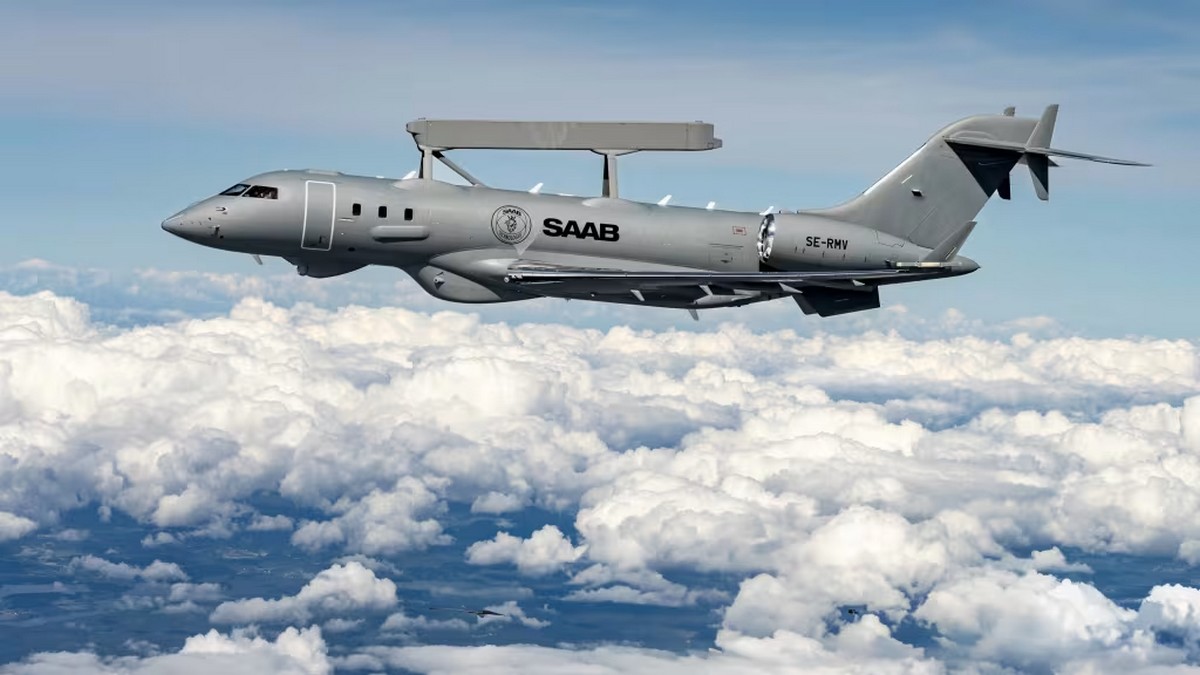
The Netherlands has taken a first formal step towards acquiring Saab’s GlobalEye airborne early warning and control aircraft, signing a Letter of Intent with Sweden for the system, according to the company.
No procurement contract has yet been signed and Saab stressed that it has not received an order from the Netherlands. The Letter of Intent instead establishes the Dutch intention to move towards acquiring the aircraft, with further procurement activity still required.
Saab said: “The Netherlands has signed a Letter of Intent with Sweden for the acquisition of a Saab GlobalEye Early Warning and Control (AEW&C) aircraft. The parties have not yet entered into a contract and Saab has not yet received an order from The Netherlands.”
The company added that it was prepared for the next stages of the procurement process.
GlobalEye is based around a business-jet airframe fitted with a suite of active and passive sensors intended to provide persistent surveillance across air, maritime and land domains.
The system is designed to detect and identify objects at long range before distributing that information to military users, allowing aircraft, ships and ground forces to build a common operational picture and respond to developing threats.
Micael Johansson, President and CEO of Saab, said: “We welcome today’s announcement by the Netherlands of its intention to procure GlobalEye. The system will provide enhanced situational awareness and early warning capabilities across multiple domains, while also strengthening NATO’s ability to operate in an increasingly complex security environment.”
He added: “GlobalEye will enable the Netherlands to detect threats earlier, respond faster, and strengthen both national and collective defence. We stand ready to support this capability with Swedish innovation and expertise.”
The aircraft combines a number of sensors rather than operating solely as a traditional airborne radar platform. Saab describes GlobalEye as a multi-domain AEW&C system capable of observing activity in the air, at sea and over land and providing information to different elements of an armed force in real time.
The prospective Dutch acquisition would add another European customer for an airborne surveillance capability at a time when NATO members are increasing investment in early warning, command-and-control and long-range sensing.
The next stage will depend on negotiations between the Netherlands and Sweden and the subsequent procurement process before Saab can book an order and begin delivery against a formal contract.




Makes you wonder what could have been achieved if the UK had got its finger out and developed such a system. This could easily have gone as a follow up to the Sentinel R1. Today the UK could have a cost effective fleet of Bombardier based sensor Aircraft and we would not be stuck with Boeing and its never ending clown show.
Open to question whether GlobalEye can handle battle management effectively. Wedgetail is a command centre and GlobalEye is more of a sensor node in a network. They represent very different operating concepts.
Agreed. While the E7 mission crew is about twice the size of the Global Eye because you don’t need multiple mission commander, radar/EW ops, you probably end up with 3 or 4 times the control positions.
That’s without looking at the additional radio suite on the larger platform.
The E7 can act as a full up CRC, and even carry a back up crew, the Global Eye will extend your radar and comms coverage but isn’t going to command a large chunk of the airspace on its own.
Not to say either is the ‘right’ way to operate, but they are very different.
I bang on about this every time AWACS gets mentioned but, I have yet to see a compelling argument as to why the RAF shouldn’t operate a High-low model with 3 E7s and some number of Saab GlobalEyes.
And don’t give me the budget argument, the PAF was running a very similar model over 10 years ago with 4-5 SAAB Erieye and 4 ZDK-03 on a tenth of the budget.
This is is an issue I see all over the RAF where the concept of having a large number of slightly worse systems is still lost on them, they instead opting for a tiny quantity of the best equipment which would be useless in an actual conflict with how little ability you would have to absorb losses.
Same with the seemingly lack of initiative to buy any Tranche 5 eurofighters to complement GCAP. The only hope I have is that several types loyal wingman drones will enter service simultaneously, Brontanax and then that really cheap 2-3 million quid one.
I agree with this, having a few E-7s, good, but having a European integrated option would be handy, especially when you consider the maintenance downtime on the three E-7s. And with the Canadian Military chief ordering Bombardier to engineer an A2A Refuelling capability on the Global 6500, which as we know is the base for the Globaleye at the moment.
GlobalEye isn’t cheap, it’s in the same ballpark as E-7’s marginal cost and less capable. They are similar in cost-effectiveness but the delays to E-7 are its main issue.
If we want cheaper AEW then the best option would be Protector LoyalEye for the RAF and Navy. Much less capable but better for dispersal and better availability.
I’m usually first to jump on the non-American bandwagon, but not this time I’m afraid.
Do I wish we’d gone GlobalEye in the first place? Yes absolutely. However, we are now committed to E7. We have 3 of them, and radars for more. The decision was poor, but it has already been made, and the money spent.
The political fallout of purchasing GlobalEye now is likely to be fairly extreme for practically no real gain.
If we are to pick a battle like that, it ought to have been over something more significant, such as a shift away from Trident, and no – I do not joke.
We had two spare radars under a tarp in a Birmingham lockup, then came a contract for 2 prototype E7s for the USAF, care to guess what radars they are using?