

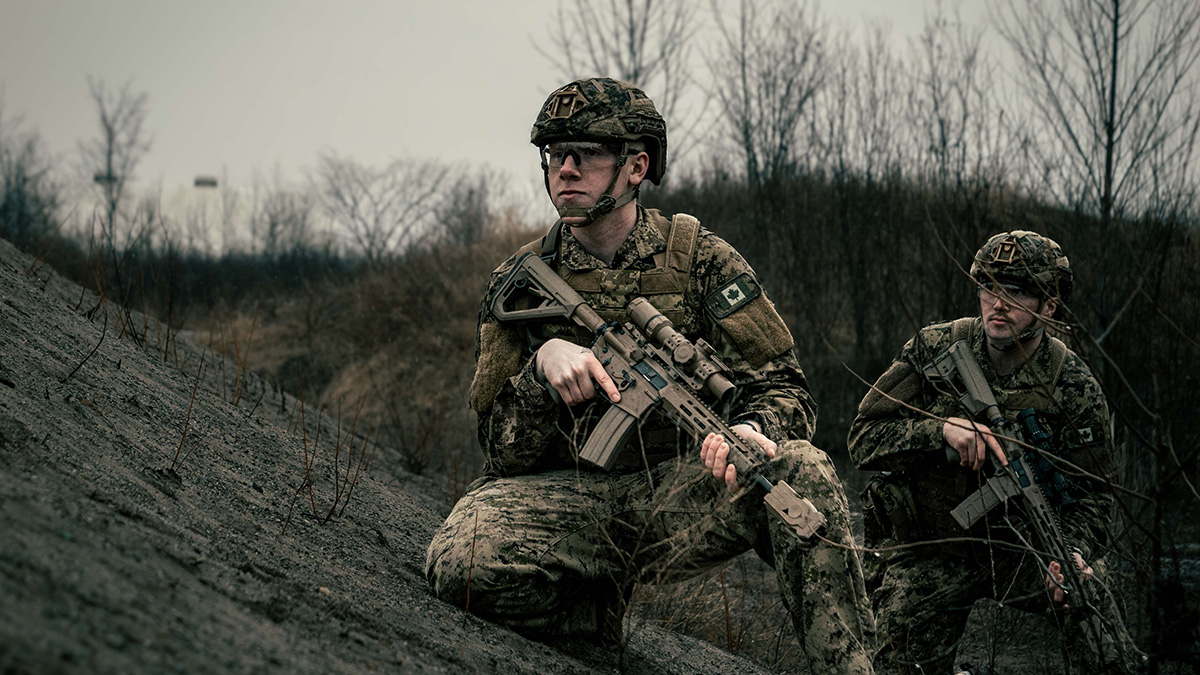
Colt Canada has given British and European audiences their first sight of the C25 rifle at Defence Vehicle Dynamics, the successor to the C7 and C8 family that has served Canadian and allied forces for more than 35 years, the company stated.
The rifle has been selected by the Department of National Defence and the Canadian Armed Forces, and was developed under the Canadian Modular Assault Rifle project.
Sean Congdon, President and Chief Executive of Colt Canada, said: “We’re really excited to be at this year’s DVD. It marks the start of us telling our story, with C25 as our focus. C25 is not simply about introducing a new rifle. It is our response to how the operational environment is changing and what soldiers need from their weapon system today.
“It builds on decades of experience with the C7/C8 platform, combined with what our customers have told us about the challenges they are facing in the field. As we bring C25 to the UK and other European markets, we’re taking the same approach that has always defined Colt Canada: listening closely to our customers and developing solutions around their operational requirements.”
The reasoning behind the design addresses a problem facing every Western army. Level IV body armour is becoming more common, and according to the company the current 5.56mm cartridge cannot be relied on alone to defeat it, while no settled view has emerged on a next-generation intermediate calibre.
Rather than change the round, Colt Canada has approached the difficulty from the other direction, making the soldier more accurate against the smaller, harder targets that armour leaves exposed, under the fatigue and stress of sustained operations. The company describes the C25 as a precision and human factors programme built around a defined concept of employment. The rifle remains chambered in 5.56x45mm NATO and carries a 13.7 inch chrome-lined, free-floating, cold hammer forged barrel, with a full length top rail on the upper receiver accommodating a range of attachments including the company’s own 1-6x low power variable optic.
The company describes four changes as central to the design, the first being a two-stage trigger intended to deliver a more sensitive, positive break under stress. Optimised barrel geometry reduces disturbance to the projectile, which the company says supports higher practical accuracy across the effective range. Controlled gas redirection at the muzzle decreases sound pressure at the firing position, suppresses flash and reduces felt recoil. The low power variable optic extends the engagement window and reduces the time a soldier spends exposed.
Colt Canada has supplied military customers across Europe since the 1990s, and says approximately 3,000 of its weapon systems are in service with the British Army including the special forces, alongside fleets in the Netherlands, Norway and Denmark.








Sometimes I wonder if we’re making too much of this rise in body armour.
Level IV means nothing to the grenade, mortar or 155mm.
Grenades ok but your average squads hasn’t got a mortar or 155mm in his back pocket!
It is not the gear we wear, but what others are now wearing. Insurgents in Afghanistan often wore gear that was as good as, and sometimes better than, what we were issued. Personally, after seeing the American 6.8 x 57 121 grain high-velocity round, I believe we should switch to it, and so should the rest of NATO. The 5.56 + conventional ball ammunition now gives us poor capability against modern hard armour. A 5.56 + specialised AP/EPR ammunition is substantially better, but still constrained by the relatively small projectile and declining velocity/energy at distance. The 6.8 + its specialised military projectile is designed specifically to provide substantially greater armour-defeat capability and maintain that capability further downrange.
At 300–600 metres, the difference becomes more significant because the heavier 6.8 projectile retains velocity and energy considerably better. That is why I would describe the 6.8×51 not as a “faster 5.56”, but as a much more powerful cartridge that happens to have a similar muzzle velocity.
If you watch the BFBS Forces News video on the SIG MCX M8 ammo, you’ll see the results of the 6.8 vs 5.56 against heavy plate, which makes a strong case for switching.
What do you think of 6mm arc which seems to me to be the best balance between performance and weight?
The 6.8 generates a higher chamber pressure than the 7.62 NATO. The case is of a similar size, but pushers a slightly lighter grain bullet, hence it produces a much greater muzzle velocity. Therefore the weapon used to fire the round has to be built a lot more substantially, even one firing 7.62, thus making it heavier. Which is good for overall sustained accuracy, but crap for carrying all day.
A lot of the issues with 5.56 penetration and accuracy over 300m comes down to the selected barrel length. The Yanks were moaning due to a lack of a effective range of their M4s. But’s that because they wanted the shorter barrel over the longer M16 barrel. As it means its handier in urban area fighting. Which was great for Iraq, but not so much for open fighting in Afghan.
As an example the L143A2, used by the Royals comes with a barrel length of 12.5″, whereas the standard Colt C7, like the L85 uses a barrel that’s 20″ long. The C7 generates a muzzle velocity of 945 m/s (3,100 ft/s), whilst the L143A2 is 2,650 to 2,750 feet per second (808 to 838 m/s), due to the shorter barrel. This lower muzzle velocity therefore affects the effective range along with the achievable MOA. But does mean its more handier in confined spaces like working your way around ship corridors.
The SIG M7 comes with a short 13.5″ barrel, yet the round fires with a muzzle velocity of 915 m/s (3,000 ft/s). Whilst giving a 1 to 1.8 MOA, which is impressive for such a short barrel. However, the downside is the felt recoil which has to be much higher. So for the layman, it would mean you can place a pretty accurate first shot, but on repetition for follow up shots or on auto, the placement will get wilder, as you fight to control the weapon’s recoil. Weapons using the 5.56 NATO are generally very good for follow up shots, as the felt recoil is very low.
Having not shot the M7 or weapons using the 6.8×57 round, I suspect it will be very similar to the G3 Carbine (fired 7.62 NATO) with the shorter barrel, which was pig to keep on target when in full auto. As Pacman, says the 6mm ARC may be a better compromise in this regard, as it has lower felt recoil that the 6.8 round, but uses a much higher grain bullet than the 5.56, so retains better energy over distance. Plus the normal AR15 platform can be easily upgraded to using it, where most just need a new barrel.
We did find a number of Taliban, using Iranian, Pakistani and Chinese made body armour. The die-hards who came across from Pakistan that had survived a season or two, were normally the ones with the Gucci armour. The newbies straight out of the madrassas, generally had nothing armour wise.
We should have stuck with the bolt action Lee Enfield .303. I have fired one at Bisley, you could drop an elephant with it at 300 yards. The MoD has hundreds of thousands of them built at ROF Fazakerly still in their greased packaging. And millions of rounds for them
They are a great hunting rifle . My family have a few Lees in Canada. They can drop a Moose no problem.
I think I’d like a shot on one of these. C7 has been very good but something along the lines of an MK22 in .338 would be in with a shout; would also keep the Yanks onside.
I’d need a day on the ranges to come to a proper conclusion…
Whilst making a weapon more accurate at distance and in action that is not always going to happen. The larger round with its increased hitting power is what we need today. One round, one target and its out, let’s- go for the heavier round which will both ensure a positive kill on the full target and if your trained to shoot correctly you will use less ammo too.
Like the black rod of death with its 7.62 you mean😉
That sounds great on the range, not so much in combat. For example when you don’t know exactly where the target is and you are laying down suppressing fire one shot one kill doesn’t work so much.
Depends on your training, its how many of us were trained and it worked in combat too. But you want stopping power which the heavier round will do. Suppressing fire can come from the machine guns within a unit letting the sharpshooters to move and then do what they do best, KILL the opposition. It’s always a mix.
Canada has also just applied to join the JEF.