

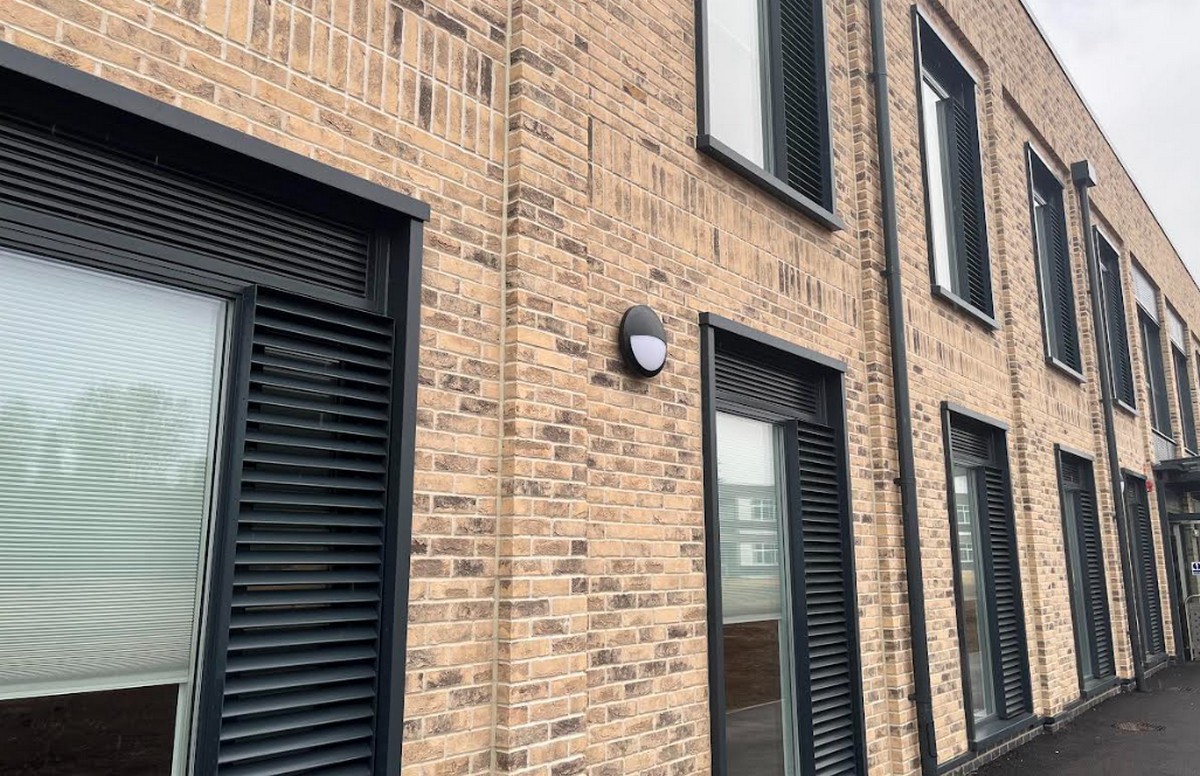
A new £14 million accommodation block has opened at Defence Munitions Kineton in Warwickshire, named in honour of an Ammunition Technician killed during operations in Iraq in 2003, the Defence Infrastructure Organisation has said.
The Muir Building was named after Staff Sergeant Chris Muir, who had served as an instructor at DM Kineton before deploying to Iraq. He was killed during an explosive ordnance disposal operation in 2003.
His son, Ben Muir, was invited to formally open the building and cut the ribbon in front of members of the family and former colleagues of SSgt Muir.
Ben Muir said: “It was a lovely surprise to hear that the building would be named after my Dad, so that his example will continue to inspire ammunition technical officers for years to come. It was a great pleasure to be here to officially open the new block.”
The new building contains 46 ensuite bedrooms intended for officers and senior non-commissioned officers, including two fully accessible rooms. It also provides kitchenettes, communal areas, laundry and utility rooms and a cycle store. The Defence Infrastructure Organisation led the project, with Algeco constructing the facility on behalf of VIVO, one of DIO’s built estate industry partners. The accommodation was produced using modular construction, with units manufactured away from Kineton before being transported to the site for assembly.
DIO said the approach reduced disruption at the base during construction while allowing the older accommodation it replaces to be removed from use.
Richard Walsh, DIO RD Central Project Delivery Manager, said: “Reaching handover is a fantastic achievement and marks the culmination of a huge amount of work from everyone involved in the project. The Muir Building provides modern, high-quality accommodation that will significantly improve the lived experience of personnel based at DM Kineton for many years to come.
“By replacing older accommodation that had reached the end of its useful life, we have delivered a sustainable and cost-effective solution that meets the needs of today’s Armed Forces while also supporting future generations of personnel.”
The building incorporates solar panels to generate electricity and air source heat pumps for heating. Water recovered from sink drainage is also reused at boot-washing stations, while additional trees have been planted around the development.
Lt Col Chris Ralling, Head of Establishment at DM Kineton, said: “The Muir Building was named in honour of one of our colleagues who tragically died on operations so it was a great pleasure to be joined by his family to open the building. The new block will provide fantastic, sustainable accommodation to 46 personnel on site, as well as comfortable communal areas, cooking facilities and more – a fitting tribute to a much-loved colleague.”
The first personnel are due to move into the Muir Building in early September.












Solar panels and heat pumps????
When the people charged with our defence make political decisions to spend money in this pointless way, I truly worry for my country.
So would you prefer natural gas boilers/heaters with ever increasing gas costs. Very likely costing more to run than solar panels and heat pumps.
Tell us where public money is being saved if your plan is to install natural gas heating?
I have both solar and a heat pump. If they haven’t fitted enough solar and the right amount of battery storage, it will still cost a fortune. We paid 40% more with a heat pump at this house than we did with the boiler at our old home. I had to buy £2.5K worth of battery storage to capture enough energy from solar panels each day to reduce costs this coming winter. Even then, the hot water can take 40 seconds to reach the bathroom tap. Unlike GCH, where the boiler stored enough hot water, a heat pump doesn’t. So, that building might struggle to supply enough hot water for X residents. Given the choice, it would be a gas boiler all the way for me. As our new estate has no gas supply, I’m up the creek.
Wake up J !
Solar panels and heat pumps are now political? LMAO I hope they keep doing this and keep installing solar panels and heat pumps on every postcode. Just to spite these right-whingers 😅
So 46 en-suite rooms for £14m. That works out at over £300k per person, can anyone explain why it’s so expensive, even taking into account boot washing, solar panels and a bike store.
Add in the defence requirement of partition and structural division to prevent total collapse in the event of a blast or terrorist actions, blast glazing et al.
The grey water systems etc. Possible install of diverse IT provision ( might be used as private study on cses etc as i presume they train folks thier)
Fitout and finish tend to be higher in Off and SNCO Accom as they are less prone to smashing the crap out of everything.
Why are officers not accomodated in the Officers’ Mess? Why are they living with SNCOs in the same block?
£14m, that’s equivalent to £304k for each “pre-fabricated” room, no wonder the armed forces are skint, and I bet they already owned the land.
33 comments. Intrigued to know what I missed with most having been moderated?