

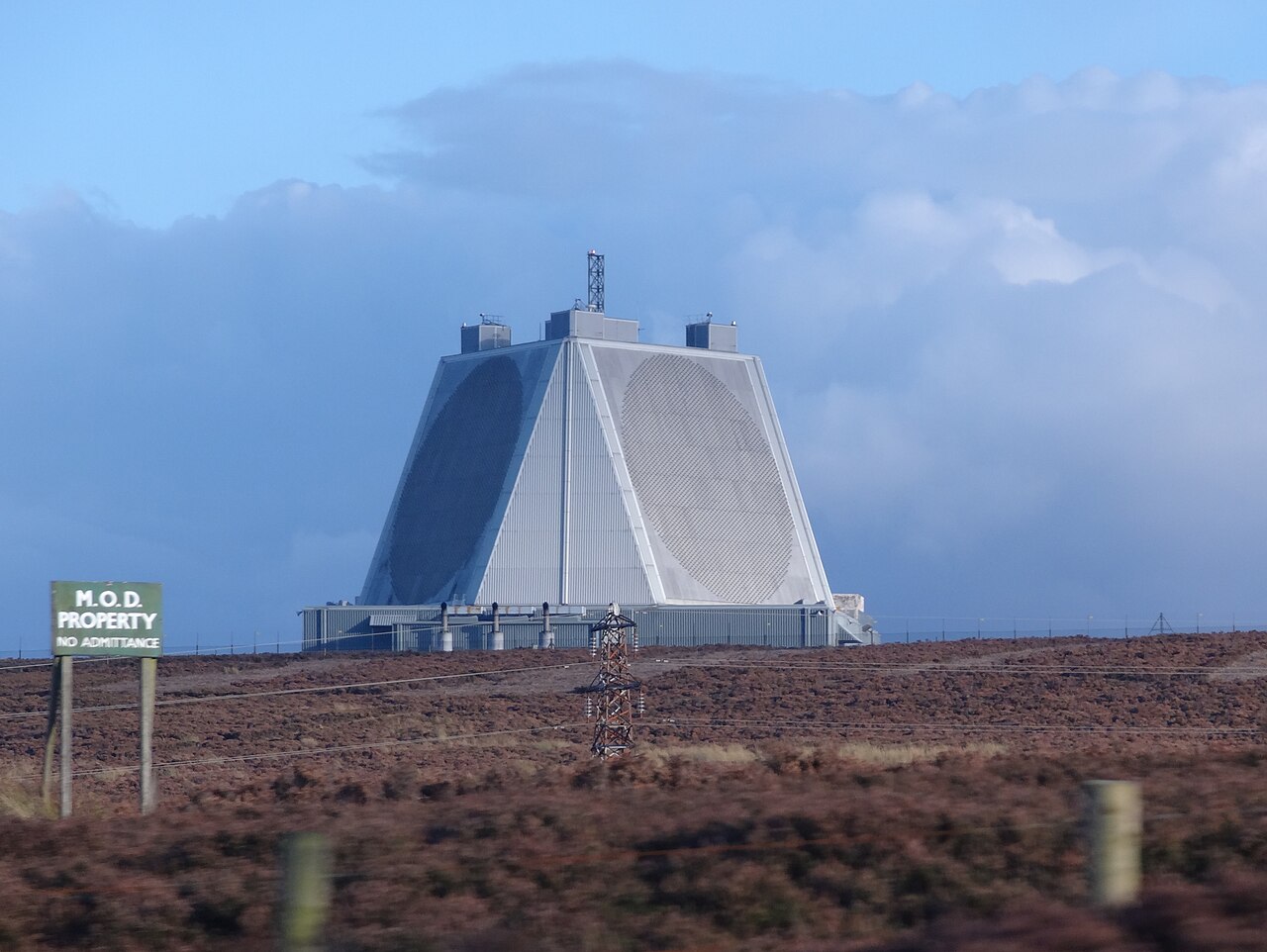
The Ministry of Defence has refused to publish a risk assessment of private sector involvement in running the Solid State Phased Array Radar at RAF Fylingdales, saying the recent contract activity continues arrangements that have been in place for years, according to an answer given in Parliament.
Mark Pritchard, the Conservative member for The Wrekin, asked whether a risk assessment of outsourcing the operation and maintenance of the radar would be published.
Louise Sandher-Jones, Parliamentary Under-Secretary and Minister for the Armed Forces, said: “Private-sector support to the Solid State Phased Array Radar at RAF Fylingdales is longstanding. The recent contract activity represents the continuation and re-let of existing support arrangements, rather than a new decision to outsource the capability.
“The contractual re-lets were subject to the Ministry of Defence’s established investment, commercial, security, safety and risk-assurance processes. Operational command of, and accountability for, the radar remain with the Ministry of Defence. Contractor personnel provide defined operational, maintenance and sustainment support within established contractual, security and technical governance arrangements.”
RAF Fylingdales stands on the North York Moors and has provided ballistic missile early warning since 1963, originally through three radomes that gave the station its nickname of the golf balls. They were replaced in 1992 by the present solid state phased array, a truncated pyramid with three faces each covering 120 degrees, which watches continuously without moving parts. The station feeds the United States Ballistic Missile Early Warning System as well as British users, and contributes to space surveillance.






Good grief, why should I be surprised anymore.
I think this is just saving money on a piece of paper which will tell everyone what they already know.
I doubt I am alone in supporting eliminating financial waste even though it would not have amounted to much.
There are some things that have “NO” written all over it, and civilianizing Ballistic Missile Defense strikes me as being very high on the list.
The private sector here I understand is involved in the maintenance and support of the radar, power generation, and other specialist systems.
It has been the same for decades.
So BMD isn’t civilianised in this case, operations are still run by the RAF No2 SW Sqn and the attached USAF liaison.
Serco aren’t picking up the phone to London, the NADOC, and CinC NORAD to warn of incoming.
Does this Fylingdales site have any GBAD/ABM protection? Bit of a huge sitting duck if not? Any back up sites if hit or when out of action? Why not purchase some deployable SkySabre CAMM/CAMM-MR or Aster/SAMP-T or UK Patriot for it?
Might be a good reason for the UK not to scrap the T83 idea completely and order a couple, like Japan/Aegis and Italy/DDX, to offer sea based ABM coverage for the UK and surrounds and any CSG and can still can have half dozen CCVs and T91/T94s.
Of course not.
BMEWS consists of Fylingdales, Thule, and Clear in Alaska, the radars are so powerful, there are in effect no back up sites beyond cross checking with missile launch warning satellites that NORAD also have access to.
Intetestingly, I long ago read that Thule and Fylingdales themselves are breaches of the ABM treaty, a bit rich considering the Americans complained about the original Soviet version at Krasnoyarsk.
I understand that the ABM Treaty stipulated that such radars must be placed on the periphery of the nation and point outwards. Krasnoyarsk was thousands of miles inland, and pointed eastward across Sibera filling a gap in coverage, thus a breach.
And Fylingdales and Thule are obviously not in the United States, didn’t stop the usual American hypocrisy.
Thanks for the reply and historical detail which I was totally unaware of as of their size. I think we also have some equivalent sites down here in Aus too. Just thought the Japan/Italy decision on having a pair of large ABM destroyers is something the UK could potentially replicate offering fleet and land protection in the absence of anything being land based and the T91/T94 combo might have their limitations. Thank goodness there’s still the very decent T45s for now!
I think they both predate the ABM treaty, therefore not being a breach.
Hi Chris.
Interesting, I first read of this issue in a critique of the Pentagons annual report “Soviet Military Power” about 1988 time frame, where the author mentioned this.