

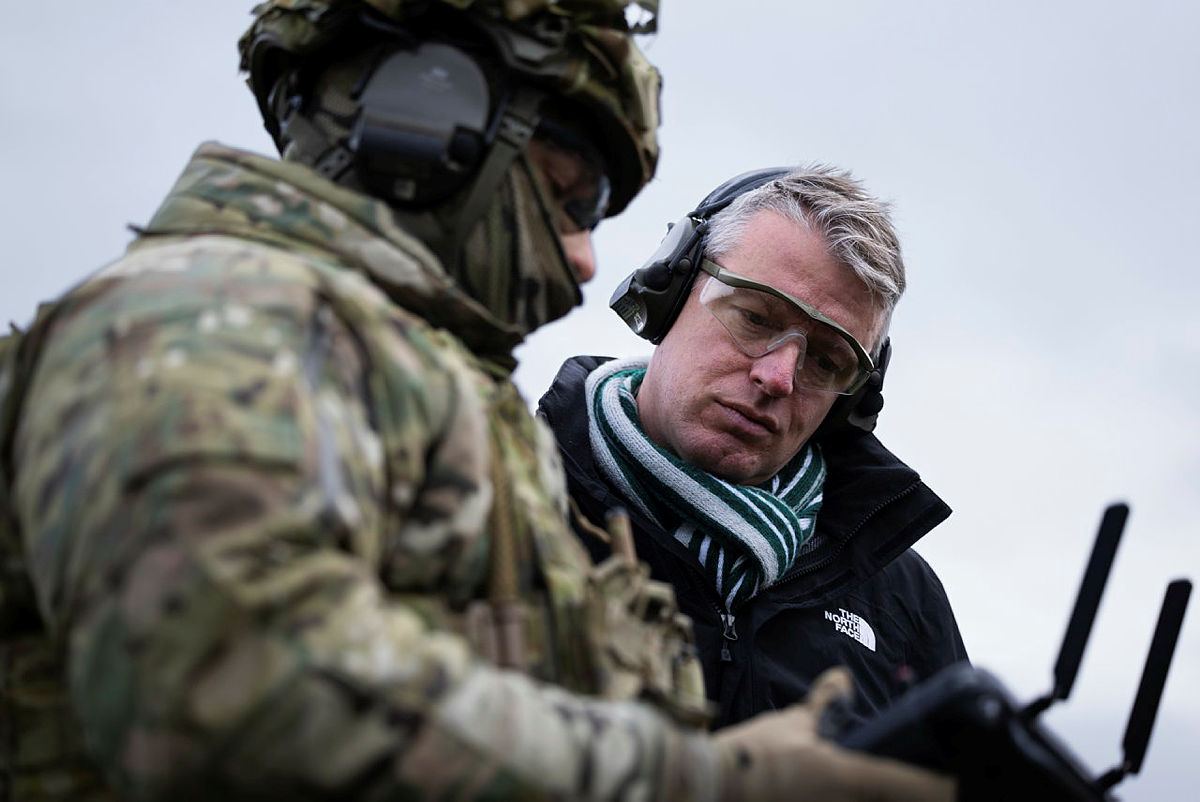
Equipment that would not survive the war in Ukraine has no place in the British armed forces, the Minister for Defence Readiness and Industry has told an audience of financiers and defence firms at Mansion House, in a speech setting out how the government intends to bring private capital into defence.
Luke Pollard was speaking on Tuesday at an event hosted by the Lady Mayor, ahead of remarks by the Ukrainian Ambassador, and used the address to announce a Defence Finance Investment Strategy to follow the autumn budget along with a defence investment summit in December.
Warning that Britain must “discard the warm comfort blanket that we are used to, of polishing old things and pretending that that will protect us”, he put the test in a single sentence: “If our technology and kit will not work in Ukraine, I do not want it in our armed forces.”
That, he argued, opens the door to “new technology, new thinking, new weapons”, and to designing for “the conflicts of today and the battles of tomorrow”.
“The way that the United Kingdom would now fight is fundamentally different today than it was at the point when Putin launched his full-scale invasion of Ukraine only those four and a half years ago,” he told the room, adding that learning from Ukraine means changing how Britain itself operates.
Finding, funding and firing up
Much of the speech turned on speed, and on where the useful ideas are now coming from. Many of the most critical advances in defence, in the minister’s account, are emerging from technology startups and scale-ups, agile businesses “seizing the opportunities on offer and driving change at speed”. The challenge he set the room was framed as a question. “How can we get better at finding, funding and firing up the most creative minds and enterprise to get the best technology into the hands of our armed forces and those of our allies as fast as possible?”
He was unsparing about the position two years ago, describing a defence programme that was “to be honest and to be frank, unfit to counter the dangers that we now face”. Industry, he suggested, needs no reminding. “Those who work in our supply chains know how painfully slow, wasteful and costly the procurement the MOD previously undertook was,” he said, singling out small businesses and scale-ups with good products who “struggled sometimes to find the right buyer within the MOD”.
Small firms
Against that, Pollard set out the machinery now in place: a new National Armaments Director in Rupert Pearce, recruited from a FTSE 100 company and bringing what the minister called a new corporate approach and energy to procurement; the Defence Office for Small Business Growth, established to cut red tape and remove obstacles to entry; and an SME Action Plan published so the department can be held to account for the change.
The headline commitment is a 50 per cent increase in departmental spending with medium and small firms by summer 2028, which the minister described as “moving an extra two and a half billion pounds into the pockets of SMEs by changing the way we procure”.
Regional defence and security clusters have proved successful enough that more regions are developing them, he said, creating local routes that bring together major suppliers, devolved and local government, and giving investors a forum in which to meet them.
Bringing in the City
Running through the address was an argument that public money alone will not build the capacity required in the time available, however welcome rising budgets are. “As a defence minister, of course, I would like more defence spending,” he said.
“But it’s not just from the taxpayer that there’s opportunities for investing in defence. It’s how you crowd in private capital, how you use the institutions, the networks, the structures of the City of London and the UK’s place at the heart of global financial trade, to bring more private capital into defence, creating more good jobs and more deterrence.”
Waiting was not, in his view, an option: “In a more dangerous world, we need to build more capacity now, rather than just wait for the increase in defence money that we know is coming over the next 10 years.”
Whether the two sides can understand one another is a separate problem, and one he acknowledged. “There’s a risk that we sometimes speak past each other,” he said, arguing that a shared language and shared data would improve the department’s ability to deliver. The Defence Investment Unit announced in the Defence Investment Plan is meant to close that gap, giving investors a clearer interface with the department while bringing financial expertise in to turn priorities into market-facing propositions.
Companies already through the door
To show the approach producing results rather than remaining theoretical, the minister turned to firms that have already taken the route.
Thirteen British startups won contracts of up to £4 million in May under the Defence Unicorn Fund programme. Among them was Kraken Technologies, which builds maritime uncrewed surface vessels and has since raised $175 million in a Series B round on the back of a $1 billion valuation. Green Jets, one of three firms selected to develop a low-cost drone interceptor, has also secured significant funding. Both drew money from the National Security Strategic Investment Fund and the NATO Innovation Fund, with the British Business Bank financing Kraken as well.
JET Connectivity, a small business building 5G and 6G communications tools, was the only British firm admitted to the NATO DIANA mission track programme this year from more than three and a half thousand participants, which Mr Pollard called “fantastic recognition of British innovation at its best” while adding that it is “just the tip of the iceberg”.
There was a moment of self-deprecation over how the language has shifted under the current Prime Minister, with the Minister saying, “I used to be incentivised by the MOD press office to say defence is an engine for growth in all my interviews,” he told the audience. “With Andy Burnham in Downing Street I now say re-industrialisation, but the fundamental truth is there. Investment in defence creates good jobs. It provides opportunities in particular for our young people and we should be unafraid and unapologetic of saying that truth loudly.”
His closing argument was that none of this rests with his department alone, describing defence as “a whole of society endeavour, a whole of government endeavour” which the Ministry of Defence must lead but cannot deliver by itself.
He finished on deterrence, and on what follows if it does not hold, saying “That’s why increasing our deterrence matters with new technologies. But if deterrence fails, we must be ready to fight, and we must be ready to win.”









Wow there’s so much spin in that garbage I’m dizzy and about to puke! Just ask your unelected boss for the cash injection defence needs and stop taking shite!
‘…increasing our deterrence with new technologies matters’
New technology, its effectiveness unproven, cannot deter.
Javelin ATGW, new to Ukraine, saved Kyiv in 2022 but it did not deter Russia.
What deters a dictator with a land army of over one million?
Mass: armoured divisions deployed on Continental Europe.
Surely taking out the oppositions military vehicles and major weaponry and by doing so the troops tied to them achieves success on the battlefield and by association offers deterrence by that reality or the mere threat if it. Equally whether it’s achieved by mass armoured formations or other means, be they Javelins, Hellfires, Brimstone or drones, other technology or indeed any pre-determinable combination is irrelevant to that end. It’s about the best overall result.
I am not sure however losing hundreds of tanks and the men in them to whatever similar technology the enemy employ is going to be as easy to ‘sell’ to the western public as it is in a dictatorship like Russia, China, North Korea et al. If they are convinced they can take them out or simply take more pain the deterrence value becomes at best nebulous. So simply matching (or better) brute force with brute force per-se isn’t a realistic answer in itself, you need to out think and out innovate to ensure your success and acceptable losses, keeping the enemy unsure of what he is dealing with over a known traditional threat he feels he can handle, delusionally or otherwise. Surely for all the waffle in these matters there is enough realisation of that fact coming through and I am grateful about that vision. Acting upon it, choosing the correct options (and part of this speech actually focuses on that thankfully) and ensuring it happens in timely fashion are the main issues here surely.
We have to distinguish between deterrence and warfighting. Our immediate priority must be to deter.
We know that capable weapon systems do not deter on their own because they failed to do so in Ukraine in 2022 and have failed so to do in Israel and elsewhere on numerous occasions. Javelin entered service in Ukraine in 2018.
A great deal of work has been done on the subject of deterrence in Central Europe. Here are two examples:
‘Europe’s NATO members are not yet ready for large-scale combat operations. Across Europe, there are profound mismatches between rhetoric and readiness: some NATO militaries, including the British Army, could only sustain frontline combat for a few weeks under conditions similar to Ukraine’s…Recognise the seriousness of Russia’s ambitions and the interconnectedness of its efforts, not just in Europe but globally..Adopt a war-time mindset: acknowledge that Europe is already at war. Policies must reflect the urgency of this reality and address different warfare techniques. ..Limit dependence on the US where dependence for hard security is untenable. With Washington pivoting its focus toward China, Europe must take responsibility…Accelerate decision-making procedures. Cut through bureaucratic red tape to reduce legislative and logistical delays. European countries must spend faster and deliver quicker…Strengthen Europe’s hard power and self-reliance/resilience though expanding its defence industrial base to ensure domestic production of ammunition, drones, weapons, and ensure interoperability…Deliver solutions at scale, not just individual weapons systems: training troops, supplying ammunition, maintaining supply chains.’ Chatham House 2025
Mass is key.
‘in Central Europe, the nations of the Atlantic Community maintain an army structured into 26 divisions and about 1600 tactical aircraft. There is a litany of shortcomings that one hears with ever more frequency in regard to the effectiveness of this army. Nonetheless, for almost 30 years, it has accomplished the basic mission for which it was formed-to deter (Russian) attack on Western Europe.’
‘Now, military forces, including land forces, have two important effects on an adversary. One is the physical, the other is psychological…Erosion of the effectiveness of the Atlantic army will inevitably result in an erosion of political will, strategic flexibility, and freedom of action.’
And that is precisely the situation that we see, in particular as regards the British Army but right across UK armed forces today and its effect on this country’s government.
‘As a bare minimum, it is the role of the Atlantic army to replace the strategic nuclear deterrent as the instrument with which the attack option is foreclosed to (Russia). But that is a bare minimum. In a modern strategy the Atlantic army must provide for the West a sense of security to a degree that will encourage it to act and react in respect to global events with confidence. That forecloses to (Russia) the options of intimidation, blackmail, and political leverage…’
Lt Gen DeWitt Smith 1977
We know what to do. We have done it before. It produced the ‘Long Peace’ in Europe 1945-2014. It works.
BMD seems pretty important but we lack any form of it for GBAD. If he wants things that work it’s probably worth a look, drones can’t shoot ballistic missiles down.