

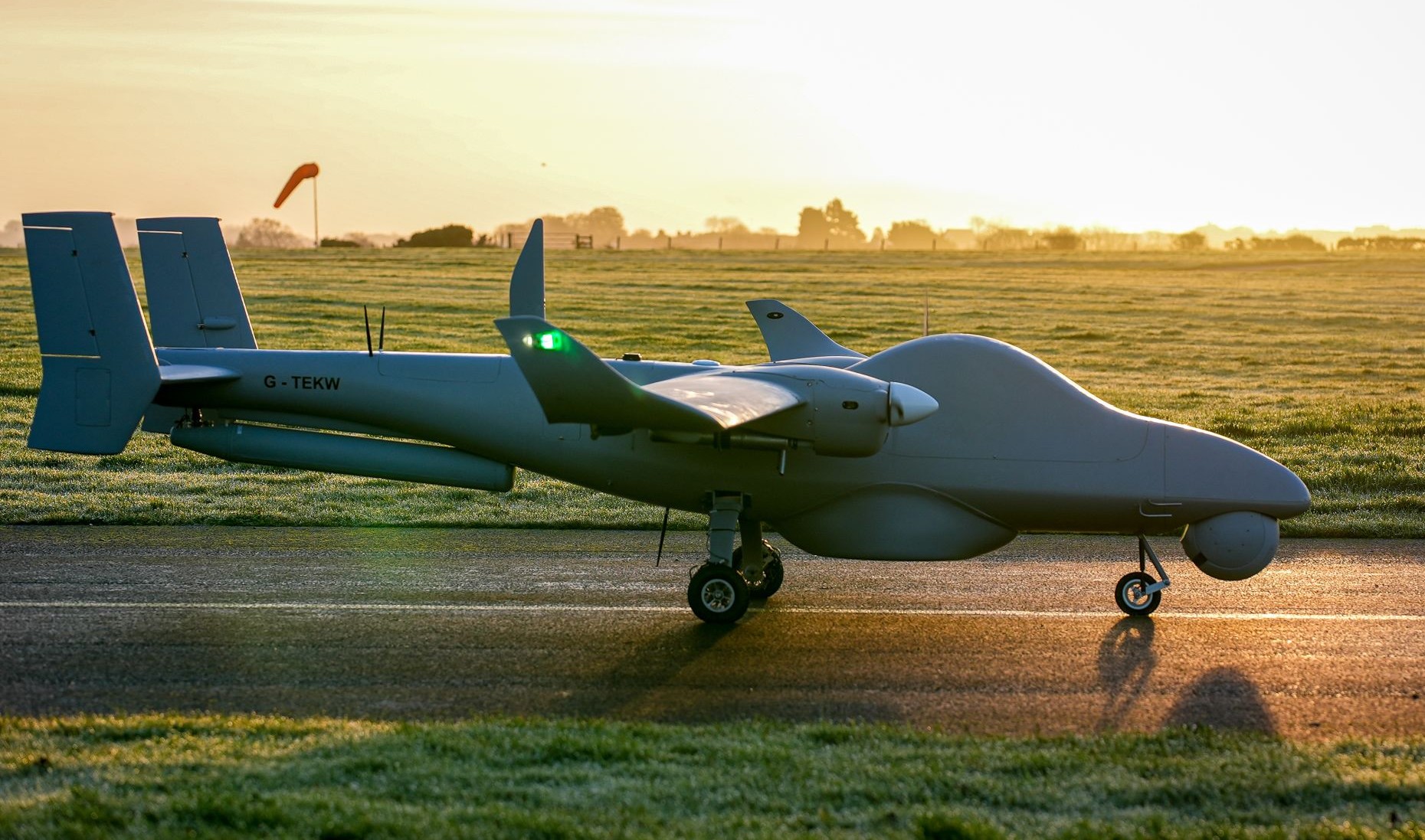
Tekever has signed a contract with the Portuguese Air Force to supply its AR5 uncrewed aircraft for maritime surveillance, with delivery and initial operational capability scheduled for September, the company stated.
The deal covers the aircraft themselves along with a ground control station, the ATLAS mission system and operator training. Initial training for Air Force personnel is due to be completed by September to coincide with delivery, followed by a second phase in October intended to consolidate operational readiness.
According to the company, the aircraft will fly maritime surveillance, security and defence missions, monitor Portugal’s exclusive economic zone, and support public interest tasking including the country’s rural firefighting arrangements, coastal security and environmental protection.
Lieutenant Colonel Luís Henriques, operational coordinator of the Air Force’s AR5 working group, said in the release that the platform meets current surveillance, security and defence requirements while providing “greater range, endurance, and operational flexibility”, and that its integration would strengthen the ability to monitor the exclusive economic zone.
Pedro Petiz, director of strategic development at Tekever, said the contract puts a capability developed and produced in Portugal to work protecting national airspace and maritime territory, adding that the company would work with the Air Force “to consolidate and develop its own operational capability”.
The AR5 is a medium-altitude long-endurance fixed-wing aircraft with an endurance of up to 20 hours and a payload capacity of 50kg. It carries satellite communications, allowing it to operate beyond radio line of sight, and can fly from short or unprepared strips.
British readers will know the type from a rather different context as Tekever aircraft have been flown on behalf of the Home Office to conduct surveillance over the English Channel, monitoring small boat crossings, work carried out under contract alongside operations for the European Maritime Safety Agency. The company says its systems have accumulated thousands of flight hours across coastal patrol, border protection, environmental monitoring and search and rescue tasking.
Tekever systems are also in service in Ukraine, where the company states they conduct surveillance and reconnaissance in an operational environment. That deployment has given the aircraft something few Western surveillance drones possess, which is sustained exposure to a contested electromagnetic environment where GPS denial and jamming are constant rather than exceptional.
The company has expanded its British footprint substantially in recent years, announcing investment in UK manufacturing and research and development, and was among the firms named in connection with British support to Ukraine. Founded in Portugal, it now operates as a pan-European business with sites in both countries.
Portugal’s exclusive economic zone is among the largest in Europe, running out to the Azores and Madeira and covering an area many times the size of the mainland, which makes persistent aerial coverage expensive using crewed maritime patrol aircraft. The Portuguese Air Force operates a small fleet of P-3 Orions for that role alongside C-295 aircraft configured for maritime surveillance, and the AR5 is intended to add endurance at lower cost per flying hour rather than to replace them.



“Portugal buys drones used to watch the English Channel”
So what are we going to use instead?
(Just kidding, obvs)
You never know 🙂
Surely the most important context for AR5 is that it won the Corvus competition to replace Watchkeeper? That’s surely more relevant to defence than the Border Force duties.
France likes to watch the small boats crossing too. The more the merrier, I guess. Its a pity UK defence has become an industry of voyeurs.