


The Scottish Government is facing renewed pressure to use national security provisions within UK subsidy law to support domestic shipbuilding, following a new parliamentary question tabled by Paul Sweeney MSP, the UK Defence Journal understands.
Sweeney confirmed he has lodged a further written question asking ministers whether they accept that “national security” extends beyond the narrow list of reserved matters set out in the Scotland Act, and whether recent UK defence policy provides scope for Scotland to apply exemptions when procuring public-sector vessels.
The question follows earlier exchanges over the delayed Marine Vessel Replacement Project, which is intended to replace the Marine Protection Vessel Minna and the Marine Research Vessel Scotia. That programme has been pushed back beyond previously indicated timelines, with procurement milestones formally reset after months of inactivity.
In his latest question, Sweeney argues that national security should be interpreted more broadly than conventional defence platforms. He points to the UK Strategic Defence Review, particularly its chapters on home defence, societal resilience and the maritime domain, as evidence that civilian-owned vessels can still play a role in national security functions. He is asking the Scottish Government whether, in light of that review, it agrees that procurement under section 45 of the Subsidy Control Act 2022 could legitimately be used to exempt vessel construction from standard competition rules, and whether ministers will now engage directly with the Secretary of State for Scotland and the Secretary of State for Defence on the matter.
Section 45 allows public authorities to bypass normal subsidy restrictions where this is necessary to protect national security. The Scottish Government has previously argued that the planned replacement vessels would be built to merchant standards and do not constitute defence assets, placing them outside the scope of such exemptions. However, Sweeney and other critics argue that the legislation is framed around national security rather than the technical classification of a platform; i.e., ships do not have to be warships to meet the fit. They point to the operational roles of marine protection and research vessels, which can include fisheries enforcement, maritime domain awareness and the protection of sensitive offshore infrastructure.
Louise Gilmour, GMB Scotland secretary, told us that repeated caution around procurement risk did not justify inaction, especially when Fergusons needs new work. “Every month that passes costs the yard valuable skills while draining morale,” she said, adding that legal risk should be managed rather than used to justify what she described as a “paralysis of action”. She also warned that the absence of clear timelines was fuelling concern that decisions could be delayed until after the Holyrood election.
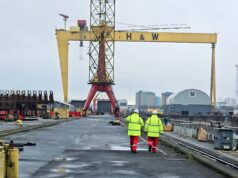
The new question builds directly on Sweeney’s earlier warning that continued delay risks deepening uncertainty at Ferguson Marine, which is publicly owned by the Scottish Government and faces a looming gap in work. He has previously said that Scotland has not ordered a new public-sector vessel from a Scottish yard in more than a decade and argued that the absence of a coherent procurement strategy is undermining efforts to sustain an indigenous shipbuilding base.
Sweeney has also warned that even if future ferry contracts are directly awarded, mobilisation timelines mean that they would not prevent a near-term downturn in workload, particularly for outfit trades. He has called for ministers to capitalise Ferguson Marine in line with First Marine International recommendations and to establish a consistent pipeline of publicly funded shipbuilding orders. In addition, he has urged the Scottish Government to use financial mechanisms, including the Scottish National Investment Bank, to support builder’s refund guarantees and patient finance, which he argues are essential if Scottish yards are to compete for commercial and export work.
The Scottish Government has not yet responded to the newly tabled question, nor published a revised timetable for the Marine Vessel Replacement Project beyond confirming that earlier indicative procurement dates no longer apply.
A Scottish Government spokesperson said, “We remain steadfast in our support for the company and its workforce. Up to £14.2 million has been allocated over two years to support modernisation at Ferguson Marine. To date, the Scottish Government has received 11 capital expenditure requests, all of which have been scrutinised rigorously and approved. Any decision on a direct award must fully comply with procurement and subsidy control rules. We will continue to consider vessel contracts on a case-by-case basis at the appropriate point in the procurement cycle.”







How does that work with student politics?
They want to be part of EU but behave like the Irish in defence.
There is a reason the Russians and Iranian proxies are so keen on an independent Scotland….
Are we the only country in the world that seems to deliberately self-destruct at every opportunity? Being able to build our own ships is surely a national security issue? We are an independent country we should do what we like with our own industry like every other country in the world does but no, we fart around and use any excuse possible to let some nebulous foreign entity build things for us. “We remain steadfast in our support for the company and its workforce” The same trite old nonsense. Why are people surprised at what is still going on at Liberty Steel? Why is anyone surprised that they may not be able to fulfil their commitments on the supply ships? This is a company that has illegally dodged filing accounts for 5 years, what will it take to convince people Gupta is a wrong un?
We’re doomed……do ya hear what I say?…….we’re doomed!
I. The and these procurement rules are very very loose and pretty much every other nation takes as much of the give as they can to support their strategically important sovereign industries.. the level of neoliberalism in the UK goes will beyond what is needed for health free market capitalism and into the self destructive…..