

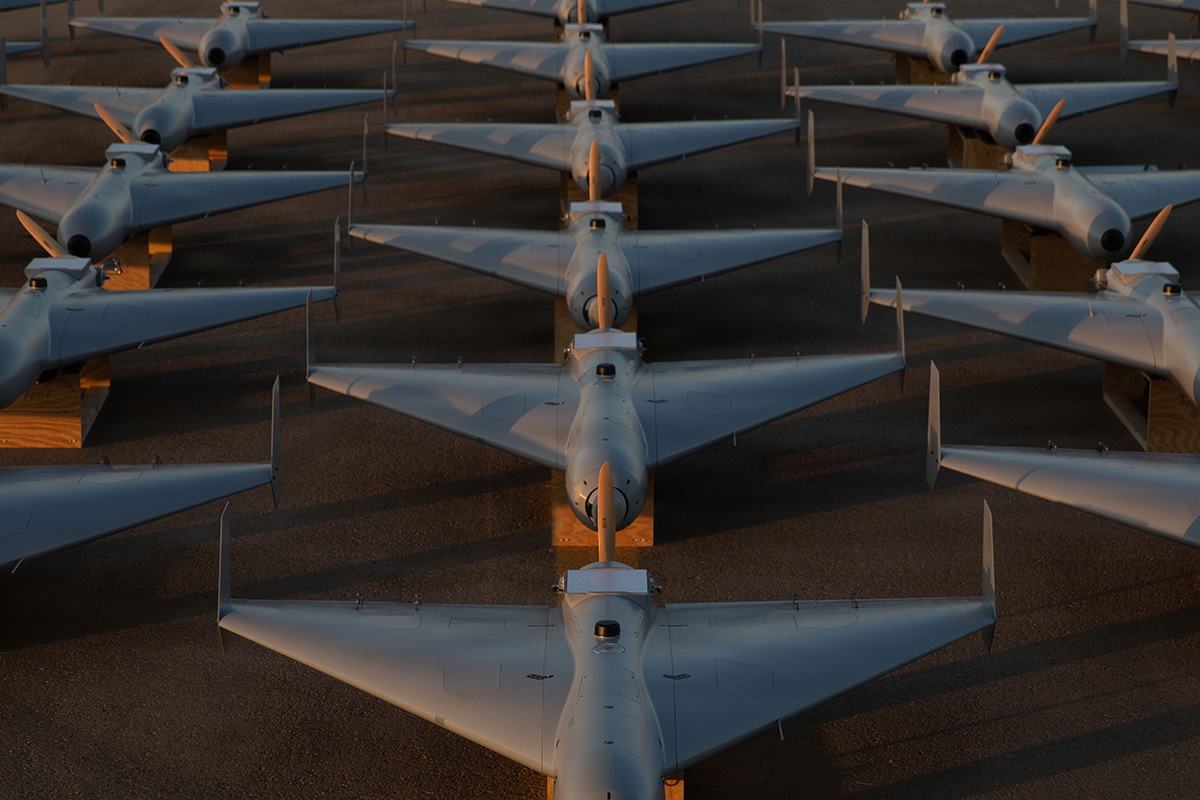
The Ministry of Defence has set out its current approach to developing policy for the active engagement of unmanned aerial systems, following a parliamentary question on counter-drone measures, the department stated.
The issue was raised by Luke Akehurst, Labour MP for North Durham, who asked what progress had been made on establishing a policy framework for engaging unmanned aerial threats.
Responding on behalf of the department, Minister of State for Defence Luke Pollard said the MOD is working with partners across government on a range of counter-uncrewed aerial systems issues.
“The Ministry of Defence works closely with partners across Government on a range of Counter-Uncrewed Aerial Systems issues,” he said.
Pollard explained that responsibility for counter-drone policy differs depending on circumstances. During peacetime within the UK homeland, responsibility sits with the Home Office, while wartime policy falls under NATO-aligned Integrated Air and Missile Defence arrangements overseen by the MOD.
“The Home Office is responsible for C-UAS policy and strategy in the Homeland during peacetime,” he said. “During wartime, C-UAS policy falls under the Integrated Air and Missile Defence framework, which the MOD is responsible for.”
He added that existing arrangements for Military Aid to the Civil Authority provide an established mechanism for Defence capabilities to be deployed in support of other government departments when required. “The process of providing Military Aid to the Civil Authority is well established and ensures a robust framework under which Defence capabilities may be used to support Other Government Departments,” Pollard said.
The minister also confirmed that legislative work is ongoing to enable the use of authorised counter-drone equipment by Defence personnel. “Work is underway to develop a suitable legislative framework that will enable Defence personnel to operate authorised equipment to protect critical Defence property and activities from the threat of UAS,” he said.











So, after all those statements of the bleeding obvious regards policy, how much further forward is the UK in having meaningful CUAS capabilities beyond the minimum already fielded?
What are we actually physically buying?
You beat me to it Daniele. Approach to, planning for, thinking about, blah blah. Answer to your question…Nothing is being ordered.
It really does feel as though there’s a moratorium on the MOD spending any money at all unless already committed. And the DIP seems to have disappeared without trace. Things must be really bad.
Meanwhile down under – the ADFs Project LAND 156 counter UAS capability was announced in mid 2025 and by July 2025 had let contracts totaling $16.9 million to 11 vendors and in August 2025 had appointed Leidos Australia as project systems integrator with a further $45.9 million contract.
The project includes a sovereign Australian developed C2 system and both a range of different sensors (including MESA radars) and effectors including EOS Slinger gun system, Droneshield jammer ‘guns’, L3 Harris Vampire rocket system – much of the kit is Australian designed or developed.
By December 2025 these systems were being field tested with live fire demonstrations (Southern Arrow 25) to develop and field a minimum viable counter drone capability (MVC) and some systems have now been photographed dockside at RAN bases protecting ships in port.
It’s designed for rapid acquisition and described as ‘continuous acquisition model’ to learn from feedback from the field (Ukraine style of innovation to keep pace with emerging threats).
The program is continuing apace into 2026 with high energy laser testing planned (probably Australian company EOS Titanis ).
For progressive policies, welcoming “refugees” and illegals is something there is money for.
Blah blah blah, no movement forward, no capability upgrade and nothing in the pipeline! The CUAS is yet another can to be kicked down the road as these muppets know they are dead clowns dancing at the next election and their immediate priority is to spend the next 36 months buying both votes and support from those who rely on the state!
If there is to be a major change in power distribution within NATO due to the US fracture, should the UK concentrate its immediate efforts towards UK airspace protection against both drone and missile attack? If the US do drawdown on its military establishments in Europe, the UK may need to decide on a strong navy and air force at the cost of a major land force renewal. It’s obvious Poland, Germany and France are to expand their armies way beyond the UK’s current plans, and therefore the lion’s share of heavy armour fighting will be ostensively down to them. Britain, with two large carriers and new build warships on the horizon, could be more effective if it majors on the RN expansion, beyond its current new vessel projections.
This Is excellent news, add this to all the other excellent news and together we are In an excellent position of strength and vision In our efforts to
Go bloody Nowhere fast.
Excellent work by all concerned (or not concerned at all).
We can be as impatient as we like but nothing will happen until the DIP is resolved.
The issue is that there is nowhere near enough money on the table to fund everything the services need just to replace old or gapped equipment, let alone embark on a whole new raft of ‘transformational’ goodies.
Blaming the government for not conjuring up more money is just economically and politically naive. HMG has already committed an extra £13bn to defence over the next 4 years. That is a 22% increase in the defence budget, the biggest – and just about the only – increase since the end of the Cold War. It is fairly miraculous getting that much out of the Treasury, when every department is squealing for more money. There won’t be any more for defence because the coffers are bare.
Even with this extra cash, the services are still £27bn over budget for the 4 years. They are going to have to cut their cloth to fit the budget. The RN in particular must already be miles over budget, trying to fund 20 ships over the next ten years – and that’s before they fund this mega Atlantic Bastion project, unmanned helicopters, Dragonfire laser weapons and whatever else is on their wish-list. The other two services will have big problems too just funding what is already in the pipeline.
I remain to be convinced that the uplift in the defence budget will be any new money, and not just stuffing it full of fluff to plump it out.
I wonder why you say that. The money is committed and the forces are working to the new budget.. Inevitably there is wriggle room. Does it include the money and equipment for Ukraine and is it inflation-linked? What other foreign office spend is going to be nudged into the defence budget? And so on.
I will be particularly interested to see if they will henceforth show the split in the defence budget between ‘core’ defence and ‘other’. Not holding my breath on that one.
I believe there is an infrastructure component (1.5%?) to the new minimum 5%, this is tailor
or made for anything and everything to be shoehorned in with the most wafer thin reasoning, this is where the fluff will be added.
As for the rest, rumours are the SDR wasn’t fully costed after all and there’s a 28bn odd black hole, since denied by the government, but I can see it being somewhat accurate, just semantics over the size. Any new money will hence be mostly swallowed by this, or programs will have to be cut.