

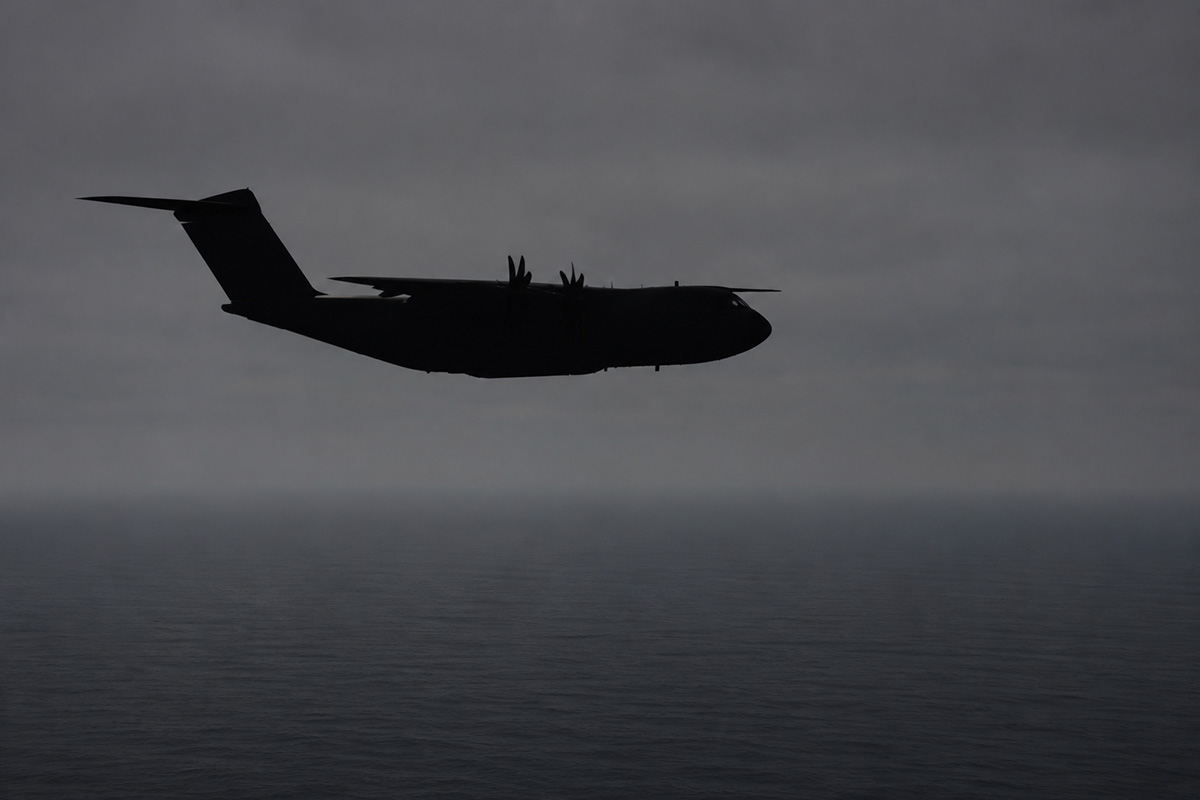
An RAF A400M transport aircraft has deployed to Poland for training in temporary and unconventional runway operations, as NATO air forces sharpen their ability to disperse aircraft and continue flying if established bases are threatened, according to the Royal Air Force.
Personnel from 70 Squadron flew an Atlas C1 A400M to Powidz, where crews worked alongside the Polish Air Force on tactical low-level flying, temporary runway take-offs and landings, air drops and the loading and unloading of allied military vehicles. The training centred on dispersal, allowing aircraft to operate from multiple austere or improvised locations rather than relying exclusively on established air bases.
The RAF said that approach is increasingly important for protecting aircraft and maintaining operations during conflict, particularly where fixed infrastructure could be targeted.
Wing Commander Doug Grove, Officer Commanding 70 Squadron, said: “The A400M continues to prove its worth. By providing the RAF, UK Defence and NATO with the agility to airlift the wide variety of large vehicles, supplies and troops of the alliance to challenging locations, it remains a key cornerstone of the Air Mobility Force in helping the UK protect the homeland and secure NATO territories.
“Giving our crews the chance to practise unprepared runway operations ensures the RAF remains ready to fly and fight. Seamless interoperability with our NATO partners is of particular importance to reinforcing the cohesion of the Alliance and a great deal of mutual learning has taken place with our Polish friends.”
Operating from grass strips and other temporary surfaces gives transport aircraft greater freedom to move troops, vehicles and supplies without being tied to a small number of permanent airfields. The capability can also complicate targeting for an adversary by allowing aircraft and supporting personnel to be dispersed across a larger number of locations.
The A400M is designed to combine strategic transport capacity with the ability to operate from shorter and less developed airfields than larger transport aircraft, allowing it to move personnel, vehicles and equipment closer to forward operating areas.



Yet another skill set which has been neglected, but which certainly with the absolute minimum bases and platforms remaining, essential. Should be routine and part of planning considerations to get at least 50% of assets off and away from airfields and re-deploy to the many number of old airfields around the UK. It may be wise to already have the teams picked, vehicles packed with tools/spares and stores ready to go on any increase of tensions.
Agree.
My concern is the force has been so civilanised in the maintenance area that there’s not enough people to facilitate effective dispersal.
Are civies going to deploy to a bare base, austere site, or even a regional airport in a war?
Then you have the super bases obsession, all about saving money. The RAF called thrm “Centre’s of Excellence.”
Cobblers, you can have excellence in more than one place.
They cannot even bring themselves to disperse bigger aircraft on the same station as it adds to the logistics.
So multiply that by, how much?
Fast Jet Force, how many dets would it realistically be divided into? Each one with FP Det, ATC, ground maintenance, armaments, fuel ( if not at a GPSS site )
Bigger aircraft in the AR AAR force, ISTAR Force, don’t need armanents, but they still need people.
Then the shift pattern, GBAD that already barely exists.
Then the locations themselves. No shortage of those.
Have the HAS been checked as usable?
Are there available storage areas for any weapons carried by the aircraft?
The RAF SHF at least is used to deploying into the field.
But what of the enablers?
The RAF TCW from 90 SU, can it support a dispersed force?
Can the TSW at Stafford support dets effectively as well as the SHF at the same time?
Has anyone asked and actioned these questions?
This is window dressing. There’s no problem with the aircraft dispensing, and no shortage of places to disperse to, it’s the enablers that worry me.
Apologies for the many spelling errors, some caused by this damn phone autocorrect! The edit function is missed.
Hi Dan, I fully expect the RAF’s rotary wing to be capable of deploying in to the field for a couple of weeks without outside support, as they are mostly self-sufficient. The fast jet sqns I suspect will struggle. As they mostly deploy to airfields that have all the infrastructure ready for them, such as the Lielvarde Air Base in Latvia. However, in the UK we have a lot of airfields where the runways are still serviceable. Yet they are very rarely if ever used for austere training. The airfields have varying levels of austerity. For example Machrihanish has had all its legacy RAF hangars removed, and is now pretty open. This would be an ideal place to find out how to operate jets from a very austere site and understand what infrastructure needs to be put in place to operate around the clock safely. It used to have dedicated bomb dump, is it still available and how would you store weapons if it wasn’t? It’s on the Mull of Kintyre peninsular, making it far enough from anywhere to make logistics troublesome without proper planning. Additionally it would allow all the support services needed to run fast jets to cooperate together in an environment that can be rather testing. Can all these services act together to get a working det up and running in a couple of days or would it take a couple of weeks? If we were in a European conflict, would we have a couple of weeks to play with?
Machrihanish is just one example, there loads available. But the RAF’s other large aircraft would be a problem, as its really hard to hide them. Plus the needed infrastructure, such as large aprons to park on, won’t be as readily available. If they are parked at airports that has everything they need, then the airport would become a valid target. Plus airports are a lot harder to defend, as there’s usually built up areas around them. There’s a lot to think of, on how to disperse the larger aircraft, where they can be safely operated from, but also defended.
Thanks, Davey.
Thanks for those insights.
Agree on the SHF, they’re used to that and the tactical ground support units are there.
Ahh Mac, a place I’ve studied at length since before the Aurora stories in the mid 90s.
Yes, it had nuclear depth bombs 💣 for a time, and a SEAL team. There’s also a long disused pipeline running to the airfield from NATOs Campbeltown POL depot, so fuel supply is possible.
Thought that was for V dispersal in the mid Cold War.
The Army used to deploy there for exercises so yes, a good austere base example.
I recall they used St Mawgan a few years ago, we had an article here. Not austere enough.
I even doubt they have the ability to disperse to more “ready made” stations like Leuchars and Leeming, with the facilities in place.
Nail on the head as ever mate! 👍