

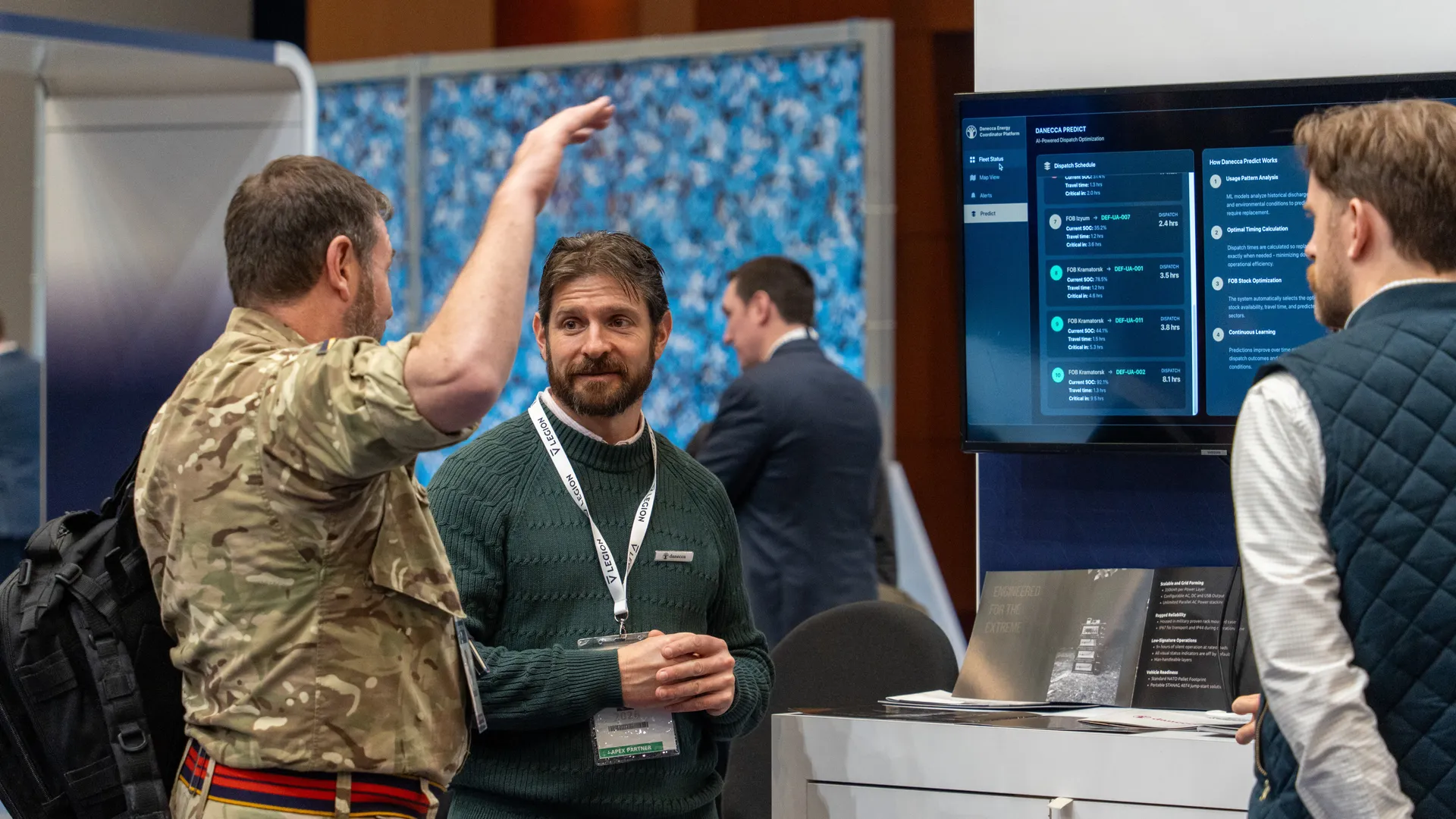
A new defence event opening in London next week has attracted 400 military and government end users among around 800 people registered, a balance its organisers say they have not seen before at a defence show.
Nick Waite, product director for Apex Europe, told the UK Defence Journal that the end user turnout has been exceptional. “We’re actually going to have more end users in the room than industry,” he said, adding that in eight years working in the defence trade show and conference industry he had not come across that before.
Apex grew out of research carried out about two and a half years ago with the industry and government partners who attend DSEI, which identified the value of targeted, mission-led conversations that complement a large trade show such as DSEI UK. The result rests on three things: near-term capability, operational problems rather than platforms, and access for smaller companies.
On the first of those, the cut-off is deliberately tight and keeps the focus on what can reach operators quickly. “The focus is on near-term capability, so we’re looking at technology that can be integrated in the next 12 to 24 months,” Waite said. “The defence landscape has changed dramatically in the last decade. Geopolitical context to that, but also the rate of technological change is driving that. So our ability to find technology and take them from idea through to prototype through to operationally ready, then put into the hands of the operator, that iteration cycle, there’s a requirement for it to be much quicker.”
The second principle is what everything else at the event is organised around, because rather than dividing the event by domain or platform type, it is built around what the organisers call mission sets, six operational problems. “These range from autonomy related operational effects that European and allied forces want to achieve, to deep precision strike, spectrum related topics,” he said. “These are the things that anchor who attends, the topics, the conversations, which lends itself to having an audience which is much more focused than you would get at a traditional trade show.”
Those problems were not settled internally and then announced to the market. “They were chosen based off of research with the user, in short, and validated by speaking to another 20 users to say actually yeah, they’re spot on,” he said, describing a process that drew on the company’s relationships with industry and government alongside a set of advisers, some named publicly and some not.
The format follows from that choice, and each operational problem gets a panel of roughly fifty minutes, with at least a couple of end users on it to set the context and a mix of large, medium and small companies that have delivered against the problem in Britain or elsewhere in Europe. Immediately afterwards comes a run of ten minute capability presentations, mostly taken up by small businesses, responding to the problem that has just been discussed. Working group sessions run alongside for anyone wanting to get further into the detail with peers from industry and from allied nations.
Waite connected all of this to language he heard from the British Army at DVD last week. “There was a phrase I heard constantly, which was the way that the British Army was putting out this signal to industry was mission before platform, sharing the mission with industry versus traditionally, it’s okay, here’s my shopping list of strict requirements for this vehicle that we need,” he said. “It’s here’s the problem we’re trying to solve. Come on this journey early and try and help solve it. And that’s what we’re trying to mirror with Apex.”
Asked why Europe needs its own event rather than European delegations travelling to the American original, he said the two sets of priorities are complementary but distinct. “There is a separate need for European and NATO nations to have their own opportunity to lead the conversation in their own right,” he said. “There’s different priority sets, although they do overlap. And alongside that, there’s an industrial base that supports them equally.”
Apex and DSEI sit under the same Clarion umbrella, and the difference between them is one of scale and access as much as content. “DSEI is all halls of the Excel. Apex is much more intimate and focused,” Waite said. “Once you’re in the room, it’s open doors. Everyone eats together, everyone drinks together. There’s no closed doors. It’s all access, all areas within reason.”
Flagship speakers include a number of flag officers, which Waite described as a seal of approval for what the event is trying to do, but the bulk of the audience sits lower down. “If I showed you the attendee list, they’re going to be that SO1 capability, they’re going to be the programme manager level, they’re going to be the people who are responsible for delivering and integrating this capability in the day to day,” he said. “For us, that’s our primary audience from a user perspective. It’s to make sure that there’s an event for that cohort of people who would benefit from a more technical, operationally driven conversation.”
Asked what success looks like for a first outing, he described a single conversation rather than a number. “Success would be X, Y, Z person from UK MOD or a different government saying, hey, really enjoyed the event, I met with six companies I didn’t know existed that have capability that I didn’t know was a thing,” he said.
The multi-domain structure is where he sees the event adding something distinctive. “Any operational effect that’s trying to be achieved cannot be done by a single service or by a single type of kit nowadays,” he said. “So it’s by being multi-domain and having these multi-domain problems that integration piece across the services and across these problem sets is allowed to happen in a way that doesn’t necessarily happen at traditional events.”
The American event, Apex Defense, enters its third year in January, and Apex Europe returns in 2027 on the Monday and Tuesday of DSEI week, which Waite described as carving out a day and a half for a mission-focused conversation that complements the larger show while everyone is already in town.








But not many of the ‘buyers’ are British…
‘The US has organised a round of talks on NATO’s future – expected to be held in Poland – from which Britain has been shut out…after the first meeting, Mr Colby said that those invited were ‘Nato allies that are rapidly meeting their Hague spending commitments, have the scale to contribute, and are ready to get down to practical business’.
Daily Telegraph
In other words, the meeting is for NATO members who possess a credible conventional deterrent. That clearly rules out Britain.