

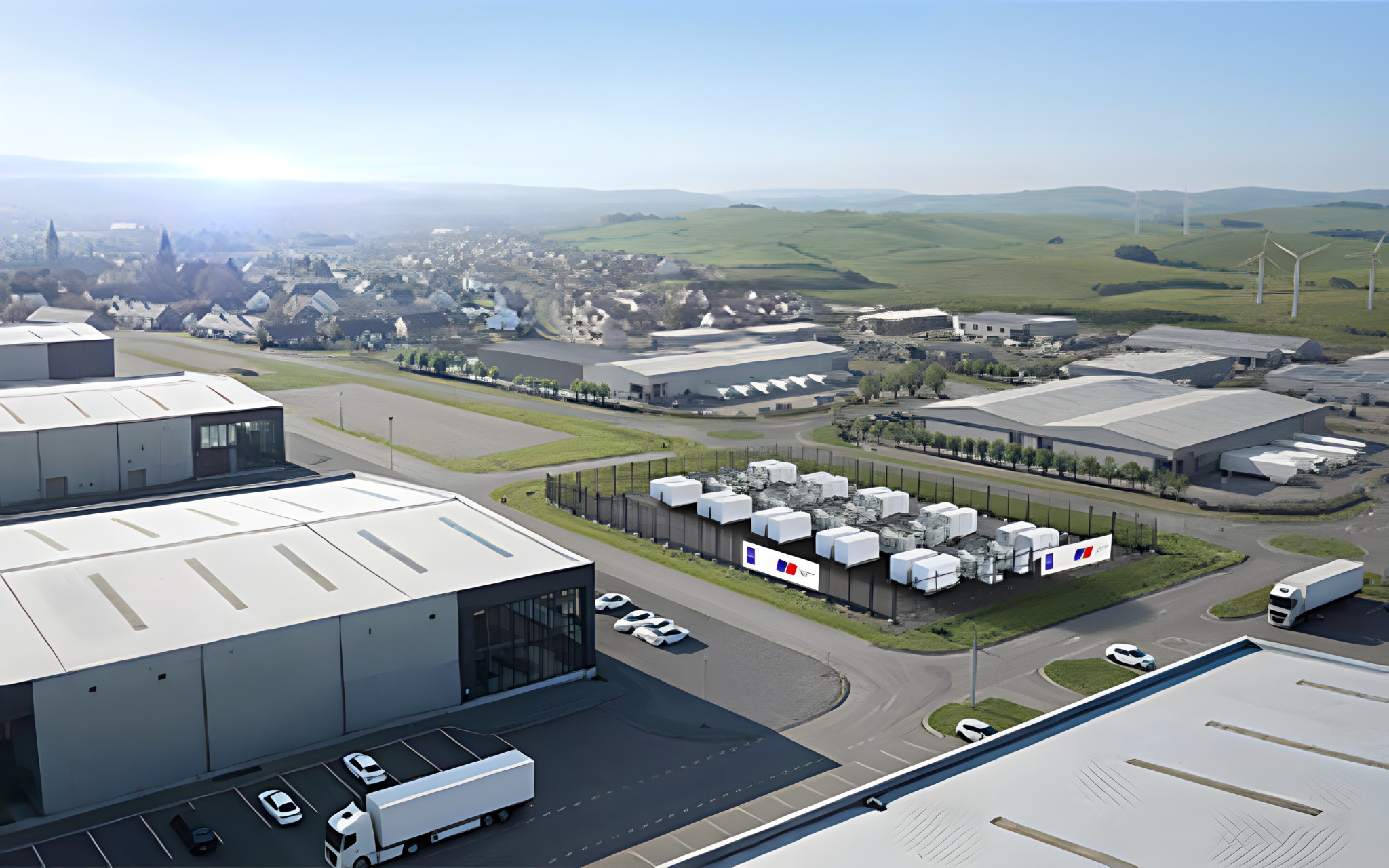
Rolls-Royce has begun construction on a large-scale battery energy storage facility in Falkirk, Scotland, marking the company’s first such project in the United Kingdom, the company stated.
The facility, being delivered under an engineering, procurement, and construction contract for Voltaria Helios Energy Storage, will have a capacity of 86 MWh and an output of 43 MW, which Rolls-Royce says is equivalent to the demand of around ten thousand homes. The system is expected to connect to the grid in 2026 and become operational in 2027, with Rolls-Royce maintaining it for 15 years.
The project will use the company’s mtu EnergyPack system, storing energy during periods of high renewable output and feeding it back into the grid at times of peak demand. Rolls-Royce said the facility would also help reduce the need to curtail wind generation during periods of oversupply.
Nigel Jefferson, CEO of Voltaria, was quoted as saying: “Rolls-Royce were selected because we were impressed by their commercial and technical offering, as well as their technical advice and engagement in the run-up to the decision, and their 15-year full-wrap long-term service agreement.”
He added: “Rolls-Royce has also leveraged the Scottish supply chain, which is great to see.”
Andreas Görtz, President of the Mobile & Sustainable business unit at Rolls-Royce Power Systems, said: “As a European turnkey integrator, we foster the energy transition by delivering storage solutions – from system design and EPC delivery to intelligent control and lifecycle support.”










While Scotland produces an abundance of wind energy, the transmission infrastructure is currently insufficient to move this power to high-demand areas in England. So why is Rolls-Royce building battery storage North of that bottleneck? Wouldn’t it need to be on the side of the high demand to reduce peak prices?
As Falkirk is centrally placed between Edinburgh and Glasgow it might be argued that developing a battery storage facility there is adding to the node points needed to create future flexibility in any National infrastructure.
I suppose that could be a reason… But looking where we are reading this, I suspect Babcock’s Shipyard up there might be a likely candidate for why this has been chosen to be situated at the “bottleneck”.
Grangemouth refinery is next door to Falkirk as a potential customer also.
The refinery that used to produce aviation fuel? The refinery that UK gov failed to save? Despite promising to do so? The refinery owned by sir Jim ratcliffe whose company got £600million of UK taxpayers money to invest in a Belgian operation? Is that the refinery you mean?
The £600m is to rebuild Man Utd.
No. There was even more taxpayers money wasted on that.
The best place for storage is before the bottle neck, that’s where the electricity is the cheapest and it allows for a more steady supply and hence efficient use of the energy transmission infrastructure.
A more steady supply if you are Scottish, which isn’t to be sneezed at, I suppose. Unfortunately, with the fakakta way we price electricity, only the highest cost matters for price. As I understand it, if we need gas generation anywhere in the UK, we pay through the nose everywhere. So the Scots may have a smoother supply, but it won’t be cheaper. Only reducing the number of days when gas generation (firm, flexible) is needed will lower the price. For that we need increased cheap supply South of the border, or a wholesale revamp of the electricity pricing system, which I’d also be up for.
Sorry you mis understand my comment , the supply will be smoother for the customer at the other end of the line I.e England by having batteries located at the other end of the bottle neck I.e Scotland.
Ideally you do both. Store cheap electricity north of the bottleneck which would otherwise be lost by having to turn off the wind generation at times of peak generation. And store it south of the bottleneck to smooth supply to the areas of high demand.
Absolutely, if the transmission structure is limited, then reducing peaks in its usage to even-out capacity is essential.
This is just the beginning however I have just been reading about the latest storage battery technology about to be fielded that already dwarfs this capacity, meanwhile China is reportedly soon going to bring a terawatt level storage battery pack into operation. The criticisms against renewables, in particular not producing power as and when required, is beginning to look increasingly irrelevant, even if a lot of work on transmission still needs to be done to fully exploit this capability. Most people are not yet seeing the enormous progress being made in battery technology, especially more widely than storage with Lithium sulphur and solid state batteries coming into the automotive industry, reducing prices and recharge times to the point ICE vehicles will simply not be able to compete. Chery is to fully roll out a range in 2027 with 800 mile range and removes the danger of thermal runaway. We either jump on the wagon or get left in the dust like US car makers. Thankfully JLR have a long standing link to thus company as they enter their (if unsmooth) electric future.
I agree, the batteries will change everything. They will also make nuclear power much more cost effective although it’s going to struggle to compete against solar long term.
Like all solid state electronics it will just keep getting cheaper and better.
This isn’t that much it is the battery capacity of 1,000 x Telsa Y’s – they are about 88kWh each for the long range ones.
“even if a lot of work on transmission still needs to be done to fully exploit this capability” that depends on where the battery packs are located. You are assuming that the sensible place to store the excess juice is upstream. If you have an upstream holding capacity and a downstream storage capacity the link can then be run at the normal loadings. The issue with UK is that there is a huge spike twice a day and then consumption drops by almost 1/2 at night so there is quite a lot of spare grid capacity at off peak times the issue is having the juice where it is needed.
The other point is that some of the cheaper and robust battery technologies have a poorer power to weight which is almost irrelevant in a static location.
I agree that there is incredibly battery tech around the corner that will make the current Tesla tech look irrelevant.
RT are building it there because that’s where the timer, Voltaria wants it.
Yes transmission is a bottleneck, and prevents the U.K. from enjoying far cheaper electricity from the offshore wind-farms. But supply resilience is also import, and this facility addresses the latter issue.
The government should override NIMBY planning objections to speed-up the required grid expansion.
What battery technology are they using? Self igniting lithium ion or safer, but silver heavy, solid state?
New battery technologies, solid state or otherwise, are becoming a fraction of the cost of lithium ion batteries and rapidly removing costly and rare materials, even if their impact is still a few years away. Equally they are so long lasting that much of the disposal problem is being substantially reduced. Watch this space.
So not them then.
The British government should look at setting up direct business in Scotland that require large amounts of electricity but can be switched on and off rapidly. Green Hydrogen, aluminium smelting and electric arc furnaces all spring to mind.
Then surplus electricity can be directed into these industrial processes instead of paying wind turbines to switch off.
The UK government should also start buying up existing gas plants and start to directly provide low cost marginal electricity production to the grid so we get away from this insane system where gas prices set the electricity price for low cost marginal producers like wind, solar and nuclear.
This latest crisis in the Gulf has shown we need to be domestically self sufficient in energy production and not subject to the whims of international markets, Eastern European dictators or theocracies blocking international maritime traffic.
The technology is now available and the UK is leading the world in rolling out offshore wind. We need to double down and finish what we started.
Nice idea one might hope that Great British Energy would at least be looking to create new possibilities to guide such matters. That said Scotland once had the biggest Aluminium Smelter in the war (Wales had a large one too) powered from hydro electric power, what’s left of both are just tourist attractions now so I can’t imagine aluminium smelting is a possibility, I assume importing the base product simply made it unviable compared to those who have it in abundance and cheap energy isn’t going to change that. It was previously deemed a strategic necessity, don’t see that state of mind returning.
We do need to be imaginative mind. People go on about the cost of establishing green energy projects, but ignore the cost of setting up a major nuclear plant (which nonetheless I believe sensible in present circumstances) or face up to the fact that all that (now naive looking) rush to gas powered stations from the 30+ years back means that we are going to have to start replacing these most expensive electricity generators very soon, a cost that the pro fossil fuel mob are conveniently keeping from us. So thanks to past decision making the idea that we are going to get cheap energy any time soon is a myth whatever route we take and costing energy based on gas (unlike more enlightened Spain for example) is just a way of the powers that be that made these bad decisions covering up the true reasons for our high prices.
The fort William smelter is still operational,the only one in UK, so not a tourist attraction, largely thanks to it’s own supply of hydro power. I’m sure I read an article recently that demand had increased for it’s product thanks to a knock on effect of one of trump’s tariff Wars.
Unfortunately, furnaces don’t react too kindly to on/off production styles. Yes, you can heat them and they can coast for a while but the problem is that when the power comes back up the temperature of the whole furnace and melt has to come back up so the whole thing is a consistent melt that doesn’t have separation and that takes time in the scale of 4-8 hours and maybe more depending on how much it has cooled and how much oomph is available. There is a huge specific heat capacity.
Both smelters had their own dedicated hyro power.
The problem was that the cost of wholesale electricity made it a better business to just sell the power.
‘The total subsidy cost per unit of renewable electricity generated has risen by nearly 50% in real terms since 2005 and now stands at approximately £200/MWh. This contradicts government and industry claims that renewables are becoming cheaper but is consistent with expectations from the physics of energy flows, the empirical study of the capital and operating costs of both wind and solar, and the grid expansion and reinforcement and system management costs known to be imposed by renewables.
It should be borne in mind that about one third of this total cost, £77 billion (2024 prices) has hit households through their electricity bills, with the remaining £153 billion being first paid by industrial, commercial and public sector consumers and then passed through to households in the form of increased prices for goods and services, in taxes, and in reduced wages and rates of employment. In this context it should also be noted that subsidies to renewable generators result in an increase in the Treasury’s VAT receipts and thus an increase in the general cost of living. Electricity consumed by households is charged at the reduced rate of 5% and cannot be reclaimed. Businesses also pay VAT on electricity, but we can assume that this is fully reclaimed. However, as the renewables subsidy costs are passed through to end consumers of goods and services they will become liable to VAT, unless the goods and services are exported or exempted. The precise magnitude of this VAT uplift resulting from renewables subsidies is uncertain, but the potential is significant, amounting to around £3 billion a year at present, and to around £30 billion in total since 2002 (in 2024 prices).
There can be little doubt that renewable electricity subsidies are a significant factor in the much-discussed cost of living crisis and are very likely to be an important element underlying the weak growth in productivity in the UK economy since the financial crisis of 2008.
Renewable electricity generators have now enjoyed generous financial support for over twenty years without showing any significant progress towards independent economic viability. On the contrary, the requirement for such support seems to be rising. The public is surely entitled to ask when government will bring this extraordinary and insupportable level of subsidy to an end.’
‘capacity of 86 MWh’…’estimated cost to decommission a 1-MWh NMC lithium-ion battery-based grid energy storage system is $91,500.’
Storage unit life: 5 years
Fires at some BESS installations have caused concern in communities considering BESS as a method to support their grids. BESS fires pose challenges to first responders due to the:
Difficulty in putting out lithium-ion battery fires.
Potential health impacts from emissions.
Need to clean up and properly dispose of burned or impacted batteries.
‘A series of explosions caused a large fire to break out at a battery recycling plant in North Ayrshire, Scotland on 9 April (2025). The incident happened almost exactly a year after the factory, owned by Fenix Battery Recycling, was largely destroyed in another fire which took several days to extinguish.’
A valid counterpoint to the every increasing sycophancy around ‘green’ ‘cheap’ renewables. I find it interesting that even RR with their investment in SMR’s (which for industry would surely be a more suitable solution that battery storage ) has started to look at this .Its almost as if they have given up that Mad Ed will ever be forced out or change his zealous approach to UK Energy production and look at viable alternatives to his current policies.
A lot of nuclear power is wasted, especially at night, batteries make nuclear more efficient as it can charge up batteries at night especially if solar charges them during the day.
But RR is interested in any tech it can make money from. I believe they are politically agnostic.
Spot on!
Even worse, the main product offering appears to be from the RR MTU business located in Germany…
The Troll is back, you figures are nonsense, I don’t know who’s propaganda your spouting, i suspect St Petersburg.
That’s not really any contribution to the discussion at all, is it?
Once you are able to come up with credible worked figures of your own to offer as a counterargument, copy them to the Renewable Energy Foundation, from where my figures originate:
‘The Renewable Energy Foundation (REF) is a United Kingdom-based registered charity with a stated aim of promoting the development of sustainable energy technologies. The REF’s primary activity is commissioning and writing reports to provide information on energy issues. Since 2006, the REF has published a comprehensive set of statistics, describing in detail the performance of renewable energy generators in the UK that are registered under the Renewables Obligation. On 2 February 2011, the REF released a report critical of wind power, saying it would lead to higher prices for consumers.
The REF also publishes constraint payments made by the National Grid Electricity System Operator to wind farms to reduce output. These payments are made when excess electricity is being generated in a particular region and a grid bottleneck prevents that electricity being exported to a region where the electricity could be used.’
Ah yes, same as those doctors funded in the 1950s to issue reports into the health benefits of smoking…
Few words, no numbers, zero evidence…truly pointless.
Yes, I’d say that’s a pretty accurate description of yourself 🤷🏻♂️
Now tell us something we didn’t already know.
Really…why bother…?
As I thought, you don’t have anything both new and truthful to say.
I notice Monro still likes to reply to himself instead of the person he’s talking to so they don’t get updates.
I suspect in the real world he probably does a lot of talking to himself too, or rather to the voices in his head. 🤷🏻♂️
‘Your landscapes are lovely and gay,
Along each side of your waters, to Fort Augustus all the way,
Your scenery is romantic…
With rocks and hills gigantic…
Enough to make one frantic,
As they view thy beautiful heathery hills,
And their clear crystal rills,
And the beautiful woodlands so green,
On a fine summer day…
From Inverneaa all the way…
Where the deer and the doe together doth play;
And the beautiful Falls of Foyers with its cystal spray,
As clear as the day,
Enchanting and gay’
Loch Ness, McGonagall
Indeed Jim it all sounds impressive to the easily led but it simply does not add up to the most basic scrutiny. Let’s take California, figures in 2024 shows 62%+ renewable energy generation, so even greater now. Now this is the powerhouse of the US economy (the 4th biggest economy in the World and rapidly growing unlike much if the rest of the US) and yet it seems to have none of the supposed green energy economic anchors some on here keep harping on about. Indeed on some days nearly 100% energy production is green or nuclear and despite Trump trying to sabotage them thanks to being thwarted by the Courts, new offshore wind projects are close to opening or are planned. They also have substantial battery storage facilities to even out supply (15,040 MW in 2024) which has made usage far more flexible. Increase in renewable generation is running at around 4% per year and that is despite a drought that caused a decrease (indeed reversal) of hydro electric import supply from BC.
As for fire risks, well if we simply use that logic as an argument then we would surely have to ban much of our battery use in items we use every day. But fact is far safer battery technology is already coming into place (see my post above) and will become mainstream from next year that pretty much eliminates fire danger, are far cheaper, makes batteries far more long lasting (present batteries by the way already outlast the life of most cars for example) can be charged in minutes and are far less problematical to deal with post operational life. It’s always foolish to base your decision making on the limitations of present technology when that technology is already heading for obsolescence especially when you’re trying to make out a case for far more ancient if mature technology that is problematical in its own right and has little room for improvement. We pretty much invented the Lithium ion battery yet didn’t see its potential, it seems some people never learn the lessons from that and of many other technologies that are written off in their earlier less developed days so never flourish here. Geez but for war we would have done it with the jet engine.
We always look backward to the Victorian ‘golden age’ here in Britain without ever realising that the Victorians were predominantly looking forward and exploiting new technologies which is what made it successful and Britain world leaders rather than whinging laggards.
California’s economy is not growing. It is stagnating.
‘California’s economy has been in an extended slowdown for the better part of two years, characterized by a soft labor market and weak consumer spending,” Petek said, adding, “Outside of government and health care, the state has added no jobs in a year and a half. Similarly, the number of Californians who are unemployed is 25 percent higher than during the strong labor markets of 2019 and 2022. Consumer spending (measured by inflation-adjusted retail sales and taxable sales) has continued to decline throughout 2024.”
This week, the California Center for Jobs & the Economy, an offshoot of the California Business Roundtable, issued a report that mirrors and builds on what Petek said.
“California’s economy in 2025 presents a troubling paradox,” the detailed report declares. “While the state continues to rank among the largest economies in the world, the underlying data reveals an economy that is no longer delivering broad-based growth, opportunity, or stability.”
“Rather than expanding,” the report continues, “California’s economy is increasingly defined by stagnation in job creation, erosion in its private sector base, and mounting structural challenges tied to affordability and competitiveness. Many of the state’s headline strengths — particularly in technology — are masking deeper weaknesses across the broader economy. The data show an economy that has largely stalled since the pandemic recovery, with employment barely returning to pre-2020 levels, private sector job losses accelerating, and consumer activity weakening in real terms.’
‘The core issue is simple: California’s policymakers prioritized renewable energy mandates over affordability and reliability. Over the years, they have forced utilities to integrate ever-growing amounts of wind and solar power while discouraging natural gas, nuclear and large-scale hydroelectric projects. These decisions ignored the reality that intermittent renewables require extensive grid upgrades, costly backup power sources and expensive storage solutions — all of which drive up costs for consumers and industry.
California’s high electricity prices are not an accident; they are a direct consequence of these policies.’
We have been hearing about revolutionary advances in ‘renewables’,of one sort or another, for decades now.
‘There can be little doubt that renewable electricity subsidies are a significant factor in the much-discussed cost of living crisis and are very likely to be an important element underlying the weak growth in productivity in the UK economy since the financial crisis of 2008.
Renewable electricity generators have now enjoyed generous financial support for over twenty years without showing any significant progress towards independent economic viability. On the contrary, the requirement for such support seems to be rising. The public is surely entitled to ask when government will bring this extraordinary and insupportable level of subsidy to an end.’
‘The fire was the Pinnacle West Capital Corp. subsidiary’s second significant blaze at a lithium-ion battery installation after a pilot project was destroyed in a 2012 fire. Analysis of the fire in 2012 revealed critical system design flaws,including a lack of proper ventilation and an inadequate monitoring system, as stated by an APS official. Those shortcomings were supposedly corrected in subsequent installations, but that did not prevent the second event in 2019. The probe into the 2019 fire was critical for APS, which planned to add at least 850 MW of batteries by 2025, including at existing and new solar farms, and for the U.S. storage industry as a whole, given the
current dominance of lithium-ion batteries for new projects. PG&E battery storage facility A BESS fire at the PG&E battery storage substation in California resulted in total destruction of a Tesla MegaPack container with lithium-ion batteries in September of 2022. The cause of the fire is unknown, and no injuries were reported. The 700-kW mega battery, one of 256 Tesla batteries at the 182.5 MW energy storage PG&E plant, eventually burned out five hours later, but it continued to smolder, raising concerns the lithium-ion batteries might be releasing toxins into the air. A shelter-in-place order was issued for Moss Landing and the surrounding area, and the highway and businesses nearby were shut down. Protection for the system consisted only of thermal alarms with battery packs and capability of automatic shutdown of the plan, along with early warning notification using visual and audible alarms.
A major fire erupted several months ago in a battery energy storage system within a Pennsylvania Food Bank facility that collected energy from a photovoltaic array onsite. The fire initiated during normal hours of operation within an LFP lithium-ion battery storage system located in the basement of the structure. Energy capacity ratings and total damages were not reported; however, it appears that the BESS was destroyed. This was the third fire at this former power plant since it was established by PG&E in 2022 as a destination for energy storage.’
86MWh sounds roughly what you would need to run an EV Type 31 for about 3 hrs.
Enough to power 10,000 homes – for less than 2 hours. They never give the time power can be supplied.
That’s true but the facility is tiny, barely the size of two gardens and it can power an entire town the size of falkirk for two hours.
If you had one of these in every industrial estate in Britain you could go along way to offsetting any intermittent issue from renewables.
Sadly it’s difficult for some people to fully comprehend just how quickly this technology is developing. Trump is not against it because it doesn’t work he is against it because he knows just how far ahead China is in developing it. It’s classic Luddite behaviour akin to banning the motor car because you breed all the horses you need while struggling to build cars. China, like it or not is now taking over most World markets with its electric vehicles including South America (US will hate that) and in that environment not competing is only an internal battle between failing quicker or slower not the actual end result. Well unless you want to be the Amish and keep the World out while you celebrate living in the technological past. Don’t see Trump doing too well in that environment mind, Airforce One would be a Wright Flyer after all.
Really so three years ago people on this very site were saying solid state batteries would be in full scale production this year and yet lithium battery plants are still being developed. People also don’t comprehen how forced regulation has cause development of other tech to be abandoned in favour of state subsidised tech. Ironically where Britain’ could be leading is in Nuclear I seem to recall we were a pioneer in that field. And as this is a defence site the easiest thing to defend is a small dense power source that could be buried underground rather than 1000s of sq km of wind farms. Hmm perhaps something like a small nuclear reactor thats sovereign would be a good idea. As for the comment on banning cars isn’t that irony because Europe is actually far ahead in ICE and could potentially push efficiency further and develop hydrogen or synthetic fuels but instead were handing the industry to a foreign power.
I think facts speak for themselves
Energy density comparison (today’s tech) Petrol
~12,000 Wh/kg (12 kWh per kg)
Lithium-ion batteries (best widely available today)
~250–300 Wh/kg (typical EV packs)
Cutting edge (lab/commercial high-end): ~350–400 Wh/kg
Science limits the efficiency of ICE but we could reach 50%, start using blended fuels some bio some fossil and some efuel then you’ve reduced carbon emissions but you have an industry that can easily produce ICE units on mass for military purposes. You also have a dense portable fuel that can be stored and tankered. Electricity is militarily a logistical nightmare. As is scalling EV moters and batteries for military purposes. Lastly if I was China I would be creating and supporting a huge amount of positive messaging around a sector that would limit an adversaries ability to scale military production domestically. That’s just logic.
Im not against renewables its am against the inflated data, the projection that its secure and forced direction on the best route to decarbonisation.
Well the first of the latest Lithium ion packages being introduced are estimated to power a million homes for around 7 hours but of course that is in America not here, and Trump if he had his way would likely ban them no doubt. China is looking to introduce new technology battery storage packages far greater than that mind of around a terawatt but that’s a few years away.
Not to mention we’re beginning to see the first consumer products featuring Silicon-Carbon (Si-C) batteries.
China is at the same time the biggest installer of renewable energy, the biggest emitter of greenhouse gases, and the biggest user of coal.
In 2015 coal generated 69 percent of China’s primary energy, and by 2024 it was down to 56 percent (still much higher than the United States at 8 percent). But the actual volume of coal consumed was greater than ever, simply because China’s electricity demand continues to grow.
In 2021, China’s leader Xi Jinping made two important promises intended to signal China‘s commitment to fighting climate change. At the Leaders Climate Summit in that April, he announced that China would “strictly control” coal generation until 2025 when it would start to gradually phase it out. He also pledged that year that China would reduce the energy intensity of its economy—the amount of CO2 used to produce a unit of GDP—to 65 percent below 2005 levels by 2030.
This month, as China unveiled its plans for the next five years, both promises appeared to be in trouble.
The unpopular truth (acknowledged by the) OECD and IEA, is that (a) wind and solar at grid scale are always more expensive than coal and gas, even nuclear, and (b) the total costs to an economy rises exponentially with higher wind and solar share in the power system. The result is that the proposed “energy transition” would cost over 7 – 10% of the global GDP, amounting to trillions of dollars, and as per IPCC data would supersedes the cost of a warming climate.
‘Despite international agreements, government spending and regulations, and technological advancements, global fossil fuel consumption surged by 55
percent between 1997 and 2023. And the share of fossil fuels in global energy consumption has only decreased from nearly 86 percent in 1997 to approximately 82 percent in 2022.
• The scale of today’s energy transition requires approximately 700 exajoules of new non-carbon energies by 2050, which needs about 38,000 projects the size of BC’s Site C or 39,000 equivalents of Muskrat Falls.
• Converting energy-intensive processes (e.g., iron smelting, cement, and plastics) to non-fossil alternatives requires solutions not yet available for large scale use.
• The energy transition imposes unprecedented demands for minerals including copper and lithium, which require substantial time to locate and develop
mines.
• To achieve net-zero carbon, affluent countries will incur costs of at least 20 percent of their annual GDP.
• While global cooperation is essential to achieve decarbonization by 2050, major emitters such as the United States, China, and Russia have conflicting
interests.
• To eliminate carbon emissions by 2050, governments face unprecedented technical, economic and political challenges, making rapid and inexpensive
transition impossible.’
Vaclav Smil 2024
This is why intermittent energy is far more expensive than politicians claim; it needs a whole extra layer of infrastructure to go with it.