

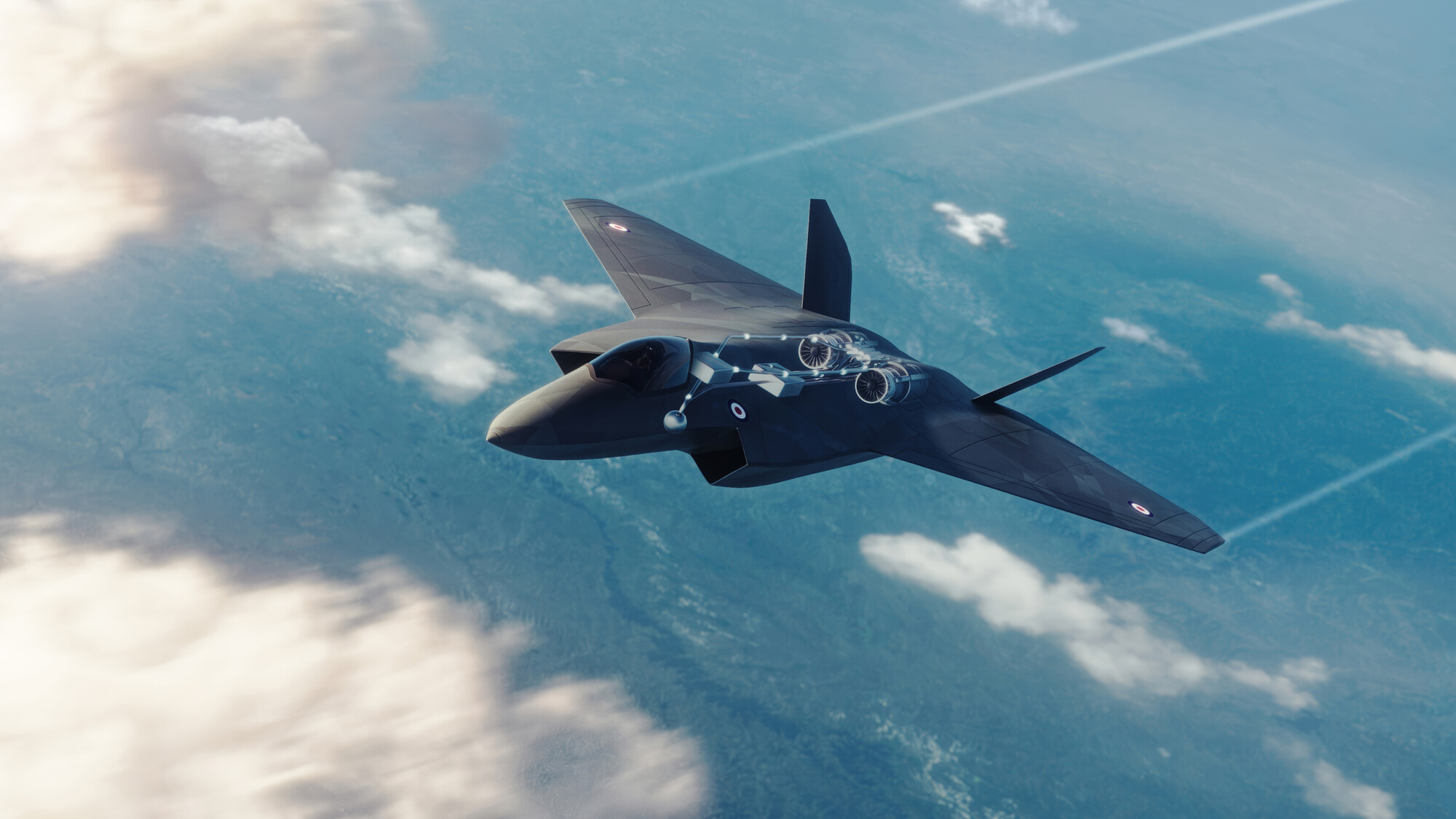
Rolls-Royce has reported a series of propulsion milestones for the UK’s future combat air effort, drawing on its Orpheus demonstrator to progress the design of the engine demonstrator for the Global Combat Air Programme, the Team Tempest partners stated.
The update formed part of a wider set of announcements from the partnership between the Ministry of Defence, BAE Systems, Leonardo, MBDA and Rolls-Royce on programmes supporting the UK’s Future Combat Air System and GCAP. For the FCAS flying combat air demonstrator, Rolls-Royce is providing two modified EJ200 engines, the powerplant used in the Typhoon, to support the aircraft’s development.
According to the company, the path to the next-generation propulsion system begins with the Orpheus demonstrator, which it uses to test new working methods and agile engineering processes. Rolls-Royce says the rapid learning model developed through Orpheus, aimed at compressing traditional timelines, is directly shaping technology development and reducing risk for future aircraft.
Those lessons are now being scaled internationally through the GCAP engine demonstrator, developed by a consortium of Rolls-Royce, IHI of Japan and Italy’s Avio Aero. The company says the international effort is advancing power and propulsion technologies toward the ground-testing of the engine demonstrator, which is intended to gather the data needed to de-risk the programme.
Richard Berthon, Director of Future Combat Air at the Ministry of Defence, was quoted in the press release as saying: “These achievements demonstrate the pace and scale of progress being delivered through the Team Tempest enterprise. From advanced digital manufacturing and flight testing to next-generation propulsion technologies, we are maturing the critical capabilities needed to deliver a world-leading Future Combat Air System for the UK. The expertise, skills and technologies being developed today are not only reducing risk for GCAP, they are strengthening our sovereign combat air capability and ensuring the UK remains at the forefront of air power innovation for decades to come.”





I love Farnborough week. Just need a Vulcan doing a touch-and-go.
“Spock”…. We need you !
Wouldn’t go that far
Boo!
Just come back v poor flying schedule compared to how it used to be.
Are you going then?
I’m there on Friday to wander round the stands pestering companies for a placement for next year, the flying schedule won’t really matter for me.
No, when I “go” these days I stand outside.
Been in too many times and seen the static so many times.
For you, perfect to go and harass! 😄
And why they don’t have a proper weekend for the public any more? Didn’t know that had stopped.
Today only saw F35A and Italian Typhoon of real interest. Also the UAE display team in Chinese advanced trainer I’d not seen, a J15. Had a strange sound.
Only RAF contribution was a Chinook, which we see every flipping day where we are!
Was one down in deepest Hampshire today, pottering around at medium-low altitude.
The flying lineup looks a bit better on Friday, they put a bit more on for the general public. Parachute display, Spitfire etc rather than trying to sell the latest safety feature on an airliner.
What are you studying…? 🤔
Engineering, I need a placement to keep myself up to date on maths and engaged rather than taking a typical gap year to reapply to university.
2008 scared them when that Typhoon nearly pancaked in along the flight line in a dive – way too bloody close and much more restrained displays after that.
That’s all understood, nothings been the same since Ramstein, and rightly, they stay air side.
Hell, I was staying alert standing in the street yesterday after Shoreham, though with the speed not much I’d probably be able to do but try to run!
Even a muted display would be good, especially to see the varied RAF, AAC, and FAA types we pay for.
I guess if one wants that, go and look at the static lineup.
And a Harrier bowing to the crowd.
Saw most of a Sea Harrier Sqn doing just that at Mildenhall, some proper displays there.
B1. B2. F117, F15, 16, 18, Mirages, Russian types, Hinds, Harriers, Tornado, Typhoon laterly.
Transports of all kinds.
Brilliant, those Air Fetes.
I’ve always found Farnborough naff for the displays, I only go as it’s local.
It’s grown into industry reps trying to sell aeroplanes to other industry reps, not really about entertainment.
Yes. So I’m not paying to go in!
Lots of articles on GCAP. Need to accelerate this project as fast as possible.
It would be good to see this aircraft in quantity at airfields all around the UK and around the world (in friendly countries) and soon.
Part of me thinks we could see it before 2035!
Flying next year and then what. Full production in 2028- depends how quickly we can build a jet but I wouldn’t be totally surprised if we get it for 2032-2033 period
They seem to be actively trying to automate the production process. As long as the Government don’t try and slow them down we might as you say manage to get things moving.
In my opinion we need them as fast as possible. It also will begin to release our reliance on other countries.
Taper your expectations. It won’t be based across the UK. It won’t be in large numbers. If a Typhoon still costs 80M+ after 23 years of production what is Tempest going to cost. I’d predicte 100-140 max. With loyal wingman making up the mass.
To be fair the expensive Typhoon does have have ‘cheap’ flying cost of £30k / hour relative to the £50k / hour for the F35. Those are approximate costs I would suggest.
If Tempest does come in in the price ranch you suggest then hopefully the flying cost will be more ‘reasonable’.
It all comes down to pricing strategy.
Cheers CR
PS. I use the words ‘cheap’ and ‘reasonable’ in context with tongue in cheek 🙂
Much of the cost is in the design I suspect CR.
Obviously the more that are ordered the lower the price per unit.
Clearly if it turns out to be an excellent piece of kit everyone will want some and it can be done at a decent price.
And we will deter. Just don’t expect 250 Tempests. Loyal wingman will provide the mass as reviled today at Farnborough.
610 Typhoons have been built to date and they still cost 80-100+ M. I’m not sure the idea of building more keeps the cost down in this day and age.
Norman Augustine‘s Law N#16:
“Defence budgets grow linearly but the unit cost of a new military aircraft grows exponentially.”
Yeh, that has been well known for years. It all comes down to the fact that everyone is trying to achieve the “best”.
As Waston-Watt put it,”Give them the third best to go on with; the second best comes too late, the best never comes.”
Third best is cheap FPV drones at the moment and look how they have put the wind up every regular military you can think of… They have been the cause of the largest number of casualties in Ukraine for some time, most notably overtaking artillery!
So drones to provide the mass is the only way forward at the moment, especially for the medium powers of Europe.
Cheers CR
Robert I’m attempting to separate out what we need from what we are likely to get.
Typhoon came to us at the end of the cold war. This is coming at the beginning of a new cold war which is already hot in Ukraine and quite capable of becoming hot throughout Europe. This at a time when it would be wise to remember that we not sure exactly what is going through the Americans minds. Between us and our European allies we might need to be able to dominate the air from jets to drones – and quickly.
Are not the days of peacetime military kit over. Whilst we do not want to provoke we certainly need to deter.
I think 80, no more.
I’ll be amazed if 100 get into the hands of the RAF, and I’d not be surprised if it is far less than 80.
Hmm, I think 80 is too few. There is no attrition pool in that number so the RAF will treat Tempest rather like the RN used to treat it’s Dreadnoughts – way too valuable to risk in anything other than a head to head with the Germany High Seas Fleet.
The Tempest would end up being a command platform for the drones which begs the question, why build it in the form of a fighter?
Of course, you are likely right on those numbers unless something really unexpected happens to push defence spending up..!
Cheers CR
Agreed, far too few.
Was going by F35 numbers and this thing will be more expensive I’d think.
Sadly, I think you might well be right. Things are moving in the right direction in a few respects, but it is still way too little and might yet be too late.
The one good thing about all this is this wek’s announcements about Brontanax and StormFighter. Streeting was quoted as saying these drones could come in at about a fifth of the price of, and fly 500 miles a head of the controlling Typhoon. That puts them in at about £20m a pop, so just a tad too expensive to consider attritable. Even so given their possible capabilities on entry into service and their future develop paths they still represent a low cost supplementary, collaborative capability.
Not forgetting they could be carrier capable as well.!? So the RAF and FAA might yet be sorted! (Sorry, out break of optimism.)
I’ll have 200 please, thank you!
Cheers CR
Japanese need a very long range strategic air dominance fighter, we need a very long range penetrating strike fighter.
Big internal bays and lots of range = very big plane
I realise that, mate, and totally agree.
It’s just that if it gets too expensive and takes too long to build we will not be able to suffer any losses, so you hold it back from the most dangerous missions to preserve the force or risk losing the war.
As it is I believe that the idea of the drones / loyal wingman concept is that you send them forward to knock a hole through the defences for the crewed aircraft and strike drones to attack the primary target. It would not take much adjustment in conops to see an evolution to something not dissimilar to that which I describe. Depends on what compromises and risks are acceptable to the force commander at the end of the day.
Cheers CR
I’d anticipate about 110 -120 which will be at the cost of far fewer F35,s than the 136 -ish as planned.
I’m ok with that- particularly with wingman type drones in the future.
That and 74 F35? Plus CCA, bite your arm off.
Yep. A large stealthy 6th gen fighter is not going to be cheap to purchase or to operate. Interesting that numbers have yet to be discussed in public yet.
I believe each of the partner nations are committed to 100 airframes.
You believe wrong.
Next year is not the GCAP first flight, that’s in 2030. Next year is the first flight of the demonstrator, which is not the same thing.
So how come we need two first flights. Build tempest demo for 2027 and start building the production ones
A prototype will be a Tempest production standard aircraft. A demonstrator is very different, and will likely look very different from the production aircraft. A demonstrator is to prove the technology. Like EAP before Typhoon.
So you are saying 2030 will be the first production plane but next year will be the demonstrator flight.
So in theory production might well start 2028 onwards all being well.
The first one might take 1-2 years to produce but in theory further batch could come quite quickly with automation.
“So in theory production might well start 2028 onwards all being well.”
No! A demonstrator is not a prototype. A demonstrator might not even have same size or even scale.
Excuse my ignorance. I think i am confused by mentioning prototypes.
“A prototype is an early, preliminary model of a product or system built to test a concept, evaluate functionality”
This would seem to come before demonstrator if at all. Maybe I’m wrong.
Are we going to get both or just a demonstrator or neither and when exactly.
The demonstrator is there to make sure the new tech for GCAP works. New electrical management systems, new radar, new stealth coatings, new cockpit interface, new distributed sensors. All of those can be tested and proven without using a GCAP airframe, and this is what the tech demonstrator does.
The prototype is there to make sure the shape of the airframe, weapon bay release, component performance etc are all as expected in the digital modelling.
👍
I remember seeing the EAP at Farnborough! Woooo.
EAP was a proper bodge, it had a Tornado tail and engines rather than Tempest’s all new airframe.
ooooh, you must be very old! 😁
When was it…? 85, 86? I would have been 13 or 14! 😆
How about me!. I can remember the Short Demonstrator before the EE P1. was produced . Right enough I was only13 years old and lived for the arrival of my FLIGHT magazine.
Tempest – Grandson of Replica
No connection
The demonstrator is a different airframe to the GCAP fighter. You can’t use that as the basis for the GCAP, because it isn’t designed with the same principles in mind. For example, the demonstrator uses EJ200 engines, the GCAP will use a larger design that will require reworking the airframe.
In 2030, the first GCAP prototype will fly. This will be the first GCAP airframe, and it’ll be used for late-stage testing.
Between then and 2035, production of the airframe will begin.
In 2035, the first production GCAP examples will be delivered to the Japanese.
Remember what we see next year or more like early the following in terms of flying, is a bit smaller and a uk take on the overall programme platform so not the final full blown design, so still a lot more development work thereafter. It’s mostly to test the systems and aerodynamics and how they all come together in a similar airframe before establishing the final details of the eventual design, so 2035 still seems the earliest likely date for true production models.
Anybody know if the projected thrust figures for the GCAP engines is in the public domain? Given GCAP is looking like it is going to be significantly larger and heavier than Typhoon, plus electrical output will need to be much more, we are presumably talking higher output than EJ200.
I would doubt that is in the public domain and will probably stay that way.
It will have to be a significant increase due to bigger size. One question have is : 2 Mach necessary? then if not afterburner necessary or super cruise enough?
Power rates per wiki
EJ200 Maximum thrust: 60 kN (13,500 lbf) and 90 kN (20,200 lbf) (with reheat)
SNEMCA M88 (Rafale): Maximum thrust: 50 kN (11,200 lbf) and 75 kN (16,900 lbf) (with afterburner) to be improved to TREX variant with 88 KN
Saturn AL-31(Su-27/57 family): Maximum thrust Maximum thrust: 8.8 tf (86.30 kN; 19,400 lbf) dry thrust, 14 tf (137.3 kN; 30,860 lbf) with afterburner 14.5 tf (142.2 kN; 31,970 lbf) emergency thrust
Since the Tempest will be near size of Su-57(34t max toff weight vs Typhoon 23.5t ) maybe even bigger will need a comparable engine for same performance, something that has not been build in W. Europe.
F 35 engine: F-139 Maximum thrust:
28,000 lbf (125 kN) military thrust
43,000 lbf (191 kN) with afterburner[N 3]
So we see at the moment Euro military engines on Maximum 90 kN, Russian on 140 kN and US on 190kN power levels.
Most powerful civilian engines:
RR Trent XWB 420 kN
General Electric GE90 is in 515 kN
Yes let’s put a Trent XWB in Tempest, now who’s up for designing the s-ducting?
:))) just for fun
It all depends on what Tempest wants to be.
Typhoons engines are the way they are because it was designed as pure interceptor and dog fighter. Is that really what Tempest aims to be first and foremost? I doubt it. Thrust to weight ratio performance may not have to be equal to or better than Typhoons if other mission parameters are the priority such as endurance.
If and its a more likely if, the aircraft is in a similar weight class to the F111, with a max take-off weight of 100,000lbs (45,359 kg) and you want a similar performance to Typhoon. Which has a max take off weight of 51,809 lbs (23,500 kg). That uses a pair of EJ200s to give it a power to weight ratio of 1.15:1 when configured as an interceptor (much lighter take-off weight). Then the engines for GCAP will need to produce around 115,000lbs (52,163kg) of thrust to match the power to weight ratio.
As you’ve pointed out the two EJ200’s each produce at maximum thrust: 60 kN (13,500 lbf) (dry) and 90 kN (20,200 lbf) (with reheat). Which is a long way short of what is required. Bearing in mind the two Pratt & Whitney TF30-P-100 afterburning turbofan engines, produced 17,900 lbf (80 kN) thrust each dry, 25,100 lbf (112 kN) with afterburner, to give a power to weight ratio of 0.61:1
As a comparison, the P&W TF30 had a diameter of around 49″ (125cm), whilst the EJ200 is 29″ (74cm). The RR Olympus as used by Concord had a diameter of 40″ (100cm). My prediction is the engine will be much bigger than the EJ200, if the jet is expected to be supersonic, possibly having a similar diameter to the Olympus. As it will need a a large fan diameter to have enough air to work with to generate the necessary thrust for the aircraft’s expected weight.
Much, much more so than the EJ 200, there have been general goals and expectations released by Rolls Royce which gives some indication of its class but nothing concrete that I am aware of. Again they are studying the various design parameters in Orpheus so that will no doubt determine the final specs and thus is going to be an adaptive engine so the figures will be quite wide in scope no doubt.
Engines are one of the often overlooked aspects of 6th generation fighters. Rolls Royce is the main reason the UK can build a true 6th generation aircraft and Russia and China can’t. There are only 3 maybe 4 companies on earth capable of working at this level currently.
Safran is going to struggle in future if it’s now lost out in building the next generation of engine because Dassault spat out its dummy on FCAS.
That failure makes GCAP even more important for the west. Along with F47 this might be the only other manned fighter developed for the next fifty years if not ever.
Especially given that the last thing commercial airlines and aircraft leasers want are any new engines. They just want improved reliability and on-wing time for existing ones. The only opportunity to push the envelope on engine technology is the military sector.
RR are doing a lot of advances in their big engines to greatly update and eventually replace Trent as well as attempting to re enter the mid range sector, all with re imagined core design criteria so we will see on that one.
They are, but airlines don’t want them.
Which is why neither Airbus or Boeing are planning on developing any new aircraft anytime soon. Most aircraft efficiency improvements come from new engines, if you’re not designing aircraft with more efficient engines than currently, it’s pointless to go to the expense of a new design.
While RR has improved Trent reliability, frequency and cost of maintenance is still too high for airlines compared to older engines (this is an issue not just limited to RRs new engines and arguably their competitors are in a worse position).
Airlines don’t want them until suddenly one day they are desperate for them and refuse to fly anything that’s not the very latest fuel efficient capability.
They are like this all the time, no one wants a new engine that’s more expensive to look after everyone wants a plane that’s 20% more efficient.
You do write a lot of rubbish.
Safran is literally developing a modern engine for India right now. And there WILL be a future French fighter with new engines. Don’t worry about Safran. France wants variable cycle engines unlike GCAP.