

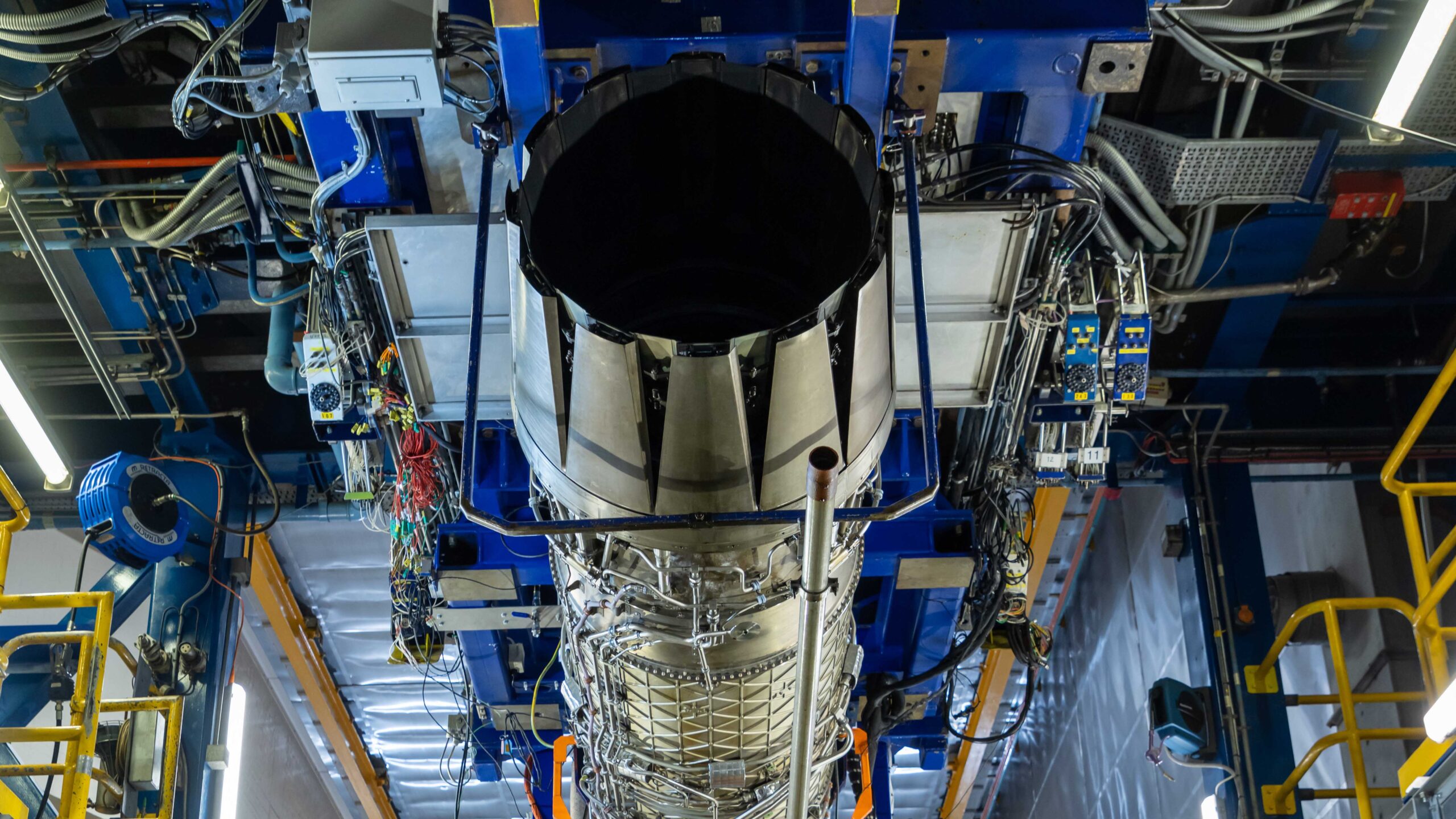
Rolls-Royce has reported a strong start to 2026 in its defence business, with more than a 20 per cent year-on-year increase in original equipment deliveries and a series of significant programme milestones across engine and marine gas turbine programmes, the company confirmed at its annual general meeting.
Chief Executive Tufan Erginbilgic said the company had had “a strong start to the year driven by our transformation and self-help” and that its diversified portfolio of three high performing businesses left it “better equipped to respond to changes in the external environment.” Defence was identified as one of the most resilient parts of the business, with a highly attractive growth outlook.
Among the headline defence developments, Rolls-Royce confirmed its AE 3007 engine powered the first flight of the US Navy’s MQ-25 autonomous refuelling aircraft in April, describing the programme as demonstrating the company’s unique positioning in next-generation autonomous aircraft propulsion. The MQ-25 Stingray is the US Navy’s first carrier-based uncrewed aircraft and is designed to extend the operational range of the carrier air wing by taking over the aerial refuelling mission from crewed F/A-18 Super Hornets.
In March, Rolls-Royce received an order as lead partner in the EUROJET consortium to provide EJ200 engines powering a new fleet of 20 Eurofighter Typhoons for Turkey, adding to the substantial existing EJ200 production programme which also powers Typhoons operated by the UK, Germany, Spain, Italy, Saudi Arabia, Austria, Oman and Kuwait.
The company’s MT30 marine gas turbine was selected in April to power up to 11 of the Australian Navy’s new fleet of general-purpose frigates, described as helping to enhance undersea warfare and air defence capabilities. The MT30 is already in service as the propulsion system for the Royal Navy’s Type 26 frigates and the US Navy’s Freedom-class littoral combat ships, and the Australian selection extends the engine’s growing international footprint.
Engine testing for the US Army’s MV-75 programme, which will power the Sikorsky-Boeing SB>1 Defiant X competing for the Future Long-Range Assault Aircraft requirement, is progressing well with endurance and altitude testing on track for later this year, keeping pace with an accelerated production timeline. Rolls-Royce also confirmed it collaborated closely with Boeing in March on the next stages of the critical design review for the US Air Force’s B-52 re-engining programme, which will see the Cold War-era bomber fleet fitted with the company’s F-130 engine.
In Power Systems, Rolls-Royce announced it would supply 350 upgraded mtu Series 199 engines on new Boxer armoured wheeled vehicles for the German Armed Forces and other international customers, and received an order for around 200 compact mtu PowerPacks for the Bundeswehr’s Puma armoured personnel carrier. The company also signed a memorandum of understanding with Polska Grupa Zbrojeniowa, Poland’s largest defence technology group, to provide services to mtu engines used by the Polish armed forces.
Rolls-Royce maintained its full year guidance of £4.0 billion to £4.2 billion of underlying operating profit and £3.6 billion to £3.8 billion of free cash flow for 2026, saying the Middle East conflict’s financial impact on the business was expected to be fully mitigated.





Think I must have been 12 when I first read that the B52’s were to get new RR engines.
Hadn’t realised you were so young, out of short trousers yet Halfy. 😈
12 in 1996, he’s quite the spring chicken!
I do not as yet, possess any Grownup s clothes.
Shorts and Tee’s are the norm.
I think my real father was a postman.
Just reminds me of the blackadder quote “Pitt the glint in the milkman eye.”
Was his name Ernie by any chance?
Ah nuts, he was a milkman!
Lol, I was never told his name nor profession !
Now, let’s push for the EJ230 for Sweden ans South Korea.
Article picture Is captioned “Tempest engine”.
Anyone know much about this ?
(can’t be arsed to look It up when there are so many great enthusiasts on here).
Looks a lot like an EJ200 to me, though it could just be a similar design heritage. I looked up “Rolls Royce TDV3/1” and it just led me back to the same photo on another site.
It says ‘intake integration testing’ and RR say they have some new technology with the supersonic inlet for GCAP so perhaps they were testing it on an EJ200?
A pair of EJ200s are being used in the Tempest demonstrator. Rolls Royce also used the EJ200 to test a new S shaped stealthy air-intake developed by BAE.
This suggests that the demonstrator will test the aerodynamic developments that are going into GCAP as well as just the systems stuff. RR’s video on GCAP shows various features like a composite initial stator and a ‘distortion tolerant fan system’ so there’s a lot to integrate, intakes-wise. I suspect there might also be some modifications to the front end of the EJ200 in this picture, we just can’t see them.
Yes, we spent many Millions on Taranis too. Hopefully those millions were not wasted.
I heard (although a while back now), that Japan was involved in the intake/body section around here too- as it’s such a critical technological piece. Both for stealth and for aerodynamic performance. But no mention of that here- interesting.
If Japan were in Scotland, you’d hear all about It on here, I can assure you !!!
Specifically the picture is a testbed for developing technologies to go into the future Tempest engine rather than the new engine itself. As mentioned in the note in the bottom right they seem to be testing a new intake (which would be cut off the bottom of the picture). As far as I am aware they have been testing various parts of the new engine but not necessarily brought them all together into a single new platform yet, but I’m not privy to the details beyond what gets mentioned in the news so they may quietly be further along than that.
I’ve gained $17,240 only within four weeks by comfortably working part-time from home. Immediately when I had lost my last business, I was very troubled and thankfully I’ve located this project now in this way I’m in a position to receive thousand USD directly from home. Each individual certainly can do this easy work & make more greenbacks online by visiting
following website—.,.,.,.,.—>>> JobatHome1.Com
A Rolls-Royce engine (AE 1107F, a derivative of the Rolls-Royce T406/AE 1107C used on the Osprey) will power the Bell MV-75 Cheyenne II tiltrotor for FLRAA. The SB>1 Defiant compound helicopter was deselected.
Has engine technology moved on much since EJ200 was designed?
You would hope so. The electricity generation and embedded engine starter, additive manufacture, adaptive cycle, new high-temperature materials, thermal management, all come to mind.
Yeah, some pretty cool possibilities out there for a “6th Gen-ready” jet engine. Will have to see how many of those they can fit into the production unit…!
I think 3 would be good, just like the Chinese !
Actually In my Bike World, a “Triple” has many “real world” attributes that offer genuine benefits over a Twin or Four cylinder Engine configuration. In fact a “Triple” such as my MT09 can be seen mostly almost fully airborne, at speed most days.
(MT09 is a Yamaha Cross Plane Crank 900cc Triple, It’s a bonkers road bike being lightweight and rather nimble but still has plenty of go when wanted).
Triumph also embraced the Triple In their comeback range of the early 1990’s, just adding depth for anyone not Interested one little bit.
😊👀🤦♂️
Why are you all so boring ? 😁😁😁
Haha, I like motorbikes, I just can’t be trusted to stay upright on one..! My Dad has a Triumph Bonneville (one of the new ones), off the top of my head I couldn’t say if it’s a triple or not. But a mate of mine has a Sprint, which I think is?
3 engines would certainly give it some oomph- in some ways not too dissimilar to those high speed/ high altitude penetrator type aircraft that were dreamed up during the Cold War. The challenge will be fitting big enough weapons bays in and around the engines and the fuel tanks, as I think range and big weapons is going to be key.