

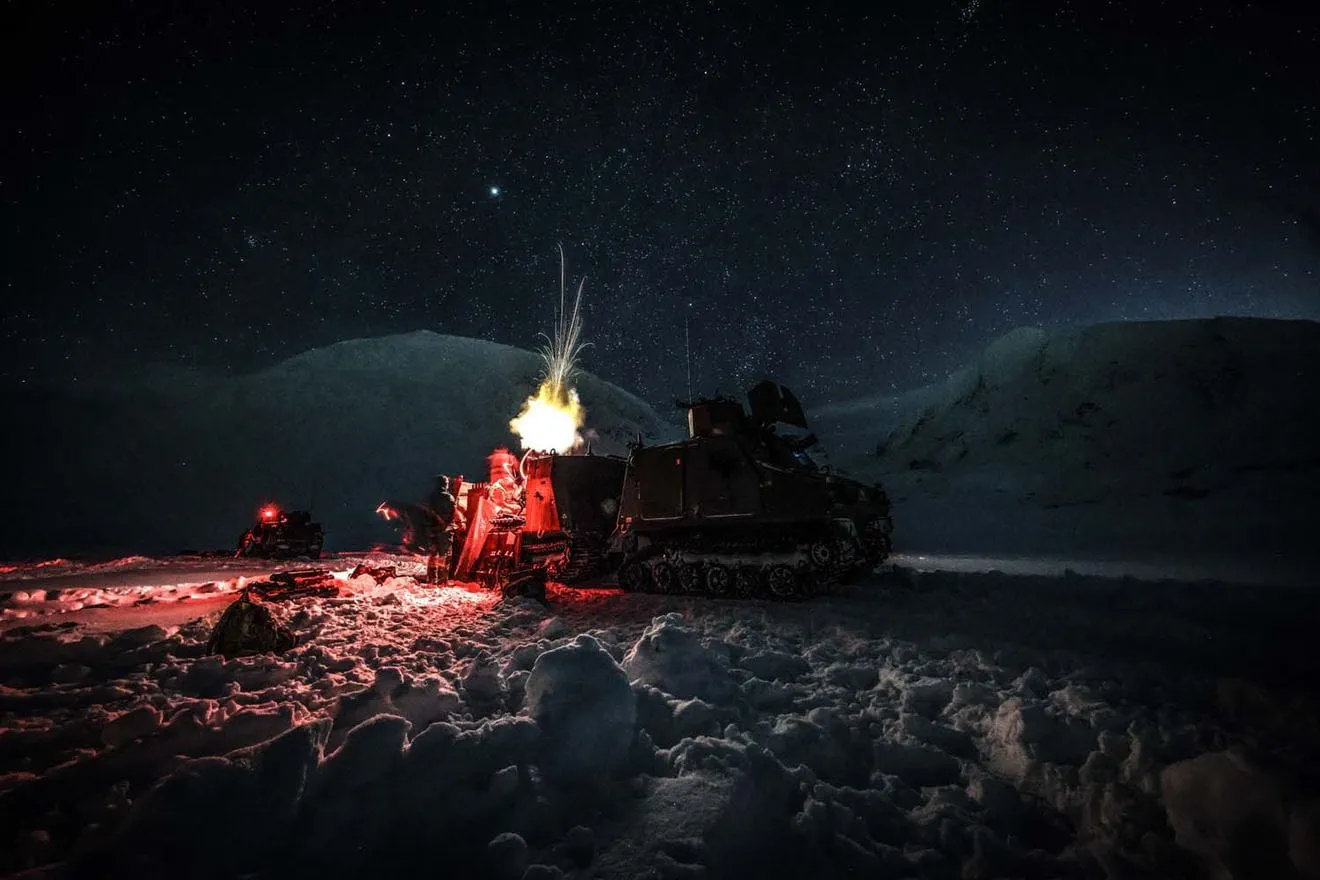
Royal Marines have carried out live mortar firing drills in northern Norway as part of preparations for a major NATO exercise and an expanded UK role in Arctic security, the Royal Navy stated.
The mortar training took place near the village of Moen, more than 200 miles inside the Arctic Circle, as around 1,500 UK Commandos continue intensive mission rehearsals in sub-zero conditions. The activity forms part of NATO’s wider efforts to strengthen its northern flank and protect Nordic member states.
According to the Royal Navy, the marines practised firing 81mm mortars from Viking and BV206 all-terrain vehicles, combining mobility with fire support training in harsh terrain. The service said the weapons are capable of delivering around 15 rounds per minute, with ranges of up to 3.5 miles.
The drills are part of preparations for Cold Response 26, NATO’s largest Arctic exercise this year, due to take place from 9 to 19 March. The exercise is expected to involve around 25,000 troops from 14 nations operating across northern Norway and Finland.
The Royal Navy said the training also comes amid plans to increase Britain’s presence in the region, alongside expected UK participation in NATO’s Arctic Sentry mission and further Joint Expeditionary Force activity later this year.
Defence Secretary John Healey said: “Demands on defence are rising, and Russia poses the greatest threat to Arctic and High North security that we have seen since the Cold War.”
He added: “The UK is stepping up to protect the Arctic and High North, doubling the number of troops we have in Norway and scaling up joint exercises with NATO allies.”
Healey said: “Cold Response and Lion Protector will this year see thousands of troops deploy across the Arctic and North Atlantic, with the UK leading the way. We train together, we deter together, and if necessary, we will fight together.”
The Royal Navy said the mortar troops fired day and night for a week in temperatures close to -20°C, using vehicles to rapidly reposition through deep snow in order to avoid remaining static. The service noted that modern battlefield radars can detect mortar firing positions, increasing the importance of mobility to reduce vulnerability to counter-fire.








How are we stepping up, Mr Healey?
Please detail the deployment, what commitment you’ve withdrawn from elsewhere to enable it, and the extra kit and people you’ll be paying for so it can be maintained?
But you cannot, can you?
I do often wonder if someone like Healey or others in the MOD actually take the time to read stuff that’s posted on defence orientated websites.
Still, there loss if they don’t, probably don’t want to hear a few home truths, might be a tad embarrassing for them.
Nice seeing you post, Deep, been a while?
No idea about MoD, but you know that each of the three services have info security units that do persuse forums such as this for Opsec issues.
So I’m sure that lots of serving personnel including officers might enjoy sites such as this.
I’m a nobody, with no influence at all and just a bloody civvy. But if I can embarrass with my comments great. These peoole need highlighting.
NL and UKDJ are read widely.
Some of the silly arguments don’t help as people can’t be bothered to wade through pages of off topic material and petty arguments to find the nuggets.
That is why George is right to get rid of the troublemakers.
Hmmm. I can think of one “individual” who pops up occasionally having been banned before, so it’s a shame it’s only temporary.
UKDJ gets referenced in Parliament occasionally so some of them must read the articles at least, George’s reporting has a good reputation and readership as it’s the biggest defence-focussed site in the UK.
From other forums and websites the UKDJ comments don’t actually have a great reputation so they probably just dismiss us as a bunch of cranks.
In fairness a lot of people I’ve seen on other forums and websites bitching about UKDJ used to post here and left because they got called out a lot.
Yes, I’ve read some of those comments on other websites to. Think that you’re probably right about their views of those that post on hear. Bit unfair really, but you can’t cater for all tastes, so to speak.
I don’t look at any of the comment sections elsewhere, apart from NL on but a handful of occasions. And the rows looked even worse there so I don’t bother with posting elsewhere.
Saw a couple of familiar names.
To be fair, unless I’m digging for something, I’ve cut down on what I look at, post even less on other sites. Agree with you, some of the pitching is OTT, so just limit myself to the occasional post on here.
Any news on the Army getting the 120mm mortar thats been shown at various shows off the back of a truck or wheeked or tracked? Is it something the RM could get?