

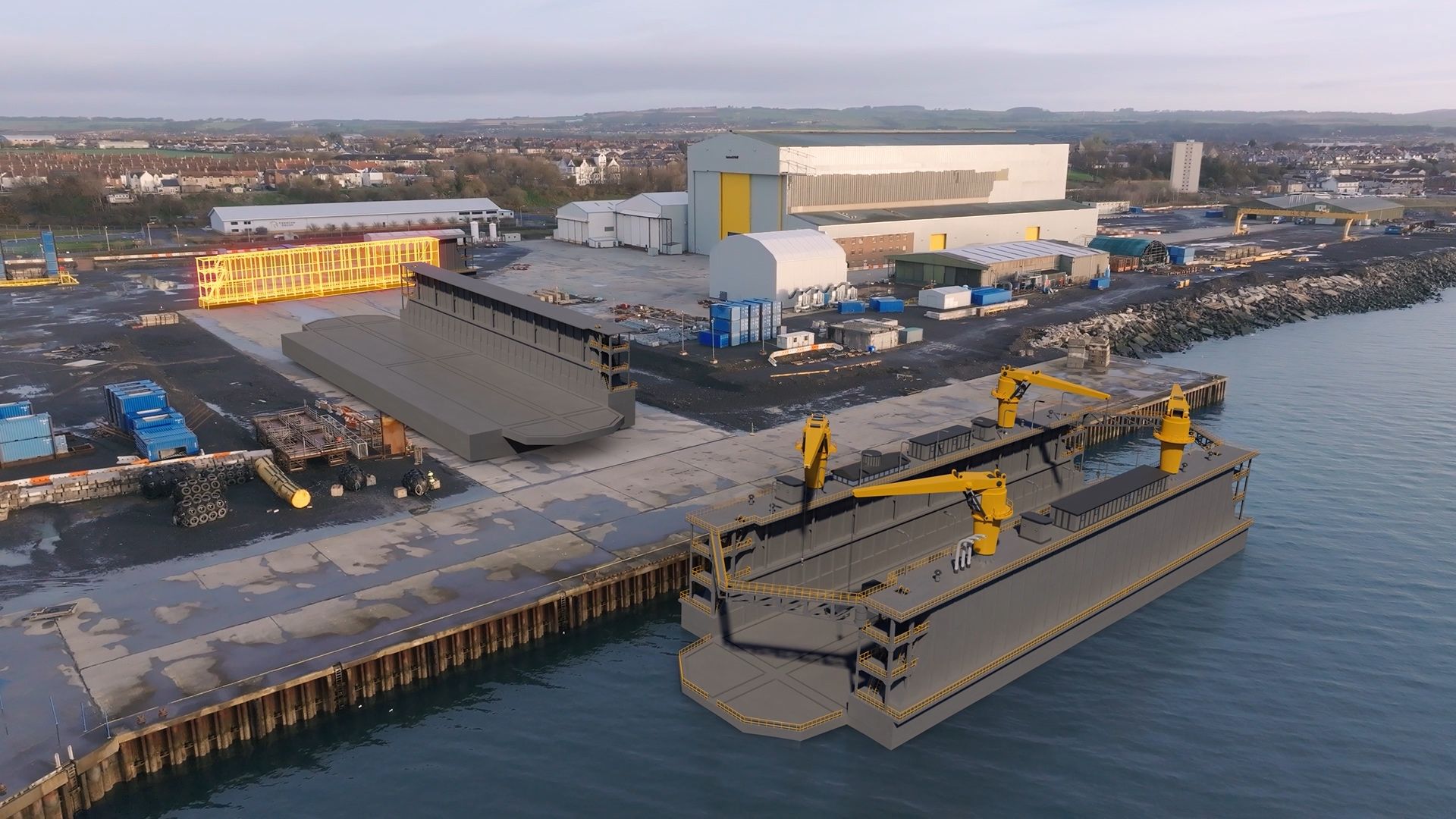
The Ministry of Defence has confirmed that the Royal Navy’s long-planned additional fleet docking capability is now formally being delivered through Programme Euston, with the aim of providing new out-of-water engineering capacity at HM Naval Base Clyde in the early 2030s.
In a written parliamentary answer, Defence Minister Luke Pollard said Programme Euston is the Navy’s solution to the requirement for additional fleet time docking, a capability seen as increasingly critical to sustaining the UK’s submarine force.
“Programme Euston is the Royal Navy’s solution to Additional Fleet Time Docking Capability,” Pollard said. “The programme aims to deliver a resilient out of water engineering capability at HMNB Clyde by the early 2030s.”
He added that the next major milestone will be the submission of a Programme Business Case in mid-2026, after which timelines will continue to be reviewed through the Ministry of Defence’s major programmes portfolio. The department declined to provide more detailed delivery schedules, citing commercial and operational sensitivities. The latest response aligns with earlier parliamentary disclosures indicating that design work on new floating dry docks is already underway.
Last year, Defence Minister Lord Coaker confirmed that the Ministry of Defence intends to place a manufacturing contract once technical specifications have been finalised and a formal procurement process completed. At the time, he stated that a contract would follow “production of the technical specification and upon completion of a procurement process.” Programme Euston is intended to address long-standing constraints in the Royal Navy’s ability to take submarines out of the water for maintenance at Faslane, pressures that are expected to increase as the Astute class continues in service, the Vanguard boats remain operational, and the Dreadnought class enters the fleet.
Although the programme does not formally sit within the National Shipbuilding Strategy, the government has previously indicated that the UK industrial base is expected to be involved. Lord Coaker said in earlier answers that “the analogous shipbuilding sector is well placed to participate in an upcoming procurement for the floating docks,” and confirmed that the National Shipbuilding Office had been consulted ahead of the programme’s next investment decision point. No assessment has yet been published on the number of jobs the programme could support, with ministers previously stating that this will depend on the outcome of procurement decisions and build strategy.







Planned for the early thirties, so some time around 2040…
I find this unbelievable really.
This kind of thing can be contracted from people who make them for a day job and delivered.
I sense we are going to go down the job creation scheme route of trying to build in the UK with the learning curve. Whatever anyone says we don’t have enough welders so finding a bunch more makes so much sense – on what planet?
Might the nuclear aspect have a bearing on that? I don’t think anyone will be building submarine floating docks commercially.
So it might be difficult to find a foreign builder and given the shortage of dry docks having the ability to build floating docks ourselves might not be too silly.
Nuclear will add further complexity for sure as it will have to have additional fail safe modes and more duplications of power and control systems than would be normal.
Then there is the issue of supplying cooling to the reactor when the sub is out of the water. Which is not trivial as the cooling would likely have to function even if something terrible happens to the floating dock.
My suspicion is that MoD would be far better off ordering the floating dock from a Japanese or Korean yard and maybe fitting it out in the UK. Although that said the biggest problem we actually have in UK shipbuilding are the fitout trades….or lack of them…..
There are some pretty significant safety measures that would need to be built in..so it’s limited skillset design and build the US got general dynamics to build theirs.
At the risk of sounding flippant, if something terrible happens to the dock I imagine there won’t be a lack of water for the submarine…
The main question is, do we trust a foreign yard to build to the required standard and to maintain security for the design? As you say we have a lack of fitting out experience but a floating dock is much easier to fit out relative to the steelbashing so it seems an ideal way to build up a workforce at smaller yards.
“At the risk of sounding flippant, if something terrible happens to the dock I imagine there won’t be a lack of water for the submarine”
I am afraid that is not correct.
Yes, the reactor will be under water but it won’t have water being pumped through it meaning it is at risk of overheating.
Which is why having coolant pumped from shore is, likely, essential in such a way as to make sure that if the floating dock does go under the coolant supply to the reactor is maintained.
Provided the reactor is properly cooled there is little real risk of anything going badly wrong.
Killjoy 🙂
I’ll leave the flippancy to Halfwit in future then.
That’s it, blame the little defenceless chap !!!
Is Latvia the answer, take the coastal railway past the docks and there are any number of floating dry docks… now go back to Rīga’s role in the cold war and their ability to service SSK, SSN, FF and DDs.
We need to cast our net wider.
Ps. Lots of welders 😉
Are they actually going to buy anything in this Parliament or are they kicking the can for the next government?
I only ask as how can it take so long?
Nope. Well yes, but not for the Military.
Projects are already being scaled back and moved to the right behind the scenes as the battle between HM Treasury and MOD continues over the DIP. Add the in year shortfall and nothing much is going to go ahead until the new financial year is the reality at the moment and for the foreseeable future.
Your observation about kicking the issue of a genuine significant uplift in defence spending into the next Parliament is correct unless the current international chaos forces a change of heart. Personally I very much doubt it.
Truely pathetic. This Labour Government is all talk and no action on Defence. No Orders just projects and taking credit for Orders placed 5 or more years ago. Get thee hence Liebore.
Can someone give us a chart of what has been Ordered for the Navy since July 2024? Or indeed anything for any of the 3 services. This Dolittle will have a disastrous effect 10 years down the road. Shades of Tony Blair’s efforts who’s inaction is still hanging over us.
Yes, it is interesting all of the nothing going on and the credit hoovering for things like T26 and T31 which were really down Boris – much as we may like to diss him!
We’ve attempted this several times here.
Sp
So, possibly with stuff I forget or overlooked.
53 Jackal E.
Some trucks.
2 Dragonfire.
6 Sky Sabre Launchers. ( 100m payment spread over 3 years apparently!)
Probably various SF kit which is classified.
The rest is ongoing programmes inherited from the previous government.
Meanwhile, “retiring” equipment continues unabated.
Oh yes, plus some thousands of Drones of various types, from FPV to longer range OWEs.
24 Stormshroud.
Of the Army ones, only read one article on them and the whole thing seems shrouded in secrecy and seems to be concentrated in Cabrit rather than Army wide.
The who, the how many, I’ve no idea.
Off topic but is the author of this post a real person? The picture looks like AI and was uploaded today, no socials, and despite their description saying they write for other publications there is nothing online under that name. Also some of George’s articles were later updated to change the author to Adam Barr according to archive sites.
Maybe it might be easier to go to the National Records Office and dig out the plans for the Mulberry Harbour Cassons, and then we could have them in a few months. 😄😄😄😄
Yes it is a joke before humourless people comment
I was involved, much to my chagrin, in writing the Safety Cases for new nuclear facilities at Faslane in the 1990’s. Put the word ‘nuclear’ in front of anything and you are then in a world of truly incredible attention to the most minute of details. Before one tool is touched you have to prove your design, the methods you intend to build it, the people you intend to employ to make it, how you intend to operate it and who you intend to operate it with and submit your plans through a plethora of bureaucracy. Add to that detailed plans on how you’d deal with any form of disruption from natural or man-made disasters. Then when you’ve actually built it you have to go through many of the same processes all over again with exercise after exercise to prove the adequacy of build and procedures.
I personally felt that much of this was way OTT, wasting my time being told to climb into a culvert to check if there was actually one or two mm separation variance in cables already 1m apart. The ‘nuclear gnomes’ dominated the scene with their utter and relentless insistence on safety at any price; they probably even considered the alien threat from Mars. There again, while there have been incidents there have never been any accidents but it can be argued that the ‘risk: likelihood-consequence’ equation was taken to sometimes ludicrous extremes. That’s the reason why projects like this will cost so much and take so long – but what price safety?!?
Reading through some of the negative comments, especially the ones saying we should just build these overseas because “we don’t have enough welders” or that the UK should only do the “fit out”, completely misses the bigger picture.
If we keep sending the heavy fabrication abroad because we currently have a skills gap, that gap will never close. The only way to solve a welder shortage is to create real projects at home that justify training, apprenticeships and long-term careers. Other leading shipbuilding nations didn’t magically have unlimited skilled labour; they built it up by committing work to their own yards.
These floating docks aren’t just big lumps of steel you can bolt together anywhere and tow over. They are critical defence infrastructure for the Royal Navy, with strict standards, security considerations and long service lives. Handing the core construction to a foreign yard and pretending we can just “fit them out” later in the UK still leaves us dependent on overseas capability for the most fundamental part of the asset.
There’s also a bit of historical amnesia in some of the comments. Britain didn’t just build floating docks in the past, we pioneered them and built some of the largest in the world. This is not some exotic technology that only foreign yards understand; it’s something the UK used to lead on.
Calling UK construction “just job creation” ignores the wider effect. Heavy fabrication work supports a whole chain of domestic suppliers, steel producers, engineers and specialist contractors. Those people pay taxes, spend locally and keep strategic industrial capacity alive. That is not dead money; it’s an investment that circulates back into the economy and reduces long-term dependence on others.
Looking “wider” for so-called cheaper builds might look sensible on a spreadsheet, but every time we do that we hollow out our own capability a bit more. Eventually you reach the point where you genuinely can’t build at home anymore, even if you want to.
If these docks are important enough to support our most sensitive naval assets for decades to come, they’re important enough to justify rebuilding and sustaining the skills to construct them in the UK from the keel up, not just doing the finishing touches after someone else has done the hard part.
Plus. What is fit out?