


Russia is not just testing Europe’s reaction, it is training Europe not to react at all, Helsing’s UK boss told #ApexEurope.
Russian testing of European defences is meant to wear down the continent’s willingness to respond at all, the UK managing director of the military artificial intelligence company Helsing told the Apex Europe conference in London on Wednesday.
Ned Baker was speaking on the European Industrial Leadership Panel, chaired by Lieutenant General (Retired) Stuart Skeates, the chairman of Apex Europe, and he took up an argument made in the session immediately before his.
He said: “They’re not just testing us to see our reaction, they’re actually testing us to get us used to not reacting, and that’s the worst possible thing that we can do, is settle into a kind of slightly European malaise. The time for delivery, the time for action, is now.”
Helsing describes itself as an Anglo-German company, and Mr Baker set out the thinking behind its founding. “We were founded in 2021, based on the belief that Europe needed new technologies, new capabilities to defend itself, but also that amongst those technologies, military AI was going to become the defining characteristic of defence in the future, and I think we have seen that play out to a certain extent in Ukraine,” he said. “I think there is a lot more for NATO to do to adopt those technologies.”
“We’ve been very fortunate to raise a little bit over 2.5 billion pounds in capital over Helsing’s life, and it’s our responsibility, obviously, to deploy that capital wisely to build these technologies,” he said. “But the fact that we’ve managed to raise that capital is also a kind of a once-in-a-generation opportunity. If the threat is a once-in-a-generation risk, then the capital that is available to us now is a once-in-a-generation opportunity, and it is here in Europe, and we should take advantage of it.”
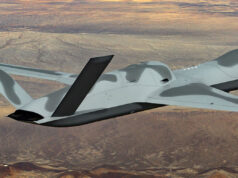
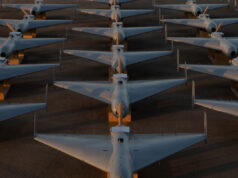
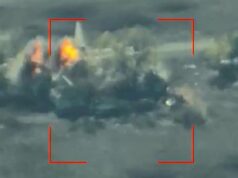
What the company does with it includes strike drones supplied into Ukraine over several years, work he described himself as very proud of, and what he called Europe’s first fully autonomous fighter jet.
Asked how companies operationalise the rapid iteration seen in Ukraine, he began with a form of information older than any of the technology. “The first one is such an important one, but it’s a piece of data that’s existed for centuries, millennia, is just user feedback, just basic user feedback, getting hands-on with operators, and as much as we can blurring the lines between technologists and tacticians, so that we can learn what works, what they need, and getting close to the end-user problems,” he said.
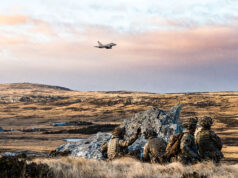
Helsing can do that, he said, because it uses its own money to develop products to a level of maturity where they can go out on exercise with the British Army or the German Army and be tried in front of soldiers, with the results fed back into development. On Ukraine he was blunt about what the shortened cycle means for everybody else. “If you do not have that kind of 24-7 service of tell me what’s working, oh, you found something, let’s go and fix it, then that is not peculiar to Ukraine,” he said. “That is just the new normal, and it will become the new way of functioning for the new style of warfare we will have to fight.”
Collecting real-world data to train models is expensive, slow and hard to do at the volume modern systems need, which is the problem behind the company’s most striking claim of the session. Helsing has built internal tooling, not sold as a product, to generate synthetic training data.
He said: “We pump lots of money and lots of brains into it to build synthetic AI data, so we can basically simulate environments. These environments can be changed at the touch of a parameter. Make it night. Make it day. Make it snowy. Make it rainy. Show me a T-72. Show me this. And you get then a synthetic AI data pack that you can train your models on.”
He went on: “That has been revolutionary for us. That has changed those model training cycles from months and potentially years down to hours, and that’s not just training strike drones. That is how we are going to do reinforcement learning for fully autonomous fighter jets, for fully autonomous unmanned surface vessels.”



Agree with the generalised theme. Europe needs to go further. Any Russian drone incursion should be immediately shot doen. Any missile that passes over nato air space, shot doen. Any aircraft, warning then shot down. That is international law.