

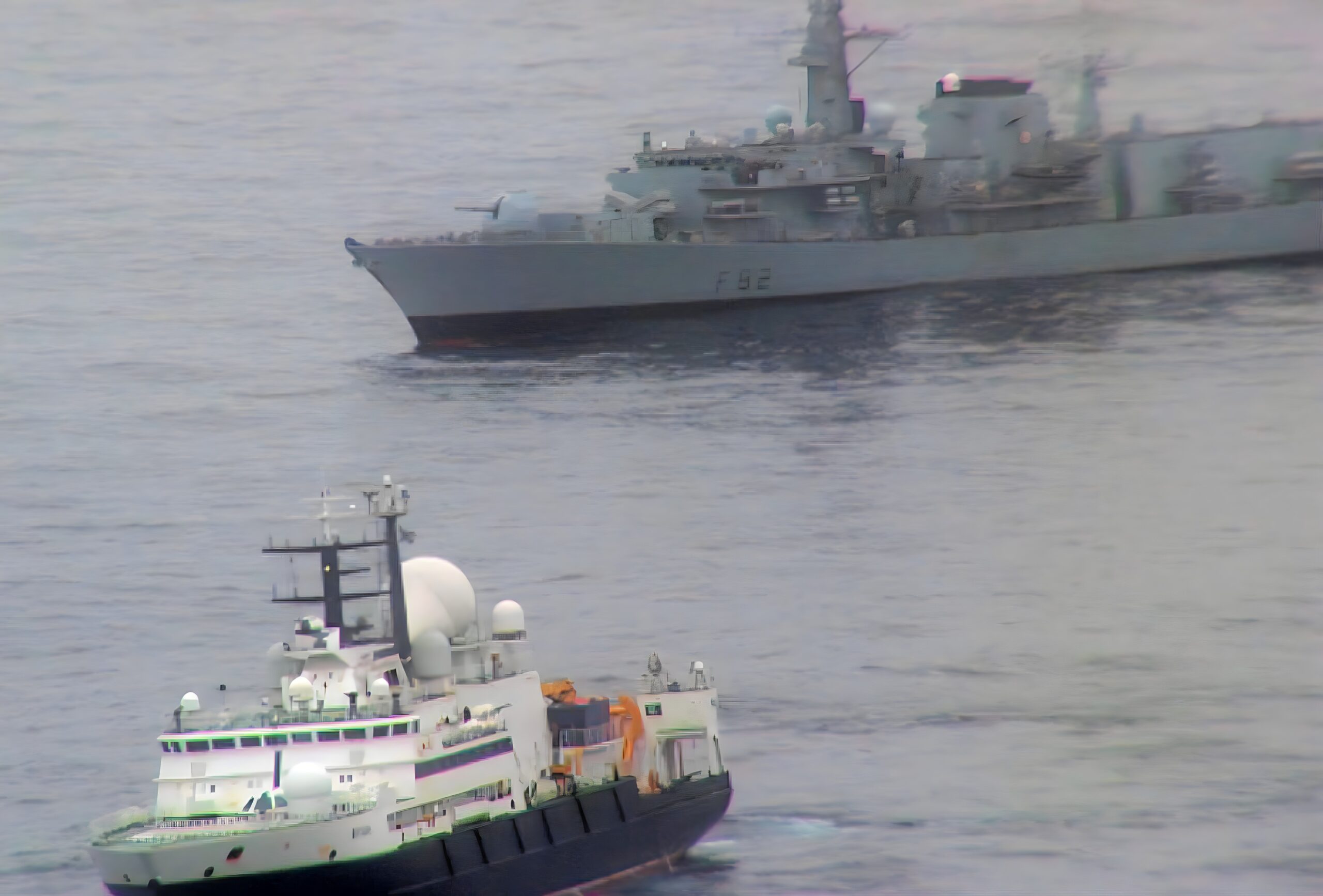
Russian specialist submarines have been used to survey critical undersea infrastructure in and around British waters, part of a broader campaign of activity that European and American officials describe as hybrid warfare, according to a report published by the Congressional Research Service.
The report, numbered R49134 and released on 11 August 2026, was coordinated by Andrew S. Bowen, an analyst in Russian and European affairs, and written alongside colleagues covering European affairs and cyber and information operations. It draws together official statements, national threat assessments and academic work to give Members of Congress an overview of what Russia has been accused of doing across Europe since the full-scale invasion of Ukraine in 2022.
On the undersea question, the report cites the British government’s disclosure in April 2026 of a covert Russian effort, in its words, “to conduct hybrid warfare activities against the UK and its Allies”, using specialised submarines to survey critical undersea infrastructure, possibly in preparation for future sabotage. Then-Defence Secretary John Healey addressed the Russian president directly at the press conference announcing the operation, saying: “And to President Putin, I say this: we see you, we see your activity over our cables and pipelines. And you should know that any attempt to damage them will not be tolerated, and will have serious consequences.”
The vessels involved belong to Russia’s Main Directorate of Deep Sea Research, known as GUGI, a specialist branch of the Russian military that sits directly under the Ministry of Defence and separately from the Russian Navy. GUGI operates a range of specialised submarine, undersea and surface vessels, and its primary missions are reconnaissance and maritime intelligence collection, including surveillance of foreign naval assets and the management of underwater surveillance systems. It may also have the capability to sever or disable undersea infrastructure, the report states.
Concern about the seabed is not confined to British waters, as American and NATO authorities alerted allies in 2023 and 2024 that Russia was actively mapping undersea infrastructure, and news reports identified at least six instances of suspected sabotage or disruption to cables in the Baltic Sea across December 2025 and January 2026. In several cases vessels are alleged to have dragged anchors across the seabed. Finnish authorities detained a cargo ship flying the flag of St Vincent and the Grenadines in December 2025 on suspicion of damaging a telecommunications cable linking Finland and Estonia, a year after seizing a Cook Islands-registered oil tanker that had departed the Russian port of Ust-Luga and was suspected of damaging several data cables and a power cable on the same route. Criminal charges followed against several of that ship’s officers.
Two incidents have been linked to vessels registered in China, though some observers suspect Russian intelligence services rather than the Chinese government were behind them. When cables connecting Lithuania to Sweden and Germany to Finland were cut within hours of each other in November 2024, German Defence Minister Boris Pistorius said: “No one believes that these cables were cut accidentally.” The earlier damage to the Balticconnector pipeline between Estonia and Finland in October 2023 was later acknowledged by China’s government as having been caused by the anchor of a Hong Kong-flagged cargo ship, which Beijing attributed to a storm. Regional officials have expressed scepticism about that explanation.
Speaking in May 2026, Anne Keast-Butler, Director of GCHQ, said: “Russia is scaling up its daily hybrid activity against the UK and Europe, stretching from the seabed to cyberspace, relentlessly targeting critical infrastructure, democratic processes, supply chains and public trust.”
NATO’s response has included Baltic Sentry, launched in January 2025 to increase the alliance’s presence in the Baltic Sea and improve its ability to protect undersea infrastructure. The alliance has also stated that hybrid threats could trigger Article 5 of the North Atlantic Treaty, under which an armed attack against one member is considered an attack against all. Russia routinely denies responsibility for suspected attacks, and the report notes that definitive attribution is often difficult or impossible to prove, with some cases well documented and others resting on circumstantial evidence.








It’s the often complely ignored fact by the main stream media. The vast majority of these under seas cabales are America and attacking them in international waters is an act of war against the USA.
The USN seems to have zero interest is defending their own cables which is unsurprising because just like ASW and MCM the US navy always seems to have little interest in doing anything that doesn’t involve sticking more missiles, planes or guns on a big blingy warship.
There are so many data cables crossing the Atlantic that Russia can attacks then all day long and it will mean not much but sllower internet speeds for the UK at the cost of hundreds of millions or billions in repair costs for US corporations.
Totally different on gas and electrical interconnections but most of the are in territorial waters or much shallower seas and knocking one of two out is a nuisance not an existential threat as the media makes out.
All of these cables regularly get cut anyway by natural processes or manned made accidents and their repair is fairly straight forward and quick. We give these Russian gray zone operations too much attention and credit which is what the Kremlin wants.
There are some cables rather more important, Jim, that we do not want Russia messing with.
Such as the one carrying financial transactions between New York and the City of London, a world where milliseconds count, and another which is a direct link from GCHQ to the NSA.
Assuming they can find them, of course.
A greater worry for me are attacks on the CLS, Cable Landing Stations, the connection from the undersea cable to the landside FO network.
They’re not hard to find.
Hi Daniele, I have no doubt the Russians could cause some disruption by attacking the cables, on the Financial side there are no dedicated cables that carry transactions however most of the cables do carry dedicated fibre optics inside them for high frequency trading. However every one of the companies has contingencies for cables being cut as it’s happens quite frequently. There are around 25 cables crossing the Atlantic, even if half a dozen of these were cut simillatiously it would result in a slowing of data speeds and nothing else. Netflix will take a hit but the NYSE and LSE will keep trading. Most of the time signals that are vital come from satellites.
I just think the Russians make too big a deal of this as it’s easy to grab headlines by having a ship float around near the cables and our own media and military make a big deal of it because it generates click bate and the military can push for yet more budget for sea bed warfare while neglecting things that actually do matter like ASW or MCM. RFA Proteous and future sister and not free capabilities.
But ultimately most of these cables are American and it’s up to America to protect them and if Russia does attack them it’s declaring war on America not Britain or Ireland legally.
The Americans may have laid them, but it’s not one way traffic. I think there is a large degree of joint responsibility involved. I am not sure how you “protect” them anyway as it’s pretty deep out there. If they have ships and/or subs continuously running back and forth in the same areas, would it rather not highlight where the cables are?
Hi spartan, they didn’t just lay them, they literally own them. Undersea cables in international waters are no different to vessels or oil rigs. The company where they are registered owns them. If Russia attacks them it’s no different to attacking a US merchant ship at sea on its way to the UK.
Russia attacking under sea cables on mass would not be a gray zone operation but a pretty old way to declare war on NATO by attacking directly its biggest member.
I used to work in the telecoms industry and I’ve long taken the view that an attack of sufficient magnitude to cause serious disruption would not be deniable, because it would require a carefully coordinated attack on numerous locations. Many cable operators can locate a break (and thus identify vessels that may be responsible) within just a few minutes.
The most critical services use geographically diverse multiple routes, so a single cut, while an expensive nuisance, has negligible impact. Additionally Banks and other financials routinely have fully redundant infrastructure (everything is duplicated off-site at remote locations) and extensive contingency plans. This is principally to mitigate 9/11 type risks, fires, natural disasters etc. but it means that their overall networks are inherently robust and fault tolerant. The big internet players (Google, Amazon etc.) have even more robust networks and extensive local caching.
I sincerely hope that we are doing as much or even more to Russian cables, pipelines etc
What with our dozens of submarines?
I understand that until we get a couple of floating dry docks we do not have any submarines but we have other ways of getting at them ^.^
Maybe we need to actually catch them in the act, video it and present it to them with a “we see you”, with a warning of continue and there will be such snd such consequences? If that’s even enforceable? Hopefully there’s backup cables, satellite fall back and dummy cables to.boot. Might help if the UK had some SSKs/drones to be able to patrol these undersea routes.
So we may claim but we also lie a lot.
Meanwhile we are threatening to cut the Baltic cables to Russia so fairs fair IMO
We deserve all we get and we will fail in hours with no data as our bankers will not be able to steal anymore.