

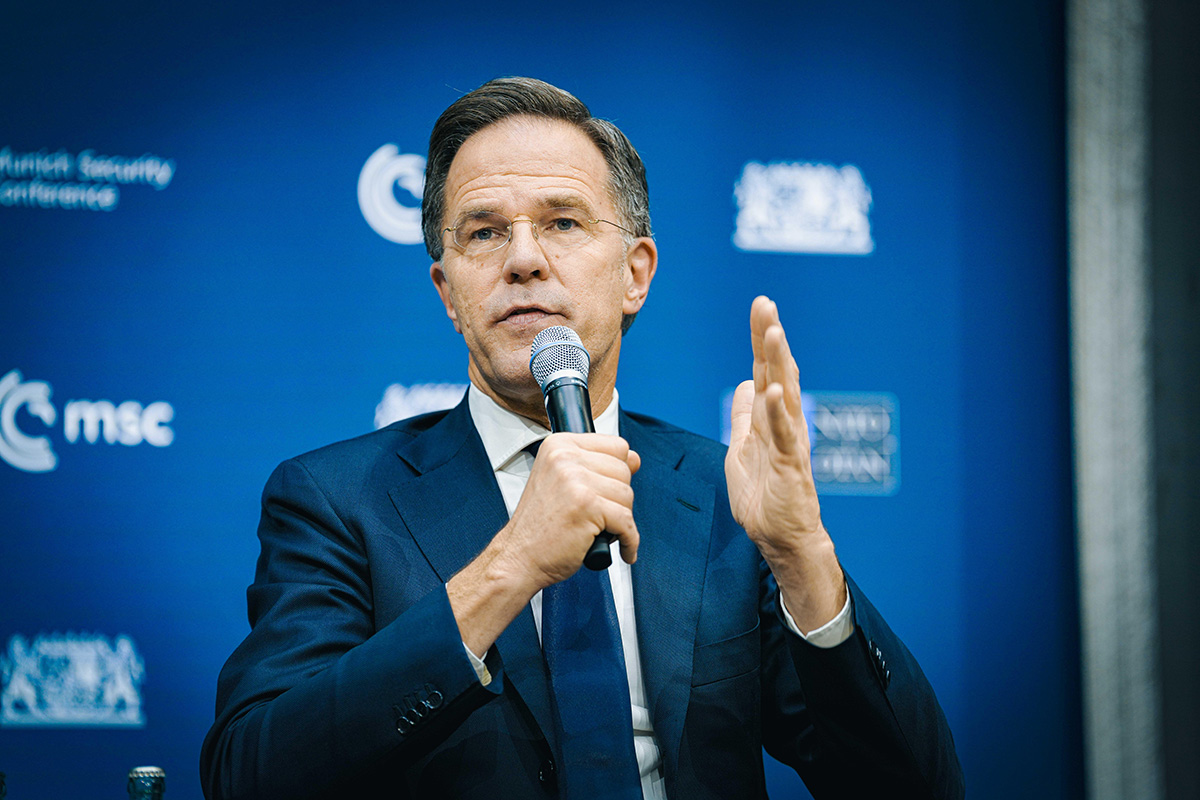
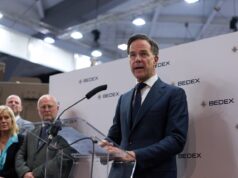
NATO Secretary General Mark Rutte has said European allies are increasingly taking a leadership role within the alliance, arguing that higher defence spending across NATO is strengthening the transatlantic relationship rather than weakening it.
Speaking at the Munich Security Conference following a NATO Defence Ministers meeting in Brussels, Rutte described what he called a “real shift in mindset” among allies, with European nations and Canada stepping up investment and assuming greater responsibility for their own defence.
“Yesterday we had the Defence Ministers session with NATO, and there was a real shift in mindset,” he said. “The Europeans now, all, and Canada, on 2%, and we agreed, of course, in The Hague… to reach the 5%.”
Rutte said the shift was not simply about meeting spending targets, but reflected a deeper political change in how European governments view their role in NATO. He suggested this would reinforce the US commitment to the alliance by addressing longstanding American concerns over unequal burden-sharing.
“What I was also seeing yesterday is this notion of Europe really stepping up, taking more of a leadership role within NATO, and also taking more responsibility for its own defence,” he said. “And I think this will only strengthen NATO.” He added that Europe’s increased spending would remove what he described as a persistent point of friction between Washington and its allies.
“I’m convinced it anchors the United States even more in NATO than it was already because of this dealing with this big irritant… of Europeans spending less than the Americans,” Rutte said. Asked about the role of the United States, Rutte insisted Washington remained fully committed to NATO’s collective defence posture, including its nuclear deterrent. “They are totally committed… both nuclear and conventional, to the Alliance,” he said.
Rutte also said the priority for allies remained continued military support to Ukraine, describing fresh funding commitments as “good news” but warning that more urgent assistance was still needed, particularly in air defence.
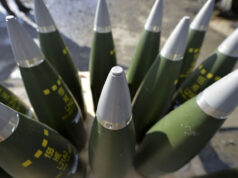
“One: good news, more money coming in to support Ukraine in the war effort, but we still need more,” he said. “Particularly, we need interceptors. We need the ammunition to make sure Ukraine can stay strong in the fight.”
During the exchange, he also rejected suggestions that Russia was winning in Ukraine, claiming Moscow’s progress was slow and coming at a heavy cost. “What I will also be doing today and tomorrow is make clear that the Russians are not winning this,” he said. “This so-called Russian bear is not there.”
Rutte described Russia’s battlefield movement as sluggish, while pointing to what he claimed were high monthly casualty figures. “It is basically the stilted speed of a garden snail what we are seeing in Ukraine,” he said. “Staggering losses, tens of thousands a month. 35,000 deaths in December, 30,000 deaths in January.”
He argued that Ukraine was making effective use of Western support, reinforcing the case for sustaining military assistance. “We have to keep Ukraine strong, because what we see is that they make the best use of our support,” he said.
Responding to questions about whether Europe could become militarily independent from the United States, Rutte said NATO’s core strength remained the transatlantic partnership, while acknowledging that allies were moving toward a more European-led model. “I think we all agree in NATO that we should stick together, the US and European and Canadian NATO,” he said. “But having said that, we also all agree that NATO should be more European-led.”
He cited Germany’s increased spending and deployments, alongside European purchases of US equipment for Ukraine, as evidence of that shift.
“We have seen, for example, Germany doubling his defence spending… A clear example of Europe stepping up,” he said, adding that Europe’s expanded role would develop gradually. “We will do this step-by-step, in close conjunction with United States, based on the defence planning process we have.”
Rutte also addressed a question on the reported deployment of Russian ballistic missile systems in Belarus, using it to reiterate the urgency of providing Ukraine with interceptors and counter-drone capabilities. “This is reason why I’m saying here today and tomorrow… we need to do even more,” he said. “Because when it comes to the interceptors to take out missiles… we need the counter drone technology.”
He said NATO allies should also expand cooperation with Ukraine’s defence industrial base, while continuing to rely on US-produced systems purchased through multinational funding mechanisms. “Making use of this essential gear coming out of the US, including, of course, PURL… which only the US can provide, paid for by Allies and partners,” he added.






Good to hear Germany are taking defence seriously now like some other NATO members .This still won’t make any difference to Starmer government .
It will be interesting to watch how Starmer matures, particularly the behaviours and attitudes he learns in his interactions with Macron, Merz, Meloni and Tusk.
Giving the UK command of JFC Norfolk makes massive sense, we are now in operational command of NATOS entire northern flank comprising the Atlantic, Arctic, Scandinavia and the Baltic.
If Russia kicks off then it will be in the area covered by this command, having the UK in command means NATO can fight with or without US involvement. US troops can and will fight under British leadership as they have done multiple times in the past 70 years however now they can be added as an additional capability instead of a day one necessity. US troops would never serve under any other European nations command other than the UK.
This is a very smart move on the part of European NATO. The USA has been quietly sidelined with the US military being fully complicit in the decision and a few US four stars have now been transferred to largely irrelevant strategic commands while being moved out of the three important operational commands.
This has probably saved NATO, we just need to make sure these are permanent moves and the USA is never allowed back into European operational commands.
Us troops have regurarly served under command of non uk troops but ok.
Please sight examples.
1965, Inter-American Peace Force in Dominican Republic, brazilian general
1982, Multinational Force and Observers in the Sinai, canadian general
1991, desert store, 82 airborne under French command
1992, UNPROFOR, under French and swedish command
1993, UNOSOM II, turkish general
1999, KFOR, French, spanish german… and other nations generals
That’s just for most recent examples, obviously.
Your faith in the europeans is charming but naive.
They have never had our best interests at heart and we have always had a better working relationship with the yanks
Trump won’t be president forever if that’s what you are hung up on 😄
The EU made a fatal mistake in the Lisbon Treaty when it chose, in response to pressures of secularisation, not to include the Vatican’s suggested recognition of Europe’s Christian roots. As it is turning out, liberal democracy, the cult of the individual and consumerism do not constitute a strong enough defence against competing external and internal forces which work to undermine western society. We are raising children to believe that lifestyle is like a restaurant menu; the most recent nonsense is that gender is an individual choice. The rejection of the Vatican proposal is the reason the EU went into decline and why Trump uses phrases like ‘civilisational collapse’. The UK is no better than the EU, worse in many respects in its addiction to ‘diversity’, consumerism and ‘, ‘liberal’ ( i.e. amoral) democracy.
1. Recognition of Christian Roots: The Vatican emphasized that Europe’s Christian heritage should be acknowledged as an essential part of its history and identity.
2,Cultural Contribution: The idea was that recognizing this heritage would help foster a deeper understanding of European unity and common values.
3. Diverse Religious Context: While advocating for the recognition of Christianity, the Vatican also indicated the need to respect the continent’s religious diversity, including other faiths
I wonder if the Americans are getting tired of winning yet
This is what the US has been asking for, for 20 years.
‘WAFFLING RUTTE’ couldn’t lead a ‘Lanyard Festival’ (NATO)
I doubt Trump is fooled.
Quite mate, Starmers speech an hour ago, was full of usless and meaningless platitudes.
Verbal diarrhea, they are doing ‘sod all’ regarding defence, absolutely nothing of substance, while using his speech to basically call for stronger ties with the EU…
God help us with these clowns in charge.
Powerful speech by Rubio emphasising that ‘the US is a child of Europe’ and that the US and Europe are ‘spiritually and culturally’ connected. ‘We are part of one civilisation’ – western civilisation.
Did he tell the rest of MAGA that?
Singjupost carries the transcript of the speech. Worth a read.
Unfortunately Europe and some here in Britain seem to be forgetting what western civilisation is.
Cousin fucking, women wearing bin bags and cruel religious animal butchery is rapidly becoming the norm in some cities.
No wonder some in america are worried about Europe
Blimey, don’t sit on the fence Clunker🤣🤣🤣
I tell it like it is. If Starmer wants to send his stasi after me for saying so online, I’d say it again in court
Have you never been to the Forrest of Dean Clunker, its just like that anyway, but with the odd Whicker man thrown in…
Speaking of western civilisation.
“ one that does not maintain the polite pretense that our way of life is just one among many, and that asks for permission before it acts.
And above all, an alliance based on the recognition that we, the West, have inherited together, what we have inherited together is something that is unique, and distinctive, and irreplaceable. Because this, after all, is the very foundation of the transatlantic bond.”
This is our problem. Let’s be clear, Rubio is saying that we have ceased to believe that our western culture founded on Christianity is our preferred way of living and it needs be explicitly defended. Starmer take note.