

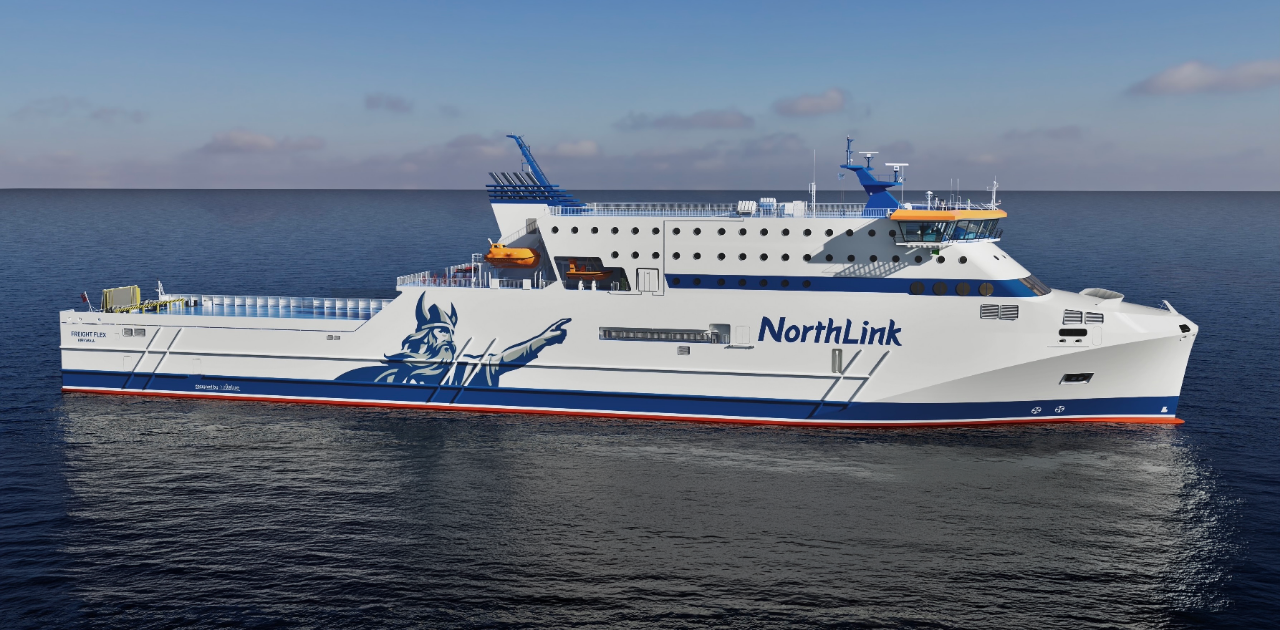
Caledonian Maritime Assets Limited has identified Guangzhou Shipyard International in China as the lead bidder for a contract to build two new freight flex vessels for the Northern Isles route.
The award remains subject to a 10-day standstill period, with CMAL stating it expects to finalise the contract on 24 March.
The two 140-metre vessels will replace Helliar and Hildasay on the Aberdeen to Kirkwall and Lerwick service operated by Serco NorthLink Ferries. They are intended to provide increased freight capacity, faster crossings and the flexibility to carry up to 200 passengers during peak periods.
Four shipyards were invited to tender following an initial qualification stage. Bids were assessed on a 70 per cent technical and 30 per cent financial basis by a panel including third-party specialists and CMAL representatives. When combined, Guangzhou Shipyard International’s submission achieved the highest overall score.
Cabinet Secretary for Transport Fiona Hyslop said: “I welcome this important milestone being reached in the procurement to build and deliver two freight flex vessels to serve the Northern Isles network.
These replacement freight vessels will bring additional freight capacity, higher operating speeds and the ability to carry up to 200 passengers on each vessel during peak times – helping address demand for car deck and cabin capacity on these routes. This will enhance the efficiency and reliability of ferry services to better support the priorities of Northern Isles communities and businesses for years to come.
I appreciate all the work, particularly by CMAL and NorthLink, that has gone into getting us to this vital stage of the procurement process, and I am hopeful that we can look forward to contracts being signed at the end of the standstill period.”
CMAL chief executive Kevin Hobbs said: “GSI’s bid demonstrated a commitment to innovation and efficiency, and we are confident they will deliver a reliable, robust pair of vessels to support the Northern Isles Ferry Service for years to come. This commitment is underpinned by strong workforce policies and internationally recognised environmental and safety management standards.
We will now enter a 10-day standstill period before finalising the contract on the 24th March.”
Stuart Garrett, managing director at Serco NorthLink Ferries, said: “We are delighted that the Freight Flex contract has reached this key milestone with lead bidder selection. We look forward to working together with all parties as we move to the next stage in delivering this design and build project which will be a game changer for the Northern Isles.”
The vessels will be owned by CMAL and leased to Serco NorthLink Ferries under the existing operating model. CMAL is wholly owned by the Scottish Government and is responsible for procuring and owning ferries and harbour infrastructure. It does not operate services directly, instead leasing vessels to operators such as CalMac Ferries Ltd and Serco NorthLink Ferries, which run services under contract to the Scottish Government. CMAL currently owns 37 vessels and 26 harbours, with five ships leased to NorthLink for Orkney and Shetland routes.








surely Scotland has the necessary skills and wherewithal to build these ships…..employment opportunities for its own people ! ridiculous decision
More taxpayer’s money subsidising the Chinese economy, at the expense of our local economy.
Pretty much par for the course under Labours Chinese subservient reset. From the London Embassy planning farce to Milibands Chinese energy capitulation- we all.know who The Party cowtows to.
Instead they should waste millions of taxpayers money on building ships with Fergerson marine that will cost 10 times, takes 5 times longer to build and wont work.
That’s a pretty selective take to be honest.
Yes, Ferguson had serious issues – nobody’s denying that – but that was one project that was badly managed from multiple angles, including the contract setup and government oversight, not just the yard itself. The ferries were effectively prototypes with changing specs, which is a big part of why things went wrong.
But writing off all UK shipbuilding because of that is just wrong.
There are multiple capable UK yards – Rosyth, Cammell Laird, Appledore, Harland & Wolff – all delivering complex vessels. The real issue is the way contracts are structured, where price is prioritised over long-term economic value, which actually discourages UK yards from even bidding.
Sending work to China might look cheaper on paper, but you’re exporting jobs, skills, tax revenue, and strategic capability. That money doesn’t come back into the UK economy.
If you invest properly and give yards consistent work, costs come down and capability improves – that’s how every successful shipbuilding nation operates.
So it’s not a choice between “wasting money” or going abroad – it’s about whether you want a UK shipbuilding industry at all.
Meanwhile in the real world, there’s a reason why the majority of the world’s ships are built in South Korea and China. Long winded grandstanding doesn’t change balance sheets.2+2 always equals 4 no matter how inconvenient it is. Buying more expensive ships just means the taxpayers are spending money on supporting industry isn’t economically viable.
Really???
It’s a sad state of affairs when this work is going to China rather than a UK yard.
This work would keep many people in the construction and suppliers, keeping valuable skills and hopefully the next generation of apprentices.
Honestly, rather see the money go to a Turkish builder or South Korea/Japan.
Not China.
Money spent here benefits more of us, for sheer low cost China always wins. Its should be about how much the governent gets back in tax/vat from the companies and workers here. Cost alone never seems to work in the long run, when you factor in lost investment here and may be lost jobs.
Yawn. Buying things at 10 times the price doesn’t benefit the taxpayers. See the 1970s for details
Was it ten times the price, how do you know how much it was? do work for The Scottish Government?
Mate look at the Glen Sann and Glen Rosa. 460 million for two ships. 4 ships from Turkish yards at half the price
Quite. I’d rather we ordered from Turkey which is NATOish than China with aims to destroy the democratic West through mercantilism and then military force.
You mean the times when we had plenty of skilled jobs, apprenticeships, could defend ourselves, and people generally had an improvement in their standard of living. We could even afford to heat our homes, and repair our roads.
Everyone doing the eye roll and a slow head shake.
I wonder which other 3 shipyards were invited to tender ? Curious to see if any UK yards were involved.
Tenders are open to anyone. Search for Public Contracts Scotland
blimey
yesterday Fergusons are expanding massively and on the up. Today the Scottish Government won’t give them an order.
Mixed messaging here – they need these orders to survive
These ships are too big for Fergusons – their length is too great for the slipways in Port Glasgow. Therefore they could never have been built there.
Since there is no other yard in the entire UK building merchant ships of this size, it was always going abroad.
I’m not saying they’d do a bang up job, but assembling a 140m hull is well within capacity at Laird’s.
Ferguson’s mentioned Inchgreen as a potential expansion site to the current operation base. That dry dock is more than capable if they go there.
Lets us be realsitic here.
Fergusons were well known for producing small ferries etc for CALMAC.
They were given bigger complex ferries and look what happened?
Give them something even bigger and predicate that with regenerating a dry dock that hasn’t been used for decades and has no facilities attached to it and you end up with a GLENBOLLOX fiasco.
If you are going to feed Fergusons work it has to be work that is within their experience competencies and capabilities.
Scottish Government would rather support China and have a few hundred more on unemployment benefit than employ those people to actually work and earn real money.
Sending shipbuilding contracts to China isn’t “saving money” – it’s economically illiterate when you look at the full picture.
The headline price might be lower, but that ignores where the money actually goes. Build abroad and the vast majority of that spend leaves the UK entirely. Build here and a huge chunk comes back through wages, taxes, supply chains, and local businesses. You’re not just buying a ship – you’re investing in your own economy. That’s basic economic circulation, and it’s constantly overlooked in these decisions.
Then there’s the long-term damage. Every contract sent overseas weakens UK yards, reduces skilled jobs, and erodes capability. Once that industrial base is gone, it’s incredibly hard – and expensive – to rebuild. Countries that take shipbuilding seriously don’t hollow out their own industry and hand it to competitors.
It’s also a strategic issue, not just an economic one. Relying on foreign yards – particularly in China – for key infrastructure like ferries or support vessels creates dependency. That might not matter to some on paper, but it absolutely matters in the real world when supply chains tighten or political tensions shift.
And the idea that UK yards “can’t compete” only exists because they’re not given consistent work. Any industry becomes more efficient with a steady pipeline – that’s how South Korea, China, and others built their dominance in the first place.
So this isn’t about being protectionist or sentimental – it’s about whether the UK wants to retain industrial capability, skilled jobs, and economic return, or continue making short-term decisions that weaken itself long-term.
But sure, if the goal is to ship taxpayers’ money overseas, hollow out what’s left of British industry, and then act surprised when we’ve got no capability left… then I suppose it’s a brilliant plan.
I’m 100% with you Val.
Meanwhile in the real world. The UK’s tax burden is the highest ever. The government borrowed a further £152 billion. The country is paying 126 billion a year intrest. How do you intend to find the money for more expensive ships. You are promoting exactly the same fantasy that led to the 1976 Sterling crisis. Tax and spend doesn’t work, 2+2 always equals 4. You can’t spend money you haven’t got
Well, Ron, what’s your suggestion?
How about living in the real world, not a fantasy of where government has never-ending money to permanently fund uneconomic industries. Industrial policy has been tried, it didn’t work and the country ran out of money. Its costing 1/2 billion a year to keep Scunthorpe open but that came at the price of cutting support for specialist steels which are actually needed.
This same debate happened in Canada with BC Ferries’ recent award to a Chinese shipyard. Situation is somewhat different in that there isn’t any shipyard that could realistically build one except for SeaSpan in Vancouver or Irving in Halifax. Both are fully occupied with RCN and CCG work. Davie in Quebec has icebreaker work….and BC giving an award to Quebec, little enthusiasm for that. SKorea would be a good option….will buy 12 subs if they offer a super deal on ferries. Too late for that now.