

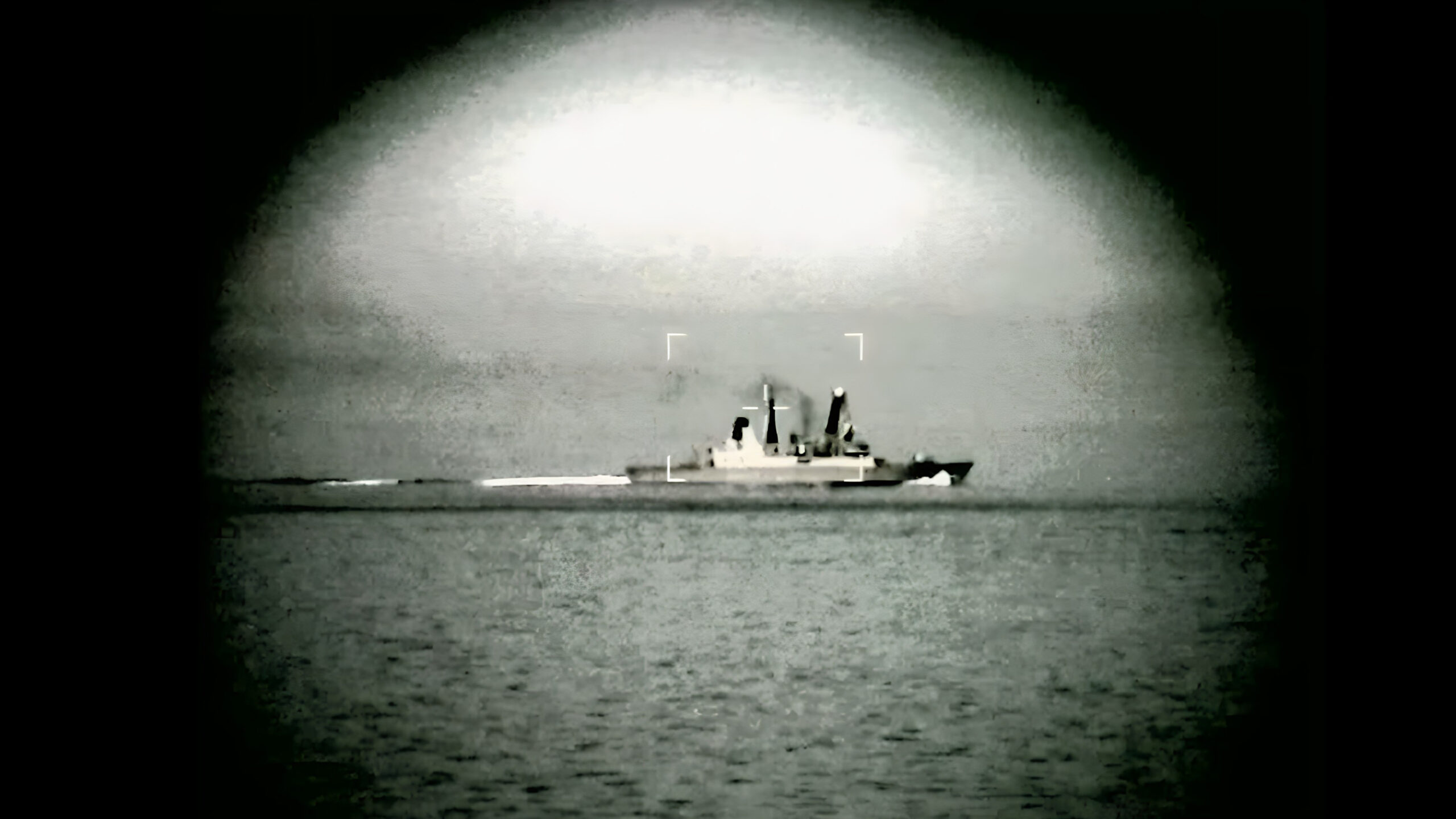
The Royal Navy Type 45 destroyer fleet is expected to remain in service until the late 2030s, with the final ship scheduled to retire by the end of 2038, the Ministry of Defence has confirmed.
Responding to a written question from Conservative MP Ben Obese-Jecty, Defence Minister Luke Pollard did not provide individual out-of-service dates for each vessel.
“On current plans, the last Type 45 Destroyer will retire from service by the end of 2038,” he said.
Pollard added that the Royal Navy does not release decommissioning timelines for individual ships, citing standard policy on operational information.
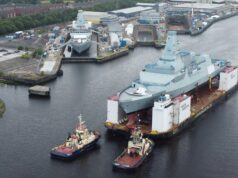
The Type 45 destroyer, or Daring class, comprises six guided-missile destroyers built for the Royal Navy in the early 21st century. The design is focused on air defence, built around the Sea Viper system, which combines the SAMPSON active electronically scanned array radar with the S1850M long-range radar to provide wide-area tracking and engagement against aircraft and missile threats. The ships were constructed using modular block build techniques across multiple UK shipyards, with final assembly by BAE Systems, and HMS Daring entered service in 2009.
The class displaces roughly 7,350 to 8,500 tonnes and measures 152.4 metres in length, with a core crew of around 190 and capacity for more when required. Propulsion is via an integrated electric system using Rolls-Royce WR-21 gas turbines and diesel generators driving twin shafts. This arrangement was intended to improve efficiency and reduce acoustic signature, though reliability issues led to the Power Improvement Project, which has progressively upgraded the class’s power generation and distribution systems.
The primary armament is the Sea Viper air defence system, with 48 Sylver A50 vertical launch cells carrying Aster 15 and Aster 30 missiles, the latter providing long-range area defence. Upgrades under the Sea Viper Evolution programme will introduce a ballistic missile defence capability and associated system improvements. In parallel, the class is being fitted with 24 Sea Ceptor (CAMM) cells, replacing Aster 15 and allowing the Sylver launchers to be fully allocated to Aster 30, increasing overall missile capacity and flexibility.
Secondary armament includes a 4.5-inch Mark 8 naval gun, 30 mm DS30B guns, Phalanx close-in weapon systems, and various machine guns. Harpoon anti-ship missiles were previously carried but withdrawn by 2023, with the Naval Strike Missile intended as a replacement. The ships are fitted with a medium-frequency hull sonar but do not carry shipborne anti-submarine weapons, relying instead on embarked helicopters for that role. Directed-energy weapons, including the DragonFire laser system, are planned for introduction on selected ships from 2027.




So, by that point we should have the Type 83 in service then eh?
Well yeah, actually a bit before then as 2038 is the out of service for the last type 45. Not much time…
Wonder if last 6 t26 will Replace them 1:1 it would mean fleet won’t be bigger than 13 until at least the 2040s….! Unless more t31/t32? are ordered…?
Okay, but the navy should be held to that l.the t45 can go longer than it’s being said to be the mega expensive LIFEX That type 23 got didn’t transfer into a notable benefit of substantial years in service whatever the overall age of the hull
Good luck with that one. We haven’t been able to build a Frigate in 10 years and now we are expected to spec, design and build more than 1 destroyer in that time frame? Yea right and I have a bridge to sell you.
Well shouldn’t we know what the replacement is and construction already started seeing how long it takes us to get a ship into service?
Definitely should be more advanced that the current project status
They will have to last much longer than that. No replacement exists, even on paper. Suspect it will be 20 years until new ship appears. FADS is described as a System of System, none identified positively to date.
I still find it funny that Type 45 relies upon an embarked helo for ASW, but it doesn’t carry one. The HM2 Merlin covers this role. The Wildcat is a lightweight general purpose utility.
Because its primary role isn’t ASW.
Even if 2 a year were going to be withdrawn , the first 2 in 2036, with a 5 year build time, work would need to start in 2031 on the first replacement if fleet size is to be maintained.
If it’s one a year then 2033 date for the first out. They would have to start a T83 next year.
No chance, unless T83 is just an AAW version of a T26 hull.
In 2040 it will be groundhog day. Ships falling apart and no replacement.
I doubt it. T45s have plenty of life left in them. They were built originally for a far longer life than the T23s, and have since been in port for several years.
A LIFEX could push them out beyond 2040 fairly reasonably.
Exactly. One has been tied up alongside for nearly 10 years as I understand it.
Wee need to operate them until they fall apart and not sell to another Navy to sail for many more years as we have done in the past with many vessels apart from the truly knackered Type 23s….
We urgently don’t need to operate ships that are falling apart.
The costs of sustaining a big ship that is in poor condition rises exponentially.
You will remember that a certain admiral said, ‘T23 are young ships with plenty of life left in them….’ Look how well that worked out?
Yeah, the difference between these two classes (that I expect you’re fully aware of) is that one was built for at best a 20 year lifespan, and the other for at best 30.
Hi SB,
This is a bit of a puzzle we have 6 T45’s all going though a programme of PIP, SVE, NSM and CAMM and all due to be finished by 2032 and all 6 will be OOS by 2038 with the youngest being only 25 years old.
Meanwhile BAe have 13 T26 on order which even if they can get to a 6 year build time and 1 year drum beat delivery cycle means they will finish F100 in 2038.
That may sound very ambitious but it’s probably doable as that’s pretty well what they managed to deliver on the T45 class.
My problem is where do they propose to build at least 6 replacement AAW ships by 2038 ?
They have to scope a new project, then design it, get main gate, order it and get 6 in service by 2038 or leave our Carriers and everything else with zero Dedicated AAW defence.
I have to wonder if someone has misspoke and it should be start to go OOS in 2038 when Daring will be nearly 30 YO.
Even that would be a massive challenge unless you develop and AAW version of the T26 and maybe get Rosyth building T26s after the T31
Nice in theory.
Then it gets solo deployed somewhere as is common for the RN and it suddenly finds that it cannot defend in the slightest against subs
But you have to be at war with somebody for a sub to try firing at a RN Destroyer and everything that implies.
It can carry a Merlin if required but it’s far more useful for most of its mission including air defence to carry a Wildcat.
It would be helpful, if Wildcat included a dipping sonar. It does if you happen to be S.Korea. Alas if you are UK it doesn’t. FFS, the work has already been done.
In case anyone here missed my point – “ The ships are fitted with a medium-frequency hull sonar but do not carry shipborne anti-submarine weapons, relying instead on embarked helicopters for that role.”. So with a Wildcat helo embarked, how is this being achieved?
Stunning how we Depend on a.layerd fleet Defence of Specialised AAW And ASW Vessels ..And yet can’t get a Fleet to Sea with both…? Not even a Sub..!
Labour have still not ordered a single fast jet or warship
27 F35s will be in the DIP and we’ve got T26 and T31 coming. As for T32, I doubt it. Tempest is moving forward, and I doubt very much aby more Typhoons will be ordered. ECRS Mk2 upgrades are going ahead which is very capable but very expensive. I think any additional mass will come from drones/hybrid.
Current FGR4s are getting fragged. With the threat picture and predictable US reliability the current orbat is woefully under resourced in mass. We need double the number of FGR4s to maintain current tempo. Typhoon Force wants more. Control the air control the battlespace.
As for t26 Cameron cut the numbers from 12 to 8 replacing them with less capable t31s (no ASW capabilities). RN needs more mass
I’d forget about more Typhoons. If we ordered 50 tomorrow you wouldn’t see the first one delivered for 5 years. Then you are into Tempest territory, and that’s were the money will go. Plus the bigger issue is people. Recruiting new pilots and technicians In greater numbers is no easy task. We do need more mass, but their is no easy solution.
We’d have said that 3 years ago, when they’re needed now. I’d order now in case 1. They’re needed. 2 Tempest is delayed/ cancelled.
I agree the additional big issue is pilot pipeline – this needs tackling alongside the additional order.
Same with the RN – additional orders need to be reflected in recruitment
If we order more typhoons tomorrow we won’t see any for more like 8 years. Turkey won’t be seeing its typhoons until after 2030. Getting how ever many tranche 1 air frames back from the bone yard and putting them through the same limited upgrade Airbus did for Spain is the only option for more typhoons before Tempest
I think the threat assessment is bad with the indicators and warnings flashing brightly. We don’t have time to bimble or wait 8 years. That means whatever we need to do now to grow mass = your suggestion plus consider others even a short term external buy. Robert’s point re: pilot pipeline is well made and also needs addressing. The US is no longer reliable.
I say F35 is the only game in town for increased fighter fleet numbers other than a rescue of the tranche 1.
I think the US is erratic but highly unlikely to cut us off from F35 (because it would f**k them up just as much) and I think sufficient contingencies exist even if cut off from LM update on code.
F35 is easily the best plane to deal with Russia, especially if armed with SPEAR 3 and Stombreaker.
I think Ukraine has shown clearly that it’s always possible to get pilots it’s getting planes that is the hard thing now a days. Buying way more panned that you can put in the air is a good idea. F35A is fairly cheap to buy, expensive to operate. Buying a few dozen to have sit in storage is probably a good idea.
DIP Will ultimately be About how much MONEY is or Can be Made Available….! Current uplift Next Year(2.5%) will at best Stabilise the Services…! Any futher improvements WILL Require more MONEY..!!
Are there any combat roles a fleet of M46 could meaningfully undertake? Just asking.
Possibly. But I think for us they would just be in the fast jet trainer role
The reality is that more mass of everything is in the super urgent basket as the situation continues to deteriorate.
Otherwise you are running the Nick Clegg argument for not investing in nuclear power…
That’ll be the DIP which has been expected since early autumn last year and has just missed publication before the parliamentary Easter recess, which will mean due to [parliamentary] scheduling (election purdah, King’s speech, summer recess and [likely] a Prime Ministerial resignation, etc) that the DIP can’t/won’t be published before autumn this year at the earliest. This government, like governments before it, isn’t serious about defence and when the ‘media circle’ has moved on from its current focus on the military, the government will quietly drop the commitments to defence and return to bribing the welfare junkies with more social spending and the Navy (et al) will continue to be in a awful condition.
Will those 27 be all F35Bs or a mix of A and B’s?
The government announced they are going for 12 F35As and 15 F35Bs. We’ll see if that’s correct in the DIP. Personally I think we should just go all in on the F35B.
I agree all in on F35B so that CSG is fully supported.
Once there are ~70 F35B in service then I’d see a meaningful buy of F35A as being sensible.
Agree . At least 70+ F35Bs before any F35A. You’d need at least 90 F35Bs to sustain 4 frontline sqns.
Thanks for that. I think i have misunderstood this. Is this the original first 12 As + 15 Bs or are these a following batch of both?
Sorry, i didnt scroll down first.
Looks like Cripes has answered.below.
The first. As of the 27th March. The first 48 F35Bs have now been delivered.
Both.
We now have 47 F-35Bs in service and are committed to buying 62. So 15 more to come.
We are also getting 12 F-35A.
So basically 27 more to come which, at our acquisition rate of about 7 a year, should see the programme completed by end 2030, unless there is some production/financial slippage. Or there could be a gap between A and B orders while the 40 Typhoons being upgraded with the ECRS radar are produced.
At the moment, these F-35s have a pretty limited choice of ordinance, as Lockheed Martin are years behind with their Tech Refresh 3 programe (TR3) and subsequent Block 4 upgrade, which will eventually enable us to fit UK weapons (Spear and Meteor?). But that won’t happen for a further 7+ years.
Little note: HMG will say that we currently have 48 F-35Bs. As far as I can unravel it, we indeed have received 48… but the RN managed to drop one over the side. It hasn’t been replaced so far and I assume had been added to the final batch of purchases, because we won’t otherwise reach the stated target of 62 Bs.
We need both A and B versions.
The RAF needed a 5th generation Strike/attack aircraft to replace the last 72 Tornados. They didn’t get it. Instead, the entire RAF combat air budget for a decade has been switched to the short-range, small weapons payload, low serviceability STOVL B version. Which is not really ideal for the Strike/Attack role. But the RN’s fervent desire to have a showpiece carrier prevailed, to the detriment of air power in general and Strike/Attack in particular.
64 Bs is quite enough. It equates to 30 frontline aircraft in three squadrons of 10. That is all that can be afforded. The RAF needs to switch its attention – and meagre fast jet budget – to the A version, which.has a longer range, double the weapons payload, far fewer maintenance issues – and is 30% cheaper.
They need 72 to form an air wing, but alas are only getting 12. The money has gone to our national floating status symbol and now all available RAF funds are going to have to go to the development of Tempest.
The A provides no real benefit for the UK. A slight range increase, but the B hardly has a short range. Double the payload only in beastmode which nobody is using. The only reason we even said we’d get the A is so we can drop the NATO shared tactical nukes, only we aren’t providing any more nukes to the pool, and it already has enough delivery jets so we aren’t actually adding anything to the program.
The QEC carries 72 aircraft at max, that should equate to about 50 or so fast jets with the remaining slots being ASW, AEW and transport aircraft. 64 B variants very simply is not enough.
A carrier with a B variant is capable of hitting targets far further away than an A variant. Is capable of more sorties a day by miles. And provides a deterrence factor A variants kept in the UK cannot. It’s also beneficial for diplomacy as port visits are highly requested, as seen with CSG25 and the number of countries that wanted to host a visit.
The 12 f35As are there for Tactical Nukes.. looks likely Carrying B61-12 and possibly
B61-13 in the Distant future..!
It’s mainly to do with Political Posturing and Ego…! UN thing..!
Did the one dropped over the side get recovered or was it in a place definitely not recoverable by anyone?
Even if it was recovered and I expect it was salt water will have destroyed everything.
And the statement was labour hasn’t ordered any ships ..they haven’t. Infact they are getting rid of the batch one patrol vessels ..which are being worked hard without replacement. Despicable at best .
Funny that. In Labour’s 18 months in office, they have ordered a second Proteus, 3 MRSS and 3 more Castle MCMVs. Plus developing 3 or 4 new classes of optionally manned/unmanned vessels.
There seems to be a feeling in some quarters that HMT and the Admiralty have these big boxes full of spare cash and should of course splash out pronto on sizeable orders of new warships. Alas, there are no such boxes, HMG.is seriously strapped for money and the RN already has more ships and subs in construction or ordered than it can afford, viz:
Building:
2 Astute SSN
8 T26 FF
5 T31 FF
Ordered incl work underway:
4 Dreadnought SSBN
1 Proteus MROS
3 Castle MCMV
3 FSSS replenishment ships
That is about half the fleet. How big do you think the RN’s budget is??!
Where is that MRSS order?
There isn’t even a design yet
It was announced recently -and featured in UKDJ – that Navantia/Harland have been given the order and the go-ahead.
Sorry, I mean FSSS, getting my acronyms mixed up.
I don’t think we will see much progress on FSSS this side of 2035. There is no more spare cash to pay for it. There will be no spare capacity at Harland while the FSSS build is underway.
Are you the Defence Secretary.?..He couldn’t get his facts Straight either…
3 MRSS?
Sorry, I mean FSSS, getting my acronyms mixed up.
I don’t think we will see much progress on FSSS this side of 2035. There is no more spare cash to pay for it. There will be no spare capacity at Harland while the FSSS build is underway.
The fact it’s taken the whole Ukraine war for the UK to do an SDR and DIP is a joke.
Little Seems to be said About Britain’s Foreign Policy in all this…!
The Foreign Secretary must be Tearing her hair out.!.. Countries must be Questioning their Association with Britain Behind Closed Doors…!
Not a chance they’ll retire on those dates, unless we accept a capability gap which is something the current global situation should make clear is not acceptable.
They might, for two reasons. Firstly, I think Glasgow is imminent and the T31 frigate announced service dates are deliberately vague. By 2028 it is very likely the RN will have 3 new frigates giving the RN deployment options. The B1 Rivers would be gradually replaced by the B2s. Secondly, Uruguay geographically occupies a strategic location in the S. Atlantic. The river Plate estuary splits Argentina and Brazil. In the days of the Spanish empire Montevideo was their main naval base. I can see a case for the UK leasing a naval base there.
Lots of issues with that not least the US Monroe doctrine. Plus surely the T31s are going to take over the job of the Rivers, they’re really not suitable for anything else.
I’m betting on “45 till 45”
Key words “On current plans” that will definitely change. More than likely out of necessity.
With the 5 T26 going to Norway BAE wont be able to start this project on time. Only chance would be if Babcock are involved to, they could have yard space after T31.
So if the semi mythical Type 83 is going to replace them, I guess we’ll only get 4 to do the job of 6….
The Type 45s hulls have alot of life left in them as they’ve barely been used and I don’t see the Type 83 getting finalised and built within the next 10 years expecially with the current absolute lack of urgency relating to defence continuing. We’ll no doubt continue to build the bargain basement filler T31s and may well cut the T26 order further. I believe Canada is ordering 15 T26s fitted with AEGIS too which will be hugely embarrasing for the RN. Even more embarrassing if thr T31s suffer the same problems as the Ivar Huitfeldt they’re based on.
I agree T83 will be late and T45 run on.
Goodness, you are a cheerful, up-beat chap.
If I had any sort of reason not to be I wouldn’t but realistically neither the SDR nor the DIP both of which were supposed to be rapidly produced and result in an up tick in funding etc. that would turn things around have resulted in anything more than hot air for the duration of the Ukraine war meanwhile we’ve retired the Assault ships and sold off half the Tides whilst Argus has ended her heroic service to the country without a replacement. The last 20 years or so has been a story of neglect, down sizing and destruction of the Royal Navy, coupled with alot of hot air, spin and buzzwords. I don’t see anything changing soon. At best we can hope the Type 31s out perform the Ivar Huinsfeldt class that they were based on (that has a shutdown of its combat management system for 30 minutes whilst under houthi drone attack in the red Sea, was withdrawn from NATO stanfor one and is now judged that the problems with the ship are too expensive to repair and so she’ll be downgraded from a fleet unit to long endurance patrols. All in all it all has the fingerprints of yet another MOD/British shipuilding/RN debacle waiting to happen. Let’s face it at this point it’s pretty much traditional. I hope of course I’m wrong and everything works out fine…. I just hope we don’t have to go to war anytime soon.
The whole idea of 5 xT26 for Norway always sounded over the top. I think realistically it should be 3 x T26 for Norway & I think it would be better for Norway to then invest in a GP class (3 of). Something like A140 or similar. Note: T31 is NOT a GP frigate.
GP..
Stands for General Purpose…
The Ability to Carry out all aspects of military Work..!.Without Specialising in Any….!
In this Respect the t31 fails in ASW….!
T31 is the bare minimum you can call a warship. It just about qualifies by European standards (although even then the Ivar Hunsfielt the T31 is based on has been withdrawn from NATO stanfor one and the Danish government consider it too expensove to repair it back to a fully functioning warship after it’s combat management system failled during a drone attack in the red sea)
Little Seems to be said About Britain’s Foreign Policy in all this…!
The Foreign Secretary must be Tearing her hair out.!.. Countries must be Questioning their Association with Britain Behind Closed Doors…!
Given the ongoing conflicts involving Iran, Ukraine, and rising tensions in the Pacific involving the United States, the global security environment is approaching a level of instability not seen in decades. As a result, the United Kingdom will require a significantly larger navy, with an expanded fleet of surface combatants, particularly destroyers, to maintain presence, deterrence, and operational capability across multiple theatres.
To support such an expansion, it will not be sufficient to rely solely on existing shipbuilding capacity. The current industrial base is unlikely to meet the demands of a rapid or large-scale naval build-up. Accordingly, there is a strong case for reopening former shipyards and repurposing underutilised maritime infrastructure.
In this context, the reactivation of facilities such as Southampton dockyard should be seriously considered. While Southampton is not currently a major naval shipbuilding hub, its existing port infrastructure, industrial base, and strategic location make it a viable candidate for expansion into naval construction or modular assembly. Alongside the reopening of other historic shipyards, this would form part of a broader emergency shipbuilding programme aimed at restoring sovereign industrial capacity.
Such an approach would enable the construction of additional destroyers, potentially through a Block 2 variant of the Type 45, while also ensuring resilience in production and reducing reliance on a limited number of existing yards.
Wondering if there might be any opportunities for sharing manufacturing with Spain, Italy or France for a Trieste or Canberra-Mistral type carrier/LHD be useful as part of a future MRSS fleet mix?
Who’s going to build MRSS and When?
22000t-30000t Vessels Could be Built at Rosyth but we have the Problem of QECs in Dock 1 for Maintance…! QECs.. Could be Maintaining at INCHGREEN but the Facilities needed aren’t there (YET)..!
Nowhere in Southampton now to build ships. A better bet would be reopening the building sheds in Portsmouth naval base, but the building which housed the panel line is now a general workshop and the main shed is used for MCMV refits.
I think we are in a pre-war era, similar to the early 1930s. We may have between 7 to 10 years before a global conflict emerges.
In that event, places such as the Main Shed, unused dockyards, or dockyards currently used only for maintenance could be converted to build ships. If we were able to produce six Type 45 destroyers a year, we could have 18 within three years.
At the same time, we could restart or expand production of Eurofighter Typhoons, and further develop production lines for the Type 26, Type 31, and Type 32 frigates. We could also utilise dockyards in Norway, Denmark, Sweden, Poland, Japan, and South Korea. It may even be possible to ask South Korea to operate certain dockyards and help establish large-scale shipbuilding facilities.
A potential target could be to build 18 Type 45 destroyers and 12 each of the Type 26, 31, and Type 32 classes. We could also consider variants such as the Canadian Surface Combatant (based on the Type 26 design).
For submarines, we could procure an off-the-shelf design such as the German Type 212.
All of the ideas outlined above are based on designs that are either already in service or currently in production. I recognise that we do not have sufficient time to develop new aircraft carriers or nuclear submarines from scratch; however, we will still need to consider what our long-term approach to these capabilities will be.
All of this would require significant funding. However, events such as tensions involving Iran and the Strait of Hormuz highlight a key reality: we will need a strong navy to ensure secure shipping routes.
While Europe, the CANZUK states, Japan, and South Korea are allies, we will still require our own capabilities—ships, fighter aircraft, tanks, drones, naval bases, and logistics infrastructure.
We still have time, but we do not have forever.
Nope too expensive with our one of the largest budgets on defence in the world we’ll son have a couple of canoes with white ensign and continue to cross our fingers that we don’t actually go to war.
It would help if UK did not insist on building ships like T31. The A140 base design appears quite good (Poland & Indonesia appear to agree). Denmark are even considering it (A140 is an updated modernised IH frigate design (originally from OMT of Denmark)). T31 is in many ways a liability. It can barely defend itself but has no attacking capability whatsoever. It’s a frigate that needs an escort (under current specs). Some navies used to have a class called a “destroyer escort”. Do we now need a “frigate escort” class?
Absolutely it would make a good replacement for the Tide class patrol boats but that’s about it.
Did like the A120 option…!
Understand a Shorter Design again Could be Possible ..Either as Replacment for Batch 1
It’s best to stretch out the T45 service as long as possible. After the type 26 frigate BAE can start work on however many type 91 sloops is required. This will keel the yard working and the type 91 can provide a valuable upgrade to type 45 with extra VLS and radar. Then the Tye 83 destroyers can be built but with full knowledge of how well the type 91 works.
Once the PiP program is complete along with the CAMM, NSM and Aster 30 NT upgrade the T45 should have its AESA radar plates swapped out with the same gallium nitride plates being developed for the type 91 and type 83.
It’s probably possible to incorporate a skyward facing plate to enhance her ABM capability.
There is massive life left in these ships, we should do everything possible to keep them as long as possible.
I know its too late now but some of the projected vls for T91 maybe could have been budgeted in for the T45 upgrades happening right now. And those for the T31 should all take priority and get done. Does the RN even need the T91s especially if the T83s are going to have many vls and hopefully a decent quantity ordered? Why not just 3-4 extra T31s with vls which would have greater use and globally? Or, even a small fleet of AH120s for the T91 requirement?
It probably needs the T83 because it’s likely the T83 will just be a command ship for the T91. We will probably be lucky to get 4 T83 and each will be accompanied by two or four T91.
A carrier strike group will then have a single T83 and four T91 for air defence instead of two T45
Type 91 is a pipe dream a ship with no crew and lots of missiles will either be higely vulnerable herself and unable to do damage control or short rangesld or you end up building a full warship anyway.
The fragility of the t91 Concept…A hurdle that has yet been Reached..!.Imagine the loss of Such a Expencive Vessel due to some simple glitch….! Huge blow to such a Small Navy..!
Let’s be honest that’s their designed service life of 25 years, they are going to go on for well beyond that.. the T23s were designed for 18 years services and will end up doing 30… The T45s could probably easily manage 30 years without any issues, so I would imagine they will not be decommissioned until the mid 2040s
After all BAE have still got to build and deliver a minimum of 13 Type T26 ( it could be more as its 5+ Norwegian frigates) once you add the 6 T83s that’s 19 7000+ ton high end warships to be delivered from 2027 even if they can drumbeat 1 per year without any interruption for moving to the Type 83 that’s 2040 for delivery of the first T83.. with ICO of 2041 and the last one delivered in 2046.
For this reason alone I think the T83 is going to end up a T26 derivative or will end up being built by Babcock… there will not be time for BAE to finish all the T26s create a new line and build a completely new ship.. it would probably move IOC of the first T83 into the mid 2040s.. which would have the T45s struggling to the end of of the 2040s..
If the navy is going to recapitalise itself effectively have another wave of recapitalisation in the mid 2030s to 2040s ( which it needs) then it’s going to have to move well away from gold plate and be very pragmatic with the T83.
Gold plated to a large Cruiser size will mean massive delays, out of control costs and 3 or 4 ships.
It needs to be built on a T26 platform and re use as much T26 tech as possible.
Pushing into the 2030’s, we need 9 T83’s, to give a minimum of 5 operational ships, that provides 2 for the CVS group and 3 others for other duties.
If it’s a cruiser and it’s accompanied with a number of type 91 then maybe three makes sense.
But 3 Cruisers will mean 1 operational and probably none on occasion.
We have found out the hard way that 6 isn’t enough. We need two on standby for Carrier escorts, plus others for priority tasking.
That means 9 hulls, so they have to be affordable. Absolutely T91 is needed, we need a well armed 3,000 ton, lean manned trimaran, that is capable of taking over River class tasking, but also capable of robust independent action.
We also need the unmanned missile silo ships too.
But first rebuild a sensible core Escort group of 33.
12 x T26
12 x T31 ( full fat mk41 fitted)
9 x T83
Then 10 x T91, plus all the unmanned missile silo platforms etc.
If we go for a Type 91 with no radar, just a link to provide targeting information from a partnered escort ship then that would keep cost down. Could easily enough for 32 VLS in it, or 16 if we want a cheaper ship and maybe a 40mm Bofors to help out with anti drone capability. None of that is expensive stuff. It could be kept below £100m and easily no more than £120m.
We know the picket ship idea doesn’t really work anymore, so why bother giving the Type 91 a radar, it’s only going to be nearby the escort anyway.
Lack of complicated systems like radar should also decrease maintenance and keep evaluability up, potentially 1/2 or a bit higher if we use the 5/6 of the River class as an example of a no battlefield weapon ship.
The Type 83 imo should be a big ship, 96-128 VLS, decent sonar and very strong radar.
We can safely say if war broke out regardless of the time or size of the conflict, no new ships will be finished if ordered during the war regardless of being a carrier of type 31, as such whatever we start with is all we will have for the whole duration.
But, if the Type 91 is a small simple ship, commercial engine, low survivability standards, and only those VLS and gun, that should be able to be built on only a couple years, allowing the RN to quickly expand the fleet size and missile count.
Because of that, we’d need the destroyers to stay around long enough to receive the additional Type 91. And the best way of keeping them around, more VLS cells to allow them to defend themselves more.
I was doing a dive into Mk.41 pricing recently, and Denmark purchased 8, 8 cell modules for £10.25m a module. A recent US order for almost 300 cells but the price at £5m for each 8 cell module. Both those prices include support and spare parts.
VLS cells aren’t that expensive, making a ship bigger to hold more VLS doesn’t really increase price much. A slightly bigger engine but they aren’t that different in price when the ship varies only 1000 tonnes or so. It will have the same radar and sonar regardless of the size and VLS count.
9 Type 83
8 Type 26
10-12 Type 31
And 9 Type 91
That should allow for a:
CSG – 1 carrier, 2 Type 83, 1 Type 26, 2 Type 91.
If we get MRSS (hopefully an LHD)
1 MRSS, 1 Type 31, 1 Type 91 or escorted by 1 Type 83
Then 2 Type 26 in the North sea
And aiming for 3 Type 31 about doing patrols in areas such as middle east.
And 2 Type 91 paired with escorts wherever required
So, aiming for a simultaneously operational
3 Type 83
3 Type 26
4 Type Type 31
5 Type 91.
Is there any point in t91 if it has No radar…?
I broadly agree with your idea, but I would add radar and electro optical sensors, equivalent to T31, to T9. Its important to have an independent operations capable ship, 32 camm and twin 40mm bofors would be a sensible load out.
A helicopter deck and retractable hanger would be good too.
You need an independent escort that could handle Gulf deployments and have the ability to defend itself.
I would suggest a ship that can sail with its own silo boats too.
The QEC ran very well to budget until politicians meddled with the timeline and EMALS pause.
T45 build was also good on budget if you ignore the R&D forced on us by leaving Horizon.
So big doesn’t mean out of control costs and could mean the opposite.
Well if the last one is gone by 2038, then the only take away from that is they are being withdrawn withdrawn replacment.
That, or we are buying from abroad.
Let’s try 2045 ish.
The UK has to decide if needs a Navy or not?
If yes, then it has to resource and fund a credible naval capability rather than the half-arsed current situation. The Type-83 destroyer/cruiser needs to be accelerated now, and put into production on a continuous basis (and more than 6). There also needs to be a matching big recruitment drive to man/woman the things, as well as the Royal Navy in general – let alone the wider armed forces need.
Money spent in the UK on UK IP, manpower, and materials, is not wasted. It is an investment into the UK wider economy and will stimulate growth.
The US navy has roughly ten times the budget of the Royal Navy and it currently does not have “enough” ships.
The Royal Navy felt it was critically short on ships in 1914.
Nelson continually complained about a lack of frigates.
Yes there are shortages in the navy because of the last 15 years of cuts however almost all of those deficiencies are being dealt with, frigates, submarines, MPA, FSS, it will just take time to build everything. Once the PiP program is complete the 45 will begin to make a difference. The T31 and T26 are rolling off the production lines fast now and they are all bought and paid for.
The navy probably doesn’t need much more money to cover all its Atlantic taskings and provide a significant Indian Ocean contingency (2 frigates, 1 MCM, 1 SSN)
It’s more important for the country to size its appetite for using the navy than and amount to pay for it.
Fact is we could have a navy ten times bigger and we could not force open the straits of Hormuz, fact is less than 1% of the traffic using the straits of Hormuz is UK bound.
Your right, the problems in the Navy are being addressed much better than they were, and no Navy in the world could hold the Straits open with out heavy losses. And we are wise enough to know that unlike the USA or at least there mad as fish leader who has no clue.
I agree. It will be interesting to see if the US has the nerve to use its massive amphibious capabilities against Iran. Unless is it does, Trumps war is just a 21st century version of gunboat diplomacy.
For the UK, with, as you say, @ 10% of the USN budget, realism about what the RN should be able to do is critical.
One way to raise escort numbers from the planned 19 would be to merge T32 and LSS. A T31 variant, able to carry the small scale raiding forces the RM are planning, would give us a flexible platform at an affordable price.
I am not convinced that a small navy like the RN should have different types of escorts in specialised roles. Maintenance, training, supply chain for spares as well as overall cost, would all be easier if we opted instead for a single adaptable design.
Jim, my point was really about learning the lessons from not having a continuous UK Sovereign production capability and lack of Government understanding for the need.
Of course the UK Royal Navy should be an appropriate size. I would argue at least 1990s-era Cold War size, but also with a big dollop on top of that to partly compensate for the USA going rogue for the foreseeable future.
Considering how long the type 45’s have been in for repair and refit leaving service in 2038 seems premature.
Over the next 5 to 10 years they’ll be driven into the ground as we don’t have any other ships until a sufficient number of frigates get into service.
I though a delayed April fool. Into the 2040s is more likely. Anyone with half a brain and a spreadsheet (assuming a 25-30 year lifespan) could work out construction requirements.
Hi folks hope all is well with you.
I suppose as expected we won’t see any new plans for a replacement of type 45s, especially under this government as they have no interest in defence. Just look at the recent debacle over the Iranian US war. Jim makes a good point as u ever, what is the realty of the UKs use of the Strait of Hurmuz?
The other matter i want to question is the pledge of General Sir Gwyn Jenkins to move repairs and life extensions of ships and submarines within 18 months or something like that. Most of you may remember when he made that claim when he arrived at his current post.
Cheers
George
So when will all 6 actually enter service would a better question
Well they got plenty of life left in them as they hardly been used as always broken, will we ever 6 six working at the same time even for a day? Not got our moneys worth out of them just another bad design that needed more money to fix it but once up graded should become a very capable class of ship, Be it years after they were meant to be fully in service.
Considering how long HMS Glasgow has taken, this means we need to start cutting first steel on the first T83 pretty damn soon…
Everything has such a long lead time, which could be shortened a bit but not much. That is why Starmer/Reeves and Healey are guilty of high treason leaving us exposed for at least a decade by delaying ordering anything at all of note. They are still putting welfare and the NHS over everything and praying for a miracle that re-elects them. Meanwhile the can is kicked ever further down the road. We are nowhere near the laughing stock we will be in 5 years time assuming we arn’t speaking Russian or Farsi by then. Get on with ordering something and stop lying to the public you politically inept lying metro central divvies!!!!!
What about the pack of urchins who ran defence into the ground and didn’t commission a single escort in their 14 years in power? Any blame for them perchance?
Starmer, Reeves and Healey have been passed the poisoned chalice and a full set of empty cans that have been kicked down the road since 2010. They have at least committed.to a 22% rise in the defence budget, which is a start. Miracles are unfortunately beyond anyone’s reach ATM.
Given the past record of long procurement times, the type 83 needs to be set in progress now.
2038?! it is more like 2058…
Not a single Type 45 will have paid off by 2038.
Not a problem, PROVIDING we don’t get into our usual “delay action mode”. I do wonder though, whether we need to design a whole new vessel for the future. How many are we going to buy realistically? Four? Six? No more I suspect. The T83 is fine with the T91 as providers, but if it’s sunk, what happens then? Germany is going ahead with the Meko in two stages. Maybe a shipbased on the second batch for the R.N.? Japan have the DDX for the 2030’s. I’m not saying we shouldn’t build them but either as a collaborative project might well offer better value for money and a lot less risk.
Surely the parliamentary question should now be : given the out of service date for type 45 destroyers, what is the in-service date for the type 83s, you surely can’t have one without the other!
The MoD/Treasury, don’t even know, themselves!
Assuming the final ship to retire will be HMS Duncan (last to commission – 26 Sep 2013), she will have served for just 25 years.
That would be a ‘spring chicken’ to anyone in the army – CVR(T) Scimitar served for 50 years and many FV 430 series vehicles are still going after over 60 years.
Sadly the sea is essentially trying to destroy everything on it at all times..
Simple being in the sea essentially dissolves ships. Ships can loss 0.5 -1.5 percent of its hull plate thickness a year.. once you loss 20-25% hull thickness you need to replace the plating.
Dynamic forces.. waves and currents put massive dynamic forces on ships.. essentially a force of nature that can snap a ship like a twig in all directions.. imagine
Imagine if every day someone dissolved a bit of those armour vehicles then put them in a massive vehicle sized vice and bent them every possible way..
The underlying issue bedevilling procurement is that, while the cost of new defence equipment have soared, the limited defence budget has not kept.pace. There is nowhere near enough money to renew the equipment we have, with the inevitabiliy of more cuts to the inventory.
This is basically why the DIP is held up. The Treasury is funding an additional £10 bn over the next two years, but a lot of that is going on service wages, housing and infrastructure. There is not a lot more for equipment. But even with the new money, defence is £28 bn short. It was reported in the DT that the gap has been reduced by £10bn, by delaying some projects, gapping others and no doubt slowing down some production schedules. So it takes us back to where we were in 2023, with an £18bn black hole in the procurement budget.
Defence has very likely got all it’s getting from HMT, which adds up to £14-£15 bn under the new government. The only real option to close the gap was government borrowing, as the EU has done with its SAFE fund, which is injecting billions into European defence equipment. SAFE is a long term, low interest loan scheme, backed by the EU.
The UK objected to the £2bn+ entry fee, so that door is shut. There are other options – the UK’s own SAFE scheme, defence bonds a penny in the pound on tax, etc., but the Treasury.is apparently opposed to all.
So we will creep up to 2.5% of GDP by the end of this Patliament, with a very limited increase in the defence budget, with little to spare for new equipment.
HMG cheerfully.says that Defence Nuclear is increasing to 25% of the defence budget. That is such a misleading statement. It is already over 40% of the procurement budget, nearly as much as the total procurement budgets of the three services combined plus the weapons budget. That is primarily why we can’t afford the conventional equipment we need in anything like the numbers required. We appear to want to be in the nuclear club but the fact is we can’t realistically afford the entrance fee. Time is long past when we and France should be sharing the nuclear burden more evenly with the other E-NATO nations.
As the DIP is a 10-year plan, the shortfall of £18 bn means £1.8bn a year. To get down to that figure, the MOD has already withdrawn the Albions, Waves and Argus. We can assume that the River 1s won’t be replaced, the Hunts and Sandown will be next to go.
I can’t see the MRSS, T83, SSN-A, let alone T32, getting underway in the ten years up to 2035. I dread to think of what will be slowed, gapped or cut from the RAF and Army, there is virtually no fat at all.
It’s all very well insisting that HMG just gives defence still more money, but I can’t see where it would come from, as every other department is equally strapped for cash.
It comes back to the Treasury. Reeves needs to bite the bullet and come up with some SAFE-type scheme, it is the only way defence is going to get the extra money it needs just to stand still.and not decline further.
My gloomy take on things right now.
1
Right now, Cripes?
This has been my position since 2010. HMG are not interested in defence and this government even less so.
This has gone on so long that is why myself and so many others are seen as gloomy sceptics.
It is endless.
Correction, since 2004.