

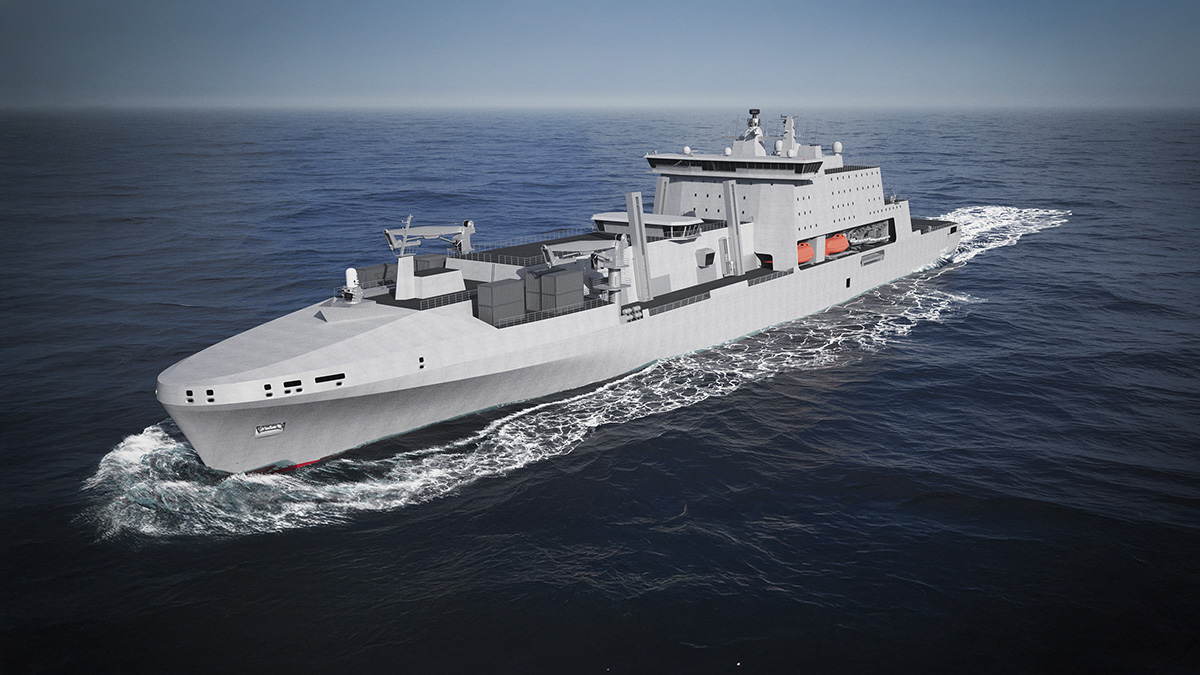
EXCLUSIVE | Navantia UK confirms production is now underway across all UK sites supporting the Royal Navy’s new Fleet Solid Support ships.
Work is running concurrently at yards in Belfast, Appledore and Methil, alongside construction at Navantia’s facilities in Spain. Test blocks are being built in Belfast, bow sections are under construction at Appledore in Devon, and blocks are progressing at the Spanish yards. Methil is contributing through specialist fabrication and logistics work, including the completion of a new transport barge, Navantia UK Seahorse, which will move ship blocks between UK sites.
Navantia UK has committed £157 million of planned investment across its four UK shipyards, with more than £98.5 million going into Belfast and £26.7 million into Methil. Across Belfast and Appledore combined, FSS-linked investment has reached £114.4 million, well above the £77 million originally committed under pre-acquisition recapitalisation plans.
In Belfast, the former Harland and Wolff yard is being upgraded with mechanised panel lines, robotic plasma cutting systems and automated quality control processes, due to become fully operational in July. Navantia describes the facility as operating under its Shipyard 5.0 concept, which integrates robotics, automation and AI-enabled processes into the production workflow.
Donato Martínez, CEO of Navantia UK, said the programme is “not only delivering vital capability for the Royal Navy and Royal Fleet Auxiliary” but is also “rebuilding industrial capacity, modernising infrastructure and creating a highly skilled workforce across the UK.” He described what is taking shape across the sites as “a genuinely integrated shipbuilding enterprise, capable of delivering complex programmes at scale and positioning the UK strongly for future naval opportunities.”
Alex Du Pre, FSS Project Leader at the National Armaments Director Group, said the investment “strengthens the UK’s sovereign industrial capabilities for the future,” adding that the shipbuilding sector is “vitally important, not just for the UK’s industrial resilience and national security, but also as an engine for economic growth.”
Engineers, project teams and apprentices from across the UK business have undergone placements alongside colleagues in Spain as part of a knowledge transfer arrangement covering manufacturing techniques, digital programme management and naval shipbuilding practice. Navantia UK currently employs 222 apprentices across its sites, with a further 121 set to join later this year.
The Fleet Solid Support ships will resupply Royal Navy carrier strike groups with ammunition, stores and provisions. Final integration of the vessels will take place in Belfast, with further production milestones expected across all sites later in 2026.








A rather long saga hopefully building to a successful conclusion. How long has it been since the Tories refused to confirm an order them at home as they were not “warships” and before that Labour kept deferring the MARS project?
Meanwhile, our 4 FSS became 3, then 1, now sitting in port.
Tragic incompetence all round.
Great news, it will be interesting to see how long it takes to get a ship from navantia. With one eye on future building. Sadly not a new issue
I agree mate, although to be fair there have been a few good news stories over the last couple of weeks. Hopefully turning a corner..? DIP notwithstanding..!
Cheers CR
There was a suggestion that RFA Fort George was in a better material state then Fort Victoria, but needed a refit . We would have been better off cutting the two older Forts and keeping the two new ones
Exactly this. Bonkers blindness in the rush to save a few millions.
Least we forget the original MARS programme was set up in 2003 from the assumptions of the 1997 defence review.. as part of a baseline peacetime navy.. for that the RFA was meant to have 12 new fleet support ships… 23 years latter all that survives is 4 tides and 3 solid stores ships yet to be built… like most of the naval elements of the 1997 defence review it was never funded, a victim of the war on terror, the 2008 crash and labour and conservative unwillingness to invest and recapitalise the navy correctly.
…and Blair has the front to lecture us now on where we are going wrong, not that he is the only one to blame.
Another point worth making is that we had the usual shrill about a foreign company being given this contract which only goes to show a lack of insight and foresight. Decisions from 20/25+ years have firstly left us with the degraded physical and intellectual capabilities in this industry (as others). The article itself illustrates that this being the case (we see it at Barrow and at Babcock and Bae too) we have lost much of the skilled work force and it will take years at considerable cost to rebuild that capability and the training of workers in Spain will as things stand be the only way to build up the skills and knowledge to achieve this within an acceptable time period and no doubt reduce the cost of acquiring those skills too. How would a uk only solution have done that I wonder, or indeed have introduced the new technology required in any sort of reasonable and successful time period, if at all without many the usual setbacks.
A lesson to be learned that once you lose these skills only foreign Investment/Cooperation can have a hope of truly regaining them competitively. And if the present policy is to use defence investment as a driver for overall industrial and economic growth then one could also argue that not only did 25 years of neglect drive out businesses that very often hit us many years after those decisions were made just as our growth flatlined but we wasted a serious opportunity to have used all that potential capability to have fired up economic growth many years earlier. All in reality to save money short term and make life more costly and difficult for future Govts for a great part of those short sighted decisions. And that’s before the stability of the World so changed for the worse.
I’m not sure what the MARS project is, but isn’t the FSS still on the same timescale that it always was under the conservatives?
Ah now I know
I’m not sure what the MARS project is, but isn’t the FSS still on the same timescale that it always was under the conservatives?I missed the “before this” and assumed it was something more recent than the Blair/Brown era which probably have been fixed under Cameron etc.
👍 Maritime Afloat Reach Sustainability If I recall correctly.
The main point was, this saga has gone on too long just to buy some supply vessels due to our splendid governments.
Yep it’s not even like it was complex or even expensive… essentially slightly jazzed up commercial hulls.
Yes and when cameron became PM he looked in too cancelling the 2 carriers but work & contracts were too far on.
Great news, it will be interesting to see how long it takes to get a ship from navantia. With one eye on future building.
Good news and good looking ships. Kudos to all concerned in reaching this milestone. An important step on RN journey back to being a credible global force.
Finally some good news!
Seems such a shame going to all this effort to reactivate all these yards for an order of just three ships then getting into a knife fight with Babcock over three MRSS only to see both yards shut down in the 2030’s. Because there won’t be any more work until the Tide Class needs replacing again.
According to Gwyn Jenkins won’t they be busy building our thousand ship navy?
I have serious doubts as to whether we’ll see MRSS, not in the next few years anyway. The tragedy potentially is what is going to happen to the RMC..?
The Tide-class is due out of service in 2040. The last FSSS won’t enter service till about 2035. That means that there would be work for Navantia if they replace those tankers on time, and especially if they choose to replace the Wave-class as well at that time.
Are these ships truly necessary? Dedicated FSS made sense during the Cold War when the Royal Navy was several times larger than today but shouldn’t they be focusing on more pressing needs instead? Other European navies don’t operate dedicated solid support ships. It’s easier to repurpose civilian ships for fleet logistics during war time than build new warships. And the Royal Navy, just like the other European fleets cannot deploy alone anymore, we all rely on NATO/Europe cooperation, therefore logistical support can be achieved through allies. The RFA can’t even crew the 4 Tide-class tankers and Fort Victoria has been dormant for years so I can see these ships being mothballed just a few years after entering service.
Rather than 3 FSS ships, 2 LPHs or LHDs to replace HMS Ocean would have been a better investment. This way an expensive 80.000 tones carrier wouldn’t have been deployed for a mere 4 helicopters on board. Hell, even more frigates would have been better.
“Other European navies don’t operate dedicated solid support ships.”
We have dedicated solid-support ships because we have dedicated oilers.
Other nations have logistic ships that do both roles.
🇫🇷 4 x Jacques Chevallier (BRF) Class
🇮🇹 2 x Vulcano Class
🇪🇸 Patino, Cantabria
🇳🇱 Karel Doorman
You don’t get RAS rigs on civilian ships. Which means resorting to vertrep – slower and reliant on helicopter or drone availability.
Wrong – you used to and still can have RAS rigs on civilian ship
You can have supersonic airliners too, but like civilian vessels with RAS rigs, none currently exist.
We used to pay BP and Weirs to fit their ships with rigs and train the crews on their use.
Another ‘peace dividend’.
We used to have trebuchets, seigetowers, and longbows too…
Nothing stopping you writing a cheque and sending it to the MoD/Treasury… as for the amount, maybe work out how much you’ve saved in taxes from the peace dividend over the last 30 years.
Plenty of people moan about the peace dividend, but I doubt you complained when your taxes fell and your take-home pay increased.
What civilian ships do we use out of interest?
I’m dubious that the RN will have three FSS’s for very long. Seems almost inevitable that one will quicky be declared as surplus and sold off for a fraction of its build cost. Doubly so if the RN is forced to move to the model of just one operational carrier, with the second in extended readiness, the two rotating every 4-5 years. Triple so given that the RN now has no other large capital warships (LHD, LPH, LPD, CG …) for which a afloat logistics support by a ship the size of the LSS design makes sense.
The whole of EU-NATO is shaped around the two RN carriers, French carrier and Italian carrier. All profiled slightly differently.
QEC, T45 and T26 are very real funded RN contributions to EU-NATO defence.
I’m very dubious your prediction is based on facts or logic, and is more likely to be based on your cynicism. Especially as you then throw in a ridiculous prediction about the carriers that isn’t proposed and makes no sense whatsoever.
Maybe the problem here is your view of the world?
From long experience I have indeed become very jaundiced. Just a few examples:
The promise of 12 T4s5 being reduced to 6. Plans to order 20 Future Surface Combatants (aka frigates) in the early 2000’s being cancelled. Ambitious plans for the FAA to replace the Sea Harrier with 4(!) frontline squadrons of F-35’s coming to nothing – and worse. A 4 year-old Bay class being sold to Australia. Three T23’s – including one of the youngest in the fleet – being sold to Chile. Four T22 B3’s being suddenly being decommissioned with a decade of hull life left. The Albion-class LPD’s decommissioned a decade early. Triumph – a desperately needed SSN good for two more years of operational service after a very expensive refit being unexpectedly taken out of service. The de-facto demise of the hydrographic survey squadron. The decommissioning of all but one of the Sandown class MCMV’s 5-10 years earlier than planned.
All of the above cuts were clearly financially driven decisions. The NAO says that the MODs current equipment plan is under funded by at least £18 bn. Press reports indicate that Starmer might order the Treasury to provide an extra £12bn, leaving a “black hole” variously estimated at £6-16 bn, depending on how you calculate the extra cost of implementing SDR recommendations. No matter how you sugar coat it, the RN will have to find some major “savings” if there is any chance of the “hybrid navy” and “Atlantic Bastion” being realised. This is likely to mean no £3 bn replacement order for the two Type 26 frigates being transferred to Norway, and omitting the Type 83 FADS programme from DIP, i.e. deferring any approval decision until the expected 2030 defence review.
🥱
Isn’t Navantia Spanish? Why would they want to build anything here, when they can do it cheaper, faster and better over there?
🤡
It’s actually the second wave of the Armada.
😁
Third if you count the Groove…
Ha I just got that !!!! 😂
Well done lad.
It is UK taxpayers money, we call the shots tax drawback is massive building here and no, judging by the cost of the Cantabria ‘s for Spain and Aus, no, they cannot do it cheaper in Spain if they wanted to.
It’s probably called expansion and they saw the opportunity to do so supporting a navy rather bigger than their home one, where they have probably plateaued in being able to expand. They very much rely on exports so having themselves embedded in UK shipbuilding was a one off opportunity pretty much ensuring long term business and can eventually reduce overall costs for the entire business through combined efforts. Standing still is hardly going to help them compete against the French, Italians, Germans and builders further afield and only winning business in that competitive field will ensure their own future, they are pretty well locked out of most of those markets. They sure aren’t doing it to be nice to us.
Just a pity they wont come with the rigs designed for already installed rigs on the carriers.
Fitted For Not With !
Indeed, though tbh, not even sure of that. The rigs are massive and the spacing of the hangers meant one had to go on port side of the fss’s helicopter deck.
Fasinated by that unusualy large sloping foredeck that I assume makes a proportion of the ships deck-space a no-go area for the crew. What the reasoning behind it not being higher, flat & accessible?
Not entirely sure but the Tide Tankers have a similar structure. Could be as simple as protection of on deck stores from mega bow waves? It also gives a nice big arc of fire for the R2D2.
Heat Shield, For Re Entry.
Signature reduction and protection of the machinery on the foredeck for operations in the high-north. One of the places that gets really iced over is the capstans and anchor-hoisting gear on the bow of the ship. Then some sod has to go forward with a sledge and shovel and smash the ice so the ship doesn’t start to gain weight up there. The sloping deck makes it harder for the ice to gain purchase and protects the line-handling and anchor-handling gear from corrosion (unless you’re the Harry De Wolfe class, in which case you let water come up the anchor-chain hole and spray into the space anyway).
Being part of the “Stonnery” on both RFA Regent and RFA Fort Grange good to see some positive news at last.
Both my old ships
Regent down south 82
Fort Grange joined her whilst in builders 78 and stayed on her for the first two years of her life
So what comes next? Tied into a Navantia designed LUSV class that can be built there? Replacement for Argus or some Amphib ships? Surely they aren’t going to regen yards then let them die?
Scholarship question: what’s the difference between a group of optionally manned LUSVs and the late unlamented concept of a Black Swan ‘Sloop of war’ ‘squadron’?
I imagine if the FSS goes well they’d be in a good spot to bid for all or part of the MRSS.
Or, for the replacement for the Tide-class, which are supposed to leave service starting in 2040.
TBF, they’ll probably be extended in service.
I have been think did Navantia only take over the business because they were already involved with Harland Wolff, Navantia really didn’t need 4 more facilities then they already have are they only sticking around to get the contract done and hope they win more work from the government and if they don’t put out and sell the newly upgraded facilities for more then they got them for
I doubt that would be good internal planning, there would be no guarantee they would even get their investment back especially as it’s unlikely there would be a queue of potential buyers.
We’ll order 3, cancel 1, build 2, sell 1, keep 1
Some good news for sure but I don’t think Spanish companies should’ve been awarded taxpayer monies due to the Gibraltar situation and Madrid,s contempt towards NATO and collective defence.
This looks good on the surface, but the ongoing fallout from the Fleet Solid Support (FSS) contract renegotiation exposes a massive political and fiscal failure wrapped up as a “pragmatic rescue.” The economics behind the government’s decision to handle Harland & Wolff (H&W) this way show an alarming lack of long-term strategy
.The Treasury originally blocked H&W’s request for a £200 million Export Development Guarantee under the guise of protecting the taxpayer. However, H&W was never asking for public cash. They simply needed a government co-signer to refinance high-interest Wall Street debt so they could fund shipyard modernisations using private capital. By blocking that standard commercial tool, the government directly triggered H&W’s liquidity crisis, forcing a corporate collapse that allowed Spain’s state-owned Navantia to sweep in and buy the historic Belfast and Appledore yards.
The claim that this protected public funds is a complete illusion. While the MoD repeats that the FSS remains under a “fixed-price frame,” they have already admitted to signing an updated contract with “improved terms” for Navantia. Industry insiders suggest this contract premium likely matches or exceeds the original £200 million loan risk. This means the UK taxpayer is now directly funding the £157 million shipyard modernisation program through inflated MoD contract payouts, except the assets are now permanently owned by a foreign, state-owned prime contractor.
To make matters worse, the first FSS ship assembly has been entirely outsourced to Cadiz because the UK yards were left unready during the financial chaos. Given the Labour government’s explicit push to re-engage with European defense frameworks, this looks like an engineered industrial stitch-up. The UK denied a domestic builder a standard financing tool, paid a massive premium to a foreign state entity to fix the mess, and gave away sovereign shipbuilding infrastructure in the process. This stands as one of the clearest cases of defense procurement false economy in recent years.
I suspect the government will try and bury the new costs with other news,these will exceed the loan guarantee, a guarantee which likely never have been call on. And don’t forget Navantia had to tech transfer H&W so trying, new apprenticeships etc would have happened irrespective.