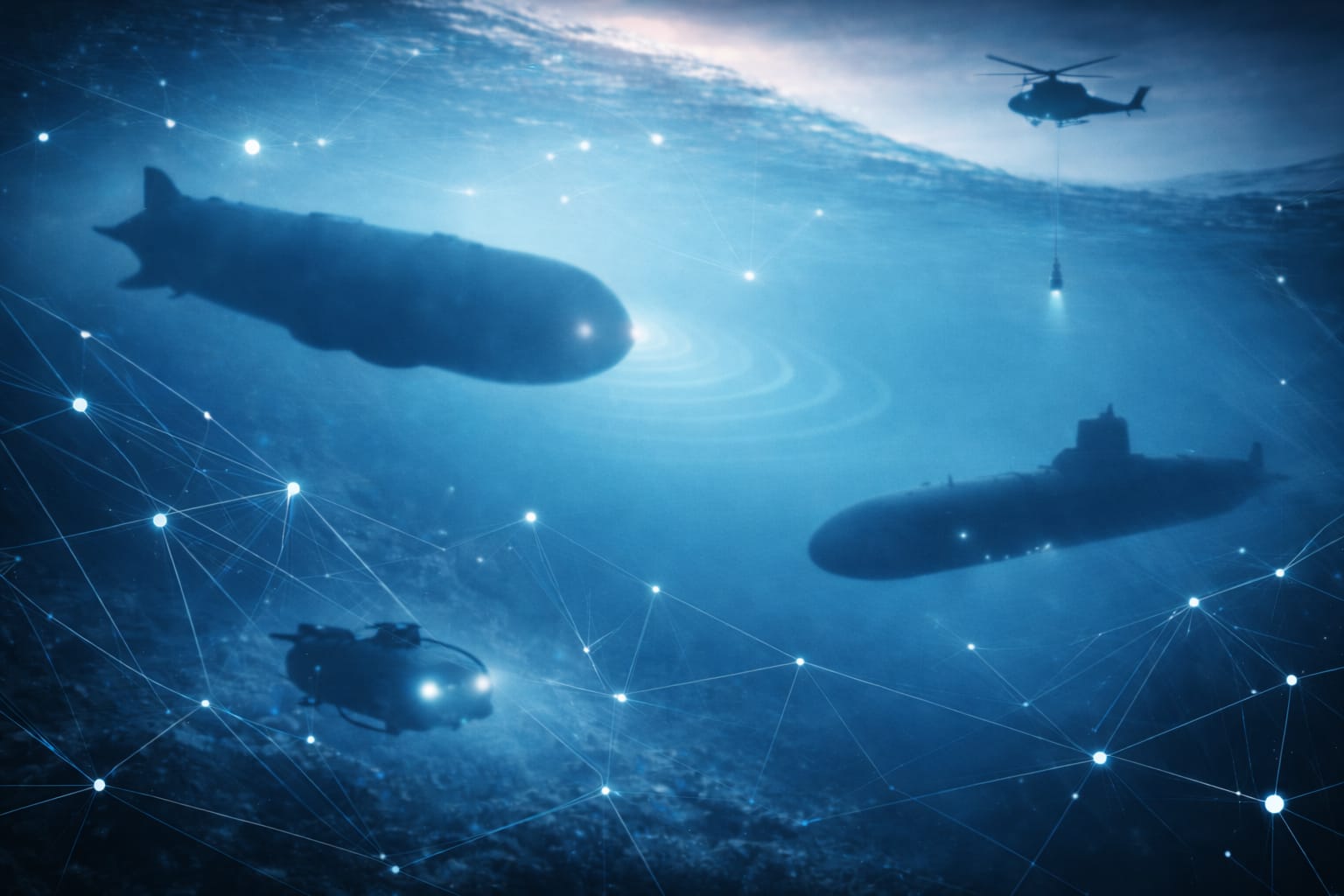
The undersea domain is one of the most strategically significant arenas in modern defence, long providing advantages in times of peace while also proving a decisive factor in times of war.
This has been reinforced by the recent sinking of the Iranian frigate IRIS Dena, marking the first time the US Navy has torpedoed a ship since 1945. As geopolitical tensions continue to intensify, maritime forces globally are faced with the challenge of translating advances in undersea technology into tangible operational advantages that can be fielded at both pace and scale.
Securing superiority at sea remains vital, particularly as allied nations contend with an expanding spectrum of hybrid warfare and grey-zone activity. In recent years, acts of sabotage against undersea infrastructure, particularly in the Baltic Sea, have underscored both the vulnerability of Europe’s subsea networks and the economic and political consequences of their disruption. These incidents have prompted a shift in Western policy and posture, including NATO’s launch of initiatives such as Baltic Sentry.
The Strategic Defence Review 2025 emphasised that the protection of critical underwater infrastructure will be a defining challenge for maritime forces in the coming decade. It also highlighted the need for deeper collaboration between governments and international partners to strengthen detection, coordination and collective response to emerging threats, particularly across the Euro-Atlantic. Supporting this effort is the upcoming Undersea Defence Technology (UDT) event, taking place between 14 and 16 April, which brings together senior figures from government, industry and the wider defence community to assess new capabilities and discuss approaches to counter emerging risks in the subsea environment.
UDT remains the largest global event dedicated solely to the undersea defence and security sector. At a time when defence debates can become overly abstract, there is value in forums such as UDT that focus on the practical delivery of capability alongside strategic discussion. The emphasis is not only on high-level concepts or long-term planning for the undersea domain, but also on the physics and engineering challenges that ultimately determine whether ambition can be translated into operational effect. This is particularly relevant in the maritime environment, where the pace of innovation demands close alignment between policymakers and those developing the systems intended for operational use.
Looking ahead, advances in artificial intelligence, data processing and quantum computing are likely to reshape the undersea battlespace through acceleration rather than disruption. For decades, navies have collected vast volumes of sonar and sensor data but lacked the computing power to exploit it fully. That is now changing. Machine processing is beginning to unlock that data at scale, while developments in compact computing architectures are pushing analytical capability closer to the tactical edge. The trajectory is therefore evolutionary, with autonomy representing the continuation of a long-term trend towards more capable, responsive and operationally effective undersea systems.
Ultimately, the renewed focus on the undersea domain reflects a broader recognition that strategic advantage at sea will increasingly be shaped by activity below the surface. Protecting critical infrastructure, strengthening deterrence in the grey zone and harnessing advances in data and autonomy will require sustained effort from policymakers, operators and industry alike. Success will depend not only on technological progress, but on the ability to translate innovation into deployable capability at pace, while deepening cooperation across alliances, sectors and systems. In a competitive and complex environment, those who prioritise and invest effectively in the underwater battlespace will be best positioned to secure both national security and economic resilience.