

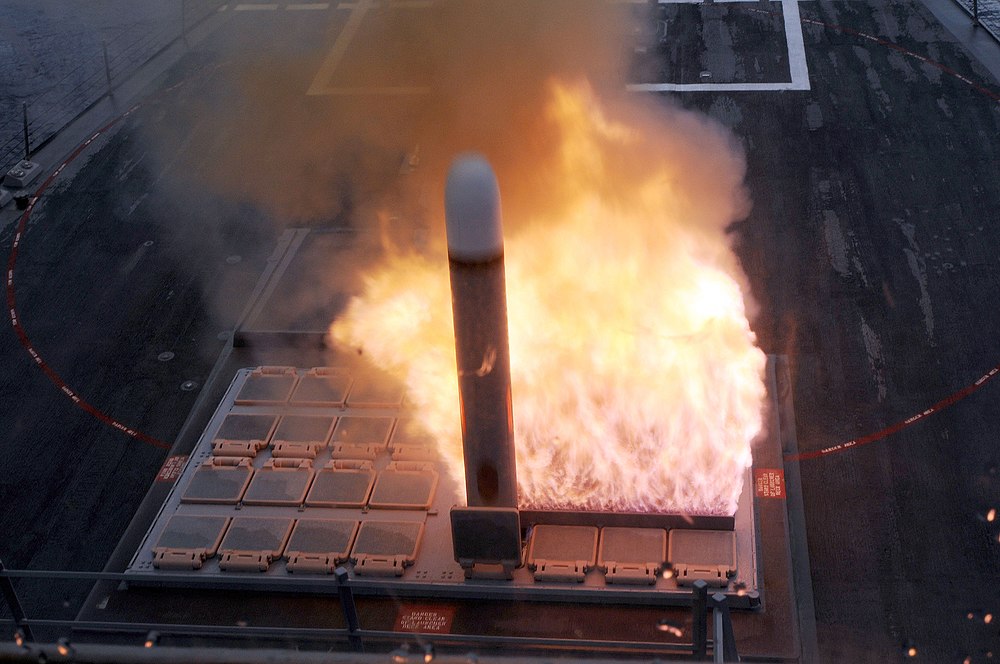
As the Middle East once again awaits a possible US strike on Iran, American and Israeli navies have recently carried out a joint exercise in the Red Sea.
A US Navy destroyer docked in Israel for a routine, pre-planned visit and trained thereafter alongside Israeli vessels as part of an ongoing collaboration with the US Navy’s 5th Fleet.
This article is the opinion of the author and not necessarily that of the UK Defence Journal. If you would like to submit your own article on this topic or any other, please see our submission guidelines.
According to CNN, over the past few weeks the USA has gathered a sizeable military force around Iran as negotiations over Iran’s nuclear programme are prolonged to the point of stalling altogether. Now it appears that Trump has run out of patience and is poised to strike Iran again.
In addition to now almost constant surveillance flights and dozens of military transport planes dropping off loads of military equipment at US bases across the region, the arrival of the Lincoln Carrier Strike Group, now in the northern Arabian Sea, represents the most substantial shift in military positioning. The group includes the USS Abraham Lincoln along with three guided-missile destroyers and a carrier air wing which includes F/A-18E Super Hornet fighters, F-35C Lightning II fighters, and EA-18G Growler electronic warfare jets.
The Navy also has three destroyers, the USS Delbert D. Black, USS McFaul, and USS Mitscher, in the region separate from the carrier strike group.
The USA has also deployed various air defence systems to the region, including additional Terminal High Altitude Area Defence (THAAD) systems and Patriot missile systems that appeared at Al Udeid Air Base in Qatar last week. Those systems would be key to combatting retaliatory missile strikes should Iran respond to a strike by taking aim at either US military assets or US allies in the region.
Faced with such overwhelming military might, the Washington DC-based think tank the Institute for the Study of War (ISW) reports that the Iranian regime is conducting a diplomatic, informational, and military campaign to try to prevent US military action against Tehran. Iranian Foreign Affairs Minister Abbas Araghchi, President Masoud Pezeshkian, and Supreme National Security Council (SNSC) Secretary Ali Larijani have been involved in heightened diplomatic activity with neighbouring countries in recent days.
Araghchi and US Special Envoy to the Middle East Steve Witkoff are expected to meet in Turkey on February 6 to discuss a possible nuclear deal. Iranian officials have signalled openness to resuming nuclear negotiations with the United States in recent days, likely to try to delay or prevent a US attack on Iran, as it did in the spring of last year.
However, the ISW considers it unlikely that Iran will agree to Trump’s preconditions for negotiations. The USA has demanded that Iran permanently halt uranium enrichment, limit its ballistic missile programme, and end “all support” for the Axis of Resistance as preconditions. Iranian officials have repeatedly insisted that Iran will not negotiate on its ballistic missile programme or support for the Axis of Resistance, which constitute the main pillars of Iran’s deterrence and defence strategies. The regime is also unlikely to accept Trump’s demand for zero enrichment.
CNN reported on February 1st that progress toward renewing negotiations between Iran and the USA “appear[ed] to have stumbled,” in part due to the United States’ unwillingness to reduce its military presence in the Middle East. This report suggests that Iran may have formally made the removal of US military assets from the region a precondition for negotiations, which would be consistent with Iran’s efforts to delay or prevent a US attack on Iran.
So it appears that we are heading towards round two of the USA (and almost certainly Israel)’s war on Iran. Already Iran has carried out two probing operations against the US Navy in the Persian Gulf, likely designed to test US Navy defensive reactions and demonstrate Iran’s ability to threaten US forces and assets. During one of these, the USN claims to have shot down an Iranian drone which was approaching its vessels in an “aggressive” manner.
I have said oftentimes before that the USA is going to have to deal with Iran and its theocratic regime at some point, and it may well be that this point has now been reached. Certainly even the Americans are not able to sustain their level of military commitment to the region indefinitely.
It may now be a case for Trump of use it or lose it. My bet is, if it is going to happen at all, it will be this coming weekend or possibly the weekend after. As we used to say on the ranges, “watch and shoot”.
Lt Col Stuart Crawford is a political and defence commentator and former army officer. Sign up for his podcasts and newsletters at www.DefenceReview.uk







It would be good to see the end of this toxic Theocracy.
However, the IRGC and Basij have an iron grip on power.
To topple the regime, there would have to be a rebellion within the Iranian military (possibly including the IRGC)
Therefore, any attack by the US/Israel should mostly concentrate on reducing Iran’s missile capability and production and stick to other military targets
Hitting non-military targets might backfire and rally Iran’s population around the regime.
Too late for many thousands of Iranians killed wounded or imprisoned who took to the streets in desperate protest urged on by Trump’s “help is coming”. The fall of the mullahs is long overdue, but Trump isn’t on a moral crusade(he allows his ICE thugs murder protesting Anericans), but playing at foreign aggression to distract from his many domestic failings & Epstien releases. I bet his mate Putin would be dead against toppling the Iran regime & we could only pray that even if it fell, Iran would get a decent government rather than another dictator.
God Speed to all Persians.
I’m looking forward to seeing the anti west, anti Israel, pro Palestine, SWP protesters out in force as the Islamists murder, rape, stonework death and massacre Iranians.
Where are they? For some reason I cannot see any protests??
🤔
Hypocrites with an agenda….that’s why.
Sadly the US and west doesn’t have a very good track record on these things, you only have to look at Iraq and Libya and recently Venezuela as cases in point.
Sure go in, kick the snot out of the mullahs by all means, but what happens then?? what’s the plan?? are they going to install a pro western government??
There was already a democratically elected government in Iran in 1953 and the west overthrew them to install the pro-Western Shah, a disastrous example of intervention that led to decades of repression, which led to the Mullahs and the Islamic regime. The people of Iran deserve a hell of a lot better they really do.
But what’s the plan, what happens the day after the regime falls?? I hope the west doesn’t walk away, I hope they stay around long enough to see things through.
As I said before the left don’t really care about the Persians/ Iranians the way they do about the palestinians
You’re quite right of course. Iraq and Libya were a disaster. Gaddafi and Hussain at least kept a lid on things.
I don’t think they really care about the Palestinians either. They just pretend to as a front for being anti Jewish.
All the Jew hate is really based in their use of ethic divides to destabilise society via crime, pain and misery.