

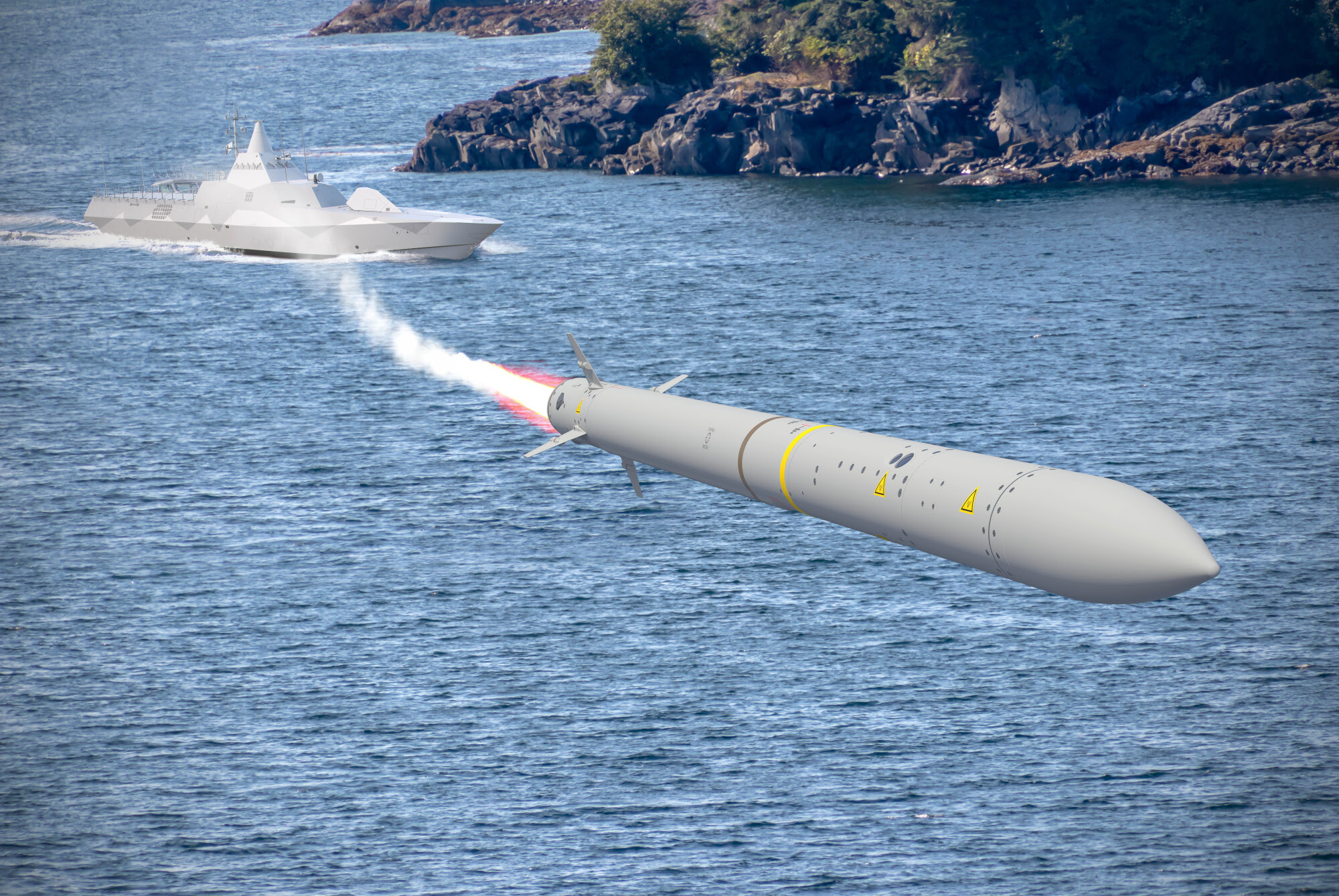
Sweden has expanded its acquisition of the Common Anti-air Modular Missile, signing a contract amendment with MBDA to enable further deliveries for the country’s air defence requirements.
The new agreement builds on an initial 2023 order placed by the Swedish Defence Materiel Administration (FMV) for CAMM missiles to be employed within MBDA’s Sea Ceptor system, which Sweden is integrating onto its Visby-class corvettes.
Lorenzo Mariani, MBDA’s Executive Group Director for Sales and Business Development, said in the release that “Sweden continues to place its trust in MBDA’s world-class capabilities with this contract for further CAMM.”
He added that through this continued partnership, “Sweden is strengthening the protection of its sovereign airspace, while maintaining interoperability and security with its European and NATO allies.” Mariani also highlighted CAMM’s performance, describing it as a missile that “has proven itself against the type of evolving threats we are seeing today.”
According to the company, CAMM provides a common stockpile for short- to medium-range air defence across land and maritime platforms. The system’s soft-vertical-launch mechanism is stated to offer minimal launch signature and full 360-degree engagement coverage, while enabling rapid firing against multiple simultaneous threats.
MBDA notes that operators have described the missile’s accuracy as sufficient to strike “targets as small as a tennis ball traveling at twice the speed of sound.”
MBDA said the latest Swedish order reflects a long-running relationship with the country’s defence sector. The company stated that deepening industrial cooperation remains central to its operating model, describing such collaboration as “a golden thread… through multiple successful programmes.”







Does anyone have a number on how many the UK is planning to buy? Generally, the UK has been pretty good with purchasing large stockpile post-Cold War compared to the continental powers – our stocks of Storm Shadow, for example, are significantly larger than those of France.
Storm Shadow stocks were good. I know France also had a pretty tiny Meteor order (160, raised from 100… for 200+ Rafale planned in service) but I’m not sure the UK is generally too much better. I’ve heard Aster stocks don’t allow much redundancy beyond loading their relevant vessels. I’d be happy to be wrong, though. ASRAAM might have been in the high hundreds (at least 400 missiles were donated to Ukraine so it could have been more – possibly 1-2k range) and CAMM is based on the same platform. There will be around 600-700 total VLS cells for CAMM in the fleet when all the T26/T31s are in service though for reference. I could see the MOD ordering enough to cover that but not necessarily incorporating too many spares. I would love to be wrong though, and to hear any more definitive information if it’s available.
The numbers I heard generally corresponded to an aim to purchase enough to fill all the cells in the fleet, and then 50% again, so a stock of around 1000 CAMM would do that pretty well.
I don’t think the numbers of Meteors ordered by individual countries is in the public domain. What we do know is the work share each country got and that was decided by what proportion of the total production was ordered. Since the UK got 39% of the work, that means the RAF has 39% of whatever the total produced allocated to it. This means even if the RAF does have what could be regarded as a “war fighting stock”, no other European country will.
I treat the tennis ball claim with some, nay, a lot of scepticism. Remember Sea Wolf was claimed to be able to hit a 4″ shell?
Seriously though, the Baltic nations are showing the way in most areas of defence. Pity our political clowns do not.
I’m pretty sure, some others may confirm that Sea Wolf did indeed hit a 4.5 inch Shell under test conditions.
Test…
Please explain how it could possibly have been anything other than a test!
Indeed it did.
@GunBuster has stated that he was the camera operator for that shot.
Funny I haven’t seen anything from GB for ages 🤔 I hope he is OK.
Last heard of working on his retirement house.
Everything seems to be able to hit a tennis or cricket ball from our naval guns from the 80s onwards. Rarely see realistic numbers given in real time scenarios but was interesting to see that Latvia’s Mk 1 anti drone missile in development is designed to have around a 94% hit rate but at present only manages about a 55% success even with its ‘Ai’ which is very honest of them to admit it. I also read that missile interceptions of drones in the Iran conflict wasn’t much over 50% per missile which surprised me but tends to suggest even if you have a 90% success in tests in actual conflict outside of perfect engagement conditions success is well below that. Not sure many tennis balls at twice the speed of sound would be taken out in reality unless you had a rather large warhead. I do remember when CAMM was used in the Houthi engagements the launches we saw two missiles per target seemed the norm to ensure a hit. I assume that’s not untypical depending on the threat level.
Oh forgot to add also read about a US pilot dropping a proximity fused bomb on a shaheed type drone and was shocked to see it fly out of the fireball.
Yup, the MlC make claims to sell kit. I used Blowpipe, saw Stinger in use and have always wondered how Blowpipe even made it into service. Stinger worked/works, at least the ones l have come across. The claims made for all need treating with a large dose of salt.
The Raven that uses ASRAAM according to Wiki has a success rate of over 70%. The question would be why only 70%. Though the MOD have said its nearer 90% against specific targets. I expect it will be very doubtful if the MOD will release the stats. If what you say is true about CAMM, that could be a new doctrinal approach, as its supposed to a one shot one kill missile. A two missile per target launch is atypical for missiles that use semi-active radar homing (SARH), not ones that use active homing. For SARH missiles, it means as the target reacts to the missiles, its returning signal will be bigger for one missile over the other, giving a better chance for success. The early Patriots and SM-2s used this technique.
I was on Penelope in 77 the seawolf trial ship. We did hit a 4.5 in shell fired from HMS Antrim off the coast of the USA. First ship ever to take out a shell
They are only starying to catching up to were we have been for years. Let’s not get carried away by a few orders from other nations.
It’ll l be interesting to know if the UK is looking at getting any CAMM, CAMM-ER or CAMM-MR for the T31s and even either of the later two for T26s and even GBAD?
T31 only has 12 vls. Mushroom farms can probably only take base CANM anyway
Firstly, this is a fantastic vote of confidence in CAMM.
T31 will have Mk41 VLS at some point and those will be able to take the MR varietal possibly in addition to the standard mushroom tubes. The mushrooms could go to the sides of the Mk41 as they are shorter.
It will be interesting to see what Italy does as it has CAMM-ER as well as A30 VLS.
We don’t really know which flavour of CAMM T45 will end up with. There is no good reason why you cannot soft launch the larger flavours TBH or indeed put an insert in a lager tube to take the smaller missile.
The RNs website seems to reference that the T26 will be getting the three cell exensible launcher.
Its states the T26 will have 12 vertical launch system cells for CAMM and each cell can contain 4 CAMM. The only possibility for that statement is if it’s having 4 3 cell exensible launch systems…that has been on the RN website for a long while now and I would imaging if it was a typo it would have been changed.
That’s great news if it’s true because the ExLS can it seems take all the CAMM family.. with MR expected to be duel packed.
As ExLs can also fire 1 missile from each silo at the same time it means a T26 could fire 12 CAMM simultaneously..that’s Al lot.
It also states that the T26 Mk41 can fire SM3, so probably best not to read it at face value.
Interestingly on the MK41 silos for the T26 it’s actually very silent and just says they will fire a selection of missiles.
Oops yeah that was the T31 description, my bad.
Is the T31 also getting the 4×3 cell ExLS arrangement for its 12 missiles?
At present it’s just the mushroom farms, but it would not surprise me that in the end the T31 got a mix of ExLs and MK41 silos.
The Exls for CAMM could have been done on the T45s. For 48 instead of 24. Wasted opportunity. A “half-Nelson ” instead of a “full-Nelson”. Bad pun intended!
Yep completely agree.. although not sure how much its costs in comparison to a mushroom farm.
We’re not getting Exls we’re getting mushrooms
I’m pointing out what the RN website says.. and we don’t know what will be the configuration on the 26s CAMM wise.. we can only speculate and say what we think would be a good idea
There hasn’t been a single render with exls or mockup. It’s a stupid error by the website, you can even see the Mushrrom farm cut outs on the current in build ships
All CAMM variants are “soft launched”.
Indeed they are. I should have read what I had written before pressing post! I think I’d edited the sentence around the idea of concentric inserts and then mangled what I was trying to say.
Please don’t remind us of this…it makes many of us here cringe.
Must be approaching the point where an extension, or additional factory, is warranted?
Don’t forget MBDA will be opening production lines for CAMM in Poland and Italy.
Nice if we could put this on our patrol ships . Has ever wishful thinking 😏
These our their major combatants not OPVs, how much money do you want to spend putting a handful of CAMM on our OPVs when we can’t even equip our frigates
T26 has plenty of kit including 5″, CAMM and Mk41 VLS.
T45 will be fine when it has the CAMM fitted to add to the A30 – I know you would like a sonar and Father Christmas may just bring one in his early DIP sack?
T31 with Mk41 added will also be very, very handy and I can see a basic CAPTAS towed sonar being added – maybe also in the Father Christmas’ early DIP sack?
Camm is not an inpenitrable defense, and we don’t have anything to go in Mk41
T45 is getting more terribly designed mushroom farms not A30
DIP will be a disaster or a list of never to be fulfilled promises, just look at our financial situation
“Camm is not an inpenitrable defense”
There is no such thing as impenetrable defence – there is appropriate and useful defence which CAMM is for some threat profiles.
“and we don’t have anything to go in Mk41”
We are developing a line of missiles with France that are Mk41 compatible.
“T45 is getting more terribly designed mushroom farms not A30”
T45 has 48 A30 missiles and is getting additional CAMM. Which flavour of CAMM is not known.
Which ones, precisely?
Stratus will be Mk.41 compatible. That provides a supersonic anti-ship missiles and stealthy cruise missiles. I haven’t got much faith in it being delivered on time but having a precision strike capability and a basic anti-ship platform on each frigate would be a significant capability increase and good use of the cells.
It would be nice to see ASROC or an equivalent delivered for the Type 26s, even in small numbers just to give them a backup in support of the helicopters. I know this is being explored but I don’t think any definitive action has been made.
You could end up with a situation where Type 26s are a multirole platforms with limited capacity of each in addition to their primary ASW role, and potentially the Type 31s then have a useful role within a frontline fleet as a missile carrier for either of the two major capabilities that the CSG will be lacking in. Currently the F-35Bs have no heavyweight land attack or anti-ship missile nor any outlook to get them in the next 5-10 years at least. If you could deploy a Type 31 loaded with 32 Stratus-Lo, along with 8 on a Type 26 and another dozen or so TLAM on an Astute then you have a reasonable long range strike capability that would otherwise be absent or just covered by Spear 3 in the 2030s (which would be fine for targeting armour or individual systems like radars or air defences, but not really suitable to hitting for instance a major weapons depot, HQ, or industrial site). In a setting like the South China Sea where your main concern might be the enemy surface fleet, adding a few dozen anti-ship missiles with greater range and payload than NSM would also be very nice to have. We’ll see how much of this materialises but there are severe gaps in the RN’s strike capacity at the moment and these could plug a few critical holes if they live up to expectations.
Nice summary Erich, are you new here?
The RN can also adopt the 4×4 NSM option on the hangar roof as the Norwegian T26 model showed for a hi-lo mix with the mk41s.
Sssssh
I was shot down on here for staring that 4 x 4 was possible….apparently both I and the manufacturer made that up…..
Too late, its been brought up here before. The UK MOD talks a lot about “increasing lethality” and then seems to have an equal aversion to wanting to do it? Even if FFBNW, it’ll be useful.
Or if we decide 24 Mk41 isn’t enough the French want a canister launch option for STRATUS, which if we assume 8 VLS allocated to VL-Stingray would double the strike capacity with 4×4.
The type 31 frigate is only being equipped with 32 MK41 VLS and 8 NSM cannisters, so a typical missile load might be 16 Stratus missile’s, 8 NSM’s and the other 16 MK 41 VLS being equipped with various variants of the CAMM missiles, so not too shabby
Be regular CAMM, there has been no indication the navy is getting any variants yet
ASROC
SB,
Presumably not more than an additional 1-46 day waiting period for release of the DIP. Detailed, firm commitments or aspirations by HMG/MoD? Updated yearly or coincident w/ SDRs? Based upon best available prediction of funds available to MoD over period, or some default funding profile? Threat scenario changes adequately forecasted? Significant tech evolution across domains, potentially both more and less predictable, but undoubtedly accelerating, w/in next decade. Amazing number of variables to be accommodated in plan. Could be a fascinating document.
Absolutely true we can’t afford them for our major vessels ,however OPV will undoubtedly be in a hots zone and a pop gun won’t do the trick . But Iike I said in my post wishful thinking .Cheers 🍺
I think the only upgrades to the River that make sense are the new helo landing system, the Schiebel UAV to enhance surveillance capability and maybe the 40mm Bofors – which I think could be directed by the existing FCEO so would not need an expensive radar upgrade. It would give better AA and defence against small boat swarms. Anything more is taking money best spent on T31.
Yes agree the rivers need a good self defence gun that can attack targets out to the the 10km mark so the 40mm or 57mm would work and as you say optimise them for autonomous vessels.. having them able to take the mine warfare capability would be useful.
Maybe a naval mount for just the Martlet/ Starstreak. Should be feasible if kept separate from the 30mm. I think Thales has several designs already and the French have a twin Mistral mount that’s even going on their new PA-NG carrier. I saw somewhere recently a proposed upgrade to the RAN Arafuras 80m OPVs, 57mm, 1×4 NSM and 2 containerised vls SAM. This should be doable on the B2 Rivers that are 10m longer!
And cost how much exactly
No idea on the cost but the RAN must be looking at it to make it work (or not). Growing naval threat down here in SE Asia – Oceania so need to utilise whatever vessels one has. They’ve just spent a few dollars on the 11 Mogami’s and AUKUS subs so there’s action happening.
I can’t copy the link but its on the Naval News site; 5 Nov
Cimivec upgrade to Arafura’s. Worth a squizz. Don’t know why the RAN went with the 80m when the 90m might have been more useful. Could have sold some B2 Rivers then!
Well, upgrading the Arafura would be a decision for RAN. I think the RN will stick with the River 2 in the global constabulary/ diplomatic ‘gunboat’ role and the T31 having the patrol/deterrence warship role. If anything I would think a batch 3 River would tend towards MCM rather than ‘corvette’.
Does anyone on here actually know the real outcome of the trials of a DS30M with 4 Martlet missiles carried out on HMS Sutherland ? The only reason I can ever find that it wasn’t adapted was due to Efflux issues which to me either means the paint peeled or it created problems too near the GT intakes.
Surely if that is the only reason for not fitting them then doing so on a Diesel powered River B2 is a complete no brainer, I can’t think of better quick / cheap fix to give them an Armament uplift.
Where’s Gun Buster or Monkey Spanner ?
Apparently the problem was that the door to the DS30M magazine was directly inboard of the mount and in the direct line of efflux when firing broadside, which in GB’s words at the time ‘would give a shock to the grunt walking out of the magazine with an armful of live rounds’
So on anything else such as a T45, QE (if we ever fit them with the 4 they should have), T26, T31 and River B2 would be fine.
As I said to me it’s a complete no brainer to add extra umph by just using existing systems that are already carried onboard most of these ships.
RB2 should be fine, with the others you’d need to check each mount individually to make sure it was safe.
Would be much more convenient and give more capability to just replace 30mm with the Bofors across the fleet.
Has the Thales 3 stack mount for Starstreak/LMM ever been adapted for a naval vessel mount? They fit GPMGs and 12mm mounts so surely its doable and easy peasy for 2×3 or 4×3 mounts? The French have the twin Mistral mount. Something similar.
I wonder if this is thinking ahead to frigate futures, not just the Visbys. Possible sign of a Babcock frigate order?
I read somewhere (Navy Lookout, I think) that the Sweden opportunity is a new corvette and that Babcock are involved in the design process, although to what extent was not made clear. The main advantage to Sweden is that Babcock can build the ships much cheaper than Swedish yards, so Babcock will build the ships and Sweden will fit them out. Given that Babcock have been involved for quite awhile I would think they are odds on for the contract.
The Danish interest in the T31 is on a similar basis, Babcock build the ships and the Danish yards fit them out.
If these orders go ahead Babock will be very busy for the forseeable. Hopefully there will some good news soon we could do with some good industrial news.
Cheers CR
Good Industrial News wasn’t us sticking 2 fingers up to Westinghouse and ordering 3 RR SMR Good or Norway ordering the first New Build Frigate export this century good enough.
Perhaps the UK building large very expensive parts for up to 8 foreign SSNs might qualify ? Oh wait yep add that to the list.
It’s not good defence industry news we need its HMG actually ordering anything from it ! 😡
Hmm, Just seen RB’s post below seems the corvette plan has been scrapped by Sweden in favour of something bigger with an Air Defence capability…
Cheers CR
I do find this somewhat surprising. As Diehl who make Iris-T are also in collaboration with Saab AB to design and produce the missiles. This is especially an interesting development as now that there is a surface launch version the Iris-T SL, which has a larger rocket motor, so it can compete with CAMM. The Iris-T SL has been recently test fired from a Mk41 on the German Navy’s Baden-Württemberg frigate (the one that leans). They are also now looking at building a longer ranged Iris-T SLX, which will be a direct competitor for the CAMM-MR, with an engagement range of 100km along with an engagement height of 50km.
All I can say is bravo MBDA, for getting into the Swedish market.
That engagement height of 50km sounds phenomenonal. Isn’t the ceiling of the Asters only 25-30km? Wonder here if Germany is gaining amything from the Israeli-US Arrow missile program?
It was not from Mk41
Okay, if land based, that’s still an impressive reach.
Good news. CAMM is really starting to building a substantial user base. Definitely another decision that hints that there is currently a very pro-UK [and pro-RN] attitude among the Baltic states.
But I see that Sweden has cancelled plans to buy a relatively modest frigate design primarily for Baltic operations – for which the T31 was a strong contender. The Royal Swedish Navy’s strategic and operational emphasis has changed since joining NATO in 2024, and it’s been decided that it instead needs four larger and more sophisticated air-defence frigates or destroyers that are capable of sustained and high-end force projection beyond the Baltic. The success of the Norway’s contribution to CSG25 has not been missed, and the RSwN Chief of Staff said – “In five or six years’ time, we [Sweden] could send an air-defence frigate”. Although the project is a high priority, no decision on a design and partner is expected before mid-2026. Overall, bad news for Babcock and the T31, but possibly good news for BAES and a variant of the T26. Having the UK, RN, and Norway all operating the same basic frigate design makes a lot of sense. However it’s safe to assume that rapid delivery of the first ship will be an important award criteria, so overall maybe advantage Naval Group and FDI?
Just for clarity, this is a top-up order for additional missiles. Sweden first purchased Sea Ceptor in 2023.
AH140 could still compete for an AAW frigate contract, it can still be adapted for the secondary radar aft or a large fixed-panel radar. It could definitely push out FDI which is much more of a general-purpose ship.
I suspect Babcock will be working on a high end AAW version for a potential Danish order and the Swedish might well be very interested in a common design.
And there’s already the Polish AH140 which looks pretty useful. Something which the CIP of the T31s should aspire to.
The polish T31s are radically different and we cannot do that in a CIP
I did say “aspire” to. The Indonesian AH140s are something else too.
Quit frankly I would be happy if they got 32 CAMM and 8 NSMs in the CIP.
Poland shows that the T31/AH140 can be developed into a very capable frigate. But Sweden has a friendly rivalry with the Norway, and I suspect that seeing the latter select the high-end T26 was a final straw that led to government approval for a more ambitious and expensive platform – which the RSwN had probably been advocating for some time. Hopefully Denmark will still select the T31 for its new frigates, a decision was expected by the end of 2025 but Trump’s extraordinary demands regarding Greenland may have changed spending priorities.
Yes, good comments. Hopefully the UK will get the gig with either T26/T31. Like to see a few more of either for the RN especially if the ASW and threats to sub-sea infrastructure domain is going to increase. And even Poland might order more? It’s a potential “feast” for UK ship building and associated systems.
I thought that Sweden and Denmark both are in the market for new frigates and that the Type 31 is being considered along with the FDI frigate??