

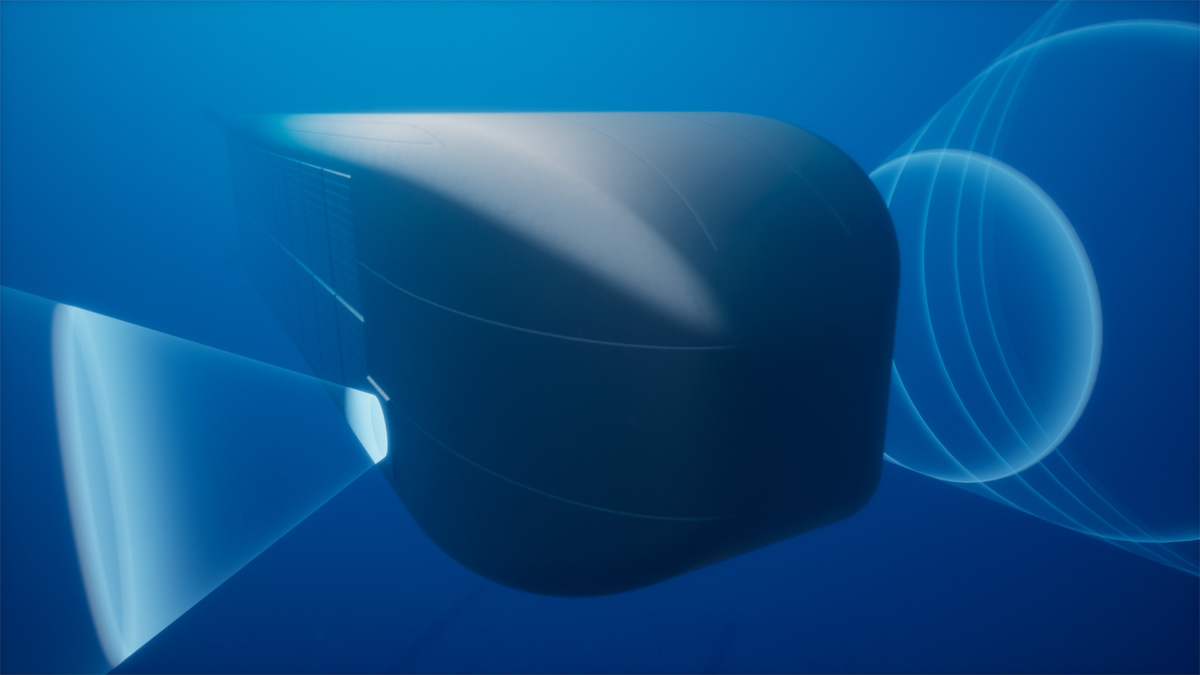
Thales has given new insight into Sonar 76Nano, a compact tile based sonar system developed to support the Royal Navy’s push toward distributed and uncrewed underwater sensing.
The company briefed UK Defence Journal on the prototype following a rapid ten month development cycle linked to emerging requirements within Project Cabot and the wider Atlantic Net and Bastion concepts.
According to Ian McFarlane, Sales Director for Underwater Systems at Thales UK, the idea behind 76Nano began to take shape about eighteen months ago. The company had observed a shift in Royal Navy anti submarine warfare activity. As McFarlane put it, “the usage was going up. The operational tempo was increasing” while the number of major platforms was falling. This created an obvious question: “How we fill this gap?” Thales concluded that the answer was a new kind of sensor that could operate from uncrewed platforms and static seabed nodes rather than rely on a shrinking fleet of high value hulls.
A central feature of 76Nano is its tile based architecture, which replaces fixed flank arrays with modular acoustic panels. Each receive tile measures seventy five centimetres square, and the active transmit tile is a forty centimetre square unit. These can be arranged around curves or assembled into larger panels depending on the host vehicle’s geometry. McFarlane likened the concept to tiling a wall and stressed that aperture and frequency coverage scale with tile count. Lower frequencies travel further underwater, so adding tiles increases detection range and improves signal robustness. Thales has engineered the tiles to butt together with a flush finish to minimise drag and simplify integration. The onboard electronics recognise the number and orientation of the tiles and fuse all returns into a single coherent sonar picture. Depending on UUV size, arrays can range from a handful of tiles on a compact node to roughly forty eight per side on a large vehicle, which, in McFarlane’s view, could approach SSN like sensing performance in environments such as the Baltic.
Thales says the tiles are designed to minimise impact on space, weight and power, a key consideration for uncrewed platforms with limited margins. While layouts vary by vehicle, the company described a typical array as comprising around thirty six receive tiles, for example arranged in a three by twelve configuration along a vehicle’s flank. Larger UUVs could carry more, while smaller platforms would use fewer tiles, allowing operators to scale sensing performance to platform size and mission need without redesigning the system.
McFarlane expanded on that point, saying that a medium or large UUV fitted with about forty eight tiles per flank would, in Baltic conditions, offer “almost the same capability as an SSN” and, in deeper Atlantic water, “better than two thirds as good as an SSN”. He however framed these comparisons in terms of physics and environmental assumptions, which play a major role in long range detection. He also pointed to cost and risk. A nuclear submarine is a multibillion-pound asset. A large UUV carrying this sonar would be far cheaper to field, easier to deploy covertly, and carries less operational consequence if lost. McFarlane argued that this differential supports the case for distributed uncrewed sensing alongside the existing fleet.
The system provides passive listening, active ASW, synthetic aperture imaging, and subsea communications in a single package. The active mode uses a narrow band ping designed for low probability of intercept. The receive tiles are built to interpret weak returns and also support acoustic communications. McFarlane described the transmit function as “a narrow band directional ping” that allows “transmit comms out” and reception of acoustic retasking signals. The synthetic aperture mode gives seabed imagery for infrastructure monitoring or environmental survey.
Distributed sensing depends on density and placement rather than a single perfect array. When asked how many nodes are needed, McFarlane resisted a fixed number and tied it to concepts of operations. In a choke point, “one or two will be absolutely sufficient” for persistent passive listening. In the North Atlantic, a handful operating alongside SSNs could offer forward cueing. For wide area networks like Atlantic Bastion, he noted earlier estimates requiring hundreds of gliders but suggested higher quality UUV sensors might reduce that mass requirement.
The direction mirrors the First Sea Lord’s recent emphasis on accelerating delivery and expanding uncrewed mass within a hybrid fleet. He has argued that maintaining credible ASW coverage with fewer major platforms will require distributed sensing and faster industrial cycles. That theme shaped discussion at the Sea Power Conference, where urgency was repeatedly stressed. Thales echoed that mindset during the briefing. McFarlane characterised the ten month development sprint as a response to that demand for pace and remarked that, if a customer were ready to proceed, “I’ll take the order today”. The company is clearly presenting 76Nano as the type of quickly fielded sensing mass that senior leadership says will be needed.
Integration was a recurring theme. Thales is not a UUV builder, which shaped the design philosophy. The tiles can be arranged around curves or assembled into different rectangles. The onboard electronics understand the orientation and number of tiles and fuse the data into a single sonar picture. This avoids presenting multiple disjointed feeds and supports both ASW and synthetic aperture modes. McFarlane said several unnamed UUV designers have shown interest. From their perspective, UUVs are often “subsea trucks” that carry payloads rather than generate capability themselves. A low drag, low power sensing package widens their utility.
Testing has been carried out at a Ministry of Defence acoustic facility. Thales used calibrated sources to verify that the tiles detect signals with the expected strength, direction, and frequency. McFarlane said, “the answer to that is yes, we are” when asked whether the prototype meets expected technical performance. The same method was used to test the active transmitter. Sea trials will follow once tiles are arranged on a host platform.
The prototype is expected to make its first public appearance with the Royal Navy later this month as part of a technology demonstration event. Thales says the demonstration will allow naval personnel to assess the system’s capabilities directly and engage with engineers involved in its development. While the event does not signal a procurement decision, it forms part of the wider effort to explore how rapidly developed sensing technologies might support the Navy’s emerging uncrewed and distributed concepts of operations.
The AI component of the system focuses on triage rather than autonomy. As data volumes have risen across successive submarine classes, operator overload has become a risk. McFarlane explained, “There’s too much there to physically understand.” The AI sorts acoustic returns, highlights items of likely importance, and acts as a filter to suppress clutter. It also supports post-mission analysis by identifying patterns or signals that might otherwise be missed. Thales frames this as cognitive assistance rather than a replacement for operator judgment.
Sovereignty is a concern for the UK, and Thales says most of the system is UK built, with some components sourced from partner nations as with 2076. The active transmitter involves Neptune Sonar, a British SME. Thales retains design rights and can license production to allies as required. McFarlane said, “We’ve tried to keep as much of it as possible within the UK.”
When asked directly what problem 76Nano is intended to solve, McFarlane offered a clear summary. “This solves the problem of getting enough fidelity in your ASW solution” while also supporting seabed infrastructure tasks. The modular tile concept allows UUVs to carry more sensing power than previously practical. “The more tiles you’ve got, the better fidelity, the better the further out you’ll see.” That logic fits the Royal Navy’s interest in distributed sensing and hybrid fleets.



So we can turn the entire UUV into a flank sonar, is that what he’s saying? Sounds cool, though it would be nice if the active panels could be used alongside a passive sonar for extra range resolution.
Passive [TOWED] sonar, of course.
I wonder how much it would cost to tile XV Excalibur and how that would compare to a thin line towed array, both in cost and performance? Not that they are necessarily mutually exclusive.
We have an opportunity to trial UUVs with sonar for T31.
I’m not suggesting the T31 be re-purposed for ASW.
But for defensive purposes/awareness this could make up for the lack of hull sonar.
It has no way to deploy a UUV this size
Tie a rope to it.
Youre funny
Proteus’ crane could. Launch from there and then pair it with a T31/26 – this is of course if you’re talking about XV Excalibur, which the article doesn’t mention. The point of this tech is that it’s scalable for a range of UUVs, but seing as there is a way of launching the largest XLUUV that Royal Navy is looking at now, it seems as though proper sea trials in the deep ocean could start fairly soon if the pencil pushers get moving.
And what happens when the T31 has to sprint and this gets left behind
Someone entirely unlike you will think of a solution.
Ooooo burn. I like it,
The reasons we have SSNs is because they can keep up with surface assets, this is not an SSN, it cannot assist the operations or a frigate unless it is notifying one far away what area to search in
No, that is obviously not the reason we have SSNs.
Their being able to travel at a reasonable speed is just one requirement of many.
The reason we have SSNs is because they are uniquely able to conduct strategic level operations; to hold other Navys’ surface vessels at risk, perform sea denial, conduct special-forces operations, secretly move huge arsenals anywhere in the ocean, protect SSBNs and Carriers etc etc etc.
I.e. the reason we have SSNs is because they are OP.
It doesn’t take much imagination to see why a network of slow moving, autonomous mini submarines that can listen and relay data to SSNs and Surface vessels are an obvious boon for a Navy. Efforts to enhance and expand this technology should be encouraged.
On a serious note, why even bother posting on here – everything I’ve read from you (including on NL) is simply to stubbonly state problems in the vein of “I’ve tried nothing, and I’m all out of ideas”.
There is a difference between being critical, which involves thinking, and being compulsively negative, which involves shitting on everything. The former is constructive, the latter is annoying and terribly boring.
Do everyone a favour and take a day off, Crimbo coming soon – have you got everything sorted?
Nah I’m good, like to inject a bit of realism into the fantasy convo of most of these comment sections.
Ok buddy, you do you.
Did i have to list every reason for having an SSN or simply point out that UUV slower than an SSK cannot work in direct concert with a frigate
Don’t be silly, of course Type 31’s can deploy and retrieve UUVs. Each has got 3 boat bays with exactly that purpose in mind.
No, those are Boat bays…. For boats. This UUV is far too large, I doubt anything smaller will be able to handle sonar equipment like this.
Boat bays may also be used for USVs but that doesn’t solve this issue
What UUV? The article doesn’t mention any.
The aft boat bays are 11m in length. That would fit a substantial UUV with a substantial array of these things.
I’ve read Nate’s note above, I think he hit the (your) nail on the head. Shitting on everything just for the sake of it.
Those boat davits are only designed for around 3-4 tonnes, that’s not a particularly substantial UUV
The article is roughly referring to UUVs like the CETUS model the Rn has just commissioned, that weighs around 17 tons
It doesn’t refer to any particular UUV.
PS so you are saying all the boatbays need is a stronger crane? Jeesh.
Yes, it does, look at the substantial system for the T26 mission bay, even that cant lift a CETUS
And yet you cannot name the UUV you claimed the article specifies.
You’re being a silly boy just arguing for the sake of it.
The t26 crane is capable of deploying UUVs. That’s one of the reasons for it’s existence.
I literally named it you twat. CETUS, it is obviously the one being referred to as part of the article as it is intended for the UUV element of atlantic bastion.
And no, T26 cannot deploy it as its crane can only handle 15 tons.
CETUS is not named in the article. Or even referred to.
What is stated is that the new panels are platform agnostic and can be fitted to any UUV. The number of tiles being set & limited by the UUV’s size.
And yes, the Type 26 can deploy UUV’s. It’s designed to do so.
Out. I’m tired of arguing with a child.
Which UUV can the T26 deploy then exactly.
And you’re acting like slapping these tiles on any UUV will make it a force to be reconned with, there is a minimum size of array to make it effective and power requirement for this equipment
I was not suggesting this specific UUV
What UUV?
How likely would the bear recover one these robo subs?
😂
I wonder how much effect on performance an auto self-destruct package would have… could maybe house the destruction system in a gapped module that uses AI to detect if its being handled ‘suspiciously’ and phones home for “permission to disassemble”
Same as the Bear’s chances of recovering any submarine.
Hovering close to zero.
so why not tow it (or an equivalent) behind an uncrewed/ low crewed surface drone alongside a T31 – then you ‘just’ need to work out how to refuel the drone at sea, how to operate a surface ship and drone together, how to communicate and make sense of data, how to protect the drone etc etc etc
Simples…
Seems unnecessarily complicated as opposed to just dropping a UUV off the side of the T31.
Until you know there’s a threat how do you know when to “drop” your UUV and tie yourself to an area
How does a Type 26 know when to deploy its towed sonar?
Cause it has one on the fricking bow for a start
If the bow sonar can detect a threat, why do they need towed arrays at all? You’re talking nonsense as usual.
No youre being a muppet, the bow sonar makes them aware something is actually out there so they can employ the Towed array, there are also weather scenarios where they cannot deploy the towed array.
More nonsense.
Nonsense? what part of that is nonsense. Instead of a credible reply with facts youre the one resorting to baseless insults.
The part that says the purpose of the bow sonar is to trigger the deployment of a towed sonar. You need to do more research into how the RN conducts towed array operations.
Out.
They cannot tow the array constantly, yes they patrol certain areas with it but when it is not deployed they can fall back on the hull sonar, unlike the T31 which has bugger all to work with
Seems unnecessarily complicated as opposed to just dropping a UUV off the side of the T31.
What seems complicated?
Righto, Ex army so please don’t call me a dunce but if these “tiles” are applique to the UUV hull etc and in requisite qty are approaching the same effectiveness as an SSN . Why cant they be put on the Hull of the T31 ? Or is it a case that surface conditions would batter the hell out of them when plunging round in heavy weather as i am presuming that the UUV at depth would be somewhat cushioned from these affects. Just asking 🙂
Flank arrays have been fitted to surface warships but as you say they don’t work anywhere near as effectively as subsurface ones and, as you point out, are subject to weather (and other) damage.